
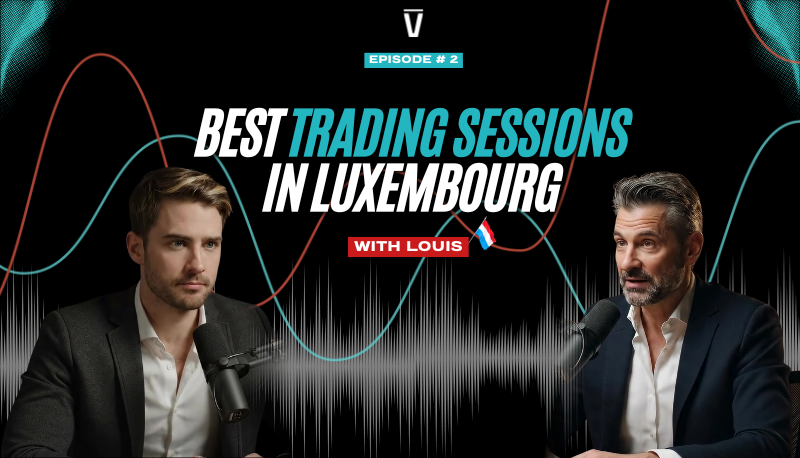




Trading Forex is fast-paced, and with this nature of speed, timing is everything. No one knows this better than the professionals who manage assets on behalf of others.
For traders and professional money managers, timing the market can be the difference between capturing high-liquidity opportunities, or struggling with slow volatility.
Meet Louis of Diekirch, a graduate of the Luxembourg School of Business. He is an experienced asset manager with a background in institutional fund management.
His expertise in international finance spans the globe, from London, to Frankfurt and Singapore. He has strengthened his discipline, enhanced his speed, and improved his accuracy, traits that now characterize his trading approach.
That is why Louis believes that knowledge of when to trade is the key to success for an asset manager based in Luxembourg, or for anyone who wants to improve their performance in the Forex market.
The Overlap That Matters: London Meets New York
The most optimal time to trade Forex in Luxembourg is between 2pm and 6pm CET, when the London and New York markets crossover. During this window, liquidity is at its peak, spreads are tight, and increased volatility creates strong trading opportunities.
For Louis, this crossover was a breaking point in how he structured his own trades. With an institutional background, he wasn’t satisfied with chasing random moves during the off-hours. Rather, he learned to focus on these high-activity periods when UK banks and institutions operate.
“At BNP, I had the structure. With Varianse, I got the agility. Trading GBP in the London New York crossover gave me both: high liquidity and the ability to act instantly without delays.”
Best Forex Pairs for Luxembourg Traders
Louis highlights GBP/USD as the best target pair that forex traders in Luxembourg should show interest in. Despite Luxembourg being a member of the Eurozone, the rhythm in the market is well synchronised with the London market, where the British pound (GBP) is one of the most traded currencies. Every ECB policy release, UK economic report or U.S. data release can provide significant volatility to GBP/USD. It is a dynamic currency pair for those who want to trade on momentum and liquidity.
Louis doesn't stop there. He also monitors USD/CHF, which is another pair that has a tendency to follow European and U.S trading sessions. News from the Bank of England, Federal Reserve, or Swiss National Bank, as well as broader geopolitical developments, can impact these currency pairs and create well-timed trading opportunities.
For Luxembourg forex traders, Louis believes that it is best to be in the right markets at the right time to succeed. By concentrating on pairs such as GBP/USD and USD/CHF, traders will be able to keep up with the events of the global economy and trade during the most liquid and responsive hours.
Worst Times to Trade in Luxembourg
Conversely, Louis cautions trading between 10pm and 12am CET hours when New York is closed and Tokyo is yet to resume. Liquidity is drained, spreads widen, and prices tend to move randomly in an unorganised manner.
Sessions and Time Zones: CET and CEST
Traders in Luxembourg operate on Central European Time (CET, UTC+1) and throughout the summer, Central European Summer Time (CEST, UTC+2). This change can be treated as a simple transition; however, it directly affects the forex trading hours.
In summer, the London New York crossover is usually the busiest and most liquid part of the day, between 3pm and 7pm (CET). It is at this point that trading volumes expand, spreads narrow, and an abundance of trading opportunities are created.
According to Louis, smart traders in Luxembourg organize their routine over these temporal changes. Understanding the seasonal shift from CET to CEST allows traders to operate during optimal market hours, rather than reacting after volatility has already occurred.
How Technology Is Redefining Forex Trading in Luxembourg
Louis, who started as an institutional fund manager and progressed to an independent trader, explains how technology has entirely changed the definition of being a trader in Luxembourg. Gone are the old days of trading - crowded offices and endless phone calls. Today, it is about having the best tech and real-time platforms which offer speed, accuracy and transparency.
Working with Varianse, Louis unlocked a blend of institutional-quality performance and cutting-edge fintech. He can now trade efficiently across multiple accounts and deliver investors real-time transparency through cTrader Copy and MAM solutions.
Louis’ Advice to Traders in Luxembourg
For Louis, succeeding in Forex is not just about catching the right move. It's about building the right structure:
- Trade during the London New York crossover for the best liquidity and volatility.
- Focus on major pairs like GBP/USD and USD/CHF.
- Avoid low-liquidity hours where spreads eat into profits.
- Build trust and discipline if you want to scale beyond your own account.
“If you’ve proven you can trade profitably, don’t stop at the limits of your own capital. Scaling is where the real journey begins, but only with structure, transparency, and trust.”
Louis’ transition from an institutional dealing environment to an independent trader demonstrates that it does not matter whether one trades 24/5 to become a successful Forex trader, but rather knowing when to trade.
In Luxembourg, that means trade during the most liquid hours, select appropriate pairs and partner with reputable regulated brokers.
Varianse was a big part of Louis' transformation. With years of institutional banking experience, he required a trading setting that was not only fast but also transparent enough to give him the accuracy of an institution. He got that balance with Varianse.
Its institutional grade performance, access to deep liquidity, and high level MAM solutions, enabled Louis to deal efficiently on many accounts and retain all the control and full visibility to his investors. His approach enabled him to grow his strategy, take responsibility of trading his own capital and progress to the management of client portfolios. The real-time reporting and professional infrastructure allowed him to do it.
“Varianse gave me what I needed most without limitation. It feels like having an institutional desk, but with the freedom to trade my own way,” Louis explains.
Whether you are starting out or you are contemplating the management of capital on behalf of other people, the experience of Louis shows that a professional mindset backed by the appropriate broker, will be the keys to success in the long term.
Frequently Asked Questions
Can I trade forex in Luxembourg?
Yes, Forex can be traded in Luxembourg. Most Luxembourg traders prefer platforms such as Varianse due to their transparency, ample liquidity and institutional quality execution factors among beginners and experts to access the market efficiently.
Which time frame is best for forex?
The most favorable period is with your trading style.
- Day traders also tend to use shorter timeframes, such as the 15-minute or the 1-hour chart, to capture intraday volatility.
- Swing traders would be able to identify bigger trends using the 4-hour charts or daily charts.
Louis is one of the professional traders at Varianse and tends to work on the London New York crossover 1pm to 5pm GMT (2pm to 6pm CET), which is a high liquidity and price action window to make well-timed trades.
What is the hardest month to trade forex?
Traditionally, the months of August and December are the most difficult to trade. Typically, institutional traders take holidays during these months, and liquidity is likely to decline, resulting in choppy or unpredictable markets.
Even professional traders, who may be trading algorithms with Varianse, tend to reduce their positions during these times and wait until September and January when the volumes recover.
What time does the forex market open?
Forex trading is open 24 hours a day, 5 days a week. The Forex market opens on Sunday in the Sydney session at 9 pm GMT and closes on Friday at 9 pm in the New York session. Trading applications such as Varianse are automatically localized to your time zone, enabling you to have easy access to international sessions.
What is the 5-3-1 rule in forex?
Many serious traders have a rule they go by: the 5-3-1 rule:
- Specialise in 5 pairs of currencies
- Master 3 trading strategies that suit you.
- Trade at 1 particular session which fits your schedule.
It is a straight-forward yet efficient means of establishing focus and consistency. Values that are aligned with Varianse’s ethos of offerring structured transparent trading.
What is the 90% rule in forex?
The 90 per cent rule underlines one of the usual facts: 90 per cent of new traders lose 90 per cent of their capital in the first 90 days. It serves as a reminder that the keys to success in Forex, are discipline, education, and risk management.
In the case of many traders who have professional-grade platforms such as Varianse, institutional-quality execution and transparent reporting can make them well equipped to handle such issues.
What are the 4 time zones for trading?
The Forex market trades around the world in four major trading sessions (GMT):
- Sydney: 9pm to 6am
- Tokyo: 11pm to 8am
- London: 7am to 4pm
- New York: 12pm to 9pm
The most active session in the view of traders in Luxembourg is the London-New York crossover as it offers its high volume and tighter spreads. Varianse assists traders to take advantage of rapidly moving markets with deep liquidity during these hours.
Is it harder to trade after hours?
Yes, after-market trading, usually between 9pm and 11pm GMT (10pm and 12pm CET), may be a challenge because of the reduced liquidity and the expansion of the spreads. Prices are subject to fluctuations, and therefore efficient risk management is crucial.
According to seasoned traders such as Louis, the advice would be to concentrate on the most active market times and utilise sophisticated resources (e.g. automated risk controls and real-time analytics offered by Varianse) to ensure accuracy and consistency.