





Why Should You Read This?
If you’ve ever wondered what separates a casual trader from a committed one, Eric’s story will resonate with you.
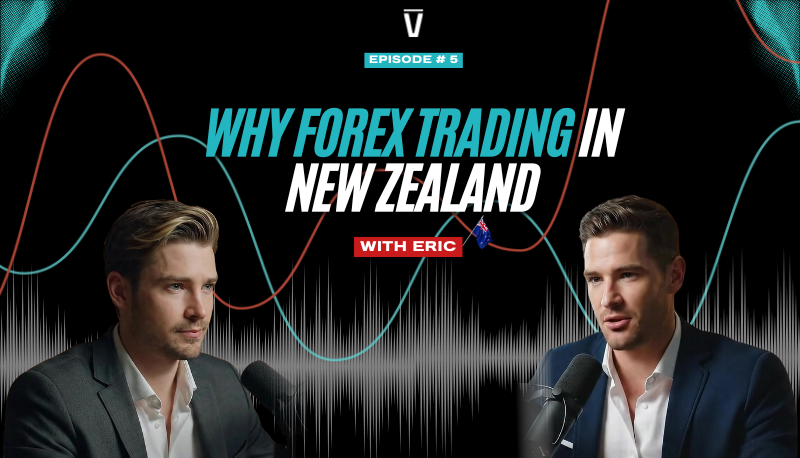
In this Why Varianse episode, Ben sits down with Eric, a New Zealand banker turned pilot, whose journey took him from the cockpit to the charts and from chasing signals to mastering structure.When the 2020 lockdown grounded his flights, Eric found himself in an unexpected classroom quarantine. There, he joined online trading groups where he met Stearne, a veteran Euro trader and Varianse client. Their connection changed everything.
Through Stearne’s mentorship, deep research, and relentless practice, Eric learned the real mechanics behind the market: risk management, liquidity zones, and order flow. He transformed from a reactive trader into a disciplined EUR/USD price-action specialist, relying on clean structure instead of flashy indicators.
In his conversation with Ben, Eric breaks down what truly matters in trading:
Not hype, not bonuses, but trust, precision, and integrity. He shares why he chose Varianse for its EUR-denominated accounts, tight spreads, transparent costs, and tailored trading solutions that work with your style rather than against it.Ben ends the episode with a reminder every trader should hear:
“Find your own Stearne, a mentor, a community, or a broker that helps you grow. Because trading success isn’t built on noise or promises; it’s built on structure, knowledge, and consistency.”
If you want to trade smarter, not louder, and discover what professional-grade discipline really looks like, this story is your blueprint.
 Ben (Host)
Welcome back to another episode of Why Varianse. Today we’re heading all the way to New Zealand, home of breathtaking landscapes, rugby passion, and some of the friendliest people you’ll ever meet.
Usually, it’s charts and candlesticks we talk about, but today we’re mixing in flight paths and jet engines. Joining me is someone who knows a lot about numbers, balance sheets, and financial journeys.
Please welcome Eric, from New Zealand…
Eric, welcome to the VDX Studio!
 Eric (Guest)
Kia ora! Thanks for having me. Happy to be here.
Ben (Host)
Let's start with some background. Could you introduce yourself to the audience where you’re from, what your history looks like, and what you’re doing at the moment?
Eric (Guest)
Yeah, I’m a Kiwi at heart, but my career has taken me all over. I kicked off flying in the US back in 2010, then spent three and a half years deep in the jungles of Borneo, then spent three and a half years deep in the jungles of Borneo flying little runways most people wouldn’t even call airports. From there, I went to Estonia, flying across snowy skies for a couple of years.
I’m now based in Asia, flying the Boeing 777 across continents — it’s been less of a straight career path and more of a global adventure story
Ben (Host)
That’s incredible. But before aviation, you actually had roots in finance, right?
Eric (Guest)
Yeah, exactly. I worked in banking before becoming a pilot — that’s where trading first came into the picture for me, back in 2007. Back then, it was so different.
No YouTube, no trading communities. I even had to explain CFDs to my own bankers because he didn’t know what they were!
Ben (Host)
Times have definitely changed. So you jumped straight into trading during the 2008 financial crisis?
Eric (Guest)
Yes, I took the leap and went full time into trading. But I lost a lot of money. The hardest part was winning trades but not understanding why. If you can’t repeat it, it’s not sustainable.
So, before I went completely broke, I stepped away to pursue my childhood dream of becoming a pilot.
Ben (Host)
Woah. And yet you always kept trading in the background, right?
Eric (Guest)
Yeah, I was always dabbling a bit in small amounts here and there. Sometimes I’d double a small account, other times I’d blow it. I had the financial knowledge, but I treated the markets casually.
I over leveraged, jumped into trades without a plan, and of course, I lost money
Ben (Host)
So Eric, you mentioned earlier that you’d been trading on and off for years.
What was the real turning point that made you take it seriously?
Eric (Guest)
Honestly, it was during the pandemic.
It was rough. Every flight meant being locked up in quarantine. Sometimes I’d only see my family two or three days in an entire month. Some colleagues even quit, or worse. I had to make a choice either fall into that same dark place, or use the time to transform my life. I decided to take trading seriously.
Ben (Host)
And that was a turning point?
Eric (Guest)
You could say that, but it wasn’t as easy as it sounds.
I tried the usual route courses, mentors, some famous brokers, and for a while, it still felt like I was just spinning my wheels.
The market has a way of humbling you, no matter how many books you read.
Ben (Host)
You know, a lot of people say trading can feel pretty lonely just you, your laptop, and a bunch of red and green candles.
How did you manage that side of it, especially being stuck in quarantine as a pilot?
Eric (Guest)
The strange silver lining of quarantine, though, was that I suddenly had time and the internet became my hangar.
I started hanging out on forums like BabyPips, Discord groups, Reddit threads anywhere traders were talking.
While I was exploring, you know how it goes, the internet started throwing every trading ad at me.
“Trade with us, make a fortune, get this bonus, that benefit”
all that blah blah. But for me, it was just noise. Ads don’t mean trust, and they definitely don’t mean results.
He wasn’t just another forum poster, this guy was a walking encyclopedia of Fore
Integrity means a lot to me, and I wasn’t about to risk my time or money on something that looked like a gimmick
So in the meanwhile I was building pen pals, but instead of letters, we were swapping charts, trade journals, and quarantine situations.
I met with Stearne in Discord, who was actually an old man.
He wasn’t just another forum poster, this guy was a walking encyclopedia of Forex. Since 2016, he had been trading with Varianse, running algorithmic models on EUR/USD, talking about execution speed, slippage control, and institutional-grade spreads like it was second nature.
In the beginning, I honestly thought he was just some promotional guy, you know? Another one of those typical salesmen.
Nobody likes a salesman, right?
Ben (Host)
True! unless the salesman selling me spreads so tight I need a magnifying glass.
Then I’m all ears.
Eric (Guest)
Exactly. And the funny thing is, it wasn’t just Stearne. Around that time, I started doing my own digging connecting the dots across platforms. And to be honest, Varianse kept standing out.
Now, sure, there were plenty of other brokers flashing glossy ads, glowing Trustpilot stars, and YouTube videos of clients supposedly making ten times their deposit overnight. But here’s the catch: most of the audience doesn’t peel back the curtain.
They get dazzled by the shiny screenshots without ever questioning the substance behind them. Integrity matters to me, and when you strip away the marketing noise, only a few actually deliver the depth and structure professionals talk about. That’s what made me stop and take Varianse seriously.
Ben (Host)
Sounds like Stearne was the real deal.
Honestly, from the way you describe him, he sounds older in trading years than me.
I think I need to ask the Varianse team to get him on the podcast series ‘Why Varianse’ because I haven’t heard of him before.
Eric (Guest)
Unfortunately… you can’t.
Ben (Host)
Why? Is he just a shy guy, camera shy type?
Eric (Guest)
No… sadly, in 2022 I heard he passed away in a car accident. What made it even harder was how it unfolded. It was a private group, and one day his contributions just stopped. At first, I thought maybe he’d taken a break. But months went by, and eventually, the entire group was deleted. At the time, I thought it was some kind of mistake only later did I learn the truth
That hit me hard. But by then, I’d already absorbed enough from him and from the community to stand on my own two feet.
I stuck with Varianse, and it gave me the structure to treat trading seriously, not just as a side hustle, but as something I could build into my future.
Ben (Host)
That’s heartbreaking. I wasn’t expecting you to say that. You can tell he wasn’t just another trader; he clearly left a real legacy with you, maybe even with the whole community.
Eric (Guest)
Yeah… he really did. Even though we never met in person, what he shared stuck with me. In a way, every trade I take now carries a little bit of what I learned from him.
Ben (Host)
Eric. It really puts things in perspective; Trading isn’t just charts and numbers; it’s also about the people and the lessons we carry with us. And speaking of lessons, I’d love to dive a little deeper into yours.
What did those early experiences learning from Stearne, the community, and your own journey teach you about building a strategy that actually works in the real world?
Eric (Guest)
Absolutely. What I realised early on is that trading had to move beyond guesswork and flashy signals.
From Stearne and others, I started to understand things like risk management, liquidity zones, order flow, and the mechanics that actually drive price, not just the surface-level candlesticks.
Ben (Host)
Alright, let’s talk about strategy. Every trader eventually finds their lane; some go heavy on indices, others dive into commodities, and a few try to juggle everything.
For you, what’s the core of your trading approach? What does a day in your charts look like?
Eric (Guest)
So today, my strategy is built on two main pillars, and at the core of it, I’m very much a Euro trader, just like Stearne was. For me, the EUR/USD is my home base. I focus on pure price action with completely naked charts, no indicators, and no clutter.
I start from the higher timeframes — the weekly and daily — to get the broader structure and then narrow it down to the one-hour. From there, if the setup is clean, I drill into the fifteen- or even the five-minute charts for precise entries.
Ben (Host)
Alright Eric, let’s shift gears into something a bit more technical. Since you and Stearne both carved your edge as Euro traders, I think it’s worth unpacking what actually matters when you’re trading the single currency.
Because it’s not just about staring at charts it’s also about the environment you’re trading in.
From your experience, what are the features or broker setups that really make life easier for a Euro trader?
Eric (Guest)
Yeah, for me, the first thing is having EUR-denominated or multi-currency accounts. It’s such a simple thing, but it saves you from losing money on constant conversions.
Then there are low conversion fees again; it’s about keeping costs down where you can. Add to that EUR friendly payment methods like SEPA or e-wallets, and it makes moving funds so much smoother.
Of course, spreads are a factor. On EUR/USD, every pip counts. Having tight institutional grade spreads makes all the difference, especially if you’re scalping or trading intraday.
But beyond cost, what really matters is trust. You need transparent fees, strong regulation, and protections like negative balance protection because when things get volatile, that’s what keeps you safe.
And then there are the quality of life things:
Multi-currency wallets, localised support, and advanced risk features. They might sound minor, but they let you focus on trading rather than fighting the platform, and honestly, that’s why Varianse stood out for me. While a lot of other brokers flash ads and shiny promises, Varianse consistently delivered on the core features that actually matter for someone trading the euro seriously.
Ben (Host)
Ah, there it is, you finally said the name! I was starting to think you were describing some mythical broker that only exists in trading fairytales. But seriously, I get it.
Most people chase the flashy ads, but you went with the one that actually ticked the boxes for Euro traders. So beyond spreads and payment rails, when you’re actually in the trenches trading the euro—especially EUR/USD—execution becomes a big deal.
Eric (Guest)
Oh, 100%. People underestimate how much execution speed and slippage control affect outcomes. On a major pair like EUR/USD, liquidity is deep, but if your broker can’t handle volatility around key events, say, during ECB rate decisions or NFP, you’re basically gambling on fills.
With Varianse, I noticed orders were hitting the book without that frustrating half-pip to full-pip slip that eats your edge over time.
Ben (Host)
That’s interesting. A lot of traders probably don’t even realize how much that costs them. They just assume, “oh, I missed by a pip, no big deal.” But if you’re scalping or running high frequency setups, that adds up fast, right?
Eric (Guest)
Exactly. One pip on EUR/USD doesn’t sound like much, but if you’re trading size or taking dozens of trades a week, it’s the difference between a green month and a red one and that’s where institutional-grade liquidity comes in.
When you’re plugged into deep pools with multiple providers, you’re not stuck with the “B-book” treatment where your broker’s betting against you that you're in the real market.
Ben (Host)
And I suppose that ties back into regulation and transparency too? Because let’s be honest, the Euro is such a politically charged currency ECB pressers, macro data, even rumors can move it.
You need a broker where you trust the playing field isn’t rigged.
Eric (Guest)
Spot on. For me, it’s not just about tight spreads, it’s about knowing I can size up, trade during volatile conditions, and still trust the infrastructure. That’s why I stuck with Varianse. It felt like I was trading with the market, not against my broker.
Ben (Host)
I like that distinction trading with the market, not against the broker. I think a lot of new traders don’t realize how different those two experiences can be until they get burned.
Eric (Guest)
Yeah, and once you’ve been burned, you don’t forget it. That’s why the boring stuff, regulation, execution quality, account structure, it's not sexy, but it’s what makes you last in this game.
Ben (Host)
Gotcha! and Eric, how valuable are tailored trading solutions when choosing a broker?
Eric (Guest)
Honestly, it’s huge. Especially for someone like me trading the Euro, or anyone with a specific strategy. You don’t want to be shoehorned into a platform that doesn’t match your style.
Varianse doesn't offer one size fits all they tailor solutions to fit your strategy style and goals.
It makes a huge difference in execution and discipline because the platform works with you, not against you.
Ben (Host)
Can you give us an example of how that tailoring actually helped you in practice?
Eric (Guest)
Sure. For me, trading EUR/USD, timing and precision are everything. With Varianse, I was able to set up a custom liquidity feed on EUR/USD, discounted commissions and multiple base currency accounts that matched my trading style.
For instance, I could define position sizes, set alerts around key liquidity zones, and even manage multiple strategies within the same account without overlap.
It meant I wasn’t constantly juggling spreadsheets or trying to adapt a generic setup to my needs. Everything was built around my approach so when the market moves, I can react efficiently, not fight the platform. It sounds small, but that kind of alignment is the difference between a disciplined month and one full of avoidable mistakes.
Ben (Host)
Ah, I see!
So it’s almost like having a trading cockpit built specifically for your style, rather than a one size fits all setup.
Eric (Guest)
Exactly. It’s not flashy or marketing-driven — but for serious trading, that kind of customization is priceless. You can focus on the market, not on making the broker’s platform work for you.
Ben (Host)
So, if there’s one thing today’s podcast conversation reminds me of, it’s that trading, like life, isn't about chasing shiny ads or quick wins.
We’ve all seen the brokers with glossy promises, too good to be true trading screenshots, and stars plastered across review sites. But the real edge comes from integrity, from the people and platforms that actually stand the test of time.
And that brings us back to Stearne. Even though he’s no longer with us, his influence lives on in traders like Eric because he chose to share real knowledge, not noise.
That’s the difference between a fleeting name online and a legacy that lasts.
For me, that’s exactly what separates Varianse from the rest. It’s not a marketing flash, it's substance. It’s building an environment where serious traders can grow, adapt, and, like Eric, turn challenges into a future.
So to everyone listening: find your “Stearne” whether it’s a mentor, a community, or even a broker that actually earns your trust.
Find your edge, and make sure the tools you choose are built for the journey, not just the billboard.