


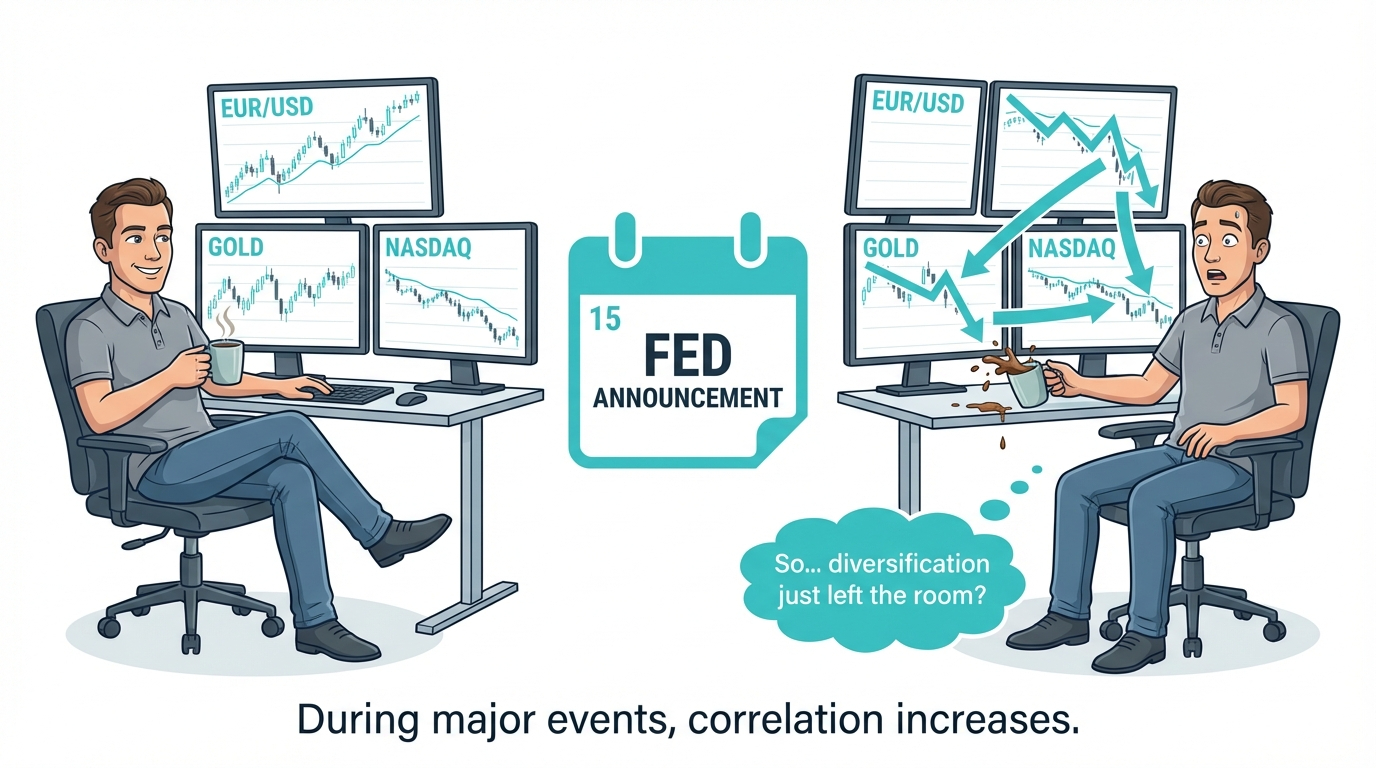
Trading risk isn’t just about where you set your stop-loss. Many traders lose money because they misunderstand correlations and risk management, opening several trades that look different but move the same way. This hidden exposure quietly adds up to losses, especially in Forex and CFD trading.
Understanding correlation isn’t just for the professionals; it is essential for survival. When multiple trades rely on the same major market force, their losses add up instead of happening one after another.
What Is Correlation in Trading?
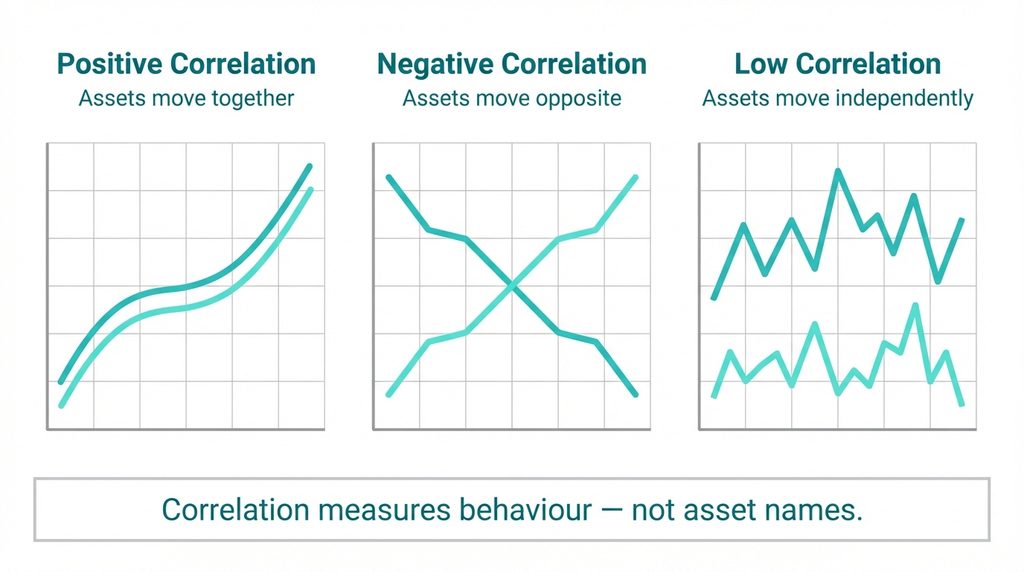
Correlation describes how different markets move relative to one another.
Types of Correlation
- Positive correlation — assets tend to move in the same direction.
- Negative correlation — assets tend to move in opposite directions.
- Low or no correlation — assets move independently
In the world of money trading, things rarely happen by chance. Currencies, stock indexes, commodities, and bonds usually react to common big-picture economic factors, such as interest rates, expectations of future price increases, and the overall mood toward global risks.
Why Correlations and Risk Management Are Inseparable
Many traders see correlation as just a technical extra rather than a fundamental risk principle. If you are betting on USD weakness or rising equity markets across several trades, you are effectively making one macro bet rather than diversifying your portfolio risk.
Risk management, therefore, involves evaluating total portfolio exposure, not just the risk of each individual trade.
Hidden Exposure — The Silent Account Killer
Hidden exposure occurs when several trades are influenced by the same underlying market driver. A trader might risk only 1% on each trade, but if they’re all tied to the same market condition, the portfolio risk adds up to much more.
Common Sources of Hidden Exposure
Hidden portfolio exposure often arises when multiple trades are influenced by the same underlying market factors, including:
- US dollar (USD) strength or weakness
- Risk-on / risk-off market sentiment
- Interest rate expectations
- Equity market movements
- Commodity-linked currency fluctuations
When these shared market drivers reverse, several positions can move against a trader simultaneously, increasing overall portfolio risk. Even trades with individually small risk allocations can create significant combined exposure.
This is known as correlation risk, and understanding it is essential for effective portfolio diversification and risk management.
Hidden exposure becomes particularly important when multiple positions respond to the same economic conditions. Understanding Risk-On and Risk-Off Market Environments can help traders recognise how shifts in market sentiment may affect several assets simultaneously.
False Diversification — A Common Trader Mistake
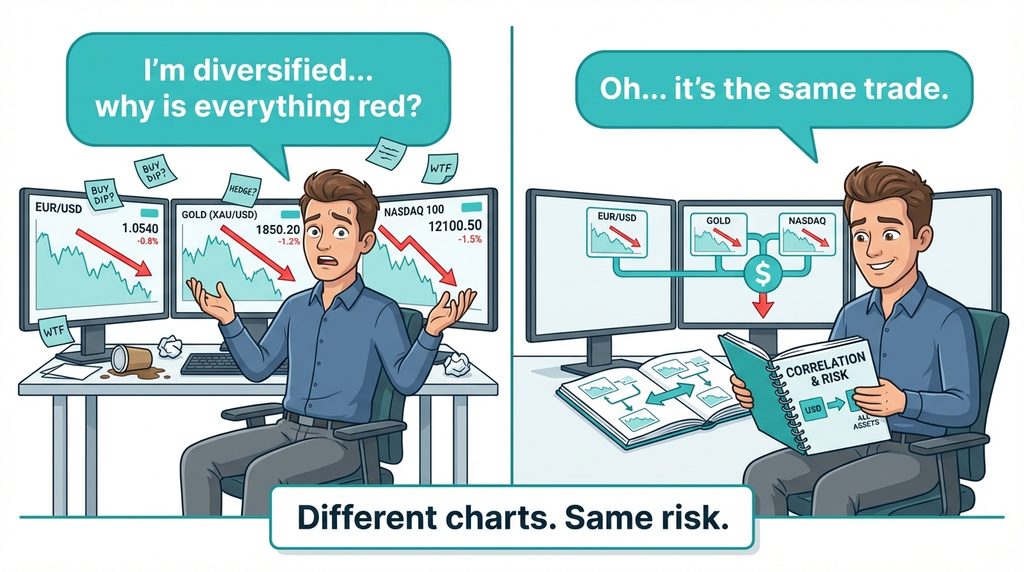
Holding positions across different financial instruments does not automatically eliminate concentrated portfolio risk. Research discussed by the CFA Institute on correlation and diversification highlights how assets can share underlying risk factors even when their historical correlations appear relatively low. This is why traders should evaluate common market drivers, combined exposure and changing correlations rather than relying solely on the number of instruments they trade.
Example of False Diversification
False diversification happens when trades look different but share the same underlying driver. Different charts do not automatically mean different risk.
| Trade | Looks Different | Real Risk |
| EUR/USD long | Different pair | USD exposure |
| Gold long | Different asset | USD weakness |
| NASDAQ long | Equity trade | Risk-on sentiment |
A currency pair, a stock index, and a commodity can all respond to the same mood shift. When markets shift, losses tend to stack up rather than cancel each other out, increasing portfolio risk.
Correlation Breakdown — When Markets Change Behavior
Correlations are not permanent; they change over time. When central banks make big decisions, countries clash, or the economy hits a rough patch, the usual ties between them can weaken or break down; this is known as a correlation break.
Pro traders watch for these shifts and cut back their bets when things start to get shaky to manage correlation risk. Retail traders usually pile on more trades when they think the market will keep doing what it’s been doing.
How Professionals Manage Correlation Risk
Professional traders think in portfolios, not isolated trades. They look at groups where people might be exposed to risks and adjust their sizes to better understand the total portfolio risk.
Managing correlated positions requires more than setting individual stop-loss levels. The principles covered in Risk Management Fundamentals provide additional context on position sizing, risk limits and controlling overall trading exposure.
Core Principles Used by Professionals
Professional portfolio risk management focuses on controlling overall exposure rather than evaluating each trade in isolation. Key principles include:
- Limit exposure per macro theme: Set risk limits for positions influenced by the same economic or market factors.
- Adjust position sizes for correlation: Reduce exposure when multiple trades respond to similar market movements.
- Avoid concentrated currency exposure: Prevent several positions from relying heavily on the same currency driver.
- Monitor portfolio-wide drawdowns: Assess cumulative losses and overall portfolio performance, not just individual trade outcomes.
- Adapt to changing correlations: Regularly reassess relationships between assets as market conditions evolve.
This portfolio-first approach to risk management is widely applied across hedge funds, proprietary trading firms, and institutional trading environments, where controlling concentrated exposure and managing portfolio-level risk are essential to long-term capital preservation.
Practical Correlations and Risk Management Rules for Traders
Understanding correlation risk is only the first step. Traders also need practical rules to identify overlapping exposure, manage position sizes, and protect their portfolios from concentrated market risk.
The following principles can help improve correlation and risk management in Forex and CFD trading.
Count Exposure, Not Trades
Three correlated positions may behave like one concentrated market bet, even when they involve different instruments. Evaluate their combined exposure rather than treating each trade as an independent risk.
Cap Risk Per Theme
Set maximum risk limits for trades influenced by the same underlying market driver, such as USD movements, interest rate expectations, or broader market sentiment. This helps prevent excessive exposure to a single economic factor.
Avoid Emotional Diversification
Trading different instruments does not automatically create a diversified portfolio. Forex pairs, commodities, and stock indices may react similarly to the same economic events, increasing the risk of simultaneous losses.
Reduce Size During High-Correlation Periods
Major economic announcements, central bank decisions, and periods of market uncertainty can cause correlations between assets to strengthen or shift unexpectedly. Consider reducing position sizes when multiple trades become increasingly exposed to the same market movements.
Review Portfolio Drawdowns Weekly
Regularly analyse portfolio drawdowns, combined position exposure, and trading performance. Identifying patterns of simultaneous losses can help reveal hidden correlations and improve future risk allocation.
Why Beginners Struggle With Correlation Risk
Most beginners focus heavily on entry signals, indicators, and win rates, but they often overlook portfolio-level risk.
They analyze trades individually rather than as a whole.
That’s why traders might get the market direction right but still keep losing cash: it’s all about having too much overlapping hidden exposure, not just guessing wrong.
Conclusion — Correlations and Risk Management Decide Survival, Not Indicators
Beginner traders often focus on entry signals, technical indicators, and win rates while overlooking how their positions interact within the wider portfolio.
They may assess each trade individually without recognising that several positions are exposed to the same currency, economic event, or market sentiment.
For example: a trader holding EUR/USD long, GBP/USD long, and USD/CHF short positions may believe they have three separate trading opportunities. However, all three positions generally share exposure to US dollar weakness.
If the dollar strengthens unexpectedly, all three trades could move against the trader simultaneously.
This illustrates why getting individual trade setups right is not enough to manage overall portfolio risk. Without understanding correlations, traders can unintentionally concentrate exposure and experience larger losses than anticipated.
Effective risk management starts with understanding how trades work together, not just how each trade performs individually.








