


Newbies tend to spend a lot of time looking for better trading entries, indicators, and strategies without paying sufficient attention to risk management.
Even an effective system that brings profit historically might face huge losses in case the trader doesn't have knowledge about proper position sizing, market environment, and possible financial exposure.
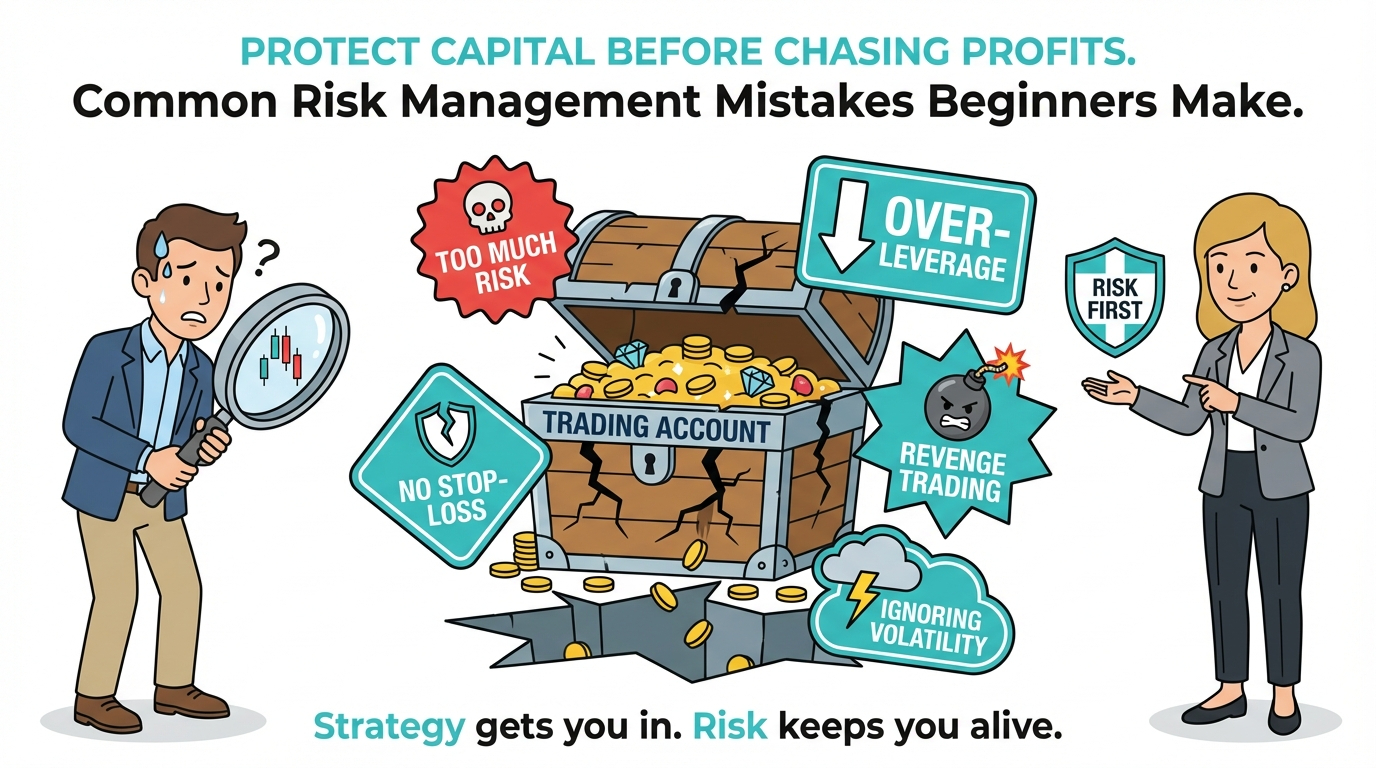
Some common risk management mistakes include too high financial exposure to one trade, wrong understanding of stop loss order, increase of financial exposure after losses, and poor execution management.
Awareness of such mistakes will help beginners evaluate their trading decisions more efficiently.
This lesson builds on the Risk Per Trade Explained, emphasizing that we set our risk before we even start trading, not after we've taken hits. In this article, we explore seven common risk management mistakes beginners make and the considerations involved in managing trading exposure.
Mistake 1: Risking Too Much on a Single Trade
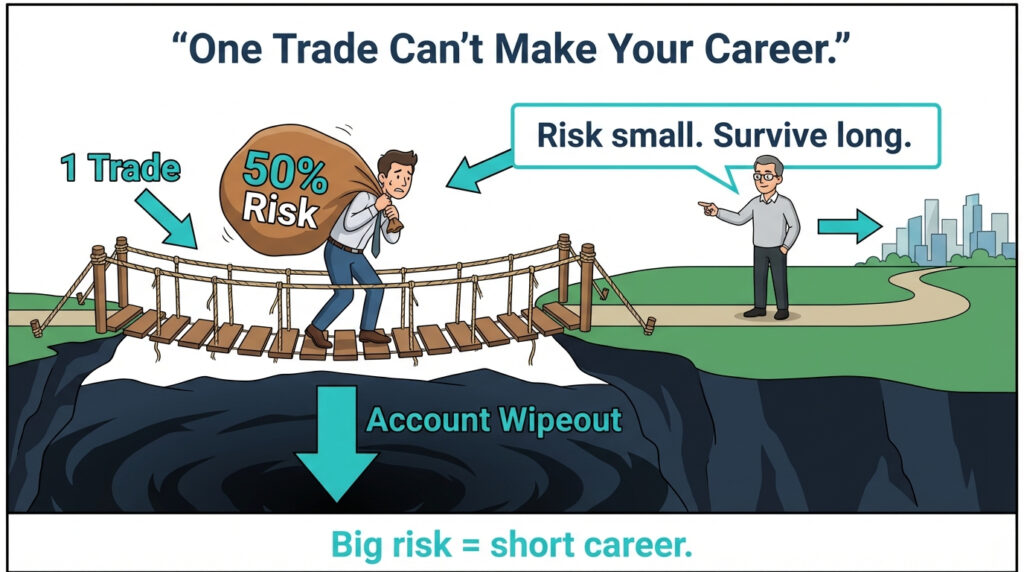
Taking excessive risk on an individual trade can expose a trading account to substantial financial losses. New traders might increase position sizes due to being overconfident or having unreasonable expectations or trying to make back past losses.
Larger positions often mean more monetary exposure to changes in the price of the same instrument.
Losing a big amount can also have an effect on future trades, especially when trying to recoup losses rapidly.
Using a fixed percentage risk strategy is one way to define planned risk relative to account size.
A trader using 1% of a $10,000 account for planned risk would initially allocate a risk budget of $100 for the trade.
Actual losses, however, could be higher than the planned loss due to market gaps and slippage or other trading execution issues.
Big financial hits can really shake your confidence, not just your bank account. Following a significant setback, traders may question their actions, take excessive risks, or abandon their typical strategy entirely.
The fixed-percentage risk model explained in Risk Per Trade Explained: The Fixed Percentage Model Guide prevents this by keeping losses proportional to account size. Controlled risk stabilizes long-term performance.
Mistake 2: Ignoring Stop-Loss Placement
Stop-loss order is meant to get rid of the position once the price reaches certain price level based on the order type and its execution.
Stop-loss order can assist in determining an exit point prior to opening a position for trading.
But a common stop-loss order cannot guarantee that your trade will be executed at the price you request.
In case of market gap, high volatility, or lack of liquidity, there is a chance that the price of your trade will be different from the stop price.
Some newbies are unaware of this issue, while others do not use stop-loss orders at all due to their ignorance of market situation and the size of the position.
Before engaging in trading activities, one should know how stop-loss and take-profit orders work.
Proper stop placement, explained in Take Profit & Stop Loss Explained Control, ensures every trade has a defined exit before it begins. Stops protect traders from emotional decision-making.
Mistake 3: Confusing Position Size With Risk
Position size and financial risk are similar concepts, but they are not the same thing. Position size is how much a person is exposing himself to the market by opening a position.
Financial risk is dependent on the instrument being traded, how prices move, intended exit point, and execution. Two traders can open positions of equal size using an identical trading account but set up different exit points.
As a result, their financial risks can be different. Beginners tend to open bigger positions after making successful trades or gaining confidence with certain opportunities in the markets.
However, confidence has nothing to do with the amount of financial risk a trader will face.
Position sizing should always follow predefined risk rules, as explained in Position Sizing Explained Without Confusion for Beginner Traders, where size adjusts to protect capital rather than amplify emotion. Risk comes first. Position size follows.
Mistake 4: Moving Stop-Losses Emotionally
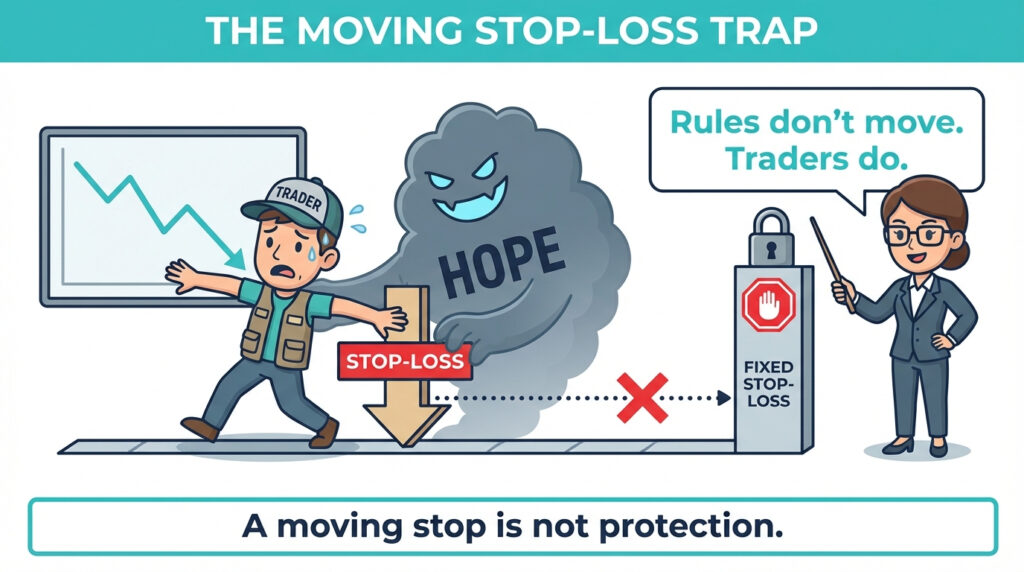
Changing a stop-loss level is not always an error in risk management. There are certain trading strategies that provide predetermined guidelines on how to adjust exit levels depending on changes in market conditions.
Nevertheless, adjusting a stop-loss order away from the initial level only to dodge loss acceptance can lead to increased capital exposure. Unplanned adjustments may also impact the ratio of the possible gain and loss.
For instance, changing the distance to a stop-loss order without decreasing the size of the position can raise the desired level of monetary risk of the trade.
It is important to note that stop-loss execution prices cannot be assured under any circumstances.
Staying disciplined with exits is key to maintaining a positive outlook, as explained in Reward-to-Risk Ratio & Trade Expectancy: Explained Simply. Changing risk mid-trade breaks the process.
Mistake 5: Focusing Only on High Win Rates
While a high success rate looks promising, it does not help one determine whether a particular trading strategy will be profitable. Success rate is the ratio of successful trades made compared to all the total completed deals. It does not show how big these successes are compared to unsuccessful trades.
For instance, a system that shows a high level of success in most of its trades may end up with an overall negative result if its average losses were much bigger than the average wins.
On the other hand, a trading system that shows a low success rate might be profitable if it had higher gains compared to the losses.
A strategy that generates big wins but also big losses can still lead to unfavorable outcomes. This idea is laid out in Why Win Rate Is Useless Without R-Multiples, where making money hinges on the size of the win, not just on feeling good about it. Risk structure determines survival, not win frequency.
Mistake 6: Increasing Risk After Losses
There are some traders who expand their positions after they incur losses because they wish to regain their old results rapidly. This will add to the financial exposure of the trader during times when emotions will also affect decision-making.
Losses may rise to higher levels if the market is going against the direction that the trader is trading in. Loss recovery efforts will often cause overtrading and also cause the trader to make decisions that do not conform to the original plan.
Risk management should be done beforehand to enable a more consistent decision-making approach. But adhering to risk management cannot ensure that emotional decision-making and financial losses will be avoided.
Mistake 7: Ignoring Market Conditions
The trading environment can greatly vary depending on the market environment being used.
At times when the market environment experiences increased volatility or low liquidity, bid-ask spreads will widen as well as slippage. A market gap may also make your trades executed at prices other than those that you expect.
This may happen due to major economic news or market opening, but its impacts will differ depending on the security and the type of market being used. Overlooking any changes in market environment will have your traders underestimating any execution cost and risks involved.
These execution realities are laid out in Market Gaps and Slippage Explained Traders who don't pay attention to the market's ups and downs can end up with some surprise losses.
Professional traders adjust exposure based on the environment. The Financial Conduct Authority emphasizes the need to understand risks in leveraged markets, noting that leverage can significantly amplify both wins and losses. Risk must always be controlled deliberately.
How Beginners Can Address Common Risk Management Mistakes
The first step towards comprehending risk management lies in the recognition of the financial risks that arise due to each trading choice.
Prior to entering a trade, the trader should take into consideration the position size, margin requirements, exit points as well as trading expenses.
Moreover, the analysis of account equity and margin available will allow a trader to grasp how changes in price influence a leveraged trade.
One can use a demo trading platform to practice all the above principles while not engaging one's capital in the trading process.
Nevertheless, the demo trading process is not quite similar to real-life conditions.
Trying out trades in a fake market setting through VARIANSE trading account link helps traders get their act together without risking real cash
Structured learning at the VARIANSE Academy helps reinforce these behaviors and links them to long-term survival. Consistency develops through controlled exposure.
Risk Management Is a Skill Built Through Discipline
Financial risk management entails the need to understand the exposure involved, to assess possible losses and use a uniform approach to trading activities.
This will require familiarity with position sizing, trade execution, market conditions and risk versus possible return.
Even experienced traders can make mistakes, and no matter how good a risk management process is, it does not assure a profit.
The goal is not to remove all uncertainties but to comprehend and handle them.
Conclusion: Risk Management Mistakes
Mistakes often made in risk management may lead to increased financial risk and large trading losses.
Taking high risks per trade, misinterpreting stop loss orders, increasing risk after a losing trade and ignoring market conditions are the key issues to be aware of for novices. Position sizing, predetermined risks and market execution conditions may help create a systematic approach to trade evaluation.
Nevertheless, any risk management cannot ensure profitability, exclude all possible errors and prevent financial losses.
This knowledge is critical for novices as part of learning about financial markets.








