


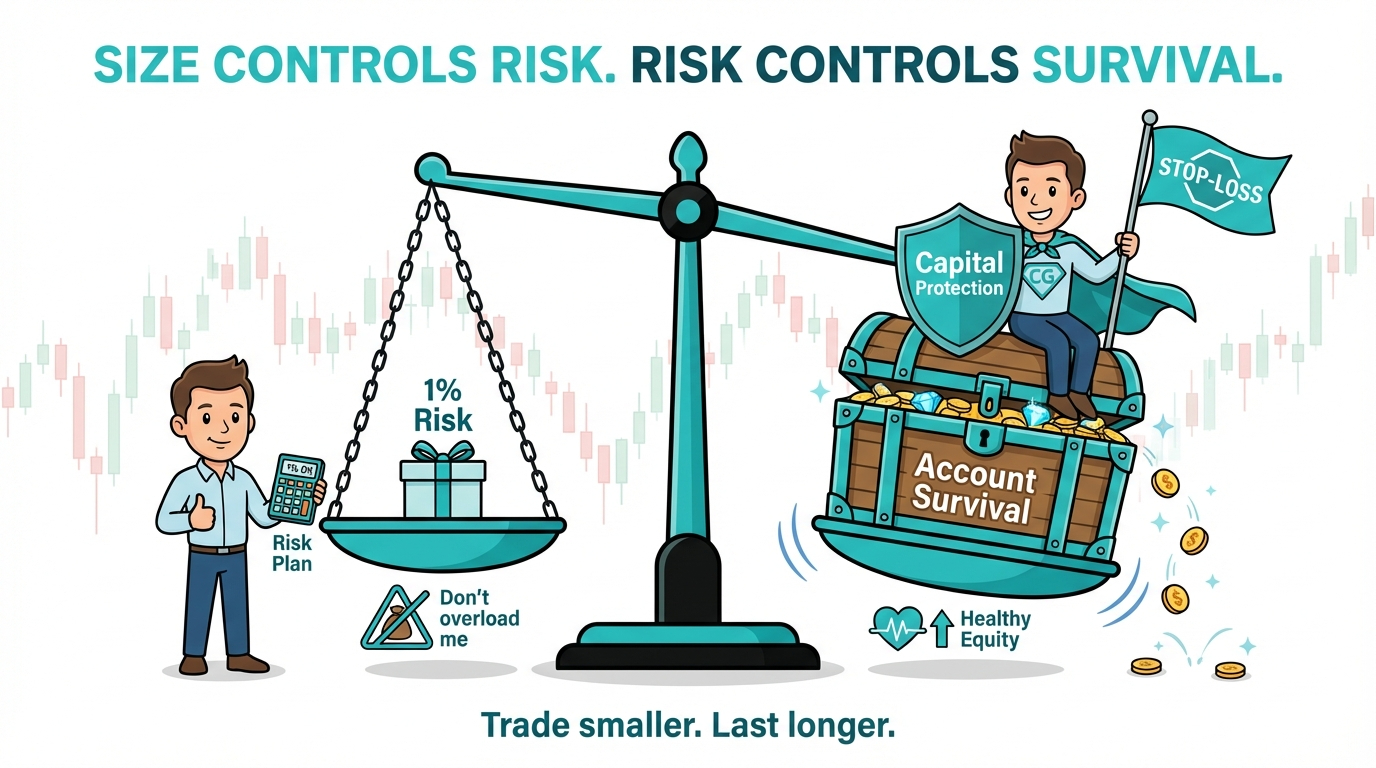
Position sizing is super crucial when you're trading, and many newbies get it wrong. A lot of traders get caught up in entries, indicators, or strategies, but they keep losing money because they're trading amounts their accounts can't handle without risking.
Position sizing doesn't forecast where the market's headed. It limits the impact of a losing trade. When you handle your bet sizes right, you keep your losses in check and can bounce back. When the trade size is too big, regular market swings can still make you go all emotional, put you under pressure, and mess with your account's stability.
This idea is based on Risk Per Trade Explained, which says you set a specific risk level to determine your exposure.
What Is Position Sizing in Trading?
Position size is the determination of the magnitude of the trade relative to your trading account and the amount of risk that you want to take.
Position size does not only depend on your gut feeling or beliefs. It depends only on the amount of risk that you want to take and the preservation of your assets.
Position Size Is a Risk Decision, Not a Market Opinion
The size of your position in an investment will determine your gains or losses in case of price movement in either direction. It does not affect the effectiveness of the analysis in any way, but it will definitely influence how gains or losses affect your account.
Even two people using the same system can get divergent outcomes if one of them sizes his positions well while the other person doesn’t. This is the reason why we consider position sizing to be an integral part of risk management and not merely trading strategy.
Why Position Sizing Matters More Than Entry Timing
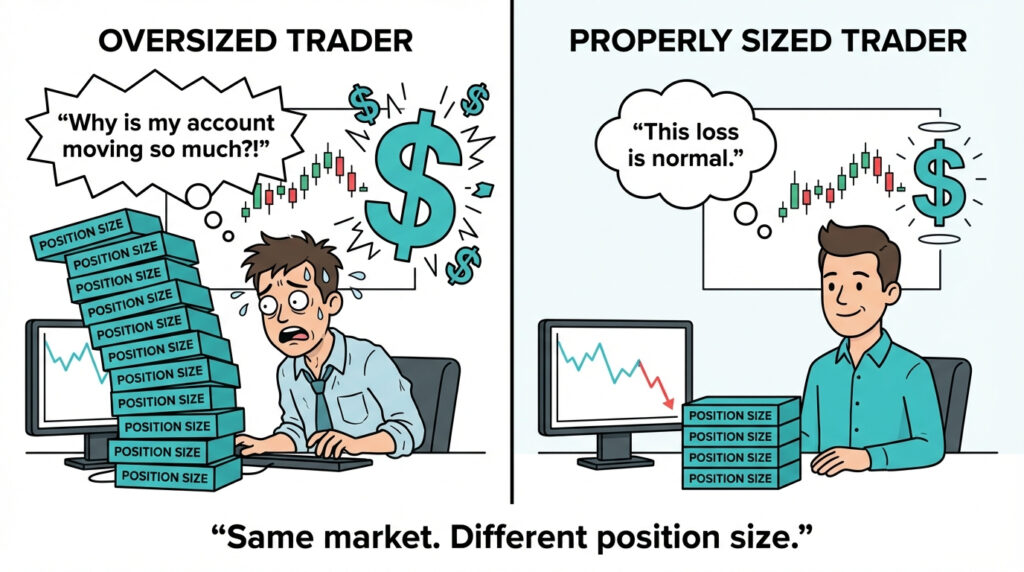
Many newbies assume that having the most successful trades is what it takes to earn money. But in reality, getting the volume wrong may ruin the account, despite perfect analysis.
How much you bet affects how much you lose, how you handle the ups and downs when you're trading, and how steady your trading account stays. This ties into the Trade Lifecycle Explained, where you plan risks before you even start. Trading results depend as much on what you see as what you think.
Position Sizing vs Risk Per Trade (Common Confusion)
The relation between the two is obvious, but they aren't equal. The risk per trade defines the maximum level we are allowed to lose. Then, the position size is calculated to adhere to our risk parameters
When the acceptable loss is 1%, then you will have to adjust the position size in such a way that the stop-loss level reaches that specific level. Such an approach helps us to follow the market regardless of the situation
This guide Risk Per Trade Explained, breaks down how setting a fixed risk amount is key to figuring out how big your trades should be
Why Oversized Positions Create Instability
Big trades can really stress you out and your wallet. When traders feel their losses are too large relative to their account, they might get emotional instead of sticking to their strategy.
Large trades often require us to adjust our stop losses, hold onto losing trades for extended periods, or attempt to recover by making a large investment. These actions are part of the emotional rollercoaster traders go through, as detailed in Trading Psychology Explained, how feelings mess with sticking to a plan.
Getting the right size for your investments keeps your account balance steady and helps you make smarter choices.
How Stop-Loss Distance Determines Position Size
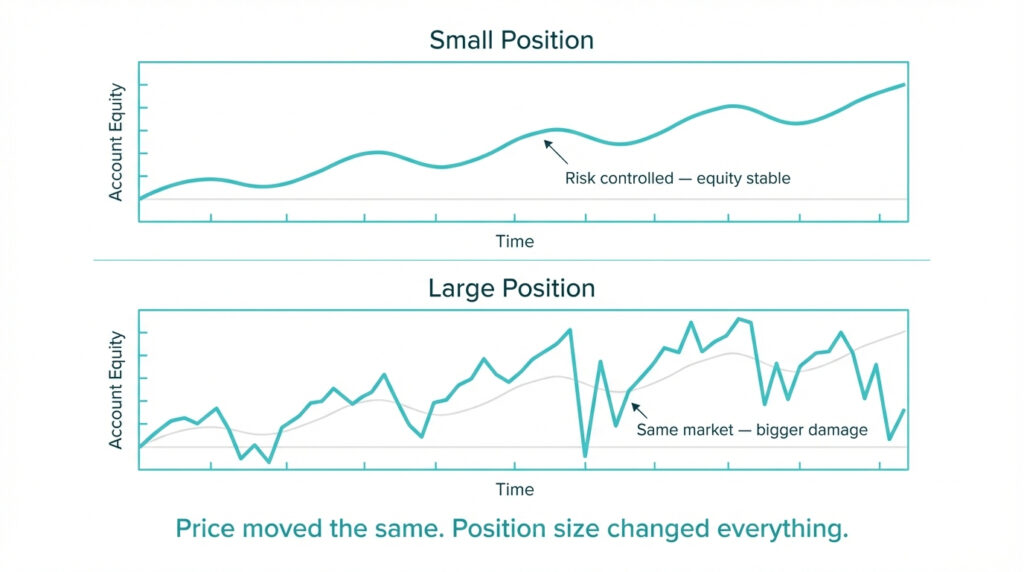
Position sizing is directly impacted by the way you place your stop losses. As stop loss gets wider, you have to reduce the position size, which would keep the risk constant. The other way around, narrower stop losses allow for taking on slightly more risk.
This keeps exposure steady, no matter how the market swings or what the setup looks like. Stop-loss placement is laid out in Take Profit & Stop Loss Explained, where exit planning sets the limit for the most we're willing to lose
Position size adjusts to match risk, not the other way around
A Practical Position Sizing Example
A trader with a $10,000 account is risking $100 per trade. The highest loss we can tolerate is $100
If the stop loss is further out, the trader reduces their bet to keep it at $100. If the stop loss is closer, you can bump up the position size a bit without upping the risk
The setup changes, but the risk remains the same. This steady balance keeps the account safe during losing streaks and avoids sudden drops.
Why Fixed Lot Sizes Create Long-Term Risk
Many newbies choose set sizes because they seem easy to manage, but many don't pay attention to shifts in their account balance and market volatility.
As the account shrinks, sticking to set inventory sizes risks more capital by accident. This speeds up drawdowns and increases the chance of hitting margin.
This chain reaction is explained in Margin Calls & Stop-Outs Explained, where too much risk eventually forces traders to close their positions. Adaptive sizing protects account stability.
Position Sizing, Leverage, and Margin
Position sizing in the market has an immense impact on the level of leverage and margin to be used. This is because when you have a larger position, it requires you to take a cautious approach in dealing with price changes. The use of small sizes means that there is no possibility of selling assets impulsively
Leverage can amplify your position size and boost your gains. This relationship is discussed in the article What Is Leverage in Trading?, showing that exposure isn't just a perk on its own; it's actually a multiplier.
You can safely practice position sizing in a demo environment by checking out the Varianse trading account page [link]
How Professional Traders Approach Position Sizing
Professional traders don't just guess how much to invest. They figure it out using a set risk level and a stop-loss range. Their aim isn't to amp up visibility, but to keep things steady and safeguard their investment
Structured education programs, like the one at Varianse Academy, really stress the importance of getting your position sizes just right as a key part of trading discipline
Consistency comes with controlled exposure.
Conclusion: Position Sizing Protects Trading Accounts
Position sizing may not necessarily result in profits but it prevents one bad trade from ruining the whole trade. The ability to manage one’s trades and remain calm during losing streaks is possible when one’s trading remains in control.
Trading accounts do not fail because of poor analysis but because of the risky nature of the positions they undertake. Trading involves survival through position management.








