


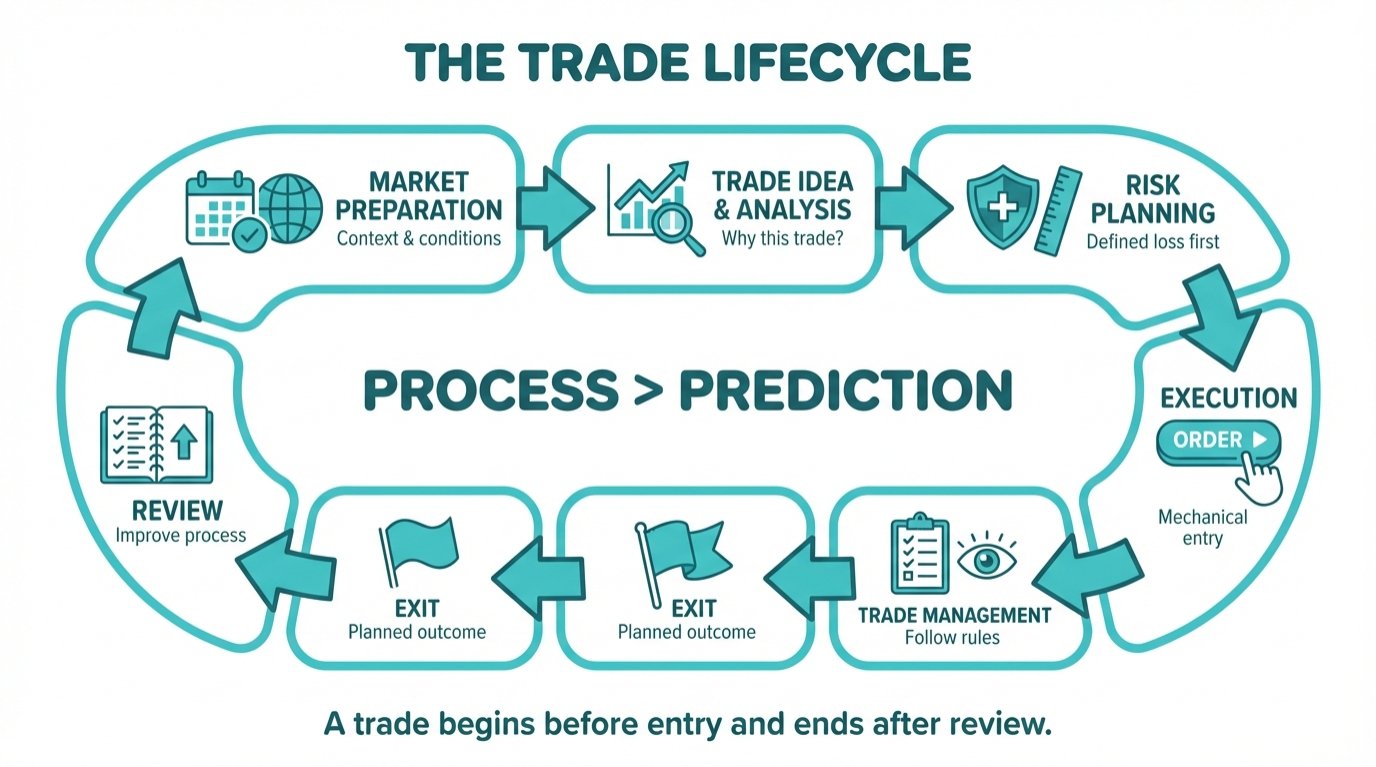
The trade lifecycle describes the stages involved in planning, executing, managing, and reviewing a trading position.
The steps involved in a systematic trading procedure include evaluating market conditions, forming a trading idea, assessing risks, making trades, managing positions, and analyzing the performance.
These steps may guide the trader towards better decision-making and help in avoiding spontaneous actions. Nevertheless, no systematic trading procedure can ensure profit or eliminate market risk.
This organized method is part of the wider execution strategy detailed in Trade Mechanics & Execution Basics: How Trades Really Work, where traders learn how orders interact with actual market conditions.
What Is the Trade Lifecycle?
The trade lifecycle is the sequence of stages involved in identifying, planning, executing, managing, closing and reviewing a trade.
For educational purposes, it can be divided into seven stages:
- Market preparation and context
- Trade idea and analysis
- Position sizing and risk management
- Trade execution
- Trade management
- Trade exit
- Post-trade review
Each stage helps traders consider different aspects of the trading process, from understanding market conditions to evaluating decisions after a position has closed.
The lifecycle provides a framework for structured decision-making, but it does not guarantee successful trades or prevent financial losses.
Grasping this process is based on the solid groundwork laid out in 🔗 Financial Market Foundations: How Financial Markets Work for Beginners, where it's clear that markets are essentially networks powered by liquidity, participants, and the flow of money.
Why the Trade Lifecycle Matters for Beginners
Most newbies lose, not because they're bad at analysing but because they skip important steps. Diving in unprepared, taking unnecessary chances, or leaving with your feelings all over the place messes up the flow.
Structure Prevents Emotional Decisions
A well-planned life cycle helps avoid rash choices. Traders set their own risk parameters, have a strategy for getting out, and stick to the guidelines rather than relying on gut feelings.
This reduces the emotional blunders traders face, as explained in Trading Psychology Explained, where feelings can trump smart thinking. Discipline begins with structure, not prediction.
Stage 1 — Market Preparation and Context
Every trade starts with getting ready. Before diving into the data, traders take a moment to assess the market conditions they're dealing with
Understanding Market Conditions
The first stage of the trade lifecycle involves assessing the market environment before considering a potential trade.
Understanding Market Conditions
This involves identifying whether there is an uptrend or downtrend, volatility, liquidity, and any likely economic releases.
This is crucial because it can affect the spread and tradable volume. Nonetheless, high liquidity does not necessarily guarantee that an order will execute at a certain price level. Information about the trading environment helps traders identify potential problems before trading.
Liquidity is super important because it affects spreads, trade execution, and slippage. These conditions are outlined in the section titled What Is Liquidity?, where how much you're involved affects how easy trades go.
Stage 2 — Trade Idea and Analysis
After assessing market conditions, traders may develop a potential trade idea based on their analysis.
Building a Trade Hypothesis
A trade hypothesis explains why a trader is considering a position, what market conditions support the idea and what developments could invalidate it.
Depending on the strategy, analysis may involve market trends, support and resistance levels, economic developments or other relevant information.
Different asset classes have distinct characteristics, including trading hours, volatility, liquidity and underlying risk factors.
Treat a trade hypothesis as a possible scenario rather than a prediction the market will necessarily follow.
Understanding your markets is crucial, as explained in 🔗 Asset Classes Explained. Each asset class has its own set of ups and downs, and how easy it is to
Stage 3 — Position Sizing and Risk Management in Trading
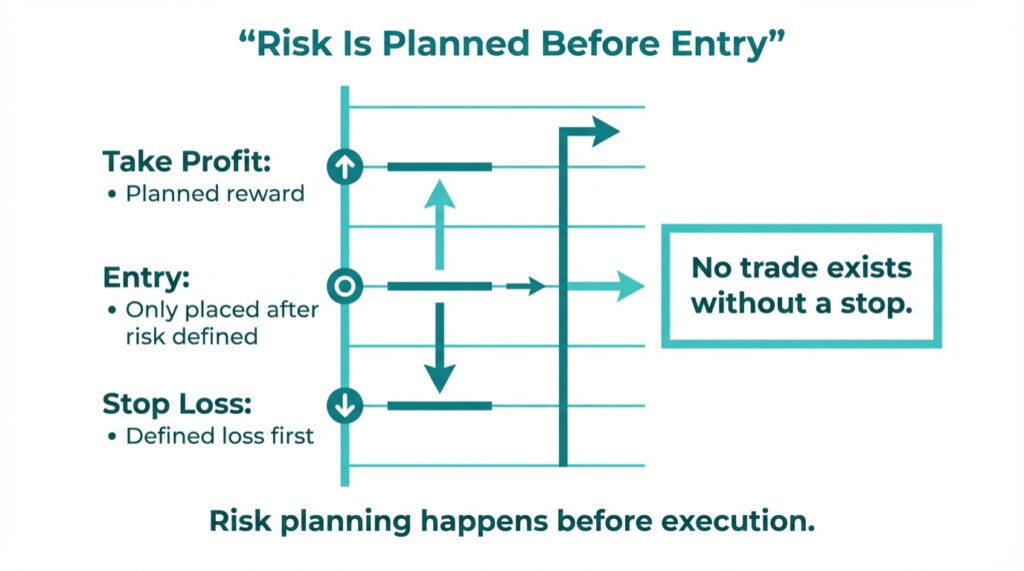
Risk planning is an important part of the trade lifecycle because it helps traders evaluate potential financial exposure before placing an order.
Defining Risk Before Entry
The stage could also consist of defining the right position size, setting up the exit points, and determining the effect of negative price changes on finances.
Traders can use stop-loss and take-profit orders in order to define their exit points.
But stop-loss orders do not necessarily mean that trades will be carried out at certain prices, and losses could be greater than those originally expected.
Position sizing helps traders match their risks with their positions, but it does not protect from losses resulting from market gaps or use of leverage.
In Take Profit & Stop Loss Explained, they break down how these set exits help keep your money safe and keep you disciplined.
Position sizing is key to making sure one trade doesn't wreck the account. This idea is supported by Risk Per Trade Explained, which states that maintaining a steady risk approach is crucial for staying in the game over the long haul.
Stage 4 — Trade Execution
Trade execution involves submitting an order and determining whether, when and at what price it is filled.
Entering the Trade
Before placing an order, traders should understand the available order types, current bid-ask spread and relevant market conditions. Market orders generally prioritise prompt execution, while limit orders establish acceptable price boundaries but may remain unfilled.
Execution can also be influenced by liquidity, volatility, slippage and the trading platform's order-handling rules.
Understanding these factors helps traders recognise that an order's final execution price may differ from the price initially expected.
Grasping the distinction between execution methods is key, as detailed in Market Orders vs Limit Orders: What’s the Difference?, since the type of order influences how well it fills and how much control you have over the price.
Execution quality can also be swayed by the spread and liquidity conditions, as explained in Bid-Ask Spread Explained: How Trading Costs Really Work?, where trading costs and participation play a role in how smoothly you can enter the market.
Keeping things clean keeps your trade plan solid. You can safely practice trading in a demo environment by signing up for a VARIANSE account
Stage 5 — Trade Management
Once a trade opens, our focus shifts from crunching numbers to adhering to the plan. The result isn't about guessing anymore; it's all about sticking to the game plan.
Managing an Open Position
The traders can examine the market conditions, check their exposure, and see if the pre-defined exit criteria have been met.
Unforeseen circumstances like market gaps, liquidity change, and slippage can impact the management and closure of positions.
Following a plan allows the traders to avoid any unwarranted actions taken purely on emotions.
Unexpected market swings, gaps, or slippage can mess with how trades go down, as detailed in Market Gaps and Slippage Explained, where disruptions in liquidity can change the prices you get
Discipline during management protects long-term consistency.
Stage 6 — Trade Exit
Every trade ends with a profit, a loss, or a manual close. The exit stage wraps up the execution phase of the lifecycle.
Planned vs Emotional Exits
Position closure is based on the closing of stop loss/take profit, manual closing by the trader, or closing by the platform in accordance with certain margin/risk management policies.
It results in either a profit or a loss for the trader.
Setting exit criteria prior to initiating the position enables a trader to develop more structured decisions.
Discipline is a big deal when it comes to traders who stick with it versus those who don't, according to Why Traders Fail? It's about staying calm and sticking to a plan, because letting emotions take over is detrimental.
Defined exits protect both capital and discipline.
Stage 7 — Post-Trade Review
The lifecycle continues even after the market's done for the day. Improvement happens during the review stage.
Reviewing the Trade Objectively
Post-trade analysis could include assessing whether there was a following of the initial plan, the appropriateness of the size of the position taken, as well as the effect of the market environment on execution of the trade.
It could also include an analysis of spreads, slippages, transaction costs, and any differences in the execution price and the planning price.
However, keeping note of all such observations in a trading diary could be useful in detecting any repeated decision and execution mistakes and also learning opportunities.
The only thing to be noted is that post-trade analysis cannot guarantee better performance and profits.
Trade Lifecycle vs Random Trading: Why a Trading Plan Matters
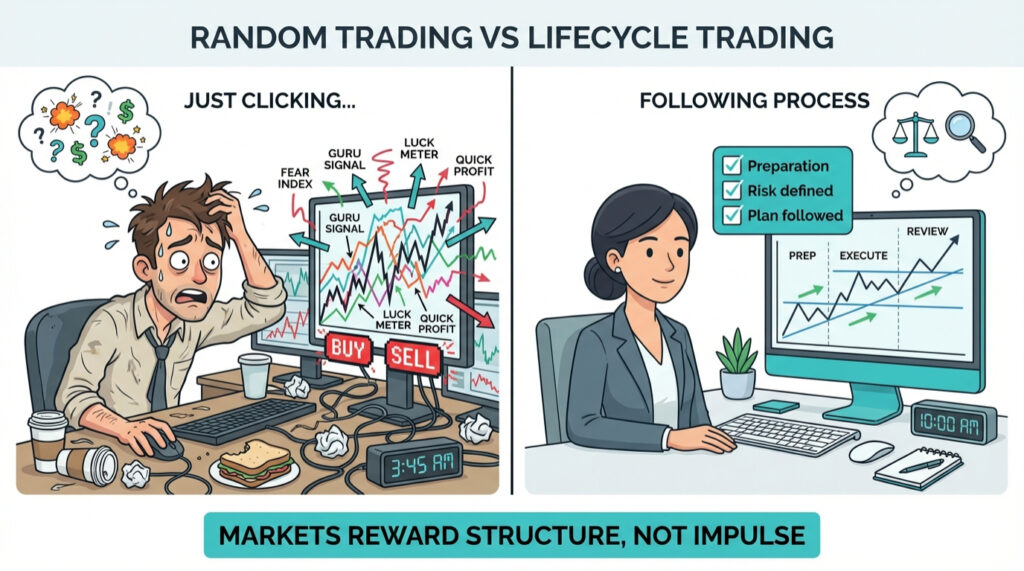
Random trading focuses on results. Lifecycle trading is all about the process.
Why Process Creates Consistency
Even though there might be some instability in the market for a certain period of time, it is still possible for traders to manage themselves. Being prepared, having an action plan, following a strategy, and analyzing your transactions can stabilize your performance.
This method cuts down on impulsive trading and emotional choices, which is what Overtrading Explained gets into, showing that too much trading just ups the risk without boosting your gains.
Consistency means sticking to the good stuff we do over and over, not guessing every little thing that's going to happen.
Applying the Trade Lifecycle in Forex and CFD Trading
Forex and CFD markets are all about leveraging, managing volatility, and experiencing rapid price changes. Without any clear plan, errors just pile up fast.
Why Lifecycle Discipline Is Critical in Leveraged Markets
The lifecycle of trading becomes significant when dealing with leveraged trading in financial products such as forex CFDs.
Through leverage, the trader has more control over the exposure compared to the amount of margin involved in the trade, which can result in high profits as well as losses.
Having an organized way of trading ensures that the trader will have time to think about the prevailing market situation, the size of the trade, execution risk and exit strategy.
Even though there is an organized way of trading, volatility, slippage, gap risks and margin calls pose a problem to the trade.
Practice sessions and training can be done through educational material as well as the use of demo trading environment.
Structured learning environments like VARIANSE Academy help traders develop these habits safely before risking real money.
Lifecycle discipline protects survival.
Common Beginner Mistakes in the Trade Lifecycle
Newbies often tend to make mistakes in the process, when they skip some stages of the process. Rushing things, taking unnecessary risks, and not doing trades reviews will not help you grow. Mistakes occur, since newcomers care about entering, but not about the process itself.
Completing all the stages of the life cycle creates a stable pattern.
Conclusion: Understanding the Trade Lifecycle
Trade lifecycle offers a logical way of analyzing the development of trading decisions from their emergence to evaluation.
Seven stages involved in this include market preparation, trade analysis, risk management, trade execution, position management, trade exits and evaluation of trade performance.
Adhering to such a plan will aid traders in formulating more rational criteria for decision making and will allow them to identify any execution and financial risks that may occur.
Nevertheless, it will not be able to reduce uncertainties or avoid losses and ensure success in trading operations.
For new traders, this information will definitely become an essential element of trading experience.








