


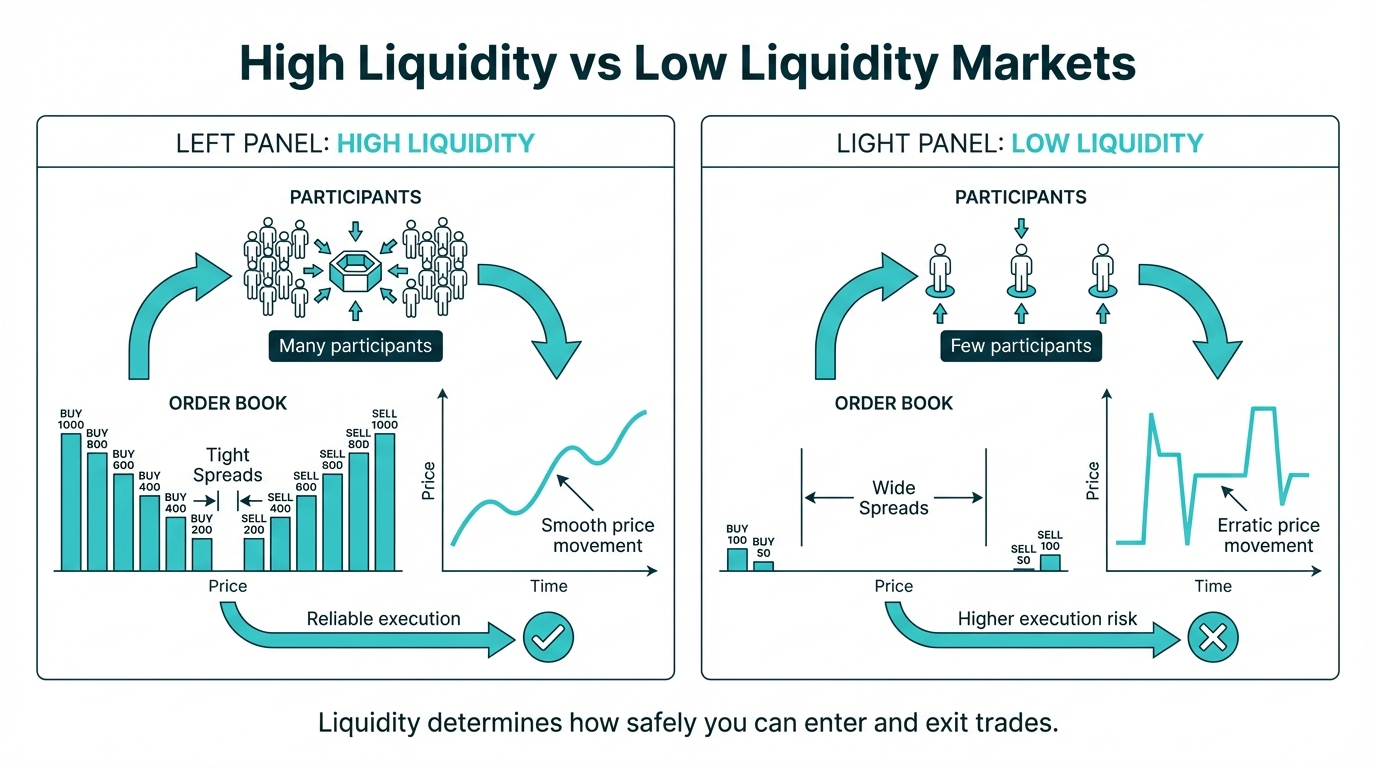
Liquidity is one of the most important concepts in financial markets, yet it is often misunderstood by beginners.
Beginner traders often overlook how liquidity in the market may affect the process of order execution when they concentrate on technical indicators and the strategy of entry into the trade.
The factors like bid-ask spreads, slippage, transaction fees, and even entering/exiting a trade may be affected by liquidity. But even high levels of liquidity cannot ensure good execution or save traders from losses.
Learning about liquidity will enable beginners to make an assessment of market situation and identify certain dangers.
This idea is straight up linked to the basics of Financial Market Foundations, where liquidity is a key player in price movement.
What Is Liquidity in Simple Terms?
Liquidity is the ease with which an asset can be purchased or sold without having a significant effect on its price in the marketplace.
In a very liquid market, there tend to be enough buyers and sellers to ensure that the transaction can take place without much effect on price.
In an illiquid market, it might be more challenging to execute the order or accept a less attractive price.
Liquidity may affect spreads, slippage, and execution.
It is important to understand that even in a very liquid market, prices can move significantly, and the risk of losing money cannot be avoided.
The Two Main Types of Liquidity
It is found in both markets for trading and in the balance sheet of finance. While the liquidity in markets is mostly emphasized by the traders, it is important for both.
Market Liquidity
Liquidity in the market is a measure of how easy it is to trade financial instruments without impacting their prices. Liquidity in the market tends to involve a lot of trading volume and tight bid/ask spreads.
However, the level of liquidity depends on the instrument, the order size, the time of day or session, and the market conditions.
Major currency pairs and shares of companies with high trading volume may have a lot of liquidity under normal trading conditions.
There will be low liquidity in smaller instruments that have few transactions. Liquidity may affect the spread and slippage in the market as well as the execution prices.
This may occur even in markets with high levels of liquidity when there are high volatility levels in the market. These trade mechanics are further explained in Trade Mechanics & Execution Basics.
Accounting Liquidity
Definition of accounting liquidity. This is the capability of a business to honor its short-term financial obligations with the help of money and current assets.
This is usually done using financial ratios, which involve comparing resources and obligations payable within a relatively short duration.
The concept of accounting liquidity is important in relation to investors, financial analysts, and creditors assessing the financial status of a company.
If a company has poor accounting liquidity, it will have more problems honoring its short-term obligations.
However, having high accounting liquidity does not necessarily imply financial stability, profitability, or stock prices that do not fluctuate.
Common Measures of Accounting Liquidity
Financial experts examine a range of ratios to gauge a company's ability to cover its short-term debt, providing a clearer picture of its financial health.
Current Ratio
The current ratio compares short-term assets that can be quickly converted to cash to short-term liabilities. A higher ratio usually indicates a company's finances are solid, but a lower one could indicate they're under financial strain.
Quick Ratio
The quick ratio excludes items such as inventory and focuses only on assets that can be converted to cash quickly. This offers a more cautious way to gauge liquidity when the economy is shaky.
Cash Ratio
The cash ratio focuses on the most immediately available financial resources.
Cash Ratio = (Cash + Cash Equivalents) ÷ Current Liabilities
It provides a conservative measure of short-term liquidity but does not, on its own, establish a company's overall financial health.
These ratios are most useful when considered alongside other financial information and industry conditions.
How Liquidity Is Created in Financial Markets
The liquidity of a market relies on the availability of buyers and sellers that would be ready to trade financial assets at different prices.
Buyers, sellers, market makers and other sources of liquidity may add orders and quotes to the market.
If there is enough liquidity available close to the market price, then trades may be completed without much price impact.
With the decrease of available liquidity, large orders have to be executed at several price points which leads to price movements.
The liquidity of the market can fluctuate during the course of the trading session and can be influenced by economic news, market volatility and participant behavior.
Market makers and financial institutions are able to provide liquidity, but not guarantee stable prices and execution.
Liquidity providers and institutions are key players in maintaining market stability, as detailed in Who Really Moves the Stock Markets?
High Liquidity vs Low Liquidity Markets
Transaction costs may be affected by liquidity, along with the efficiency and impact of the trade.
High Liquidity Conditions
The highly liquid markets tend to have high volumes of trading and tight bid-ask spreads.
It may become easy for orders to be executed without causing price impact, provided there is enough liquidity available at those prices. This does not mean that orders will face difficulties only because of market volatility. The high liquidity does not remove the risk of investing.
Low Liquidity Conditions
In markets with low liquidity, the number of orders to buy and sell may be restricted. This may lead to larger bid-ask spreads, higher slippage and also larger price impact from executing the orders.
This situation may make it harder to trade in and out of positions at anticipated prices. Liquidity is just one of many factors that affect trading performance.
Liquidity in Forex Trading
The foreign exchange market is amongst the largest financial markets in the world in terms of trading volume.
It is important to note that liquidity may differ from one pair of currencies to another, as well as according to different times of trading. Trading volumes in major currency pairs can be very high especially during the time when financial centers are operating.
Notably, less traded currency pairs may feature bigger spreads and limited liquidity.
This liquidity may vary depending on economic releases and during other instances such as market opening and low volumes of trading.
Knowledge of this information will assist traders to gauge their transaction costs and execution risks.
Traders can make use of trading simulators where they can trade using imaginary money.
Liquidity, Spreads, and Volatility
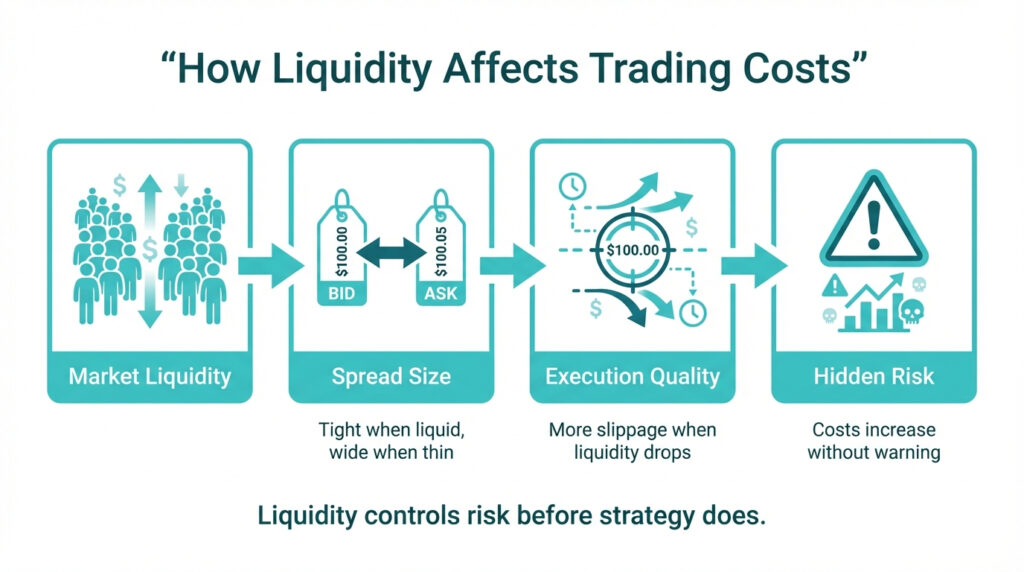
Liquidity affects transaction costs and price dynamics caused by transactions.
When there is a high amount of liquidity, transactions can be executed with little price impact.
With decreased liquidity, bid-ask spreads tend to be widened and large transactions have an even higher price impact.
When there are important economic reports, liquidity suppliers will change the terms of their quotations due to heightened risks on the market.
Thus, traders might face widened bid-ask spreads, slippage or price volatility.
It should be noted that liquidity and volatility are not the same things. It means that even if there is a lot of liquidity on the market, there can still be a high level of volatility.
This exec relationship is pretty much linked to the stuff you'd find in the Market Orders vs Limit Orders
Common Beginner Mistakes About Market Liquidity

Beginners may overlook liquidity when evaluating financial instruments or planning trades.
Common mistakes include:
- Ignoring bid-ask spreads and transaction costs.
- Trading less liquid instruments without understanding execution risks.
- Assuming every order will execute at the displayed market price.
- Overlooking changes in liquidity around economic announcements.
- Confusing high trading volume with guaranteed liquidity.
- Using position sizes that are inappropriate for available market depth.
These mistakes can increase trading costs or contribute to unexpected execution outcomes.
However, financial losses can also result from adverse price movements, leverage and other risks unrelated to liquidity.
Understanding liquidity can help beginners make more informed decisions, but it does not guarantee consistent trading performance.
Why Professional Traders Prioritize Liquidity
Market professionals typically take into account the issue of liquidity while analyzing financial assets and making deals.
The level of liquidity may affect the costs of trade, the effect of size on price, and the opportunity to change one's position.
In case of liquid markets, transactions might be performed with relatively small price effect. If markets are not that liquid, large transactions may need more time or less favorable prices. But market professionals employ other tactics and operate in both types of markets. Liquidity is only one aspect of risk analysis, which cannot ensure success.
Conclusion: Why Liquidity Matters in Financial Markets
Liquidity is an essential quality of financial markets since it determines the level of ease at which financial assets can be traded.
Liquidity could have an impact on bid-ask spreads, slippage, trading costs, and order execution prices. Acquiring knowledge about liquidity will help beginners to assess the market environment and identify some of the risks involved in conducting trades.
Nevertheless, liquidity cannot reduce volatility, protect against financial losses, or ensure good order execution. It is, therefore, an important aspect for beginners to learn about when it comes to financial literacy.








