


Understanding what financial markets are is an important starting point for anyone interested in trading or investing.
Financial markets connect buyers and sellers of financial products such as stocks, currencies, bonds and commodities.
These markets are used for the facilitation of deals, price discovery and the ability to hedge financial risks.
In case you are a beginner, learning about financial markets will help you understand reasons for price fluctuations, differences between asset classes and impacts of market environment on investments.
This guide examines major types of financial markets, factors affecting prices, financial risk management and significance of financial education prior to engaging in live trading.
However, having financial knowledge does not mean that uncertainty disappears or profitable results will be achieved.
What Are Financial Markets
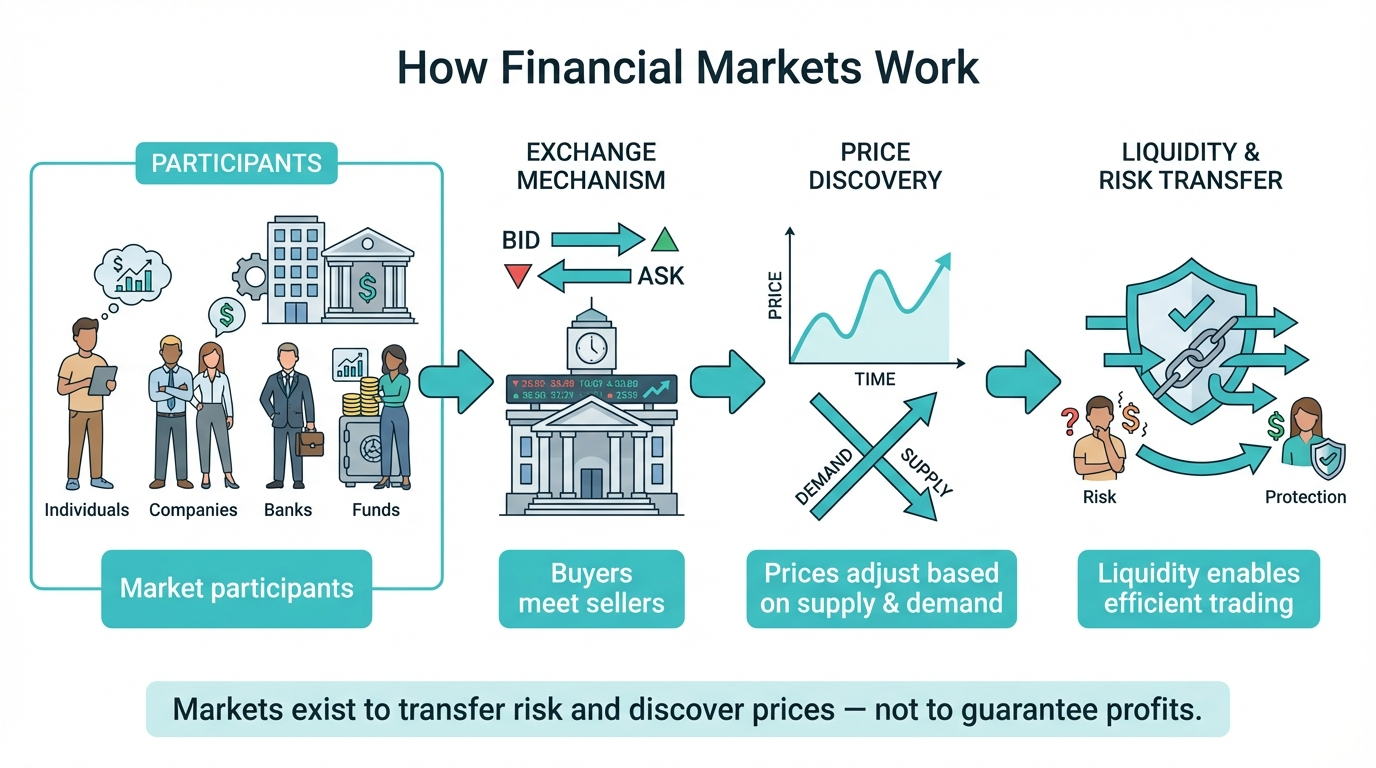
Financial markets are systems where participants trade financial securities such as stocks, bonds, currencies, and commodities.
Depending on the nature of the markets, transactions could be executed through exchanges, electronic trading systems, and over-the-counter dealings.
Some of the roles played by financial markets include transactional facilitation, price discovery, provision of liquidity, and financial risk transfer.
Prices arise from the interaction of the buyers and sellers depending on the liquidity, economic information, and expectations of the markets.
While markets assist in creating prices, the prices created do not reflect the fair or fundamental value of an asset.
The Purpose of Financial Markets
Price discovery: Buying and selling activity helps establish prices at which market participants are willing to transact.
Liquidity: Financial markets may make it easier to buy or sell assets, although liquidity varies between instruments and market conditions.
Risk transfer: Participants can use financial instruments to manage or transfer certain risks. Other participants may take on those risks for investment or speculative purposes.
Capital allocation: Some financial markets help businesses and governments raise funding through the issuance of shares and debt securities.
For further information about how financial markets and investing work, the U.S. Securities and Exchange Commission (SEC) provides educational resources covering investment fundamentals, financial risks and investor protection.
Main Types of Financial Markets Beginners Should Know
Financial markets have different structures in terms of instruments, participants, market hours, liquidity, and riskiness.
This knowledge may help newcomers to understand how certain markets function and whether these markets suit their investment strategies and risk appetites.
Below are described some of the most important financial markets.
Forex Market (Foreign Exchange)
The forex market or simply "Forex" is where the buying and selling of foreign currencies takes place.
These currencies are quoted in pairs like EUR/USD and GBP/JPY, denoting the value of one currency in relation to the other.
Forex is the largest financial market in terms of transaction volume in the world and trades using a worldwide network of financial organizations and individuals.
Standard forex trading usually occurs 24 hours a day for 5 days a week, but actual hours vary depending on the financial instrument and the forex broker.
Interest rate changes, inflation, economic events, and expectations of central banks and others affect exchange rates.
Even though the forex markets may be liquid, there is always financial risk in trading, especially when leverage is involved.
To understand how different markets operate structurally, check out Asset Classes Explained with this lesson. Forex trading isn't about guessing every single move. Managing risk in a world full of uncertainties
Stock Market
The stock market provides opportunities for buying and selling stocks.
Having a stock means you have a stake in the business, even though the rights that come with stocks may differ.
There is usually a reaction to a stock price depending on a company’s income, performance, events in the industry, the economy, and investor expectations.
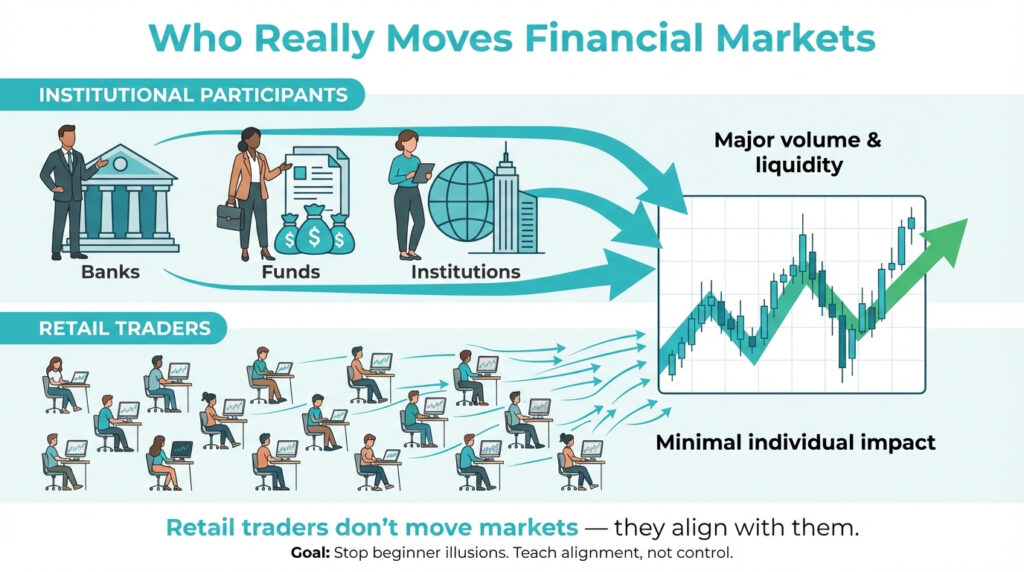
Investors might keep stocks for their long-term goals or trade stocks frequently. Nevertheless, there is the risk of losing money through either approach. The article Who Really Moves the Stock Markets? provides a clear explanation of who is actually driving stock prices.
Commodities Market
Commodity markets deal with raw materials and basic products, such as gold, silver, oil, gas, and agricultural commodities.
The price levels can be affected by supply and demand factors, production issues, geopolitical events, climatic changes, and macroeconomic expectations. Gold is often used for diversification or risk avoidance by investors.
Nevertheless, there can be significant fluctuations in the price of gold, as well as no guarantee that it would save the money from losing. In order to trade in commodity prices, participants can use physical or financial methods.
Indices and Cryptocurrency Markets
Financial indices serve as indicators of the selected set of securities or market instruments performance.
Thus, a stock market index may be focused on a certain group of publicly traded firms.
Even though indices are able to give some information regarding market performance, they cannot reflect the economic situation in its entirety.
Cryptocurrency markets are based on digital assets that may suffer from high levels of volatility, liquidity issues, and changing regulations.
Those who want to start trading have to learn about financial instruments features, costs, and risks.
How Financial Markets Actually Move
Market prices fluctuate in accordance with demand and supply forces in connection with the liquidity.
Participants can change their choices depending on economic releases, interest rate fluctuations, company performance, geo-political events, and expectations.
For instance, a statement of the central bank will impact the price of currency as long as expectations regarding future interest rates change. At the same time, the reaction of the market is dependent on how much information was expected and current trading situation.
The price chart shows past price movement but does not disclose all the factors that cause such movements and does not predict future results. This knowledge can assist a beginner in understanding the market action.
If you're looking for a clearer understanding of the structure, tie this lesson up with a primer on Financial Market Foundations. Grasping this clears up the emotional mess and swaps it with how we act.
Common Reasons Beginners Experience Trading Losses

Trading losses arise due to adverse market movement, leverage, costs associated with transactions, and lack of experience and bad risk management choices.
Novices will likely overlook how fast exposure can be changing under volatile market conditions.
Typical trading errors include:
- Trading without understanding the financial instrument.
- Using excessive leverage or inappropriate position sizes.
- Ignoring transaction costs and execution risks.
- Reacting impulsively to short-term market movements.
- Relying on unverified trading signals or unrealistic profit expectations.
But losses do not happen because of behavior alone. Sometimes well-thought-out trading choices bring about unfavorable results.
If you recognise these patterns, review Why Traders Fail? and reinforce your base with Beginner Survival Rules before progressing. Losses are often behavioural, not technical.
The Role of Risk Management in Trading
Risk management entails the identification and management of risks that have the possibility of causing financial loss.
This is achieved through an analysis of risk in terms of trade sizes, leverage, trade expenses, volatility, and exit plans for active traders.
Although stop-loss orders can be used to control trades, these orders are not guaranteed to be filled at the price at which the stop loss order was set. This could lead to losses greater than initially expected due to market gaps and slippages.
Learn the fundamentals of risk management by reading Take Profit & Stop Loss Explained. Risk management transforms trading from speculation into process control.
Understanding the Difference Between Trading and Investing
Both trading and investments are financial activities, but there can be different approaches toward them and goals that people try to achieve.
Investments usually presuppose keeping financial assets to get some results, for example, increasing capital and earning money.
Trading is the process of buying and selling financial tools in a rather short period of time; however, there are different ways to trade.
These activities do not provide any guarantee of success and have financial risks.
In addition, trading might include many operations and even leverage.
Both need learning. Trading requires you to be mentally tough and to have a solid plan for managing risk. To get a clearer picture of the mental side of trading, check out Trading Psychology Explained.
A Structured Path to Learning Financial Markets
Beginners can approach financial education through a gradual learning process.
- Understand financial markets: Learn about different asset classes, market participants and the factors influencing prices.
- Explore trading mechanics: Understand order types, spreads, liquidity and execution conditions through Trade Mechanics & Execution Basics.
- Learn risk management: Consider position sizing, leverage, potential losses and the limitations of protective orders.
- Practise in simulated environments: Demo trading may help users explore platform features and order placement without risking real trading capital.
- Evaluate personal suitability: Consider financial circumstances, objectives, risk tolerance and whether live trading is appropriate.
Why Financial Education Matters Before Trading
Educational finance could enable new traders to comprehend how market systems work, what kinds of financial instruments there are, and what risks trading involves.
Understanding volatility, leverage, execution, and cost factors could aid in building realistic expectations. Nonetheless, education cannot eliminate financial risks in trading or ensure profitable trading outcomes.
It is necessary to take into account one’s financial state, goals, and risk tolerance. You can dive into structured learning at the VARIANSE academy and try it out with a demo account before you drop any cash.
Conclusion: Understanding Financial Markets Starts With Education
Financial markets offer mechanisms where people trade financial instruments, identify prices, and manage some financial risks.
An insight into financial markets – their functioning and reason for price fluctuations – would enable the novice trader to gain a better perspective about trading and investing.
Market structure, financial instruments, risk management, and trading costs are essential components of financial education.
But uncertainty prevails in the market, and there is no certainty about successful investment and trading outcomes despite any kind of preparation.
The first thing for a novice to do is to have knowledge of fundamentals, know about risks, and make financial decisions suitable for their situation.








