


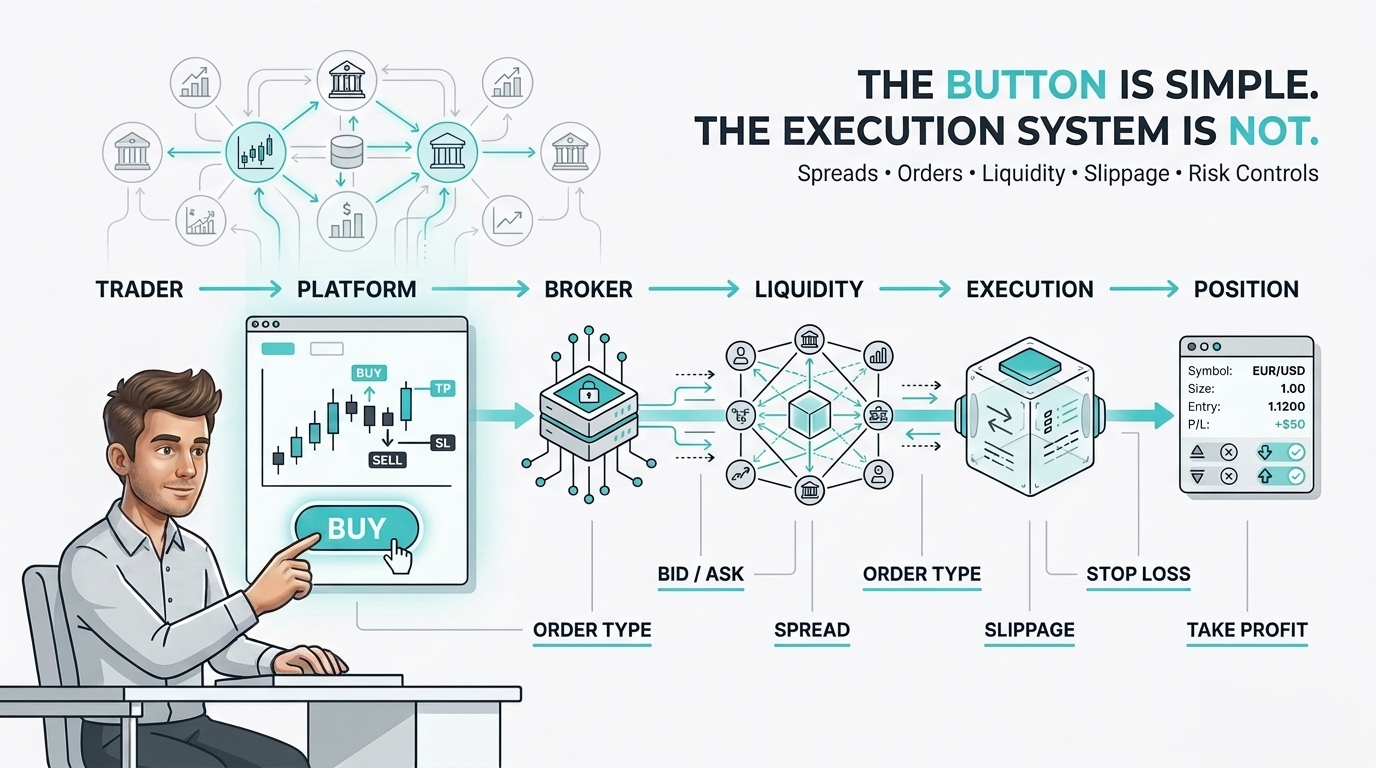
Understanding trade mechanics and execution basics is essential for anyone learning how financial markets operate. A trading decision involves more than identifying a potential market opportunity. Order types, bid–ask spreads, liquidity, slippage and execution conditions can all influence the final outcome of a trade.
Even a well-planned trading strategy can produce unexpected results when execution costs or market conditions are overlooked.
This lesson explains how orders are placed and executed, what influences trading costs and why understanding execution risk is an important part of trading education.
What Are Trade Mechanics & Execution Basics
Trade mechanics describe the processes involved in opening, managing and closing trading positions. Trade execution refers to how an order is processed and, when possible, filled at an available market price.
Several factors can influence execution, including order type, market liquidity, bid–ask spreads, volatility and the trading platform's execution arrangements.
Understanding these factors helps beginners recognise why the price requested when placing an order may differ from the final execution price.
In real life, most execution results are actually tied to liquidity, spreads, and how orders are placed- ideas we talked about in 🔗 What Is Liquidity?
Why Execution Knowledge Matters More Than Most Strategies?
Sometimes a plan looks great on paper, but how you put it into action is what really counts for your money. Even tiny changes in the cost of entry, the gap between buy and sell prices, or the slippage can really mess with your results in the long run.
Execution knowledge allows traders to:
- Understand real trading costs.
- Avoid unexpected fills and losses.
- Improve consistency
- Reduce emotional reactions to execution outcomes.
One of the main points made in Why Traders Fail? is that sloppy trading and not having a solid plan are big factors in why traders start with losses
Execution discipline protects both capital and confidence.
Bid, Ask and Spread: Understanding Trading Costs
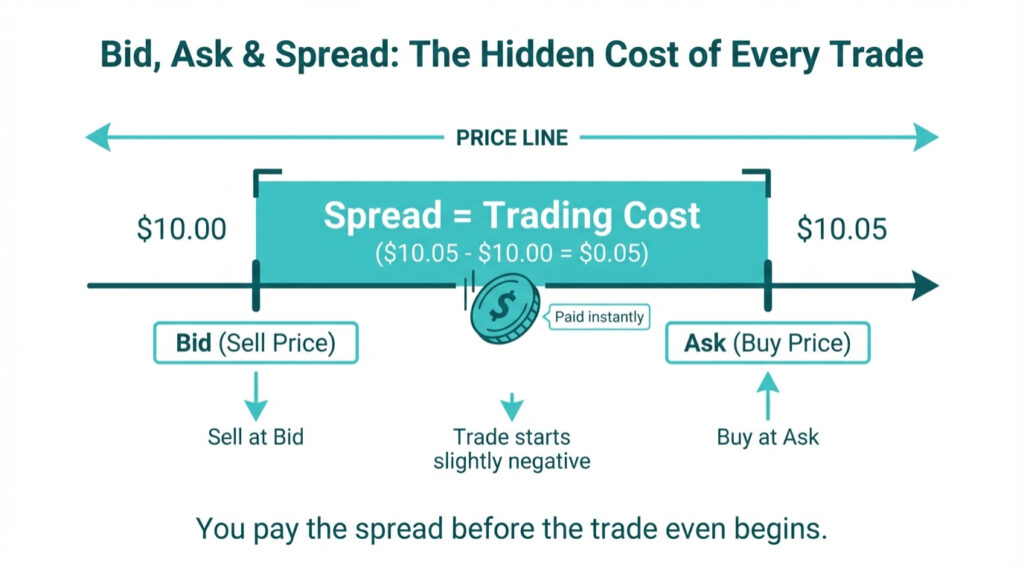
Financial instruments commonly display two prices:
- Bid price: The price at which a trader can generally sell.
- Ask price: The price at which a trader can generally buy.
- Spread: The difference between the bid and ask prices.
For example, if an instrument has a bid price of 1.1000 and an ask price of 1.1002, the spread is 0.0002, or two pips for many currency pairs.
A position opened at the ask price and immediately valued against the bid price will generally show an initial unrealized loss reflecting the spread, before considering any additional fees.
Spreads can vary depending on liquidity, volatility and market conditions. Commissions and other trading charges may also apply.
Understanding these costs helps traders assess the potential impact of execution on their results.
This relationship is spelt out in Bid-Ask Spread Explained where it's clear that the spread is both a cost and a hint at what's happening in the market. Understanding spread prevents unrealistic expectations about entry precision.
Stop-Loss and Take-Profit Orders: Managing Trading Risk
Stop-loss and take-profit orders allow traders to define potential exit conditions in advance.
A stop-loss order is designed to close or reduce a position when a specified price level is reached or crossed, depending on the platform and order rules.
A take-profit order is designed to close a position when a specified profit target is reached.
However, standard stop-loss orders do not guarantee execution at the requested price. During periods of volatility or low liquidity, an order may execute at a different price because of slippage.
Take-profit orders are also subject to the applicable execution conditions.
These tools can support a structured risk management approach, but they cannot eliminate trading risk.
This process is thoroughly covered in Take Profit & Stop Loss Explained, where determining when to exit a trade is part of the overall trade planning strategy.
Order Types: Market Orders vs Limit Orders
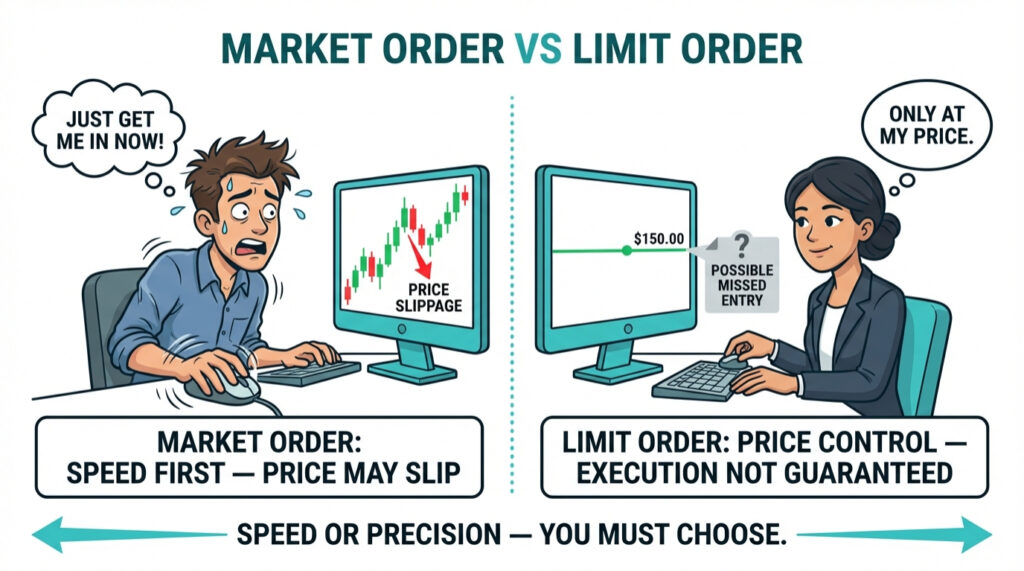
Different order types allow traders to prioritise execution speed or price conditions.
Market Orders – Immediate Execution
A market order requests execution at the best available price under the platform's execution arrangements.
Market orders generally prioritise prompt execution rather than a specific price.
However, the final execution price may differ from the price displayed when the order was submitted, particularly during volatile or low-liquidity conditions. Execution is not guaranteed in every circumstance.
Limit Orders – Price Precision
A limit order allows traders to specify the price at which they are willing to buy or sell.
- A buy limit order can execute at the specified limit price or lower.
- A sell limit order can execute at the specified limit price or higher.
Limit orders provide greater control over acceptable execution prices, but they may remain unfilled if the required conditions are not met or sufficient liquidity is unavailable.
Neither order type guarantees a profitable trading outcome.
In the article Market Orders vs Limit Orders: What’s the Difference?, traders figure out when to use each kind of order
Choosing the correct order type improves execution quality.
Slippage, Market Gaps, and Execution Risk
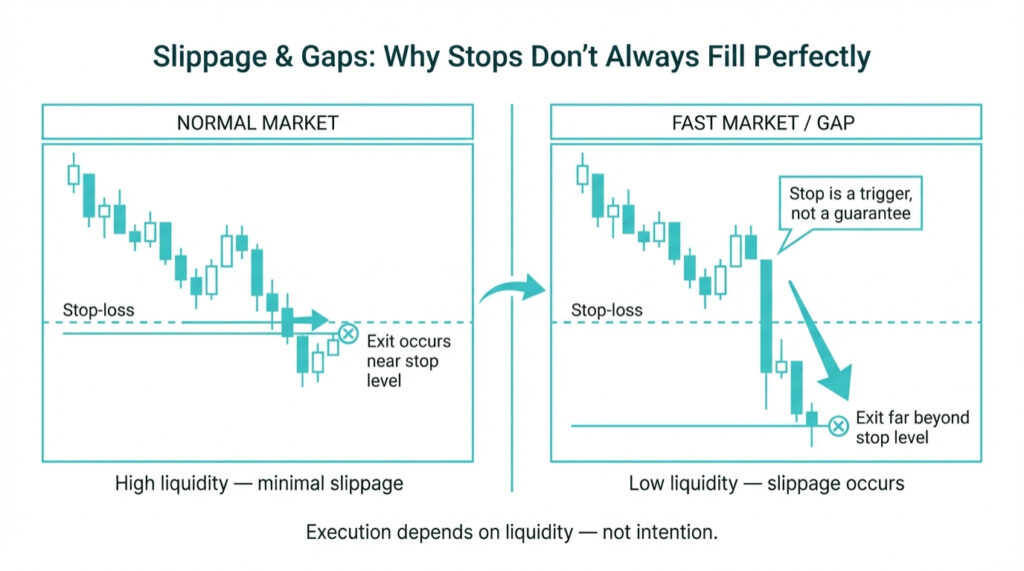
Slippage occurs when an order executes at a price different from the price expected when the order was submitted.
This difference can be favourable or unfavourable, depending on market movements and execution conditions.
Market gaps occur when prices move between levels without trading or quoting at every intermediate price.
They may arise around major economic announcements, market openings or periods of limited liquidity.
These conditions can affect order execution, particularly when traders use market orders or stop-loss orders.
Understanding slippage and market gaps helps beginners recognise that placing an order does not guarantee execution at a particular price.
The Full Trade Lifecycle
Plan → Execute → Manage → Exit
Professional trading has a well-organised lifecycle. A trade involves more than just entering the market; it encompasses the entire process.
This process includes:
- Market preparation
- Trade planning
- Risk definition
- Execution
- Trade management
- Exit
- Post-trade review
This organized process is laid out in Trade Lifecycle Explained: From Idea to Exit, where consistency replaces gut feelings.
Structure transforms trading into a repeatable process.
How Execution Components Work Together
Trade execution involves several connected factors.
Execution of a trade is made up of several interrelated elements.
Bid-offer spread is a contributing factor to transaction costs, whereas the order type chosen is what determines the circumstances under which an order gets executed.
Liquidity affects both the existence of buyers and sellers, their volume at various prices, as well as slippage.
A stop loss or take profit order can be used to determine exit points, whereas position size and leverage affect financial risk.
Practise Trade Execution Before Using Real Money
Trading in the demo account environment will allow novice traders to practice making trades, analyzing price action, and dealing with the trading positions in an environment free of risk.
It will also provide users with experience using the trading platform and getting acquainted with order types and general trading processes.
However, the environment created by the demo account might not simulate real-life trading conditions like the presence of liquidity, slippage, and loss of money.
You can safely practice trading with VARIANSE by using their VARIANSE trading account, which lets you get a feel for real market conditions without putting any of your own money on the line.
Conclusion: Trade Mechanics Turn Trading Into a Professional Skill
A working knowledge of trade mechanics and the basics of trade execution will allow new traders to comprehend how orders are made and fulfilled in the market.
Such things as order types, bid and ask spreads, liquidity, slippage, and risk management can all affect your trades.
It can be helpful to have knowledge of all of these things working together in the market when making trading decisions.
But having trade execution knowledge won't reduce any financial risk or ensure profits from trading.
Education and simulated trading will allow new traders to get a good understanding of trading before making the decision to actually do it.








