


The bid-ask spread is one of the fundamental trading costs beginners need to understand. Whenever a financial instrument has separate buying and selling prices, the difference between those prices can affect the cost of opening and closing a position.
Spreads can change with market liquidity, volatility and trading conditions. They can also influence short-term trading results, particularly when price movements are relatively small.
This lesson builds on Trade Mechanics & Execution Basics and explains how bid and ask prices work, how spreads are calculated and why they matter when evaluating trading costs and execution risk.
What's the Bid-Ask Spread?
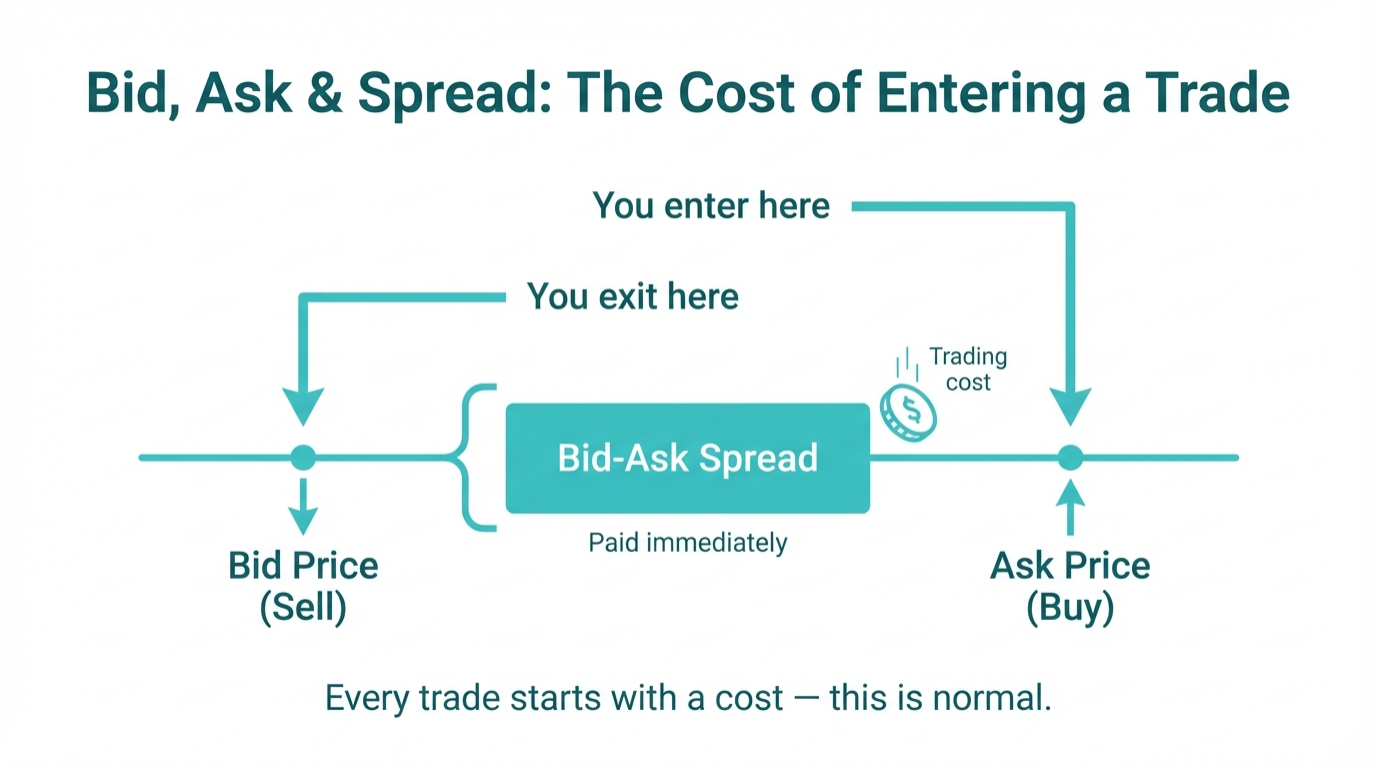
The bid-ask spread is the difference between the quoted bid price and ask price of a financial instrument.
The bid price is generally the price at which a trader can sell, while the ask price is generally the price at which a trader can buy.
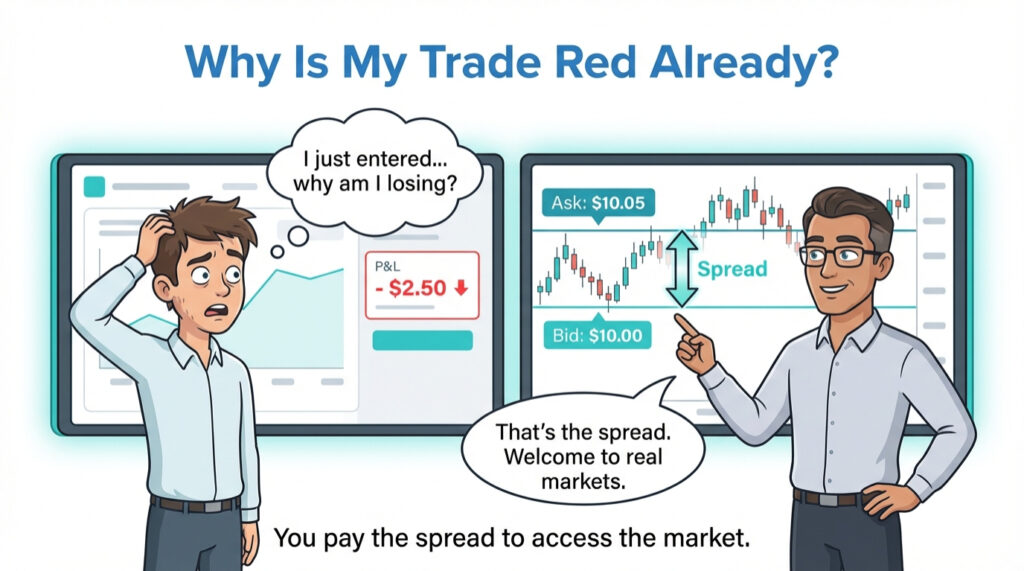
Because the ask price is normally higher than the bid price, a newly opened position may show an initial unrealised loss reflecting the spread, assuming it is immediately valued at the price available for closing.
This does not mean the market has moved against the trader. It reflects the difference between the buying and selling prices.
Bid Price and Ask Price in Practice
The bid and ask prices represent two sides of a quoted market.
- Bid: The price at which a trader can generally sell.
- Ask: The price at which a trader can generally buy.
- Spread: The difference between the ask and bid prices.
A narrower spread generally indicates lower immediate transaction costs, although it does not guarantee strong liquidity or favourable execution.
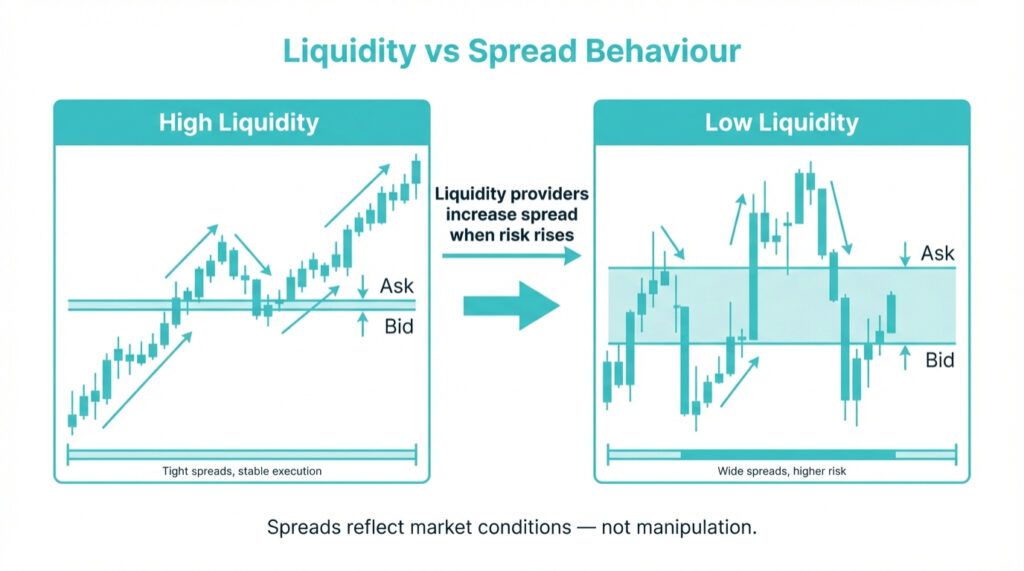
A wider spread may reflect reduced liquidity, increased volatility, market uncertainty or other pricing factors.
When prices are really close together, the market's more liquid and efficient. Wider gaps typically indicate lower liquidity or higher uncertainty, concepts explained in What Is Liquidity?
Spread size reflects market conditions in real time.
How the Bid-Ask Spread Is Calculated
The bid-ask spread is calculated by subtracting the bid price from the ask price.
Basic Bid-Ask Spread Formula
Bid-Ask Spread = Ask Price − Bid Price
For example, suppose EUR/USD is quoted at:
- Bid price: 1.1000
- Ask price: 1.1002
- Spread: 0.0002, or 2 pips
A trader opening a long position at 1.1002 would initially need the bid price to rise from 1.1000 to 1.1002 to close at the entry price, assuming the position can be closed at that quote.
This represents a 2-pip movement in the bid price.
However, reaching the entry price does not necessarily mean the overall trade breaks even, because commissions and other applicable costs may also need to be covered.
The same principle applies to short positions, although the relevant entry and closing prices are reversed.
This calculation directly affects reward-to-risk planning, which we'll dive into in Take Profit & Stop Loss Explained. Make sure to think about the costs of executing a trade before you jump in.
Why Real Trading Costs Can Differ From the Quoted Spread
The quoted bid-ask spread is only one component of trading costs.
The final cost of a transaction may also depend on commissions, financing charges, slippage and the available liquidity when an order is executed.
During volatile market conditions, bid and ask prices may change rapidly. As a result, the price available when an order is filled may differ from the price displayed when it was submitted.
Order types also affect execution.
Market orders generally prioritise prompt execution at available prices, while limit orders establish an acceptable price boundary but may remain unfilled.
The kind of order you choose can change how it's carried out. Market orders are all about getting things done fast, and limit orders are all about nailing the exact price, just like the article Market Orders vs Limit Orders: What’s the Difference?
Execution always depends on real-time market conditions.
Bid-Ask Spread as a Measure of Liquidity
The bid-ask spread can provide useful information about market liquidity.
When buyers and sellers are actively competing to trade, spreads may become narrower.
During periods of reduced trading activity, increased volatility or uncertainty, spreads may widen as liquidity providers adjust their quotes.
However, the spread alone does not provide a complete picture of liquidity.
Market depth, available trading volume and the potential price impact of larger orders are also important considerations.
A narrow spread does not necessarily guarantee that a large order can be executed without slippage.
Supply, Demand, and Spread Behavior
Some people want things done right away, while others are there to ensure everything flows smoothly.
Price Takers vs Liquidity Providers
Market participants can play different roles in the trading process.
Price takers seek to execute against available prices, often using marketable orders.
Liquidity providers, including market makers, may continuously quote buying and selling prices to facilitate trading.
Liquidity providers face risks such as adverse price movements, inventory exposure and uncertainty about future market conditions.
During volatile periods, they may widen quoted spreads to compensate for increased risk.
These adjustments can contribute to higher transaction costs, although pricing also depends on competition, market structure and the trading provider's arrangements.
How Volatility Influences the Bid-Ask Spread
Both volatility and spreads usually increase together. Fast price movements bring an increase in execution risks, which cause a spread increase.
Such things generally occur when significant economic news is announced, the stock exchange opens, or when anything extraordinary takes place in the world.
Grasping how volatile markets behave is a key topic in Financial Market Foundations. Timing directly affects execution cost.
Bid-Ask Spread Differences Across Asset Classes
Asset types act differently when it comes to spreads since liquidity isn't the same everywhere.
Major Forex pairs typically have tight spreads due to the steady involvement of major financial institutions. Stocks might have larger price differences based on a company's size and trading volume. Commodities and crypto might see bigger price swings when things get shaky. These differences show the structural traits outlined in Asset Classes Explained. Market selection affects execution quality.
The Role of Market Makers in Spread Formation
Market makers and liquidity providers invigorate the market with continuous buy and sell orders, facilitating traders' ability to place orders promptly.
They take on the risk of inventory and the chance of prices swinging quickly. To handle that risk, they tweak spreads depending on how easy it is to trade, how much the market's moving, and the flow of orders.
This liquidity provision is just one piece of the bigger picture discussed in Who Really Moves the Stock Markets?. The essential fact every trader should grasp is that institutions and liquidity providers are key to keeping the market running smoothly.
Without liquidity providers, execution would be unreliable.
Bid-Ask Spread and Trading Risk
Spreads directly impact trade risk, position sizing, and stop-loss placement. If spreads widen unexpectedly, stop-loss orders might come in sooner than we thought. Neglecting the spread cost can disrupt reward-to-risk ratios. Professional traders always evaluate spreads before entering trades.
You can observe reality. Make sure to spread your trading time safely by checking out the VARIANSE trading account page before you start trading with your actual money. Practice reduces execution surprises.
Common Spread-Related Mistakes Beginners Make
Beginners may overlook the bid-ask spread when evaluating trading opportunities.
Common mistakes include:
- Entering into trades without reviewing the current spread.
- Neglecting how spreads tend to increase in volatile market conditions.
- Implementing short-term strategies without considering the costs associated with them.
- Believing that having a low spread ensures good execution.
- Neglecting to factor in commission charges and other trading fees.
- Failing to take spreads into account when setting stop loss and take profit orders.
Understanding these factors can help beginners develop more realistic expectations about trading costs and execution.
These errors are often tied to a misunderstanding of execution, which is one of the key reasons traders tend to lose money, as discussed in Why Traders Fail? Execution awareness protects capital.
How to Make More Informed Decisions With Spread Awareness
Spreads form a crucial component in analyzing trading costs.
Prior to executing a trade, beginners should look at the existing bid and ask prices, liquidity of the market and the effects of the spread on their gains or losses.
They also need to know that spreads vary during economic releases, market opening hours and times when markets are volatile.
The comparison of spreads against other costs, such as commissions and financing costs, gives a better picture of the costs involved.
Conclusion: Why Understanding the Bid-Ask Spread Matters
The bid-ask spread is defined as the difference between the buying and selling price of a financial asset.
It forms an integral part of trading costs and gives us useful information about market liquidity and volatility.
A proper knowledge of how to calculate spreads and how changes in spreads affect other costs will help the beginner traders in making better trading decisions.
Nevertheless, spread knowledge alone cannot reduce execution risk, prevent losses or guarantee profit in any trade.
Knowledge of bid and ask prices is vital for making rational trading decisions








