


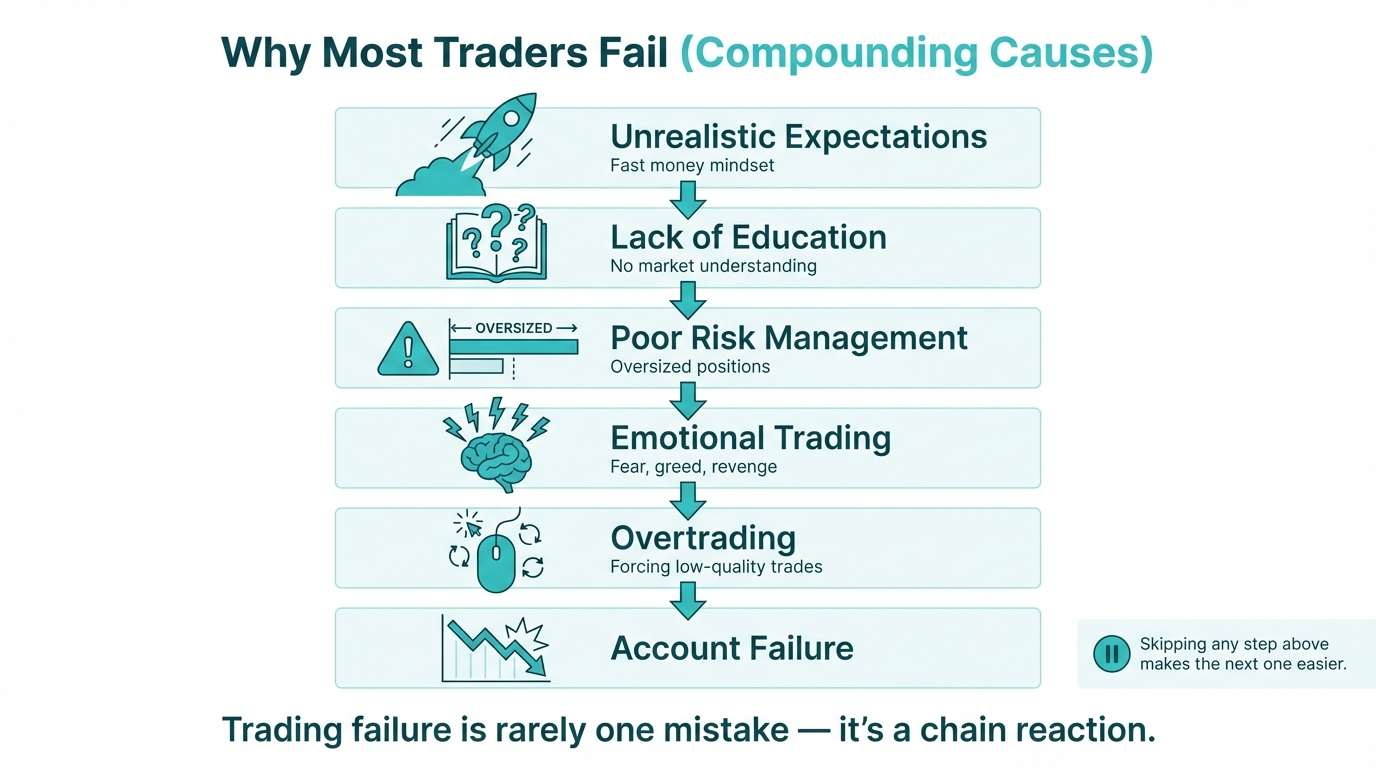
Have you ever wondered why traders fail in trading, even after spending time learning strategies and analysing financial markets?
A loss during trades may arise due to various reasons, which include market fluctuations, use of leverage, unreasonable expectations, lack of risk management, and poor decision making.
Many beginners engage in the financial markets without comprehensively knowing what they are dealing with and the financial risks that come with such transactions.
Yet even the experienced traders who trade using well-laid-out strategies may incur losses since the end results cannot be known for sure.
Knowing the common trading mistakes helps the beginners identify their possible losses.
This lesson builds directly on Financial Market Foundations where understanding the environment is the first step toward survival.
The Hard Truth About Trading Failure
The trading losses are not always incurred due to one error.
They could be caused by a mix of market volatility, leverage, transaction fees, order execution environment, poor risk management, and decision-making in an environment of uncertainty.
Among beginners, there might be unreasonable expectations and ignorance of financial products involved in the trade.
It is necessary to understand the order execution, financial exposure, and trading strategies before engaging in live trading.
These execution realities are laid out in Trade Mechanics & Execution Basics, where even minor structural errors can lead to losses.
Understanding investment risk is an important part of making informed financial decisions. The Financial Conduct Authority (FCA) provides educational guidance about investment risks and returns, including the possibility of losing money.
Unrealistic Expectations About Trading
Unrealistic expectations can influence how beginners approach financial markets.
The “Quick Money” Illusion
Beginners who begin trading may have been swayed by certain claims, social media information or tales of making a lot of money through trading.
In all these cases, it is possible that the risks involved as well as the chance of losing money have not been properly explained. As trading does not go as expected, one might end up becoming frustrated and making impulsive decisions.
Such situations can cause one to trade more often than necessary, or even engage in improper position sizing. Financial literacy and setting proper expectations can assist beginners understand that trading carries certain uncertainties.
Lack of Education and Market Understanding
One major reason traders make mistakes is their lack of understanding of how the market works.
Trading Without Understanding the Market
Financial instruments vary in terms of their liquidity, volatility, transaction cost, trading time, and exposure to economic events. New investors who fail to understand these attributes can underestimate their risks or misinterpret the trading process.
Market liquidity, leverage, and price influences should be understood by beginners in the financial world. These foundations are laid out in the section What Is Liquidity? Education provides context. Without it, traders go with their gut instead of thinking things through
Structured learning resources like VARIANSE Academy's education page are great for traders to build up their essential skills before they start putting real money on the line.
Poor Risk Management
Poor risk management can wreck your trading account super fast, even if you've got a solid plan.
Risking Too Much, Too Soon
Beginners can put themselves at a huge risk of incurring huge losses by overleveraging their investments, putting too much money in single positions or ignoring any risks involved in trading.
Positions that are big can lead to huge losses especially if prices move contrary to the trade. Some of the risk management techniques used by traders may involve position sizing, leveraging and exiting positions.
Traders may use stop loss and take profit orders to exit from their trades; however, these orders cannot guarantee an execution of trades at the desired price. This is especially true during volatile markets or market gaps.
They break it down in Take Profit & Stop Loss Explained, showing you how to plan your exits before you jump in. Risk management doesn't eliminate losses, but it keeps them from becoming disasters.
How Emotions Affect Trading Psychology
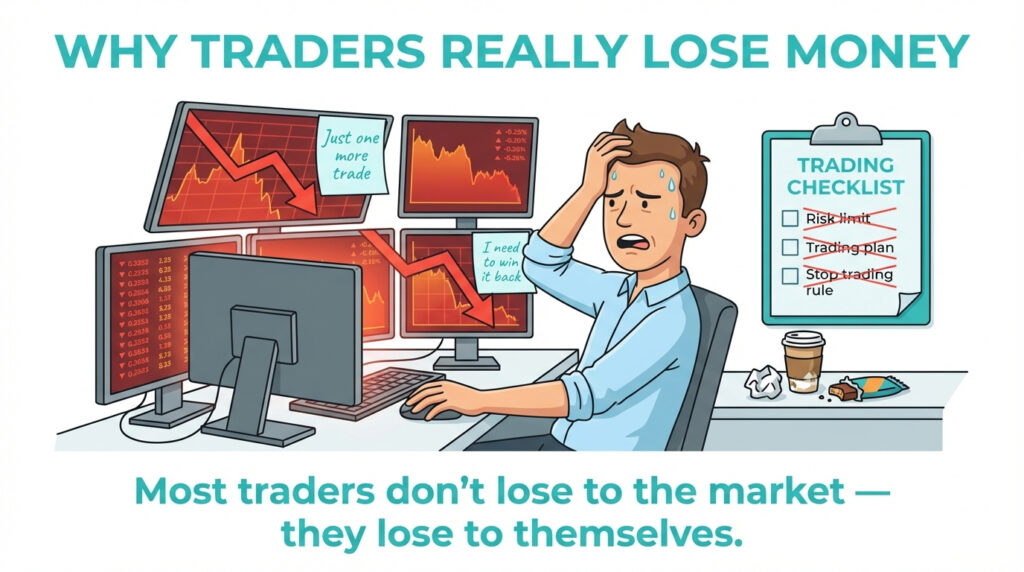
Psychology is often overlooked as a key factor in why trading doesn't go as planned.
Fear, Greed, and Revenge Trading
Fear may force traders to take profit early from trades, or make them think twice about what they would have normally done.
Greed and overconfidence may be factors behind taking too much risk, whereas frustration from losses may drive them to try and recover lost money through rash trades.
This type of behavior is known as revenge trading. But emotions cannot account for all losses in trading, nor will following a strategy ensure profits.
The knowledge of emotional involvement in trading may be helpful in making better judgments.
These emotional patterns are pretty typical for newbies, and you can dive deeper into how they mess with traders' heads in Trading Psychology Explained.
Professional traders don't just get rid of feelings; they create strategies to keep emotions from driving their choices.
Overtrading and Lack of Patience
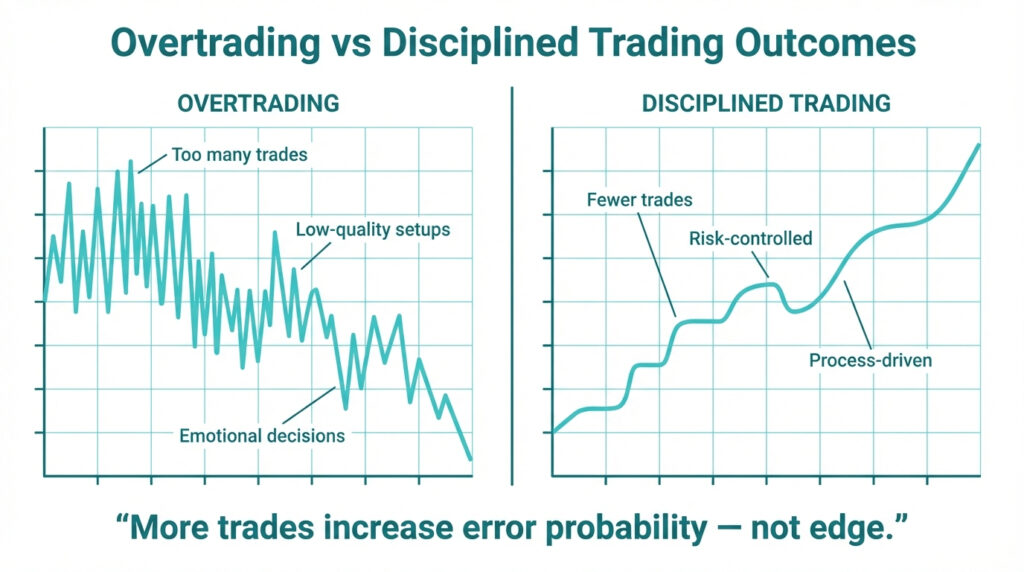
Overtrading occurs when an individual trades more frequently than is appropriate for their strategy, circumstances or risk tolerance.
Excessive trading can increase transaction costs, financial exposure and the likelihood of impulsive decisions.
Why Trading Too Often Can Increase Risk
Overtrading could possibly be brought about by boredom, overconfidence, frustration, or efforts to recoup prior losses.
While frequent trading is not necessarily wrong, trading without any purpose could lead to some unnecessary dangers.
The thoughtful way would be to examine if the intended trade is in line with previously set objectives and risk limits.. This topic is covered in the article Overtrading Explained. Patience protects capital.
No Trading Plan or Structured Process
Trading without a defined process can make it more difficult to evaluate decisions and manage financial exposure.
Trading Without Rules
The trading strategy may include the instruments involved in the trade, criteria for entering the trade and exiting it, position sizing, and the risk limit.
This process could assist in assessing the potential trade and reviewing the decisions taken. Nevertheless, an investment strategy may not necessarily yield profits even if it is consistent and systematic.
Sometimes, strategies should be reevaluated due to changes in market conditions or outdated assumptions on which the strategy was based.
This organized method is laid out in Trade Lifecycle Explained
Why Beginners May Face Additional Trading Challenges
Beginners may face additional difficulties because they are unfamiliar with trading platforms, market behaviour and the risks associated with financial instruments.
Experience Gaps and Capital Pressure
Insufficient experience may affect one’s ability to assess volatility, transaction costs, as well as the implications of using leverage.
Financial pressure can be another factor affecting decision-making, especially when people put money that they cannot afford to lose at stake.
Virtual trading platforms allow new traders to learn how to place orders and work with the platform with the help of fictitious funds. Demo trading, however, does not duplicate live-market execution, financial pressure, and emotional factors.
Training with fictitious funds does not guarantee preparation for live trading and future performance. There is no necessity to go from demo trading to real money trading.
Practising in a simulated setting lets traders hone their skills without the stress of real money on the line. You can safely try out execution and risk management using the VARIANSE trading account before you start trading with actual money.
Experience builds confidence gradually, not instantly.
What Experienced Traders May Do Differently
Experienced traders may use structured processes to evaluate market conditions, manage financial exposure and review their decisions.
Habits That Support More Considered Decisions
Examples include keeping trade records, analyzing position sizes, analyzing transaction costs, and reevaluating trading strategy in case of changes in the situation.
Some traders have pre-established limits to assist in managing their losses.
Nevertheless, even professional traders may make mistakes and incur considerable financial losses.
Risk management and decision-making should be taken into account, but none of them ensures trading profits.
They understand the process of determining the amount to bet and its level of risk, a skill that you can learn from resources such as Position Sizing Explained
Learning From Trading Losses
Trading losses may provide opportunities to review decisions, identify mistakes and reassess financial exposure.
Reviewing Decisions and Managing Risk
A trader can check whether the losses incurred were due to unfavorable market situation, transaction cost, too much leverage, or failure to make a decision based on the plan developed.
However, not all losses imply that a mistake is made. A trade carried out with great consideration can also end up incurring financial loss because of uncertainty in the results of the market.
In the same way, a profit does not always imply that the trade is properly made. An evaluation of trading activities can assist in gaining more knowledge, but will not assure future gains.
For some people, lowering trading frequency or not engaging in trading at all might be necessary due to their financial situation and risk appetite.
Conclusion: Why Traders Fail in Trading
The following reasons could cause losses during trading:
- losses due to unfavourable movements in the market;
- unrealistic expectations; lack of proper risk management; too much leverage used by traders.
Besides, beginners who are new to trading and do not know how to trade certain financial instruments will face further problems.
Financial literacy, strategic planning and risk management skills will enable people to make better decisions in evaluating possible losses. But, even experienced traders who use certain trading techniques will suffer from losses sometimes.
Knowing typical mistakes that people commit in trading is an essential component of financial literacy, but this doesn’t mean that people won’t face market uncertainties.








