
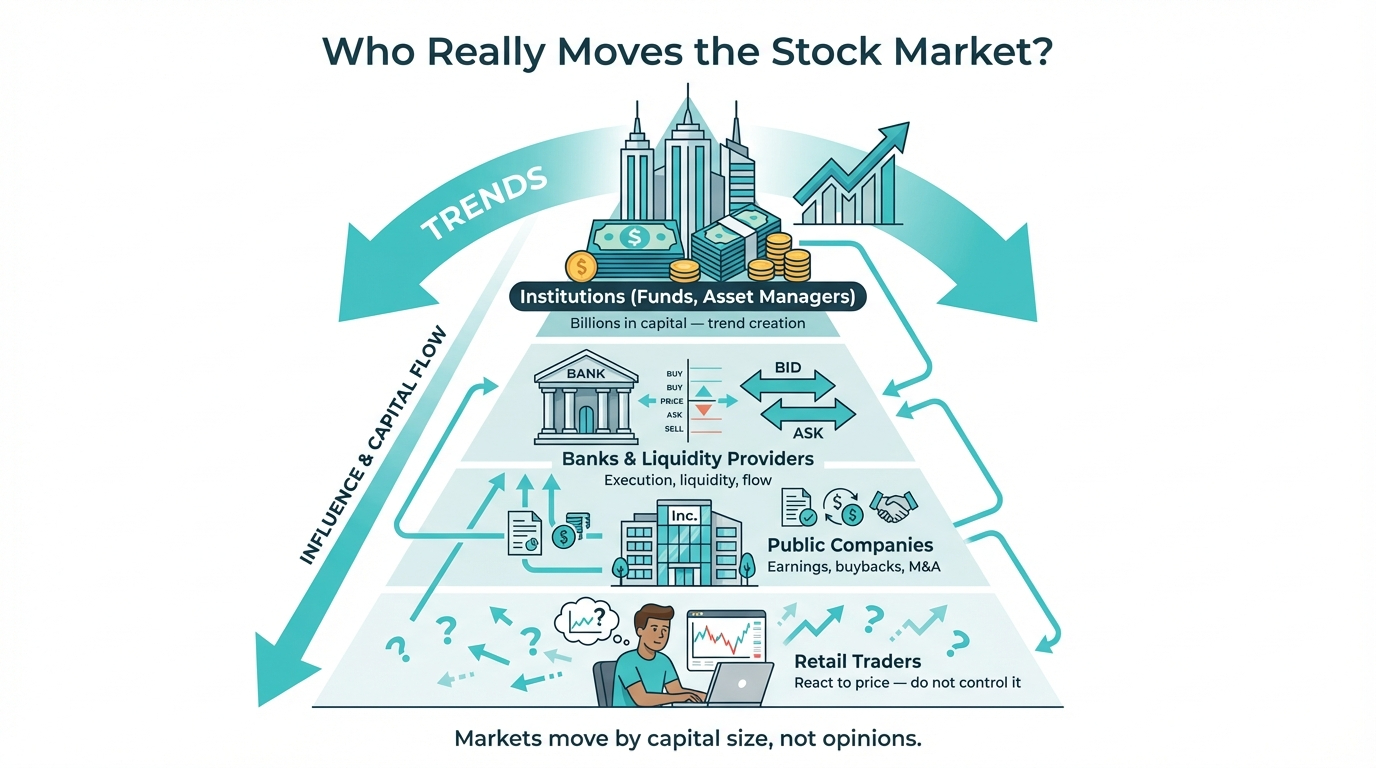
If you’ve ever wondered who moves the stock markets, you're asking one of the most crucial questions in trading. The stock market is affected by various players, including institutional investors, individual traders, banks, market makers and public companies.
Economic news, corporate news, liquidity and changing expectations of investors are factors that influence market prices.
While the big institutions do wield much power due to their volume of trades, no one entity dictates all market moves.
By having this knowledge at hand, newcomers will be better able to understand the complexities of price moves and appreciate the risks of trading.
Why Understanding Market Movers Matters for Beginners
Before getting into indicators or strategies, traders need to know who they're up against
Markets are not simply unexplored territories. Every move shows choices made by people with all sorts of resources, info, and time frames.
Newbies who overlook this fact can get all mixed up when things go backward, get annoyed when they can't break out, and get tricked by quick ups and downs. Once you understand the dynamics driving the market, you stop seeing price fluctuations as personal and begin to interpret the signals.
This idea ties directly into the bigger picture outlined in Financial Market Foundations.
Do Retail Traders Move the Market?
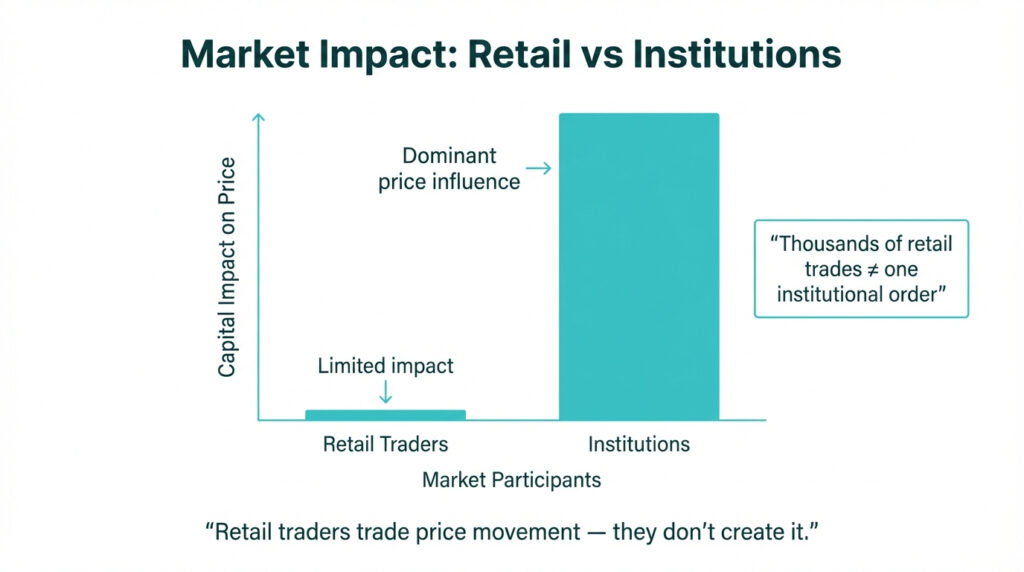
Retail traders refer to investors dealing with financial products through personal funds.
While individual retail trades may be relatively small compared to institutional trades, retail trading can affect stock prices.
The degree to which this happens depends on the size of trading, liquidity of the market, securities being traded and the concentration of buying or selling.
In very liquid markets, an individual retail trade may not make much impact on the market price of securities as a whole.
Nevertheless, large involvement in retail trading can cause major fluctuations in prices, especially of illiquid securities.
Why Individual Traders Have Limited Impact
Institutional investors might carry out transactions using a considerable amount of money, which may affect market pricing and liquidity.
Individuals usually have lower individual market impact but will still be involved in the discovery of market prices.
It is important to know the difference for beginners who need to analyze market behavior without thinking that the institutions determine every market movement.
Who Really Moves the Stock Markets? Key Participants Explained
There are many factors which affect the stock market such as people with varying amounts of money, varying intentions, and varying lengths of investments who participate in the stock market.
These include institutions, banks, market makers, retail investors, and public companies.
These have different influences depending on transaction sizes, market liquidity, availability of information, and economic conditions.
Institutional Investors
Institutional investors include pension funds, mutual funds, hedge funds, and asset managers. They handle big piles of cash and decide where to put it based on long-term goals, how it's spread out, and what they think the economy will do
When organisations gather or hand out roles, patterns emerge. Their money moves usually set the long-term trend, not just the day-to-day hiccups.
Banks and Financial Institutions
Big banks are super important in the world of finance. They provide cash flow, support trades, manage risk, and occasionally manage their investments.
Their impact goes way beyond the stock market, touching currency, bond, and derivatives markets as well. Their solid role backs up why getting the hang of liquidity is key. We dive deeper into that in What Is Liquidity?
Market Makers and Liquidity Providers
Market makers keep quoting prices to buy and sell, ensuring trades happen smoothly. Their aim isn't just to play the market for the long haul but to keep things running smoothly and handle the risk of what they've got in stock.
Spreads, execution speed, and short liquidity conditions directly impact volatility. Check out Bid-Ask Spread Explained for a clearer understanding of execution.
Large Corporations and Corporate Actions
Public companies can sway stock prices by delaying earnings reports, buying back shares, merging, acquiring other firms, and sharing their top execs' predictions.
These moves change what people expect to happen and often prompt organisations to adjust their strategies. Price moves not because of the headline alone, but because capital reallocates in response to it.
How News and Economic Data Actually Affect Markets
Economic news and corporate news affect the stock price by altering the expectations of the income, interest rate, economy growth, and financial risk.
Nevertheless, whether there will be a market response or not will depend on whether the new information matches the old expectations.
Expectations vs Reality
The market players have a good sense of forecasting what might happen even before the information is officially released.
For example, the investor might be expecting better financial results or any change in interest rate policy of the central bank.
If the release is consistent with the forecast, the price movement will be insignificant due to various factors which affect trading, regardless of the event.
However, the unanticipated news will cause investors to reassess their valuations and take their positions in such a way that would contribute to the increased volatility of the market.
The good news may result in falling prices whereas bad news may lead to rising prices.
Market Sentiment and Psychology
Capital movement is shaped by more than just numbers; our minds also sway it.
Fear, Greed, and Collective Behavior
Human emotion influences even institutional traders, albeit within risk frameworks.
Fear drives rapid sell-offs. Greed keeps the long-lasting growth phases going. Changes in sentiment lead to patterns of growth and shrinkage across different periods.
Grasping this dynamic is key, especially for individual traders handling their money, as highlighted in Trading Psychology Explained.
How Price Action Reflects Market Activity
Price charts illustrate historical trends in the market and may contain information regarding the trading process. Support and resistance, breakouts and consolidations form due to the interaction between buyers and sellers.
These patterns can be attributed to changes in demand, supply, liquidity, and market expectations. Nevertheless, price charts themselves are unable to accurately determine who is behind the specific trends.
Breakouts and reversals do not necessarily imply the presence of institutional investors. Technical analysis allows traders to analyze past price behavior but does not ensure forecasts for future prices.
What This Means for Retail Traders
Retail traders don't win by going head-to-head with big banks. They succeed by syncing up with what's clearly moving money around.
The process needs focus, careful planning, and a bit of waiting, rather than just guessing or being all about yourself.
Instead of letting emotions take the wheel, traders ought to zero in on the nuts and bolts, like structure, how easy it is to buy or sell, and keeping risks in check – stuff that's pretty much the backbone of Risk Management Fundamentals.
Practising in a demo setup before putting in real money lets you see what's up without the stress of it all.
Common Mistakes Beginners Make About Market Movement

Beginners may misunderstand market movements when they assume every price change has a single identifiable cause.
Common mistakes include:
- Believing technical indicators cause prices to move.
- Making decisions based solely on social media commentary.
- Reacting impulsively to economic announcements.
- Ignoring liquidity, volatility and transaction costs.
- Assuming every unusual price movement is evidence of market manipulation.
- Believing institutional investors can consistently predict or control market direction.
Stock markets are complex systems influenced by numerous participants and changing conditions.
Although market manipulation can occur and is subject to regulatory oversight, unusual price movements are not automatically evidence of misconduct. Understanding these differences can help beginners evaluate market information more critically.
For further information about stock market participation, investor protection and financial risks, explore the educational resources provided by the U.S. Securities and Exchange Commission (SEC).
Conclusion: Who Moves the Stock Markets?
Stock markets are influenced by a wide range of participants, including institutional investors, retail traders, banks, market makers and publicly listed companies.
Large financial institutions can have substantial influence because of the scale of their investment activity, but no single group determines every price movement.
Economic developments, company announcements, liquidity and changing investor expectations also contribute to market behaviour.
For beginners, understanding these interactions can provide a clearer perspective on why stock prices rise and fall.
However, financial markets remain uncertain, and understanding market structure does not guarantee successful trading outcomes.
Developing financial knowledge, evaluating information critically and recognising investment risks are important foundations for informed decision-making.