


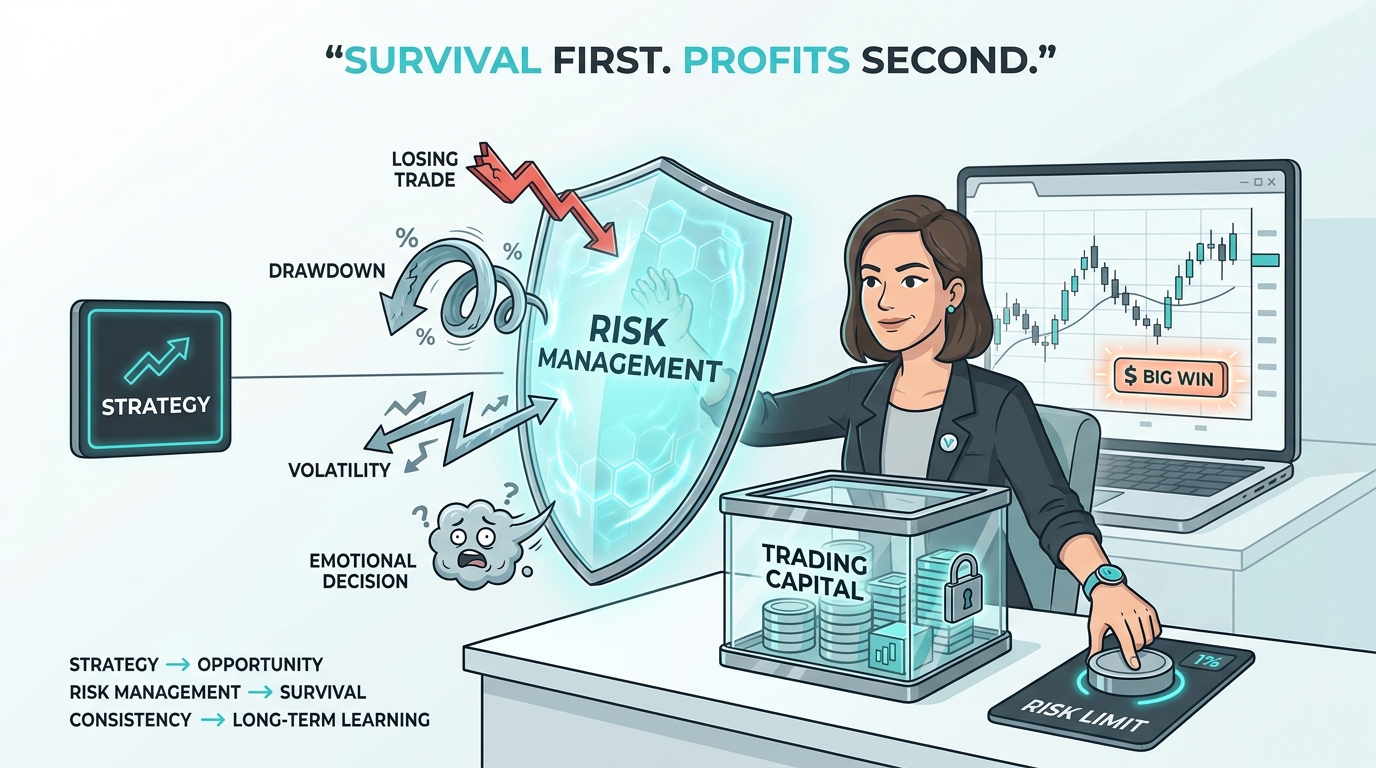
Risk Management Fundamentals help traders understand how to plan financial exposure, assess potential losses and evaluate trading decisions before entering the market.
While profitable trades might be followed by a big loss at times, it shows how important it is to manage risks alongside the process of discovering trading opportunities.
Managing risks is not only about setting stop-loss levels. It involves calculating the risk per trade, sizing up positions, rewarding-to-risk ratios, understanding trade expectancy and performance review.
The guide will help you understand all of these notions and use them to create a trading process for beginners.
Unfortunately, there is nothing that can be done about market uncertainties or guarantee your profitability as a trader.
Risk Management Fundamentals: What Beginners Need to Know
Managing risks is about keeping your losses in check before you start looking for gains. It lays out the concept before feelings get in the way
So, when you're looking at risk management, you're basically asking yourself four key things:
- What is the maximum loss per trade?
- What size of position should you take?
- What if you’re wrong?
- How do you measure performance objectively?
The trading process would simply have been a response to what happens. The trading process with them becomes a more systematic process.
The Core Principle: Survival Trumps Strategy
Most novices believe accurate entries and signals determine their success or failure. Survival is crucial for achieving success. If you fail to control exposure, even the most robust plans can unravel.
Understanding financial risk is essential before trading with real capital. The Financial Conduct Authority (FCA) provides educational guidance on investment risk and returns, helping beginners understand why potential rewards must be considered alongside the possibility of financial losses.
Pro traders build systems that anticipate and handle losses in a controlled way. This lets them stay steady on a losing streak without going broke or losing it emotionally. Risk management lets you keep improving by keeping you safe so you can keep going.
Foundation 1 — Risk Per Trade
The risk per trade refers to the amount of trading capital that a trader plans to risk for each trade that he makes. This can often be determined using a percentage of the equity in the trading account.
For instance, a trader having a £5,000 trading account and planning to risk 1% per trade will plan to risk £50.
Nevertheless, this does not imply that the maximum loss for each trade will be £50 because there could be other reasons why a trader might incur a greater loss than what he planned.
This idea is laid out in Risk Per Trade Explained, where the fixed-percentage model keeps losses in line with how much you've got in your account
Why Consistent Risk Planning Matters
The use of predetermined risk levels enables traders to gauge their risks prior to entering into a trade without making adjustments purely based on confidence or previous performance.
Nonetheless, fixed percentage risk management does not offer immunity from losing runs and cannot guarantee manageable drawdowns.
It is important to note that the objective is to design a system for risk planning and not for eradicating financial risk.
Foundation 2 — Position Sizing (How Big You Trade)
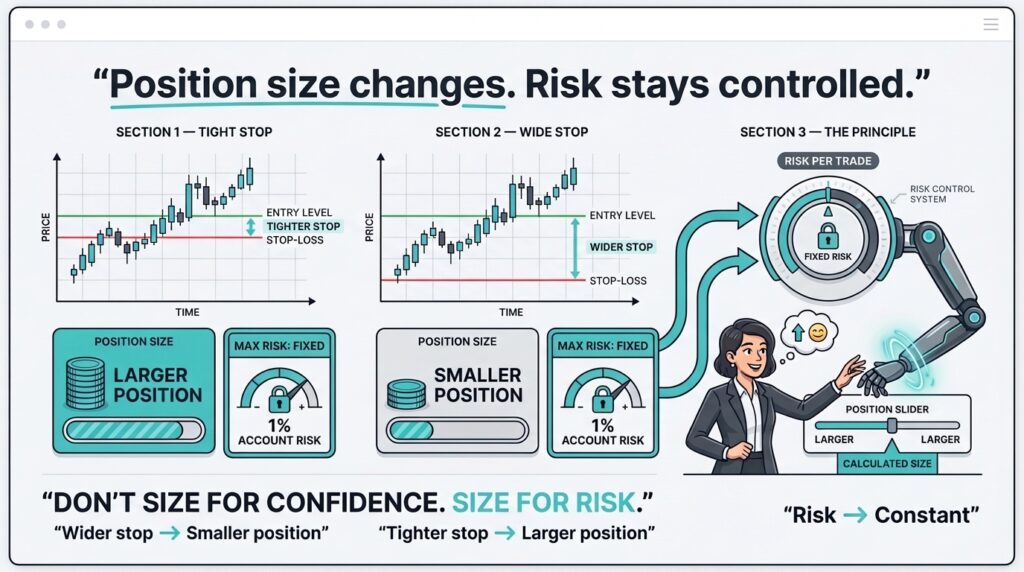
How much of your trading budget is at risk with each trade? It's not about confidence; it's about set risks.
This relationship is laid out in Position Sizing Explained, where the size of your positions adjusts automatically to keep your risk level steady.
It is an important risk-management decision because the financial impact of a price movement depends on the size of the position.
How Position Size Relates to Stop-Loss Distance
When the planned monetary risk remains unchanged:
- A wider stop-loss distance generally requires a smaller position.
- A narrower stop-loss distance generally allows a larger position.
For example, if a trader plans to risk £50 and each unit would lose £2 at the stop-loss level, the calculated position size would be 25 units, before accounting for trading costs and instrument-specific requirements.
Position sizing should consider contract specifications, volatility, leverage, margin requirements and possible execution differences.
A calculated position size does not guarantee that actual losses will remain within the planned risk amount.
Foundation 3 — Reward-to-Risk and Expectancy (How You Know It Works)
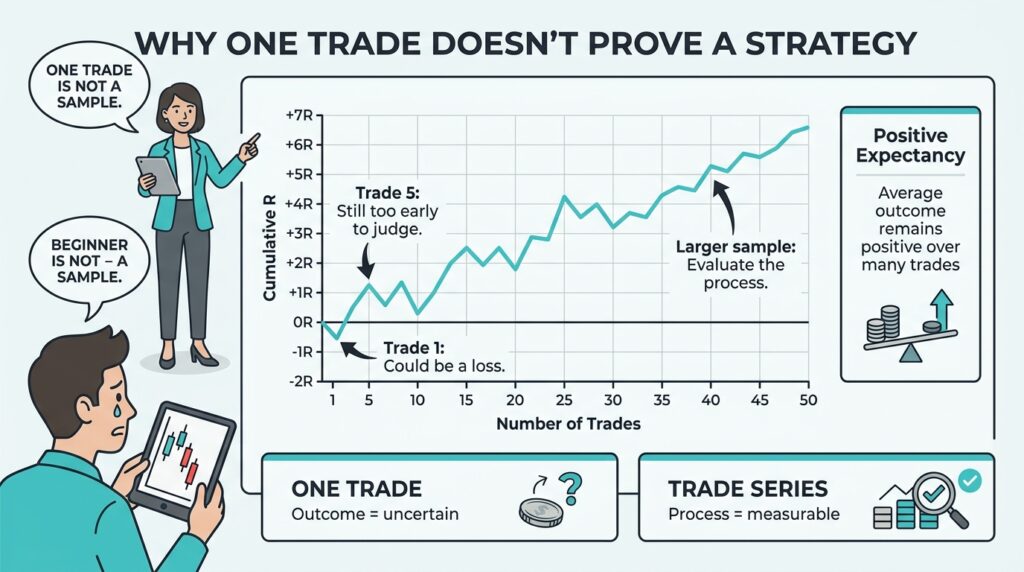
Reward-to-risk ratios and trade expectancy help traders evaluate the relationship between potential profits, planned losses and trading outcomes.
A reward-to-risk ratio compares the potential reward from a trade with the amount initially planned to be risked.
For example, a trade with £50 of planned risk and £100 of potential reward has a reward-to-risk ratio of 2:1.
However, this ratio does not indicate the probability that the trade will be profitable.
This relationship is explained in Reward-to-Risk Ratio & Trade Expectancy Explained, where profitability comes from consistent results rather than one-off trades.
Understanding Trade Expectancy
The Trade Expectancy determines the average profitability or loss for each trade by calculating the ratio of the wins and losses as well as the corresponding averages.
Even a trading system with a low win rate may exhibit positive expectancy in its history if the system’s average wins are relatively big compared to the average losses.
Conversely, even a system with high win rate may not necessarily be profitable.
Expectancy estimates are dependent on the quality of the trade samples.
Why Sample Size Matters
A few trades would not offer sufficient information to gauge the effectiveness of the strategy.
Analyzing a greater number of trades will allow traders to determine the trends, but past successes do not guarantee future results.
Foundation 4 — R-Multiples (Measuring Performance Without Emotion)
R-multiples provide a way to measure trading results relative to the amount initially planned to be risked.
In this framework, 1R represents the planned monetary risk on a trade.
For example, if a trader initially plans to risk £50:
- A £50 loss represents −1R.
- A £100 profit represents +2R.
- A £25 profit represents +0.5R.
- A £75 loss represents −1.5R.
Actual results may exceed the planned risk because of slippage, market gaps or other execution conditions.
This idea is laid out in Why Win Rate Is Useless Without R-Multiples?, where they examine how well something does its job without being swayed by feelings. R lets traders easily check their trading process.
Why R-Multiples Are Useful
Using the R-multiples for reporting results enables traders to make comparisons between trades of different sizes and amounts of money at risk involved.
They can assist in analyzing the average profit, average loss, and historical expectation.
Nevertheless, using R-multiples does not mean the removal of bias or better trading performance. It is simply a measure and does not predict future performance.
The Most Common Risk Management Mistakes
Most newbies mess up because of bad habits, not because they can't figure things out
- Risk too much on one trade
- Ignore stop-loss logic
- Increase size after losses
- Chase win rate instead of structure
- Trade the same way in every market condition
These patterns are laid out in Common Risk Management Mistakes Beginners Make, where it's clear that risk blunders are avoidable. Risk management mistakes can be corrected once understood.
The Warning Sign Most Traders Ignore
If one trade can upset your emotions or ruin your trading account, it is definitely too risky for you. Risk minimization improves your emotional balance and your chances for success in the future. Smaller losses let you learn more.
The Hidden Layer: Price Reading Helps Risk Decisions (Candles Are Not Signals)
Understanding how prices move is key to managing risk. Understanding market structure is key to making smart stop-loss moves, staying sharp on volatility, and nailing the execution.
This foundation is laid out in Candlestick Anatomy Explained where traders get the lowdown on how prices form and react. Understanding how prices move helps you assess risk more rationally.
Why Price Structure Matters for Risk Placement
The problem is that most random stops tend to be unsuccessful. Stops are consistent with how real human behavior works in the market. This method enhances both efficiency and consistency of risk.
A Beginner Risk Management Framework
Risk management involves making informed decisions about potential financial exposure before, during and after a trade.
Step 1 — Define Planned Risk Per Trade
Determine how much capital you are prepared to put at risk on a trade, considering your financial circumstances and risk tolerance.
Step 2 — Identify a Planned Stop-Loss Level
Consider market structure, volatility and the conditions that would invalidate the original trading idea. Remember that standard stop-loss orders do not guarantee execution at the selected price.
Step 3 — Calculate Position Size
Estimate the position size using the planned monetary risk, stop-loss distance and relevant instrument specifications.
Step 4 — Track Trading Outcomes
Record realised profits and losses, trading costs, R-multiples and relevant execution details. Use a representative sample when evaluating historical expectancy.
Step 5 — Review Decisions and Execution
Check whether the trading strategy was adhered to, the position size was adequate, or any unforeseen market developments impacted the result.
The rationale behind this approach is to help in making rational decisions and not ensure that the losses do not exceed certain predetermined levels.
Practice Risk Management Without Financial Pressure.
Risk management improves more quickly when it is practiced regularly in a safe setting. You can safely try out position sizing, stop placement, and execution with VARIANSE trading account.
Check out VARIANSE Academy's education page for a well-organised learning path that links risk management to actual practice and the workings of the mind. Practice builds discipline safely.
Conclusion: Building a Structured Approach to Trading Risk
The knowledge about the basic principles of risk management is among the steps in learning how trading decisions influence the risks in finance.
With the help of using the principle of risk that is already known, position sizing, analysis of reward to risk ratio and calculation of the results with expectancy and R-multiples, traders can create the decision-making framework.
The decision-making framework can be useful in determining if the risk level is too high, analyzing the history of mistakes in his trading.
However, the risk management cannot guarantee any safety from the losses in the future.
It is the task of the beginning trader to understand what happens around and think rationally about the results he wants to achieve.








