


Market orders vs limit orders is an important distinction for beginners learning how trading orders are executed. Both order types allow traders to buy or sell financial instruments, but they differ in how they balance execution speed and price control.
Market orders usually aim to execute the order quickly at the current prices whereas the limit order indicates the lowest execution price. Knowledge of these distinctions might assist beginners in understanding how the spread, liquidity, slippage, and volatility of the market can impact trades.
This lesson builds on Trade Mechanics & Execution Basics and explains when each order type may be appropriate, including its limitations and risks.
Market Order vs Limit Order in Simple Terms
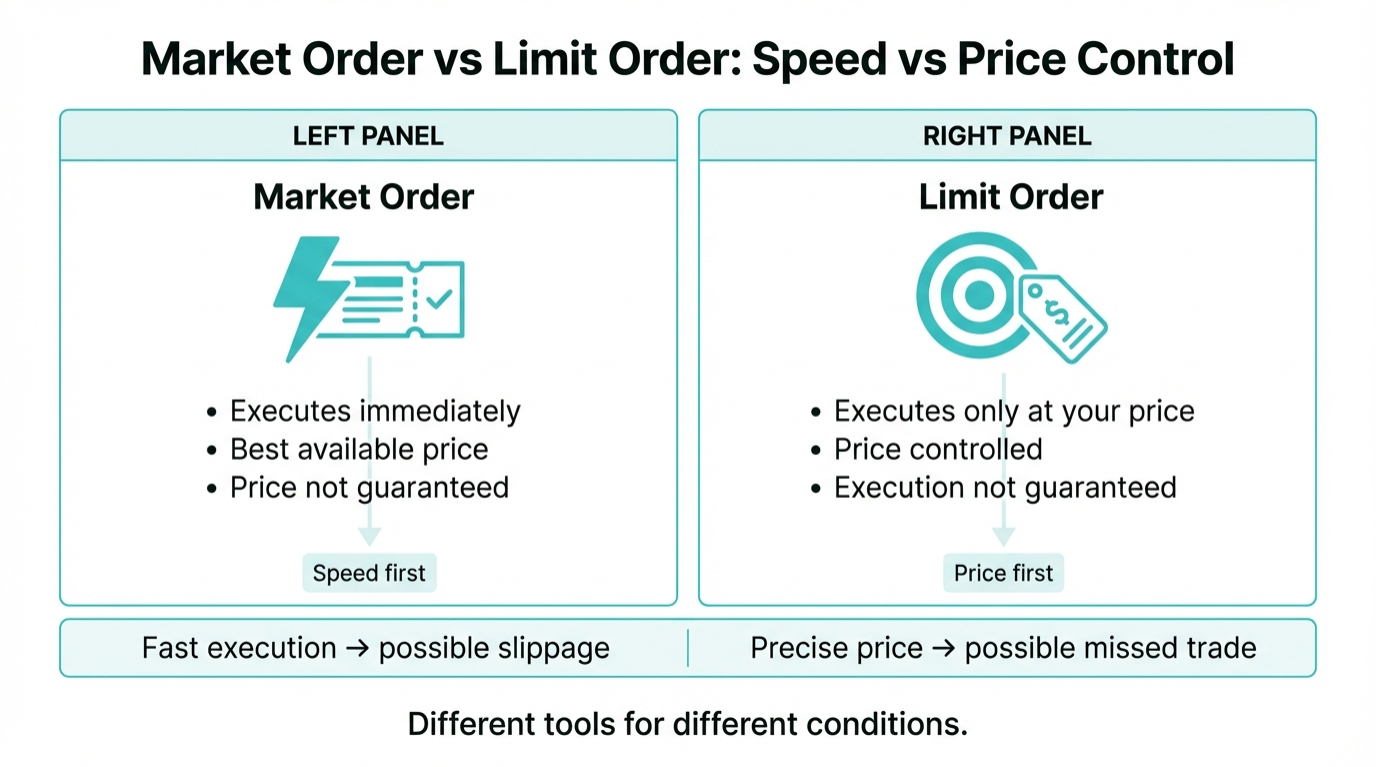
A market order tells your platform to buy or sell immediately at the best available price. A limit order tells your trading platform to buy or sell only if the price hits your set point or better.
This difference reflects a core trade-off:
- Market orders prioritise prompt execution, but the final price is not guaranteed.
- Limit orders prioritise price control, but execution is not guaranteed.
Neither order type can eliminate slippage, market risk or the possibility of financial losses. Understanding this trade-off helps beginners make more informed decisions about order placement.
What Is a Market Order
A market order is an instruction to buy or sell a financial instrument at an available market price. Market orders generally prioritise prompt execution rather than a specific price.
However, the final execution price may differ from the price displayed when the order was submitted, particularly during volatile or low-liquidity conditions.
Depending on the market, available liquidity and trading platform, a market order may also be partially filled, delayed or rejected.
Market orders can be useful when execution speed is more important than precise price control, but traders should understand the potential costs and risks before using them.
But how well things get done really hinges on how liquid things are, which you can read about in What Is Liquidity?
How Slippage and Spreads Affect Trading Costs
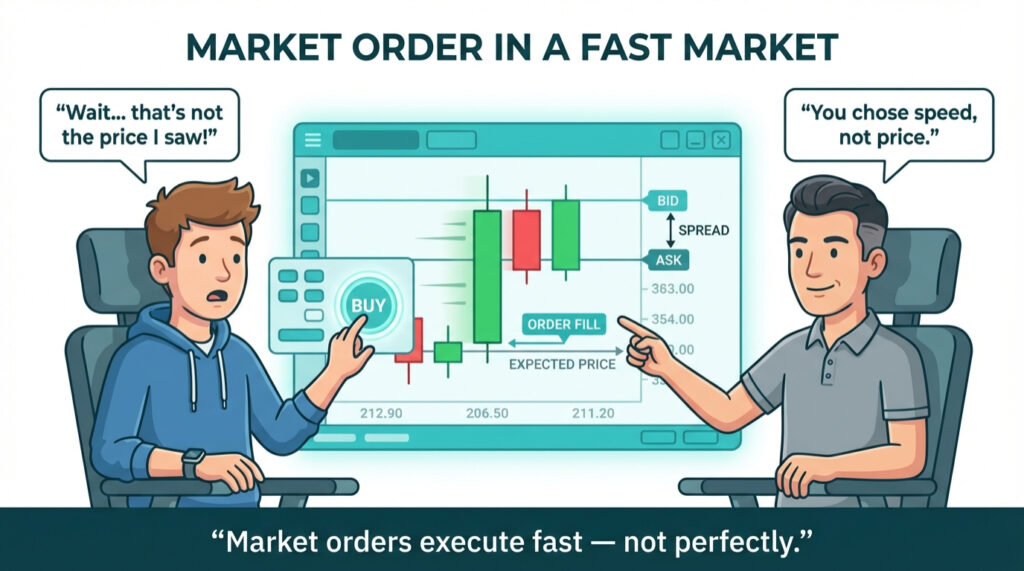
Two key elements that affect trading costs include the bid-ask spread and slippage. The bid-ask spread is the difference between the price of purchasing and selling a financial asset.
The slippage happens where the order is executed at a price which differs from what would have been anticipated when placing the order. It may be a good or bad slippage, and it becomes more pronounced in times of market volatility or illiquidity.
Spreads are likely to increase in uncertain market conditions.
The spread shows the gap between buyers and sellers, and it's settled right when a trade happens. This cost structure is laid out in detail in Bid-Ask Spread Explained, where traders get the lowdown on why every trade starts with a tiny, unrealised loss.
When things get really unstable, the price difference between two items widens, making it harder to get your order filled without paying more.
What Is a Limit Order
A limit order allows traders to specify an acceptable price for buying or selling a financial instrument.
- A buy limit order can execute at the specified limit price or lower.
- A sell limit order can execute at the specified limit price or higher.
Limit orders provide control over the worst acceptable execution price, but they do not guarantee that a trade will take place.
Even when the market reaches the specified price, an order may remain unfilled because of insufficient liquidity, order priority or other execution conditions.
Limit orders may be useful when traders prioritise price conditions over immediate execution.
The Trade-Off: Price Control vs Execution Speed
Market orders and limit orders serve different purposes. Market orders generally seek prompt execution but may be filled at prices different from those expected.
Limit orders establish acceptable price boundaries but may remain unfilled if market conditions do not allow execution.
This distinction is especially important during periods of increased volatility, when prices may change rapidly and available liquidity may be limited.
Choosing an order type involves understanding these trade-offs rather than assuming one is always better than the other.
Execution Speed vs Price Control in Real Trading
The contrast between order types really stands out when things get unpredictable.
Markets fill up fast, but the price you end up paying can change based on how much is available and how much is bouncing around. Limit orders provide price protection, but execution may never occur.
This relationship becomes especially important during economic news releases, session opens, or low-liquidity periods, when spreads widen and execution risk increases.
Grasping the link between execution and market volatility and liquidity is key to laying down solid financial market basics, as outlined in Financial Market Foundations.
Real Examples of Market Orders and Limit Orders
Understanding execution differences is clearer when you see them in action.
Market Order Example
Suppose a trader wants to buy a financial instrument currently quoted at an ask price of £100. The trader submits a market buy order.
By the time the order is executed, the available ask price has increased to £100.15.
If the order is filled at that price, the trader pays £100.15 per unit rather than the initially displayed £100.
This illustrates how market movements and execution conditions can affect the final fill price.
Limit Order Example
Suppose a trader wants to buy the same instrument but does not want to pay more than £99.
The trader places a buy limit order at £99.
If suitable selling liquidity becomes available at £99 or lower and the order receives a fill, the trade may execute at £99 or a better price.
However, if the market never offers an executable price within the limit, or sufficient liquidity is unavailable, the order may remain unfilled.
The examples illustrate the trade-off between execution speed and price control.
How Partial Fills and Liquidity Affect Trade Execution
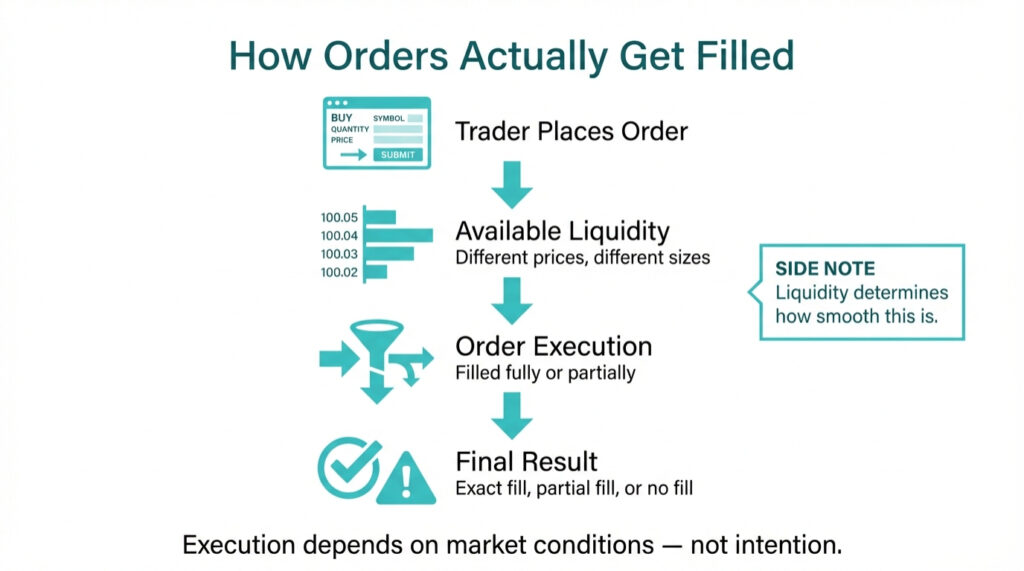
Partial fill means that not all the traded amount has been bought or sold.
For instance, when someone wants to purchase 1,000 shares, 400 shares could be bought at the time of trading at the acceptable price level.
It depends on the order and conditions in which trading is conducted. In addition, depending on the level of market liquidity, there might be different volumes that can be bought at particular prices.
If the size of the order is rather high, several prices might have to be used for its execution, which means that the average price will be higher.
However, not every trading tool allows conducting partial fills in the same way.
These execution mechanics are key components of the full Trade Lifecycle Explained, where planning, execution, and review are all part of a well-oiled, structured process.
How Liquidity and Volatility Affect Order Execution
The prevailing market situation may affect how rapidly an order is filled, as well as the price. In times when liquidity is very high, the spread may be lower, and more trade volume can be available at favorable prices.
In situations when there is more volatility or less liquidity, the spread may be higher and slippage may happen. This may happen around economic reports and market open and news events.
Nevertheless, liquidity does not ensure good execution and volatility does not necessarily result in wide spreads.
Choosing the Right Order Type for Your Trading Style
There is no universal type of order. Everything comes down to the situation at hand. In situations where you have to be quick, such as when exiting a bad trade or entering an easily tradable market, market orders tend to work well.
In cases where you require absolute accuracy with regard to your price level, using limit orders becomes wise, particularly when dealing with complex trades centered around certain price levels. Traders who know the difference do not chase their trades and keep a consistent track record.
Practical Beginner Tips for Understanding Order Execution
Beginners can improve their understanding of order execution by following a structured learning process.
Useful practices include:
- Checking the current bid-ask spread before placing an order.
- Understanding the difference between market and limit orders.
- Recognising that market orders may experience slippage.
- Remembering that limit orders may remain unfilled.
- Considering liquidity, volatility and trading costs.
- Reviewing order execution results in a demo environment.
Demo trading can help beginners practise order placement without risking real trading capital.
However, simulated execution may differ from live market conditions, and successful demo trading does not guarantee similar results with real money.
Trying out trades in a demo mode on the VARIANSE platform lets traders get a feel for how things work without risking any cash.
How Order Types Fit Into Risk Management
Order types are significant factors that influence trading strategies concerning opening and closing positions.
The market orders may concentrate on quick order execution, whereas limit orders provide the opportunity to set up certain price limits.
Still, none of the orders is free of risks. Risk management requires knowledge about position sizes, use of leverage, trading expenses, and stop-loss order limitations.
For instance, regular stop-loss orders may be executed at other price levels than the pre-set one in cases of market volatility.
Risk management strategies such as stop-loss orders and position sizing can help keep these factors in check. In Take Profit & Stop Loss Explained, these ideas are laid out clearly, showing how good execution is key to trading success over the long haul.
Execution discipline safeguards the company's assets before even thinking about making a profit.
Conclusion: Market Orders vs Limit Orders: Is Really Speed vs Control
One of the significant differences between market orders and limit orders is the connection between the execution time and price.
Market orders normally favor quick execution at the existing prices, whereas limit orders allow the determination of the execution price although the order might not get filled. Both market orders and limit orders are dependent on the liquidity of the market, volatility, spreads, and execution.
It is useful for novice traders to understand that there are certain disadvantages of the two order types along with the risks in the process of trading. Moreover, neither of the orders guarantees execution, no loss, or trading profits.
Trading can be mastered through practice and simulations.








