


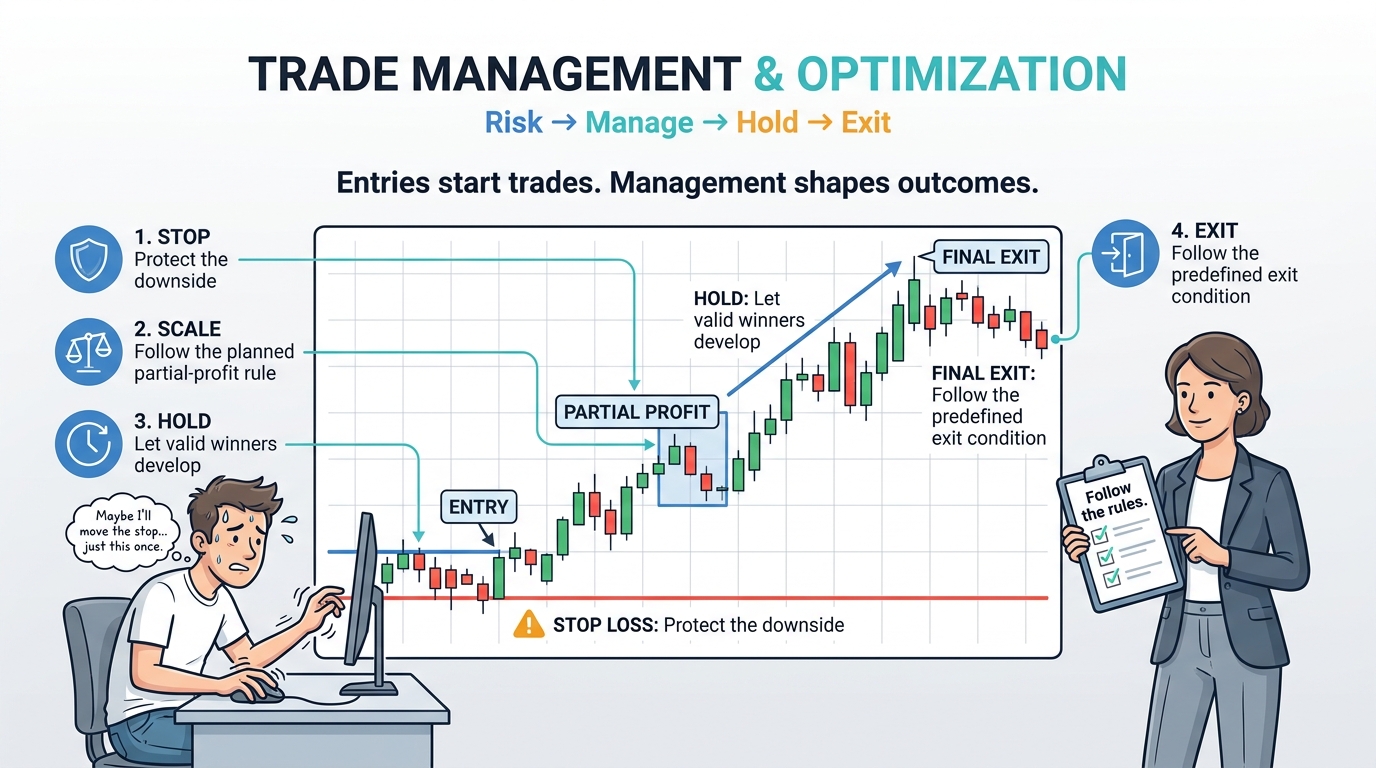
Most traders think results come from better entries. In reality, most consistency comes from what happens after entry.
Trade management and optimization is the skill of controlling risk, managing open profit, and enforcing exits without emotional interference. Optimization does not mean “perfecting” every trade. It refines decision quality and ensures your system produces repeatable outcomes over time.
This parent guide provides a clear framework for trade management and links to core supporting lessons: stop-loss discipline, scaling out, holding winners, and professional exit logic.
What Is Trade Management in Trading?
Trade management involves planning, monitoring, and controlling an active trade in accordance with pre-decided trading rules.
It starts before taking a position and involves deciding on risk management parameters such as the size of the position to be taken, where to place a stop loss, etc.
Trade management may involve:
- Setting an initial stop-loss level and defining when it can be adjusted.
- Deciding whether to take partial profits or maintain the full position.
- Managing profitable trades without making unnecessary emotional decisions.
- Closing positions when predefined exit or invalidation conditions are met.
The objective is to improve the consistency of trading decisions and manage exposure, rather than guarantee profitable outcomes.
Why Trade Management Determines Your Results
A strategy can be profitable on paper and still fail in real trading if management is weak. This usually happens because:
- Stops are moved emotionally
- Winners are cut early
- Losers are given too much room
- Exits are improvised based on P&L
- Partial profits are used as comfort instead of structure
Trade management turns a strategy into a process. Without it, trading becomes a negotiation with emotions rather than a structured execution.
Stop-Loss Discipline Is the First Layer of Survival
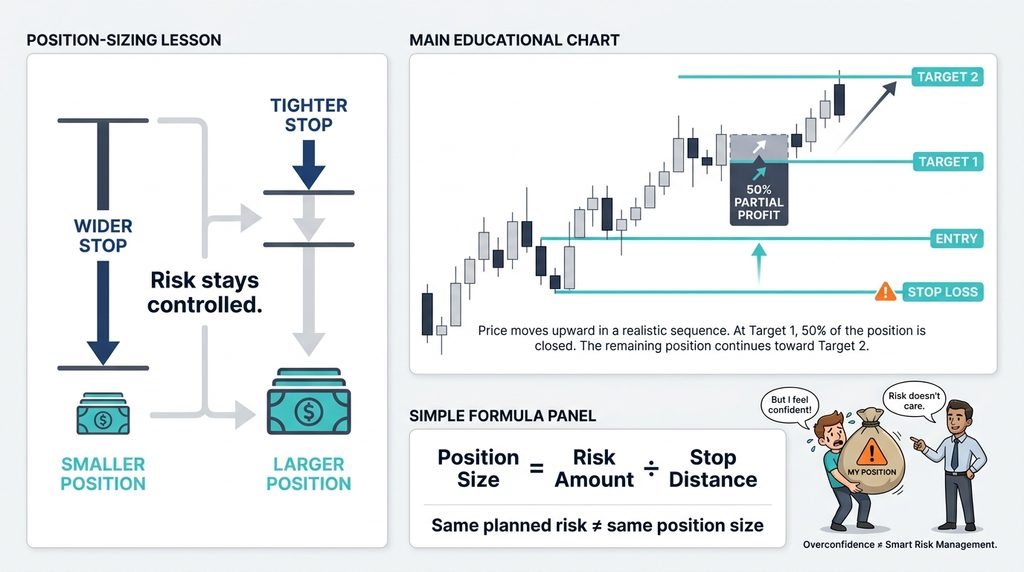
Stop losses are not just protection. They define a trade's business risk. The biggest mistake is not “having a stop". It’s moving it for emotional reasons.
Rule-based stop movement can improve performance. Fear-based stop movement destroys expectancy.
For the full framework (when moving stops help vs hurt), link to: Moving Stop Losses.
Stop-loss orders can help traders manage risk, but they do not guarantee execution at a specific price. The US Securities and Exchange Commission (SEC) explains how stop orders work and why execution prices may differ from the stop price during volatile market conditions.
Partial Profits and Scaling Out Must Be Rules, Not Reactions
Scaling out can reduce emotional pressure and smooth results, but it can also reduce your average win and damage expectancy if used incorrectly. The difference is whether you plan scaling before entry and tie it to a model (R-multiples, structure, time, or volatility), rather than deciding in the moment.
For scaling models, expectancy impact, and mistakes to avoid, link to: Partial Profit Strategy.
Holding Winners: Balancing Profit Potential and Risk
Being profitable in a trade may be tough since traders fear losing unrealized gains.
This is because in certain trend following trading systems, a few larger profits may make a big difference in performance. However, other systems depend on holding positions for shorter durations or having set profit target levels.
In any case, traders need to decide on the right technique based on their trading style and risk management policies. It is not necessarily wise to hold all winners in a position.
For the psychology and methods behind letting profits run, link to Holding Winners Without Emotional Investing.
Exit Logic and Rule Enforcement Are the Real Edge
Entries start trades. Exits shape equity curves. Exit logic defines the conditions that end a trade. Rule enforcement means executing those conditions without negotiation. Most traders fail because they change exits mid-trade, respond to noise, or react to floating P&L instead of structure.
For professional exit frameworks, exit hierarchies, and discipline systems, link to: Exit Trading Strategies Explained.
How These Skills Work Together as One System
Trade management is not four separate tactics. Stops, scaling, holding winners, and exit logic must be aligned; otherwise, they will conflict. A clean system typically looks like:
- Stop loss defines invalidation and risk
- Position size matches the stop (so risk is tolerable)
- Scaling rules are pre-written and tied to your strategy
- Stop movement is allowed only after confirmation
- Exit logic follows one hierarchy (no conflicting exits)
Trade review focuses on rule-following and expectancy, not single-trade emotions
A Practical Trade Management Workflow
Use a repeatable workflow to remove decision fatigue:
- Define the trade setup. Identify the market conditions and price levels supporting your trading idea.
- Set the invalidation level: Determine what would indicate that the original trading idea is no longer valid.
- Calculate position size: Align position size with your risk budget, stop-loss distance, and potential execution costs.
- Choose a profit-management approach: Decide whether your strategy calls for partial exits, fixed targets, or holding positions while conditions remain favorable.
- Define stop-adjustment rules: Specify the conditions under which your stop-loss level may change.
- Establish final exit conditions. Determine when to close the remaining position, including time-based or risk-related exits.
- Review execution and results: Compare actual decisions with your plan and evaluate performance across a meaningful sample of trades.
Common Trade Management Mistakes That Kill Consistency
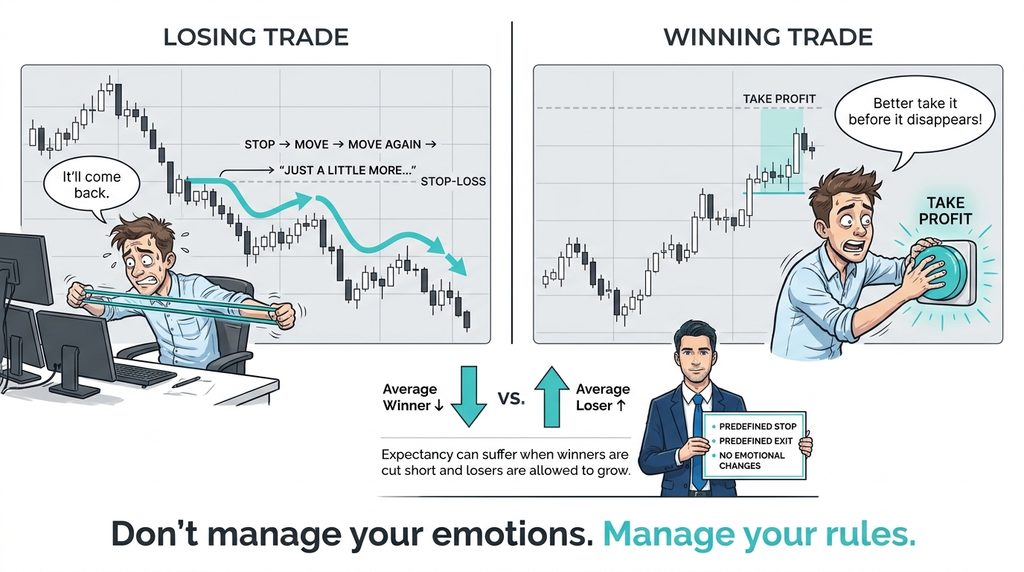
Most mistakes feel “reasonable” in the moment, which is why they repeat:
- moving stops to avoid discomfort
- taking partial profits too early “to feel safe".
- overusing break-even stops (turning winners into scratches)
- cutting winners early and letting losers breathe
- mixing multiple exit methods with no hierarchy
- managing trades based on P&L instead of structure
Each of these has a fix: rules, measurement, and repetition.
Conclusion: Trade Management Builds a More Structured Trading Process
Managing and optimizing trades is a critical component of disciplined trading.
Stop loss planning can aid in the quantifying of risk. Partial locking in of profits is one of the many ways of managing open trades. Keeping winners can assist in the implementation of a trading strategy aimed at bigger moves in the markets while defined exit points can assist in lowering emotional trades.
Nevertheless, good trade management does not ensure profitability since trades are determined by other factors such as market conditions, execution cost and risk taken.
Through the formulation of good rules together with performance evaluation, traders can learn how to make better decisions.
The purpose is not for one to perfect the management of each individual trade but rather to make sound decisions for each trade.








