


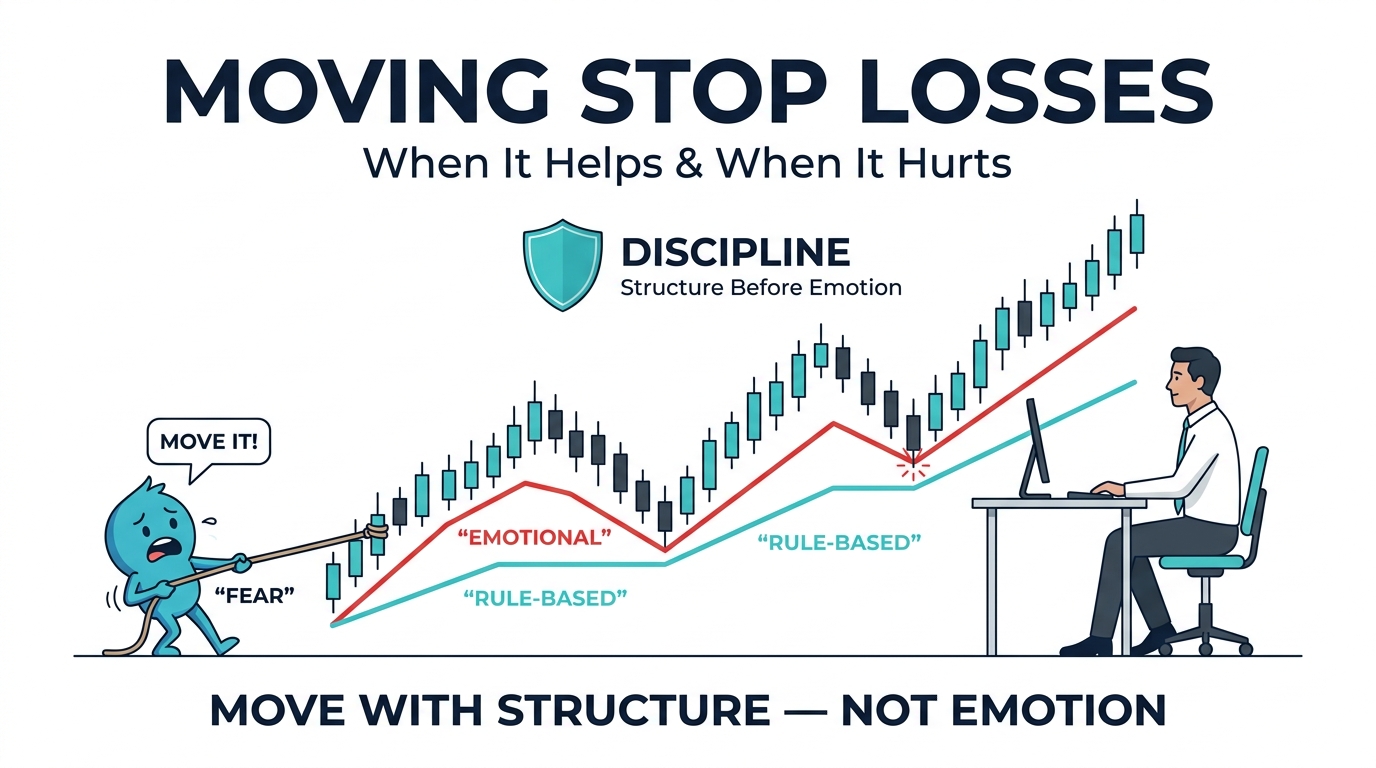
Stop losses are meant to protect traders, but for many people, adjusting stop-loss decisions chews away at their accounts bit by bit over the long haul.
Moving stop-loss in Forex and CFD trading can either improve trade management or quietly mess up a solid plan because of emotions and impulses. The real issue isn’t the tool itself, but why you adjust it and how you do it.
This guide explains how stop losses work in real trading situations, when moving stop losses can boost your results, when it might hurt your game, and how top traders handle stops with a plan, not just feelings. If you’ve ever had to pull out of a trade early, made a quick move to hit a stop, or saw your initial price goal hit after you got out, this lesson tackles that issue head-on.
What Are Stop Losses in Trading?
Stop loss is a risk management instrument which instructs the trading platform to exit the trade once the specified price level has been reached.
Traders employ stop losses to control risks by setting levels of invalidity of trades and to protect themselves from unfavourable price movement.
However, stop loss by itself does not guarantee closing at the specified price. When market volatility and liquidity are low or market gaps are wide, traders risk closing positions at more unfavourable prices.
It is especially relevant for leverage trading in Forex and CFDs, as even slight price changes can have a significant impact on account balance.
Thus, stop loss placement is only one part of a comprehensive risk management strategy which includes, among other elements, position size and leverage.
This kind of emotional slip-up is detailed in the article Trading Psychology Explained.
Stop-loss orders can help traders manage downside risk, but they do not guarantee execution at a specific price. The US Securities and Exchange Commission (SEC) explains that a stop order may execute at a different price from the stop level when market conditions change rapidly.
Different kinds of stop-loss orders traders use
Understanding stop losses begins with recognizing the type being used, since each one plays a different role in trade management.
Fixed Stop Loss
A fixed stop loss is placed at a specific price level, either based on market structure or when certain conditions clearly signal that the trade idea is invalid. It is not moved unless rules explicitly allow it. This method aligns with market-structure execution, like HH, HL, LH, and LL, as explained in the article Market Structure Explained.
This type of stop-loss works well for beginners, for testing strategies, and when invalidation levels are clearly defined.
Trailing Stop
Trailing stops refer to the stop loss order, which moves along with the market movement in the positive trend by keeping a set distance from the current price or by following a certain rule.
In case of a long position, the trailing stop order could go upward as the price goes up but rarely goes downward when the price goes down.
Trailing stops enable the trader to trade within the favourable trend as well as create the basis of getting out of the trade if the price goes against the trend.
However, trailing stop order could exit the position even when there is a pullback in the normal market situation, and the price of execution is not guaranteed.
This issue is more about chasing results than sticking to a solid trading plan, just like the article Process-Focused Thinking for Consistent Trading.
Break-Even Point
A break-even stop entails setting the stop to the initial entry price, but only after some favorable movement of the price. The main idea is to minimize the risks of loss in case of reversal of prices.
Yet, getting out at the initial entry price does not automatically mean having no net gain or loss. Spread costs, commissions, overnight interest expenses and slippages may make one lose money despite being at breakeven.
Setting stops at break-even too soon can also cause closure of positions due to normal price movements before the trading idea becomes clear.
Therefore, traders need to assess whether break-even techniques work well for them according to strategy and past trading performance.
Misusing a break-even stop often stems from fear and the desire to make money too soon, a topic discussed in the article Holding Winners Without Emotional Investing.
Volatility Stop (ATR)
The volatility-based stop employs a tool like the Average True Range (ATR) to establish the distance of a stop-loss order.
The ATR tool gauges the recent price volatility without predicting the direction of future movement.
For instance, an investor can multiply the ATR figure to come up with the distance for the stop-loss order based on recent volatility.
Nevertheless, increased stops may lead to increased losses in case the position size is kept constant. Traders need to change position sizing where necessary to ensure losses are not exceeded.
The ATR based stops cannot be used in all scenarios and also fails to prevent slippage and market movements.
Why Traders Move Stop Losses Emotionally
Stop-loss modifications are not always made according to the shifts in market conditions and structure.
Sometimes traders shift the stops due to their concerns about losing potential profits, as well as due to fear of having losses taken or the pressure of consecutive failures.
For instance, widening the level of a stop-loss is caused by the price going against one's position without having any reason behind it.
Conversely, narrowing the stop too soon may lead to exiting on a normal correction. Such actions might disrupt the strategy in terms of its risk management plan. The point is not in avoiding emotions but rather in implementing rules for making modifications.
This behavior mirrors the emotional rollercoaster of revenge trading and over-meddling, as explained in Revenge Trading Explained: Why Traders Lose Control & How to Stop It.
When Moving Stop Losses May Support Trade Management
Moving stop loss can improve outcomes, but only under strict, predefined conditions.
Rule-Based Trailing in Strong Trends
In clean trends, using a trailing stop behind the market’s structure or key swing points helps traders stay in the most likely moves a bit longer. The key rule is straightforward: focus on structure, not feelings.
This approach works best when aligned with trend context and continuation behavior discussed in Break of Structure & Market Regime Shifts: Trading Guide with Chart Examples.
Locking Profit After Structural Confirmation
When price breaks structure or confirms the trend, it may make sense to adjust your stop to reduce risk. Decision-making here is all about fresh info, not just being scared out of your wits.
Price behavior should always guide structural confirmation, not P&L pressure.
Reducing Risk Without Increasing Exposure
Moving a stop closer should reduce risk, not increase stress. If a stop adjustment causes discomfort, it’s not improving trade management; it’s revealing weaknesses in how we handle position sizing or planning.
When Moving Stop Losses Can Increase Trading Risk
This is where most traders struggle.
Fear-Driven Stop Adjustments
Setting a stop too close simply out of fear of losing can result in closing a trade as a result of regular market fluctuations.
The same can be said for expanding a stop so that you don’t take a loss.
This usually happens when people mess up scaling their trades, which they cover in the Partial Profit Strategy guide.
Moving to Break-Even Without a Clear Rule
A break-even stop may decrease possible losses, but its application at the wrong time could cause trade to be stopped even before its target is achieved.
This impact varies based on different factors including the trading method and the frequency of early stops.
Revenge Adjustments After Losses
Some traders tend to broaden their stop-loss orders, increase their trading volume, and make additional trades after experiencing losses on their trades.
These actions expose traders to financial risks and also reduce the effectiveness of their risk management process.
It is advisable for traders to have a predefined trading strategy and perform evaluations on their trading performances.
Stop Losses and Position Sizing Are Linked
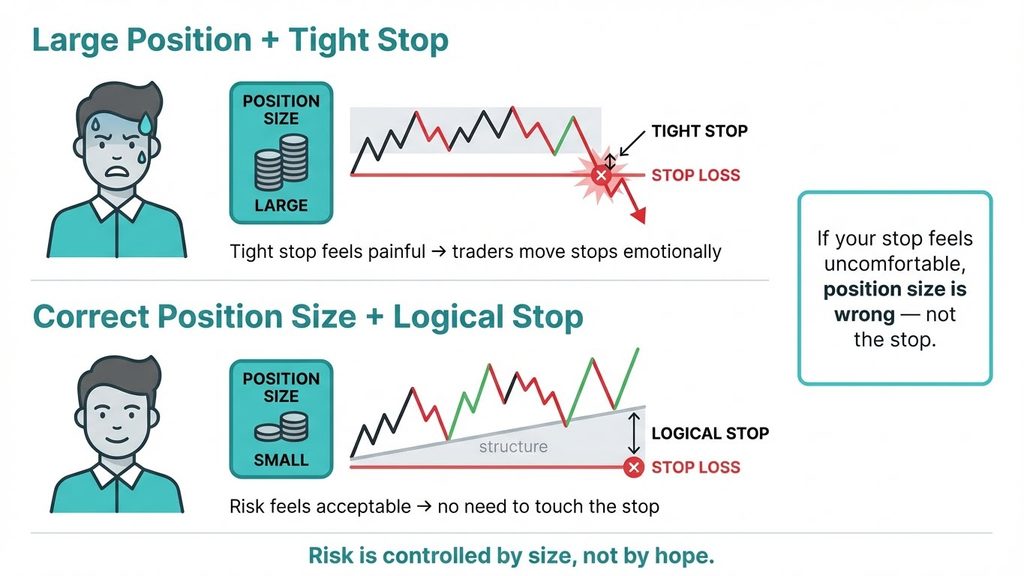
Stop losses and position sizing go hand in hand. Trading pros set their stop first, figure out how much to bet based on position sizing, and are comfortable with losing some cash before they jump in.
Retail traders sometimes flip the script, then adjust their stop losses because the risk just doesn’t sit right with them. If a stop feels “too wide,” it’s usually a sign that the position sizing needs adjusting a key idea that’s really hammered home in the Risk Management Fundamentals for Traders guide.
Good vs Bad Moving Stop Loss
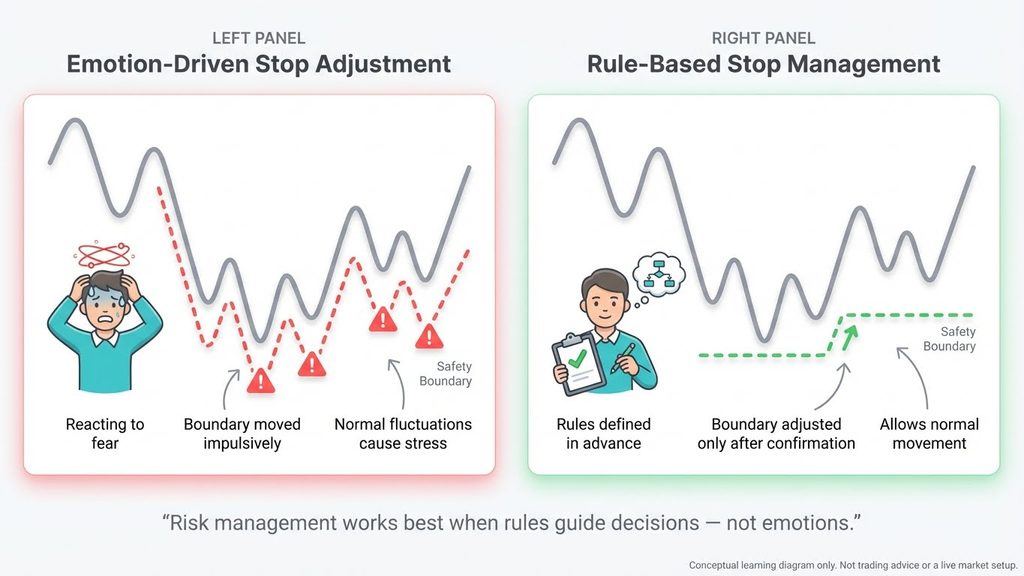
A weak moving stop-loss adjustment starts with a market-structure setup, then follows a normal pullback. The stop is tightened emotionally, the trade exits early, and the price later resumes in the original direction.
A disciplined moving stop-loss decision kicks off with a set limit in mind. When price breaks the setup, the stop adjusts to match the plan, and the trade stays valid.
The difference is not in the prediction. It is discipline.
Best Practices for Managing Stop Losses Consistently
Effective trade management starts before you even make the trade. Set up stop logic ahead of time; don’t change a stop without a rule; use a clear structure or volatility stop to guide your stops; treat losses as a business cost; and record every decision to adjust your stops.
Stop losses aren’t just personal views. These are risk contracts.
Conclusion: Moving Stop Losses Requires Rules, Not Reactions
Moving stop losses can be an effective strategy in trade management, but this depends on how and why this happens.
Trailing stops, break-even, and volatility-based techniques have strengths and weaknesses. There is no technique that would fit any trading system and any market situation.
By setting stop loss criteria prior to entering the trade, matching size of positions to risks and analyzing trading results, traders can approach the problem in a more structured manner and avoid making emotional moves.
But well-thought out stop loss systems will not be able to completely remove market risk or execute trades according to plan.
It is not necessary to move every stop loss to perfection, but to manage the risks within a defined trading plan.








