
If you’ve ever been puzzled by mixed signals, contradictory cues, or unexpected turns, the issue isn’t usually your plan; it’s a lack of understanding of market structure.
Market Structure shows how prices organize themselves over time. It reveals whether the market is rising or falling, and whether it's strengthening or weakening, long before traditional signals react.
For traders operating within the Forex and CFD trading environment, understanding Market Structure is essential. Price action is the language markets use to communicate control, momentum, and risk.
This concept sits at the heart of technical analysis and ties into how traders interpret breakouts, trend structure, and reversals, as discussed in the article Break of Structure & Market Regime Shifts.
What Is Market Structure in Trading?
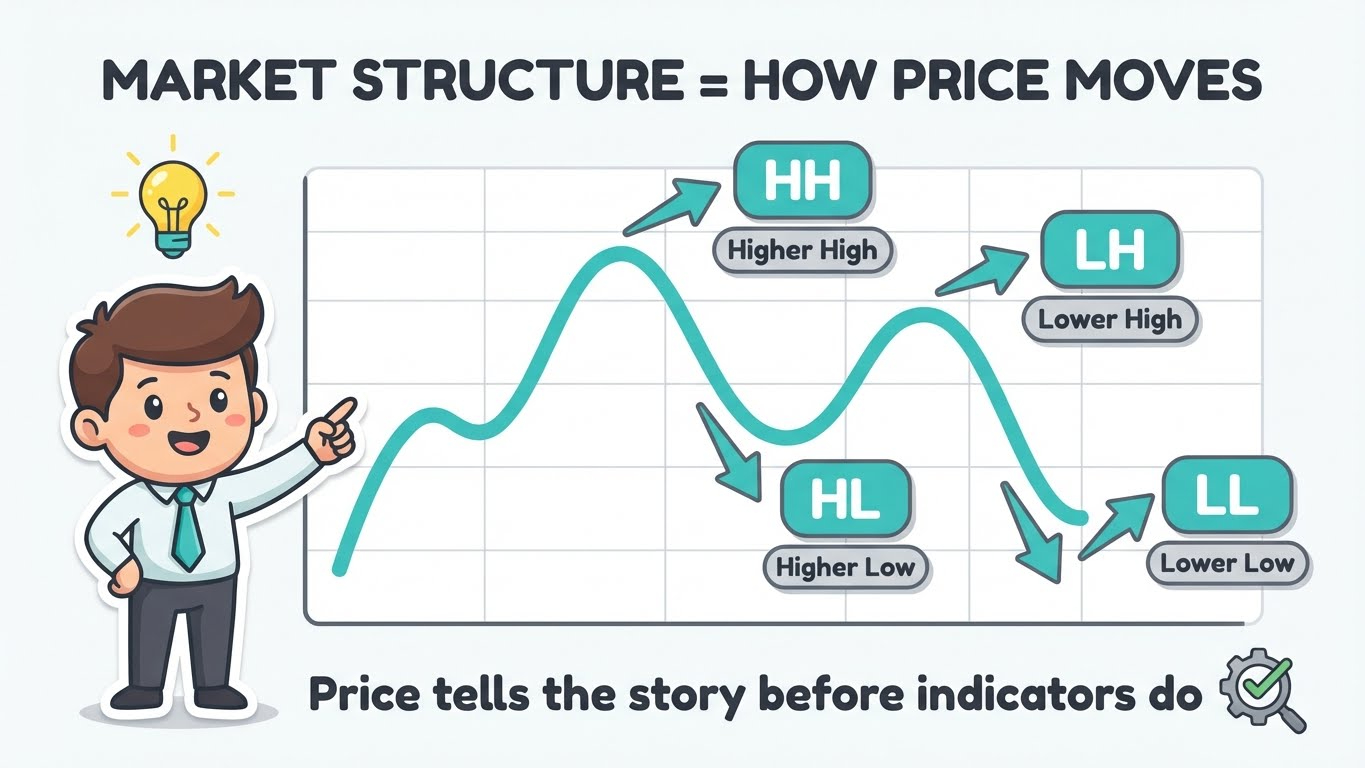
Market Structure is the pattern of highs and lows formed as the price moves over time.
Instead of trying to predict where prices are heading, Market Structure helps traders understand what prices have already shown. It highlights where buyers or sellers put their money down, where power shifts, and whether a trend structure still holds up.
Market structure on price charts is different from the broader concept of financial market microstructure. Research published by the Bank for International Settlements (BIS) examines how the Forex market operates, including trading venues, liquidity provision and price discovery. This provides useful background on the wider market mechanisms behind currency trading.
The 4 Key Elements of Market Structure: HH, HL, LH & LL
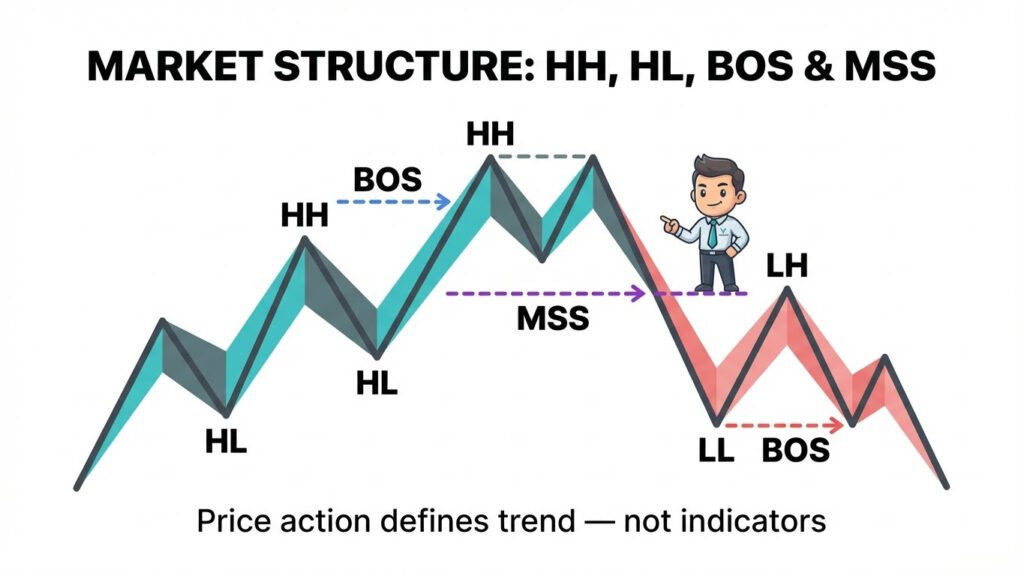
Similar price-structure concepts can be applied across Forex, indices, stocks and other traded markets, although market conditions and trading characteristics differ
Higher High (HH)
A new high occurs when prices break out from a prior important swing high.
Higher highs, coupled with higher lows, could signal a bull market. But one higher high alone is not a proof of future bullish direction.
Participants show increased willingness to transact at higher prices, a key feature of strong price action environments discussed in Trend vs Range Markets: How to Tell the Difference.
Higher Low (HL)
A Higher Low forms when price pulls back but fails to break the previous swing low.
This confirms that demand stays strong and pullbacks are being absorbed. When you see both higher highs and higher lows together, they define bullish market structure and the continuation of an upward trend.
Lower Low (LL)
A Lower Low occurs when the price dips below a prior swing low.
This indicates seller dominance and weak buyer response. It signals rising bearish pressure and often coincides with expanding volatility, which traders monitor closely in both Forex and CFD markets.
Lower High (LH)
A Lower High forms when price rallies but fails to break the previous swing high.
This confirms that supply is overpowering demand. When lower highs and lower lows appear together, they define bearish Market Structure and a weakening trend structure.
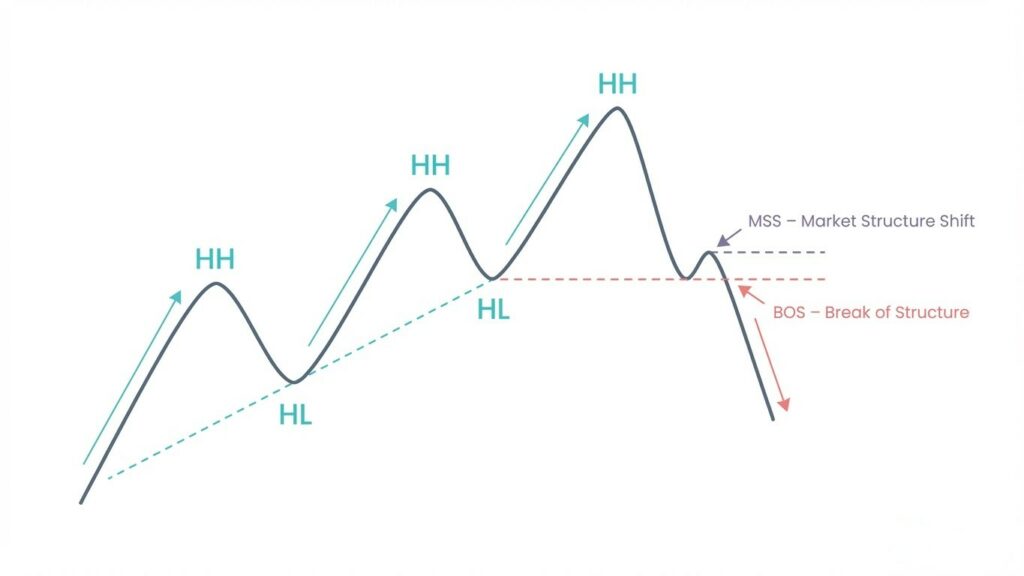
How Market Structure Defines Trends (Not Indicators)
Market structure is one way traders examine price direction without relying exclusively on technical indicators.
An upward trend commonly involves a sequence of higher highs and higher lows, while a downward trend often involves lower highs and lower lows.
When price movements overlap without establishing a clear directional sequence, the market may be ranging or transitioning between conditions.
Technical indicators can provide additional information about momentum, volatility or trend direction. However, neither market structure nor indicators can reliably predict future price movements.
Indicators respond after the market structure has already formed. That’s why professionals treat indicators as secondary tools, a principle reinforced in Why Indicators Don’t Predict Price.
Change of Character (ChoCH): Recognising Potential Structure Changes
Change of Character (ChoCH) is the term employed by some trading setups in the field of price action trading in describing possible alteration in the prevailing market setup.
In the case of an uptrend, a break below a previous higher low could indicate a possible early warning of the weakening of a bullish market setup.
Nevertheless, a ChoCH is not a confirmation that a reversal will take place. There could still be consolidation of the price, recovery, or even continuation of the prevailing trend.
Therefore, traders must put into consideration the overall market condition and risk parameters instead of taking it as a trading signal.
Internal vs External Market Structure
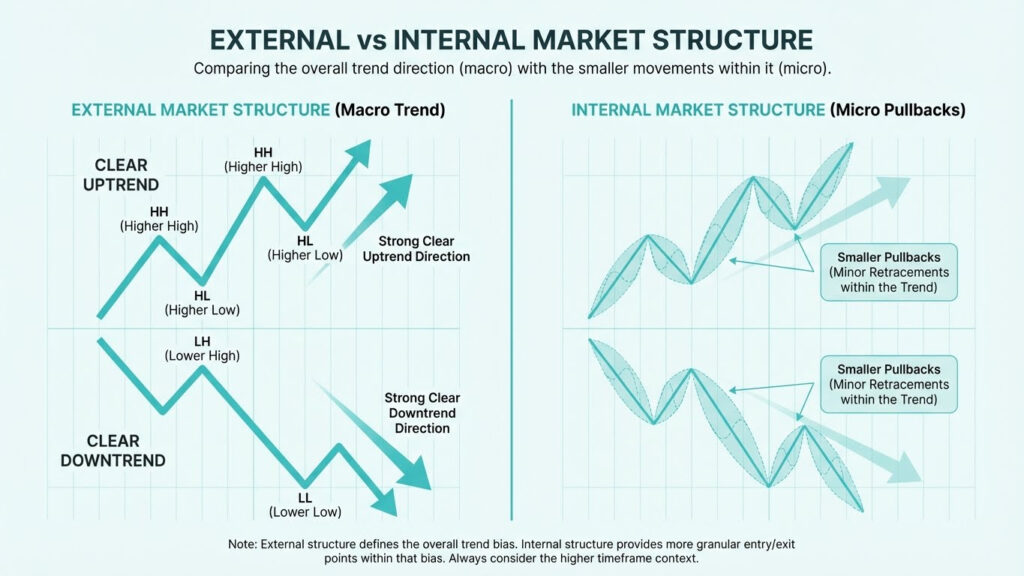
Market structure can be examined at different levels of detail.
External market structure generally refers to the more significant swing highs and lows used to identify the broader price trend.
Internal market structure describes smaller price movements and fluctuations that develop within that broader structure.
For example, a market may display a series of lower highs on a shorter timeframe while maintaining an upward trend on a higher timeframe.
Understanding this distinction can help traders avoid interpreting every short-term movement as a major trend reversal.
Trading against a dominant Market Structure often leads to emotional decision-making and revenge trading, as explained in Revenge Trading Explained.
Why Market Structure Matters in Forex and CFD Trading
In trading forex and CFDs, leverage may be used, which means the profits and losses will be amplified compared to the capital used as margin.
Knowledge of market structure will allow traders to find the right prices for their trades, evaluate market condition and determine where the trade idea is no longer valid.
Nevertheless, structural levels cannot ensure that the stop-loss order is executed at the desired price due to market gaps, volatility, and slippage.
Market structure should be taken into account along with position sizing and exposure levels.
Common Beginner Mistakes With Market Structure
Novices may incorrectly perceive market structure in that they may analyze the changes in individual prices without regard to the overall trend.
Some errors include interpreting any breakout from a swing high or low as a reversal without considering the higher time frame and inconsistent drawing of structural levels.
It is also incorrect to assume that market structure needs to be given preference over all other signals in case of contradiction between various technical indicators.
Market structure is an important tool for analysis, although it is not an insurance of future price direction.
How Traders Can Use Market Structure in Practice
The market structure can be used by traders to determine the direction of price action, analyze possible change in trend, and find possible areas of support and resistance.
It could also assist in establishing trading rules for entry/exit and possible rethinking of the trading idea.
Market structure is applied in different ways depending on the type of trading strategies and approach to analysis.
Conclusion: Market Structure Is the Language of Price
Market structure gives a way of understanding how price travels to one top after another and one bottom after another.
Through identifying higher tops, higher bottoms, lower tops and lower bottoms, beginners can get better at understanding trends, ranges and changes in market conditions.
However, market structure is not a full trading approach by itself. It needs to be used along with proper risk management, broader market analysis and understanding of uncertainty.
The key point here is that market structure helps traders understand what price has done, but not what price will do next.