


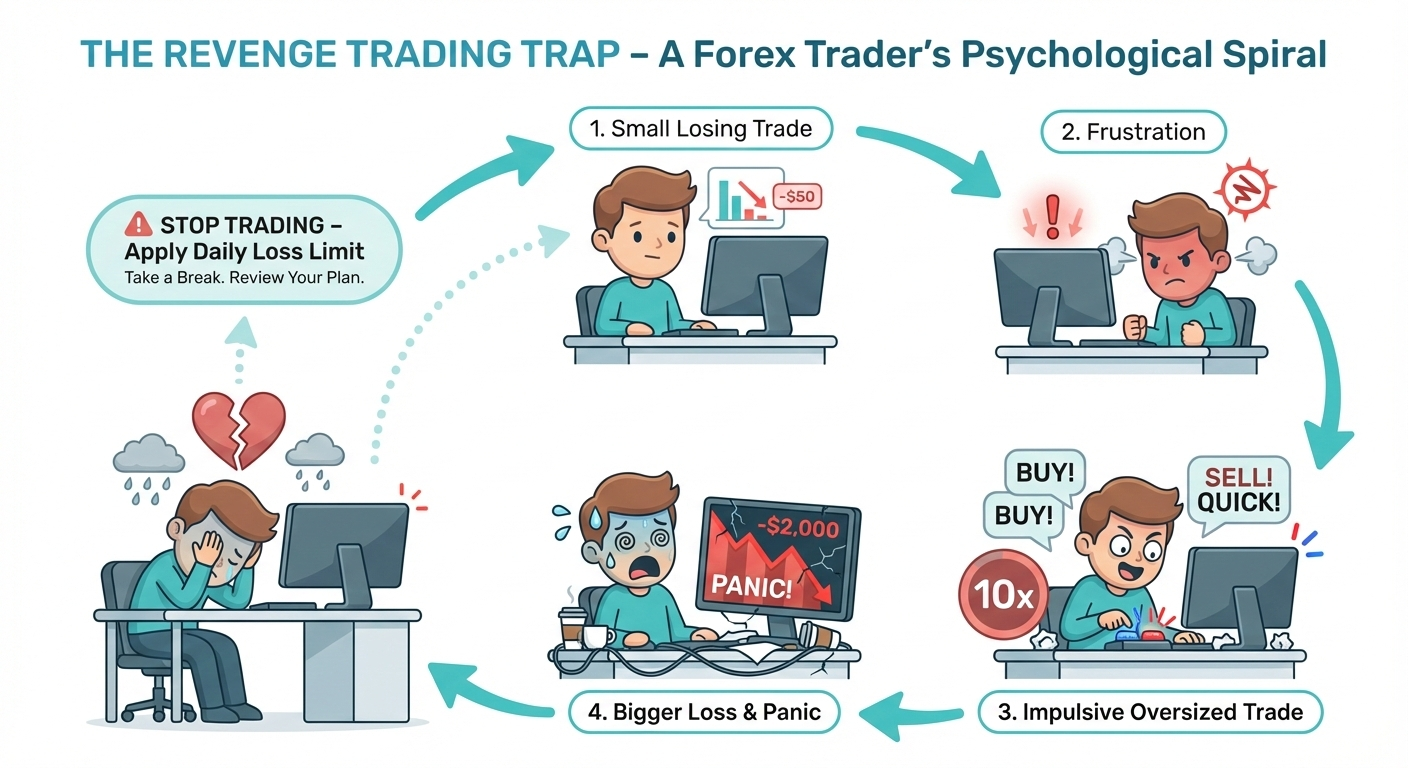
Revenge trading may transform a minor trading loss into an array of spontaneous actions. After sustaining a loss, the trader feels compelled to earn back the money instantly instead of sticking to his or her usual trading strategy.
In case you've ever placed another trade from rage, enlarged the size of your position or broken through the boundaries of the risk you can take due to wanting to make your money back fast, then you have definitely been involved in revenge trading.
The phenomenon is especially dangerous in the highly leveraged Forex and CFDs markets, where losses tend to pile up very fast.
What Is Revenge Trading in Trading Psychology?
Revenge trading takes place when a trader makes hasty trade decisions to get back his losses from past trades.
The trader does not evaluate the next move against the trading strategy but decides out of frustration or an attempt to take control.
For instance, if a trader loses money in one trade, he can decide to open another trade with more volume size to recoup the lost money.
Revenge trading is therefore highly associated with emotions, loss aversion and inadequate risk management. It should be noted that starting a trade after losing a trade does not necessarily mean revenge trading.
Why Revenge Trading Is So Common Among Beginners
Revenge trading is particularly common among beginners because trading losses can trigger strong emotional reactions before disciplined habits have fully developed. The desire to recover money quickly can override a trading plan, leading to rushed decisions, increased risk, or trades you would normally avoid.
Understanding these emotional triggers is an important step towards recognizing revenge trading before it affects decision-making.
Loss Feels Personal Instead of Statistical
Many beginners attach identity to outcomes.
Losing a trade feels more like a personal setback than just a regular business cost. This emotional angle can increase urgency and impatience, which can lead to revenge trading
This behavior is linked to loss aversion, a concept widely discussed in behavioral finance. It explains why losses often feel stronger than the satisfaction of winning.
Loss aversion, trader mindset, emotional attachment
Leverage Intensifies Emotional Pressure
Leverage enables investors to have a bigger market exposure by using a smaller amount of margin deposit.
Nevertheless, leveraging increases both profits and losses in proportion to the amount of capital used. Thus, in the case of Forex or CFD trading, even slight market changes can affect the balance in your account.
As soon as losses begin piling up fast, traders might experience more pressure to recoup their money, making them more vulnerable to rash trading decisions or exceeding predetermined risk thresholds.
The knowledge of how leverage works is one of the key aspects of comprehending why revenge trading is so detrimental.
Common Signs of Revenge Trading
Revenge trading is not always obvious in the moment. One of the clearest warning signs is a sudden change in behavior after a losing trade. Decisions may become faster, more emotional, or less consistent with the trader’s usual strategy and risk rules.
Recognizing these changes early can help traders distinguish a planned trading decision from an emotional reaction to a loss.
Behavioral Warning Signals
You may be revenge trading if you:
- Enter a trade immediately after a loss
- Increase lot size without recalculating risk
- Ignore stop-loss placement
- Trade outside your plan
- Feel rushed, angry, or desperate
Revenge trading can turn a single managed loss into several uncontrolled losses.
Why Revenge Trading Destroys Trading Accounts
Revenge trading can turn a manageable loss into a much larger one. When traders increase position sizes, take unnecessary trades, or abandon their normal risk limits, their overall market exposure can rise quickly.
The greater danger is often the cycle that follows. One emotional trade can lead to another, making it increasingly difficult to follow a structured trading plan and control risk.
A single loss does not necessarily threaten an account. Repeated decisions made without disciplined risk management can.
How Revenge Trading Undermines Risk Management
The revenge factor can cause a trader to ignore pre-defined risk levels and expand trade size or trade positions without reasons. All this might lead to bigger losses than those the trader was willing to incur initially.
The trading plan cannot ensure there will be no losses, but correct risk management can help avoid bigger ones. Once you break risk rules, probability collapses. This principle ties directly to Risk Per Trade Explained. Protecting capital, managing risk responsibly, and ensuring long-term account survival.
It Creates a Psychological Spiral.
Frustration leads to an impulsive trade, which can lead to a larger loss and even stronger emotions.
This loop quickly multiplies the damage. Many accounts fail not because the strategy is bad, but because traders lose emotional control during stressful moments. This behavioral loop gets tackled structurally in the article Process Focused Thinking for Consistent Trading
Revenge Trading vs Professional Trading Mindset
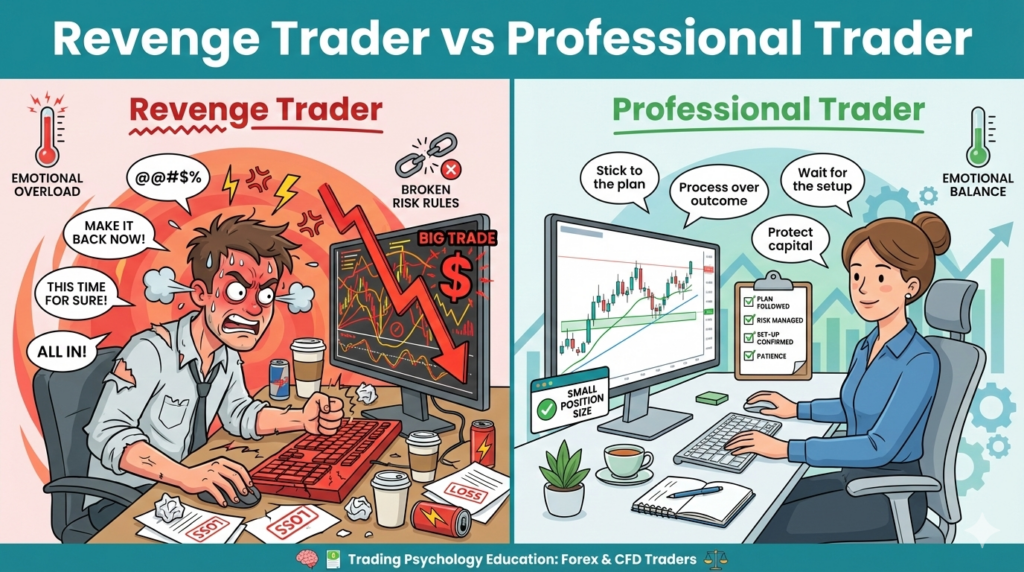
The difference often comes down to how a trader responds to a loss. Revenge trading is driven by the urge to recover money quickly, while a disciplined trading mindset focuses on following a predefined process regardless of the previous trade’s outcome.
A loss does not automatically require another trade. A more structured response is to review what happened, reassess market conditions, and only trade again when the next setup meets the trading plan.
How Disciplined Traders Approach Losses
A disciplined approach to trading may involve:
- Accepting that losses are a normal possibility in financial markets.
- Reviewing whether a trade followed the original plan.
- Maintaining predefined position-sizing and risk limits.
- Avoiding new trades made primarily out of frustration.
- Taking a break when emotions begin affecting judgement.
- Evaluating trading performance across multiple decisions rather than one result.
These practices can support more consistent decision-making, but they do not guarantee profitability or eliminate market risk.
How to Stop Revenge Trading (Practical Framework)
Stopping revenge trading is easier when you decide your response to a loss before emotions take over. Instead of relying on willpower in the moment, traders can use predefined rules that limit risk, create time to reassess and prevent one losing trade from influencing the next decision.
The aim is not to avoid losses completely. It is to prevent a normal trading loss from turning into a series of emotionally driven decisions.
Rule 1: Don't Increase Risk to Recover Losses
Do not increase your position size merely because you lost money on your last trade. Your position size should be according to your predetermined risks. This rule protects mathematical expectancy, as referenced in Position Sizing Explained Without Confusion.
Rule 2: Set a Maximum Daily Loss Limit
A pre-defined maximum loss per day can assist traders in determining when they should stop trading.
For instance, the trader could set his own loss limit in accordance with his capital and risk appetite. When this limit is reached, he stops opening any more trades for that day.
There is no universal percentage that works for all people, and the pre-planned percentage cannot assure that losses will be limited by it, especially in case of volatile market environment or slippage.
Rule 3: Avoid Unnecessary Trading
In revenge trading, one opens new positions for which there is no trading logic behind.
The practice of limiting impulsive trading will help traders to stay on track with their strategy. This behavior is dissected in teh article Overtrading Explained: Knowing When NOT to Trade.
Rule 4: Pause When Emotions Become Intense
Should feelings of irritation, anger, or even urgency start impacting your choices, you may want to step back and give yourself time before trading again.
Rule 5: Review the Process, Not Just the Profit
After a trading session, consider whether you:
- Followed your trading plan.
- Respected your risk limits.
- Made decisions based on analysis rather than frustration.
- Recognised emotional triggers before acting.
A profitable trade is not necessarily a well-planned trade, and a losing trade does not automatically indicate poor decision-making.
Why Trading Psychology Matters for Beginners
Studying technical indicators, trading strategies, and chart patterns is not enough for trading education.
Beginners must also learn how emotions, cognitive biases, and risk-taking behavior might affect their decisions. Awareness of revenge trading, overtrading, and impulsive behavior may assist traders in developing a better structure of their market analysis and risk management.
But without psychological control, none survive long-term. That’s why we stress structured learning paths on the VARIANSE Academy education page.
Practical execution should always start in a safe space, like the demo Varianse trading account page.
Conclusion: Understanding and Avoiding Revenge Trading
Revenge trading happens when the motivation to reclaim losses starts playing a role in the decision-making process. It could result in impulse trades and bigger positions than necessary.
In the case of beginners, being aware of their emotional triggers and defining risk rules in advance are vital steps in the right direction.
Nevertheless, discipline does not remove financial risks or ensure profitability.








