


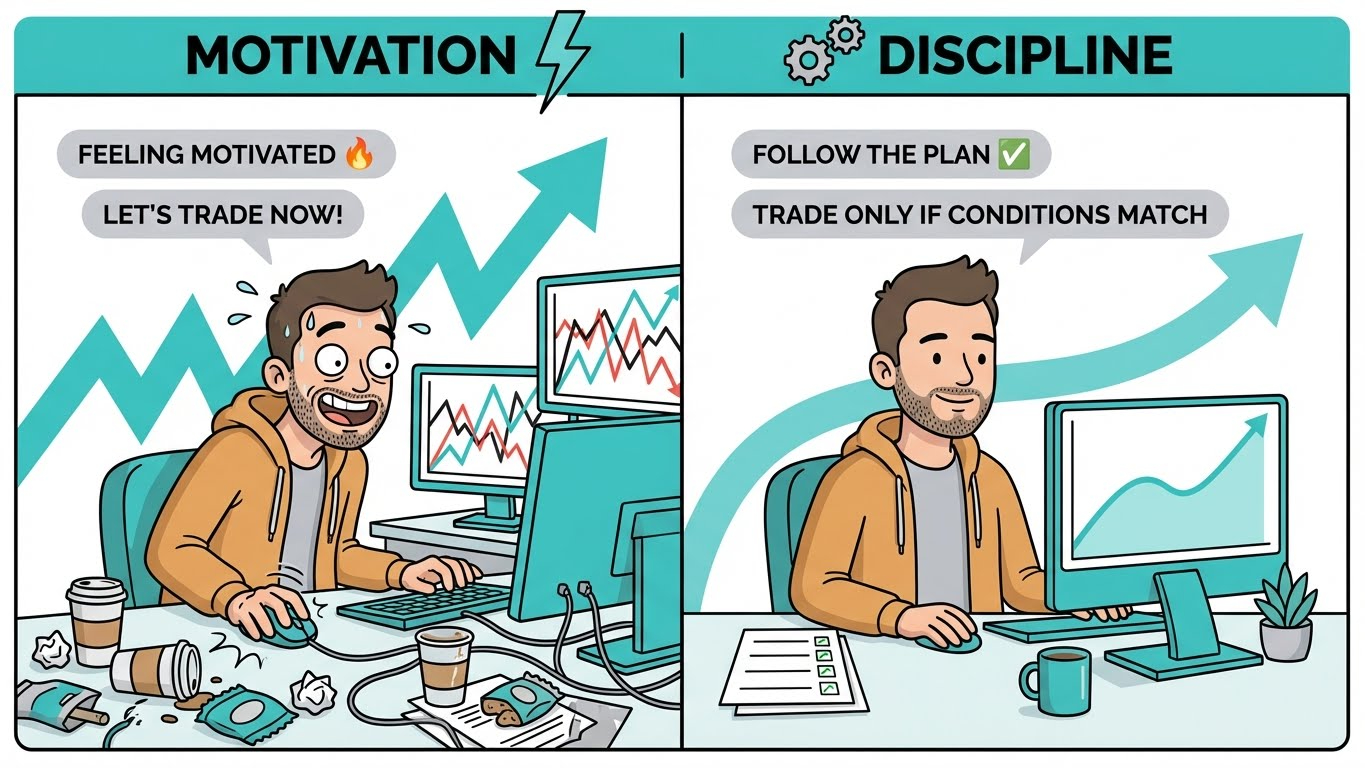
Many beginners enter Forex and CFD trading with enthusiasm, curiosity, and the motivation to learn something new. However, maintaining that enthusiasm can become difficult when markets are uncertain, losses occur, or progress feels slow.
This is where the difference between motivation vs discipline in trading becomes important. Motivation can encourage traders to begin learning, while discipline helps them follow structured routines, manage risk, and evaluate decisions even when emotions fluctuate.
Comprehending the impact of these two elements on behavior is an essential step towards creating trading psychology and better decision making skills.
What Is Motivation in Trading?
Motivation is that feeling inside you when you’re excited, hopeful, or determined to do something different. It’s often strongest at the beginning because it builds initial momentum.
For trading, motivation can be sparked by curiosity about the stock market, skill-building, or the desire to learn more about trading.
An initial passion for trading can motivate individuals to learn about market behavior and even risk management techniques.
Why Motivation Breaks Down Under Market Pressure
Motivation can fluctuate when traders face uncertainty, unexpected losses or periods of limited market activity. Understanding how these experiences affect emotions helps explain why relying on motivation alone may not be enough to maintain consistent trading habits.
Motivation Depends on Emotional Feedback
Motivation tends to grow when things are going well. When traders experience losing streaks, drawdowns, or slow markets, motivation often drops. Markets don’t always provide emotional reinforcement, so relying on motivation alone can make consistency difficult.
The uncertainty in market outcomes makes it difficult to develop a continuous learning habit because you have to be motivated only by success.
Motivation Can Encourage Unnecessary Trading Activity
Enthusiasm might at times lead to pressure to act on one’s part, especially when traders perceive movement as a positive aspect. This may prompt rash entries, or unnecessary trades based on fear of missing out.
Trading success depends as much on knowing when not to trade as on knowing when to take action. That’s why we tackle overtrading head-on. Overtrading Explained.
What is Discipline in Trading?
Trading discipline refers to adherence to the well-thought-out trading strategy and risk management guidelines despite any emotional or market pressure created by circumstances.
It includes being patient enough to look for good trading opportunities, obeying position sizing guidelines, evaluating decisions and understanding when one should not trade.
Discipline is not about neglecting emotions or adhering to poor rules forever. It is about making decisions through an orderly process but always being ready to re-evaluate this process.
This principle ties closely with the concept of Process-Focused Thinking for Consistent Trading.
Why Discipline Matters More Than Motivation in Forex & CFD Trading
In Forex and CFD trading, market uncertainty, leverage and emotional pressure can make disciplined decision-making particularly important. While motivation may fluctuate with trading results, discipline helps traders follow predefined rules, manage risk and maintain a structured approach during both winning and losing periods.
Discipline Survives Losing Periods
Trading losses are statistically inevitable. Even strong strategies experience drawdowns. Motivation can drop during these periods, but discipline keeps traders following their system.
Trading discipline protects capital, maintains confidence, and stabilizes decision-making when emotions fluctuate.
This principle is supported by structured risk frameworks such as Risk Per Trade Explained Using the Fixed Percentage Model.
Discipline also involves understanding the risks associated with financial markets. The Financial Conduct Authority (FCA) provides guidance on investment risks and potential returns, highlighting why traders should consider their risk tolerance and potential losses before making financial decisions.
How Discipline Can Help Manage Cognitive Biases
Trading strategies may be impacted by cognitive bias, such as overconfidence, loss aversion, recency bias, and confirmation bias.
Pre-set trading rules, decision-making criteria, and regular performance appraisals might aid traders in identifying these biases and minimizing their impact.
Nevertheless, discipline will not be able to overcome cognitive bias entirely, especially during leveraged trading of Forex and CFD instruments in a state of emotions.
Motivation vs Discipline – A Realistic Comparison
Motivation-Driven Trading Behavior
Motivation-driven traders base their decisions on mood and confidence levels. They switch strategies frequently, measure wins by immediate cash flow, and struggle emotionally when things slow down. Their performance varies depending on how they’re feeling. This kind of unpredictability is why traders often go through ups and downs and lose consistency in their trading.
Discipline-Driven Trading Behavior
Discipline-driven traders follow structured routines, evaluate performance objectively, treat losses as feedback, and improve gradually over time.
Their emotions do not control their actions. Frameworks like Process-Focused Thinking for Consistent Trading and consistent trading habits support this stability.
Discipline Is a Skill, Not a Personality Trait
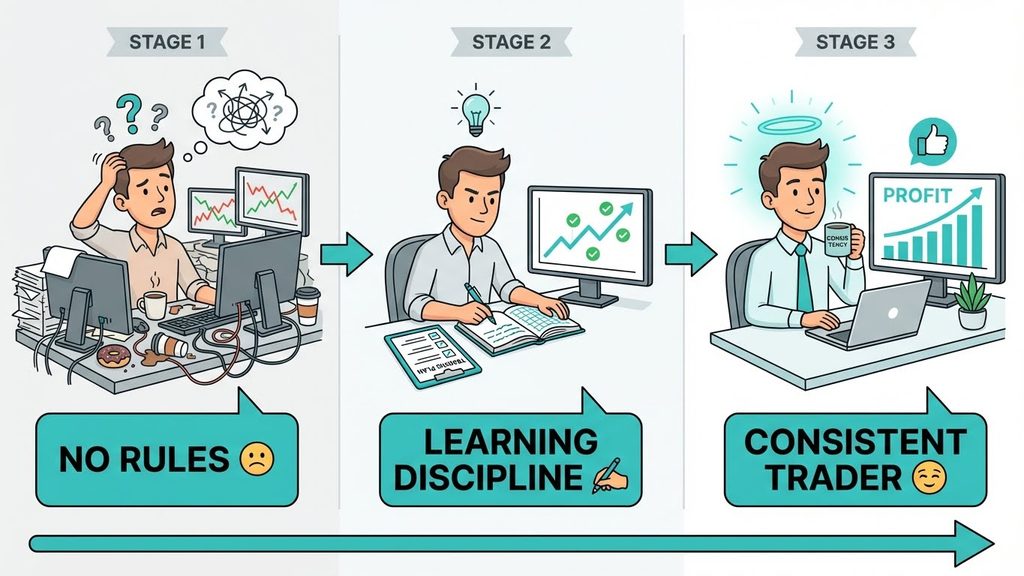
Trading discipline is something that is achieved through practice and routine reflection.
By developing predetermined trading rules and by learning from errors and documenting decisions, a trader can identify emotional triggers and avoid making unnecessary decisions.
This will improve decision-making processes although not necessarily lead to profit and financial safety.
This behavioral training helps traders understand the balance between motivation and discipline in trading within the VARIANSE Academy psychology framework.
Building Discipline Without Relying on Motivation
Development of trading discipline should start from the creation of the system which doesn’t rely completely on the trader’s enthusiasm or trading results.
For instance, traders can set up entry and exit rules, determine risk levels and maintain trading journal. Additionally, preparation for the market situation and emotional triggers may be considered helpful in reducing impulsive behavior.
The point here is not in trading every day or obeying the trading rules. The objective is in building a repeatable decision-making system which can be assessed and corrected.
Conclusion: Motivation vs Discipline in Trading
Motivation drives individuals to take interest in studying financial markets, while discipline enables individuals to keep themselves organized despite changes in motivation.
In Forex and CFD trading, both play an important role. Motivation is helpful in learning and curiosity, while discipline is useful in making well-thought decisions and proper risk management.
Neither motivation nor discipline will ensure success in trading. But knowing the difference between them will be helpful for beginners in trading.








