
If you’re digging into trader psychology, you’re probably realizing something most beginners stumble over: it’s not just the market that’s tough; it’s how you react to it as well. Charts can be learned. Platforms can be learned. Sometimes the biggest setbacks happen because traders act too quickly, get frustrated, become overconfident, or try to recover from a bad day too fast.
Trader psychology is about understanding how emotions, habits and cognitive biases influence trading decisions. It involves recognising when fear, frustration, excitement or overconfidence may affect judgement and developing a structured approach to managing those influences.
Psychology of traders is a key element in the comprehension of trading behavior for novices.
What Trader Psychology Means In Real Trading
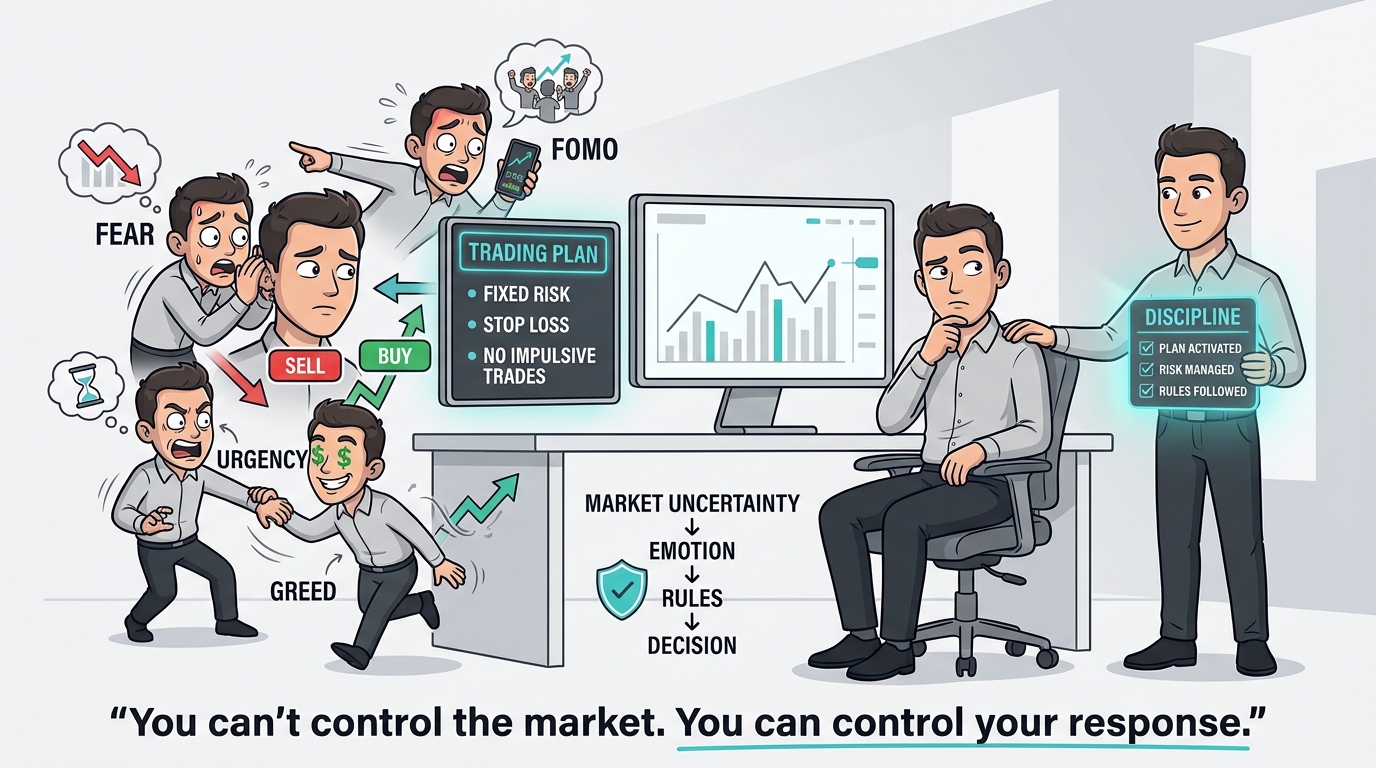
Trader psychology isn’t just about being overly optimistic or fearless. It is the ability to stick to a plan even when emotions like stress, excitement, or frustration show up.
In real-life trading, your mindset shows up in small actions: sticking to your stop-loss, sizing trades correctly after a loss, stepping away when emotions rise, and handling a normal losing streak without panic.
Why Do Beginner Traders Lose Money?
Reasons for losses incurred by beginners include market risk, high levels of leverage, transaction cost, and inefficiency of strategy and risk management.
Psychological issues may also play a part. Traders might get out of trades in fear or get overconfident and take on too much risk. Losing frustrations could lead to revenge trading.
Learning about this kind of behavior doesn’t make trading any less risky, but it can allow traders to identify emotion-based decisions.
Trading psychology is important, but emotional discipline alone cannot eliminate financial risk. The Financial Conduct Authority (FCA) explains why understanding investment risks, potential losses and personal risk tolerance is essential before making financial decisions.
Pillar 1 — Emotional Triggers: The Fastest Way to Break Your Rules
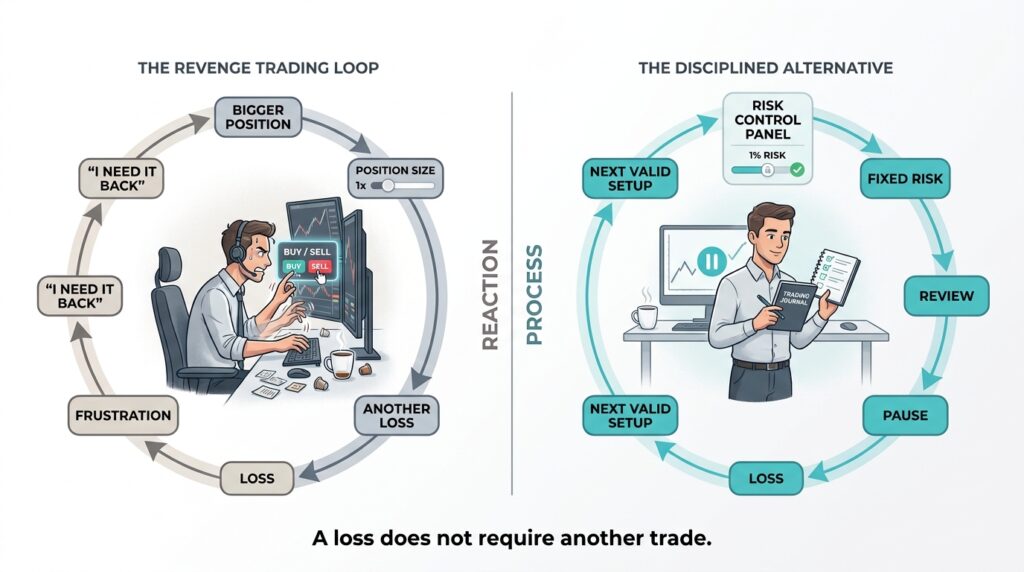
Emotions that could trigger trading include fear, greed, frustration, boredom and fear of missing out.
A trader might rush into a trade after experiencing a sudden movement in prices, enlarge his position after having made several profitable trades or make up for the loss in a previous trade right away.
Acknowledging these triggers could be helpful for a trader to stop and consider if a certain decision he has made was driven by emotions or by the trading strategy itself.
The most common triggers beginners experience
Markets move slowly, and traders get bored. Each of these emotions can push traders away from disciplined decision-making and into reactive behavior.
In Revenge Trading Explained the author describes the revenge-trading cycle as a psychological spiral rather than a way to regain control.
Pillar 2: Motivation vs Discipline — Building Consistent Habits
Motivation helps traders get started, but it fades when the market slows or gets frustrating. Trading discipline becomes important when confidence drops.
Why Discipline Beats Motivation in Trading
Trading discipline means adhering to pre-established rules regarding analysis, sizing, and risk management despite any fluctuations in emotions.
A systematic approach will help avoid any spontaneous actions and avoid changing the trading system. However, discipline alone cannot help generate profit using an inefficient strategy.
In the article Motivation vs Discipline in Trading, they explain that being consistent is more about learned habits than just who you are as a person
Pillar 3: Process Focused Thinking — Looking Beyond Profit and Loss
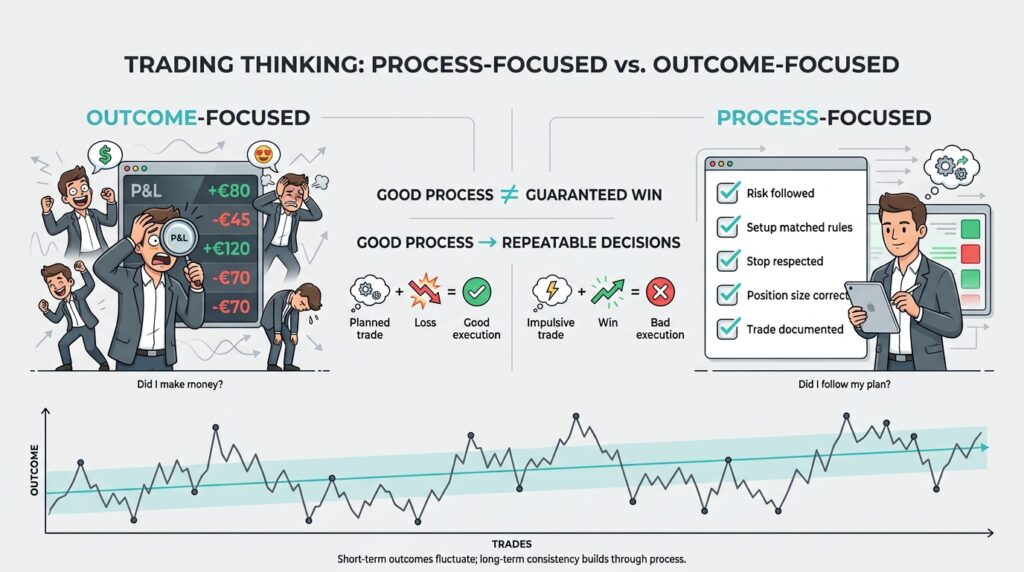
Outcome-driven investors can assess each trade on the basis of profits and losses, whereas process-driven traders assess both the profit/losses and whether the trading decision adhered to any plan.
A well-thought-out trade may lead to losses, whereas a spur-of-the-moment one may lead to occasional gains. This does not mean that the decision was right or wrong.
Analysis of both can help traders develop some behavioral insights into themselves.
Why Focusing On The Process Keeps You Safe In Markets Where Things Are Unpredictable
Sometimes a good trade loses. Sometimes a poor trade wins. When traders focus too heavily on results, emotions begin to influence their decisions. When traders focus on the process, they strengthen their ability to make consistent decisions.
This way of thinking comes from the article Process-Focused Thinking for Consistent Trading in Forex & CFDs where it’s all about taking control of your actions instead of just looking at the immediate outcomes
Pillar 4: Overtrading: That Sneaky Behavior That Chips Away at Your Self-Control
Trading too often doesn’t feel like a blunder in the moment. It can feel like productive activity, but markets don’t reward activity; they reward good decisions and patience.
Why Is Overtrading More About Our Mindset Than Our Trading Plan
Overtrading happens when there are more trades than are warranted by the trader’s strategy and risk management practices.
Some of the possible motivations behind overtrading include boredom, fear of missing out, overconfidence, and even the urge to recoup past losses.
Regularly making trades means higher transaction costs and greater exposure to the market and making spur-of-the-moment decisions. But the mere fact that one engages in regular trading does not make it overtrading.
This is covered in the link Overtrading Explained, where it’s seen as a smart move, not a lack of confidence
A Simple Psychology Guide You Can Actually Use
This is the simplest way to turn psychology into rules—without pretending emotions won’t show up.
Rule 1: Know When Not to Trade
If you’re emotionally unsettled, market conditions are unclear, or you’re trading simply to feel better, avoid trading. This single rule prevents many beginner mistakes.
Rule 2: Pause After Emotional Decisions
Take a breather after a tough loss or after a thrilling win. Taking a break after an emotionally significant win or loss can provide time to reassess your decisions before considering another trade.
Rule 3: Review the Process, Not Just the Outcome
Impulsive trading that turns a profit isn’t necessarily smart trading. On the other hand, a small, planned loss can actually be a sign of good trading. Building long-term consistency takes time and steady effort
How Beginners Can Practise Trader Psychology
Trader Psychology can be studied through observations and exercises without actually putting money on the line.
Novice traders can try writing down their virtual trading actions and determine if there are any emotions that trigger their actions and if these actions align with the pre-defined rules.
Another way for learning traders to detect repeated behavior is by maintaining a trader journal. For more structured learning, explore VARIANSE Academy, which provides educational resources covering trading concepts, market analysis and risk management. VARIANSE trading account page provides a safe environment where beginners can practice trading without risking real money.
Conclusion: Why Trader Psychology Matters
A trader's psychology is very essential in determining the reaction of a beginner to any form of uncertainty.
Having knowledge of emotional triggers and having good discipline, together with decision-making without considering personal gains or losses, could be of great help.
Nevertheless, being disciplined alone does not ensure any success or that the risk will be absent from the market.
The most important thing here: Successful trading psychology is not based on getting rid of emotions, but on being aware of them and making sure when one should stop.