


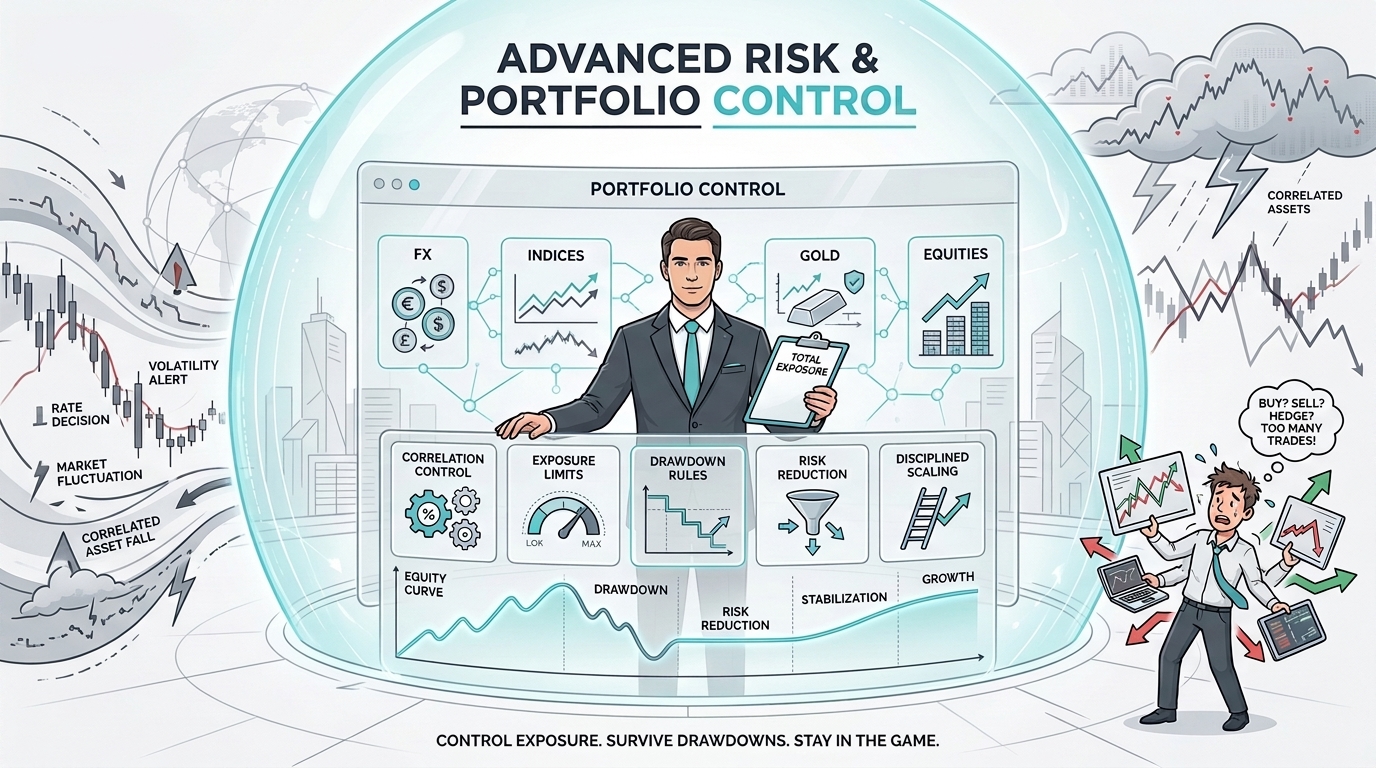
Most traders think risk management means setting a stop-loss and choosing a lot size. Professionals think differently.
Advanced risk & portfolio control is about managing total exposure across all positions, across time, and across market conditions. It is the difference between a trader who survives drawdowns calmly and a trader who gets wiped out while believing they were “only risking 1% per trade.”
This parent guide connects the full framework and links to your core child lessons for implementation: correlation control, losing streak survival math, equity curve management, scaling discipline, and strategic risk reduction.
What Advanced Risk & Portfolio Control Really Means
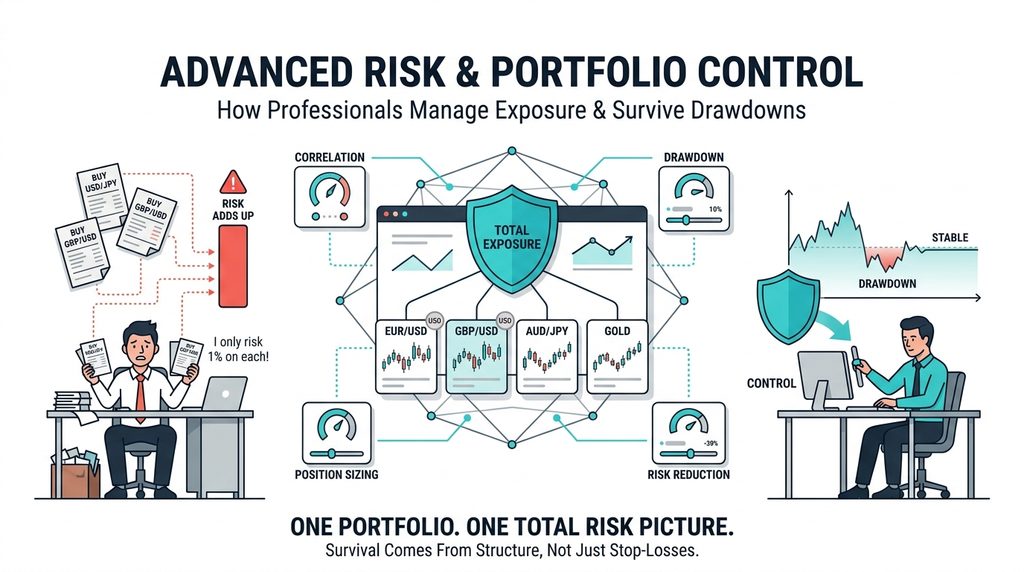
What It Really Means: Advanced risk isn’t just “lower risk.” It’s about having a better risk structure
It answers questions most traders ignore:
- How much portfolio exposure do I have to one macro driver (USD, risk-on, rates)?
- What happens if correlated trades lose together?
- How does my equity curve behave during volatility shifts?
- Do my scaling decisions increase risk or express controlled structure?
- When should I reduce exposure before damage compounds?
A professional mindset starts with one principle: A trading edge is meaningless if the portfolio cannot survive volatility. If you’re curious about the basis of this, take a look at What Is a Trading Edge?
The Five Systems That Make Up Portfolio Control
Portfolio management isn’t one-size-fits-all. There are five interconnected systems.
1) Correlation & Hidden Exposure Control
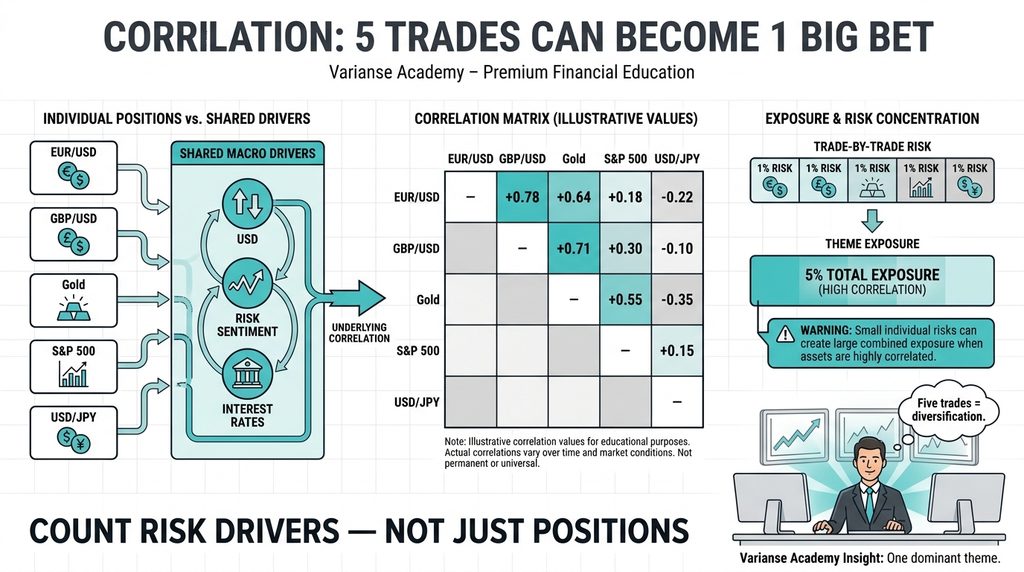
Many traders believe diversification means trading different charts. That’s not diversification.
If you trade multiple USD-linked pairs, index exposure, and gold at the same time, you might be making one big macro bet. That’s how a tiny risk per trade can hit your whole investment portfolio hard.
To get the lowdown on correlation clusters, false diversification, and how experts limit their theme exposure, check out this link Correlation & Risk Management.
2) Surviving a losing streak? - The Mathematics of Survival
Even profitable trading strategies can experience consecutive losses. The real challenge is not avoiding losing streaks, but managing risk so your account can withstand them.
Understanding the mathematics of trading survival helps prevent manageable drawdowns from becoming significant account losses.
Key principles include:
- Fixed risk per trade: Limiting the percentage of capital exposed on each position.
- Maximum drawdown limits: Setting thresholds for reducing exposure or pausing trading.
- Avoiding recovery trading: Preventing impulsive attempts to recover losses through larger positions.
- Risk of ruin awareness: Understanding how win rate, risk-to-reward ratio and position sizing affect the probability of substantial capital loss.
If you’re dealing with a string of losses, need to understand the math behind bouncing back, and want to stay afloat in the trading world, check out this link: Trading Losing Streaks Explained.
Key takeaway: Long-term trading survival depends on controlling losses and preserving capital, not trying to win every trade.
3) Equity Curve Management & Drawdown Behaviour.
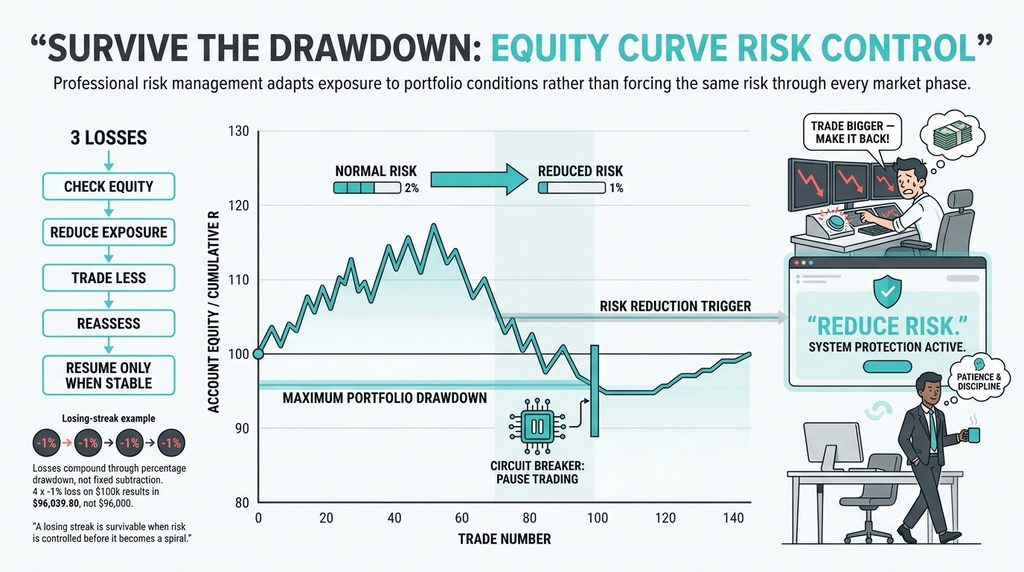
Professional traders focus on consistent performance and overall portfolio stability, not just individual trade outcomes. Equity curve management helps traders identify warning signs that could affect their trading performance, including:
- Overexposure
- Risk inconsistency
- Correlation stacking
- Volatility regime shifts
- Emotional interference
By monitoring equity performance, drawdowns, and risk exposure, traders can turn risk management into a measurable, structured process rather than relying on discipline alone. Understanding when to reduce exposure or pause trading is essential for protecting capital during challenging market conditions.
Check out this link for the managing equity curves, setting up circuit breakers, and keeping your trades smooth: Equity Curve Management.
4) Position Management Discipline (Scaling Without Gambling).
Trading quickly can lead traders to unintentionally ramp up portfolio risk, especially when emotions run high. The professional rule is simple: If the risk goes up after you get in, it’s not scaling it’s just plain uncontrolled exposure.
Scaling must be planned in advance, context-capped, and risk-controlled. It’s meant to support the equity curve’s stability, not throw it off balance.
For pyramiding rules, scaling-out logic, and the correct market context for both, read Scaling In vs Scaling Out in Trading.
5) Risk Reduction Phases (Trading Less When It Matters Most)
Effective portfolio management also means recognising when to reduce risk or step away from the markets. Professional traders may reduce exposure during:
- Drawdown phases
- Unstable volatility or news-driven markets
- Repeated rule violations
- Periods where performance deviates from expectancy
- This is not fear; it is a strategy
For a clear reduction, check out this link for insights on why dialing back on trading can actually boost your performance: Reducing Risk Trading Strategy.
A Practical Portfolio Management Workflow
Effective portfolio management requires more than monitoring individual trades. It involves understanding how positions interact, controlling overall exposure, and adjusting risk as market conditions change.
This five-step framework helps traders build a structured approach to portfolio risk management, correlation control, and drawdown protection.
Step 1 — Track Exposure by Macro Theme (Not by Number of Trades)
Rather than simply counting open positions, assess how different trades respond to the same underlying market drivers.
Key exposure themes include:
- USD exposure: Positions affected by movements in the US dollar
- Risk-on / risk-off exposure: Assets influenced by changes in investor sentiment
- Interest rate sensitivity: Positions affected by central bank policies and interest rate expectations
- Equity beta exposure: Investments influenced by broader stock market movements
- Commodity-linked currency exposure: Currency pairs affected by changes in commodity prices
Monitoring these themes helps identify hidden correlations and concentrated portfolio risk, even when positions involve different instruments.
Further reading: Correlation and Risk Management.
Step 2 — Define Portfolio Risk Limits
A structured portfolio risk management plan should establish:
- Maximum risk exposure per market theme
- Maximum total open risk across all positions
- Daily and weekly loss limits
- Maximum allowable portfolio drawdown before reducing exposure
These boundaries help prevent multiple individually small risks from combining into a significant portfolio loss. Further reading: Trading Losing Streaks.
Step 3 — Implement Equity Curve Circuit Breakers
Equity curve circuit breakers are predefined rules that help traders respond systematically when portfolio performance deteriorates.
A practical framework may include:
- Drawdown threshold: Reduce position risk by a predefined percentage when drawdown reaches a specified level
- Consecutive losses: Reduce exposure or temporarily stop trading after a predetermined losing streak
- Trading pause: Suspend new positions when portfolio risk limits are breached
- Recovery conditions: Resume normal trading only after reviewing performance and confirming that execution remains consistent with the trading plan
These rules help make drawdown management systematic rather than emotional. Further reading: Equity Curve Management.
Step 4 — Restrict Scaling to Predefined Conditions
Scaling into or out of positions should follow a documented trading strategy rather than emotional reactions to price movements.
Professional risk controls include:
- Avoid adding to losing positions outside a predefined strategy
- Establish all scaling levels before entering a trade
- Maintain maximum position and portfolio risk limits
- Recalculate total exposure whenever positions are adjusted
Effective scaling is about controlling exposure, not simply increasing position size. Every adjustment should remain consistent with the original trading plan. Further reading: Scaling In vs Scaling Out in Trading.
Step 5 — Reduce Risk Before Markets Force You To
Proactive risk reduction helps traders respond to changing market conditions before losses become difficult to manage.
Consider reducing exposure when:
- Market volatility becomes unusually high or unpredictable
- Correlations increase across previously diversified positions
- Execution quality deteriorates due to slippage or widening spreads
- Portfolio drawdowns reach predefined warning levels
- Emotional pressure creates an urge to recover losses quickly
Reducing risk does not necessarily mean abandoning a trading strategy. It means adjusting exposure to reflect current market conditions and portfolio performance. The objective is not to avoid every loss but to prevent manageable losses from becoming threats to long-term trading capital.
Common Portfolio Control Mistakes That Destroy Traders
Even experienced traders fall into these traps:
- Confusing “different charts” with diversification
- Stacking correlated positions during the same macro theme
- Scaling during drawdown phases
- Assessing the risk for each trade without considering the overall risk from open positions
- Increasing activity to recover losses faster
- The fix is always the same: structure exposure, then execute calmly
Conclusion:
Advanced risk and portfolio control transform trading from a series of isolated decisions into a structured, sustainable risk management system.
Professional traders focus on:
- Correlation exposure to identify hidden portfolio risks
- Losing streak management to limit consecutive losses
- Equity curve stability to monitor drawdowns and performance
- Scaling discipline to maintain controlled position sizes
- Proactive risk reduction to adapt to changing market conditions
Successful trading is not about being right on every trade. It is about managing risk, protecting capital, and maintaining discipline through both favourable and challenging market conditions.








