


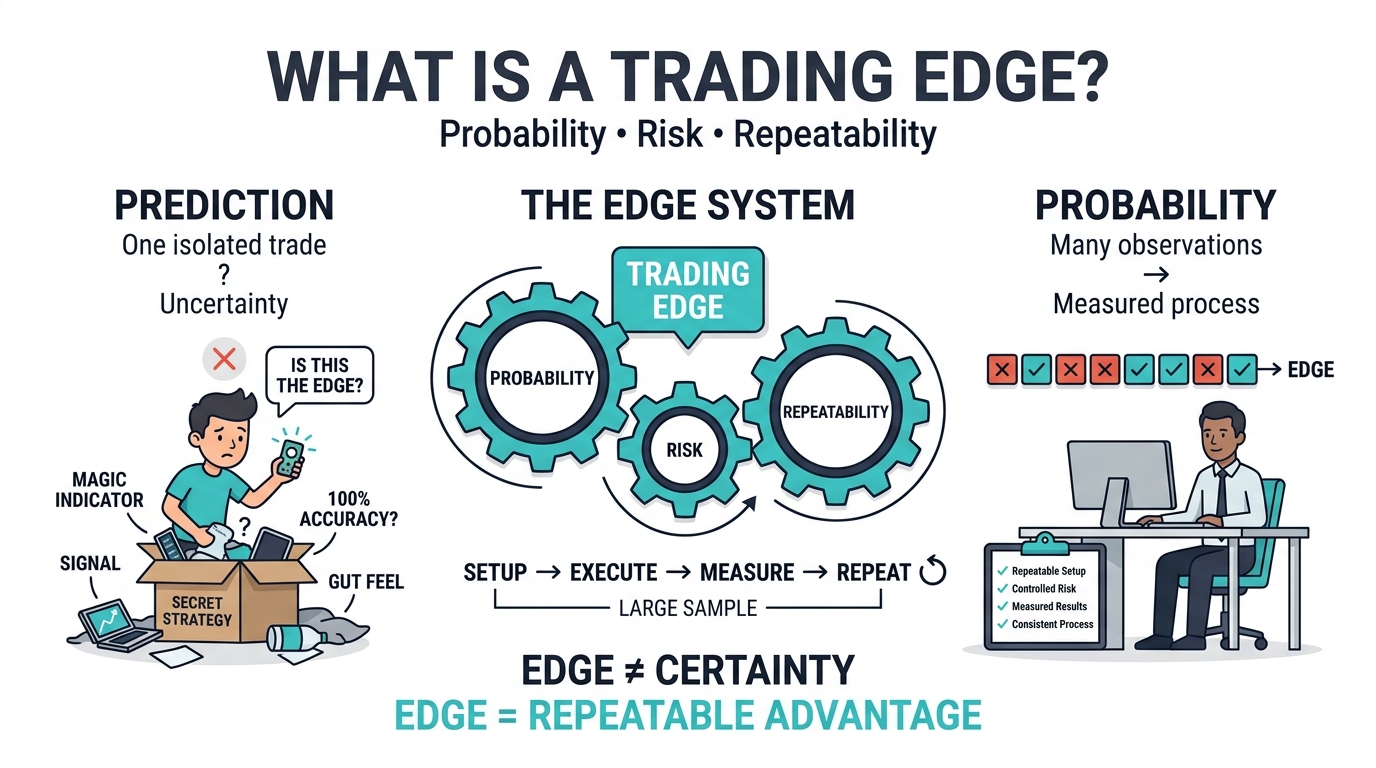
If you’ve spent time reading trading content, you’ve probably heard the term “Trading Edge” used frequently, but it’s rarely explained clearly. Signals, indicators, alerts, and even gut instinct often get called an edge, but they aren’t.
A Trading Edge isn’t a crystal ball for market forecasts. It’s not a secret plan. It’s not a sure thing for winning. A true Trading Edge is a consistent, statistical advantage that shows up across many trades — not just one setup, not just one week, and not just a stroke of luck.
This lesson explains what a Trading Edge actually means, how professionals define it, and why very few traders truly develop one.
What Is a Trading Edge?
At its core, a Trading Edge is a statistical edge. When you have a sufficiently large group of trades a meaningful sample size your strategy tends to produce positive results over time, even though each individual trade is unpredictable.
A real edge becomes clear only with time. Outcomes spread across many trades, not from a single flawless setup. That’s why tracking and reviewing your trades matters more than just throwing out your two cents. Check out Trading Performance Explained for the lowdown on the process.
A Simple Definition
A Trading Edge means that, on average, your wins outweigh your losses, while losses are controlled through structured risk management. You can keep that performance consistent across different market regimes.
To make this measurable, savvy traders watch risk, not just cash. That framework’s laid out clearly in the R-Multiple Trading Explained article, where you can see what to keep an eye on in your trading journal.
Why Most Traders Think They Have an Edge (But Don’t)
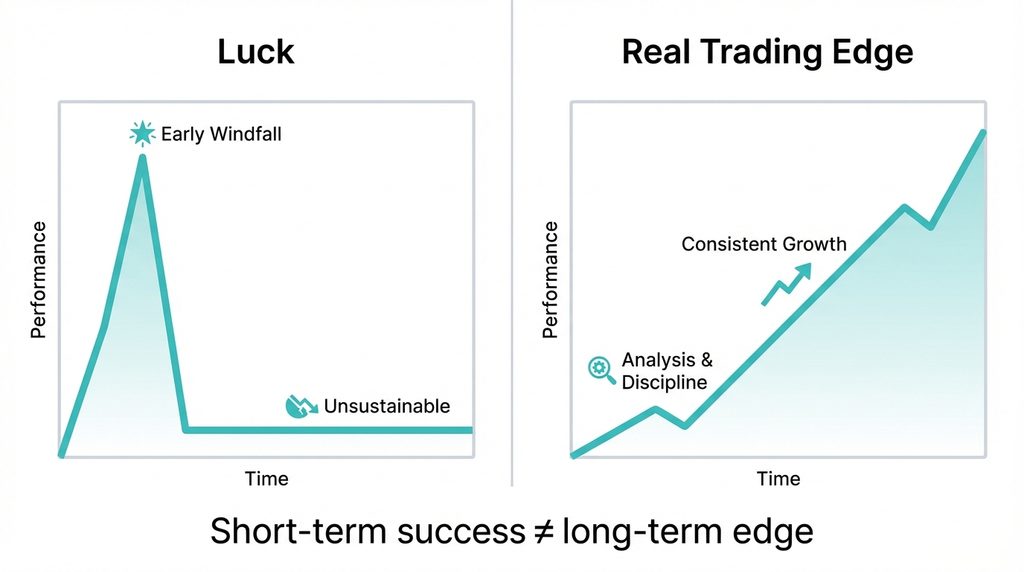
Many traders think they’re ahead of the game since they’ve been on a winning run, stumbled upon a new market signal, or just happened to jump on a big market move. None of these qualify as a real edge because they do not demonstrate repeatability across a large sample size.
That’s where traders often get caught up in their feelings. A couple of winners can boost your confidence, but that confidence isn’t just numbers. When the market changes, the “edge” vanishes because it wasn’t really put to the statistical test.
Common False Edges
A strategy tested on too few trades means too small a sample size; over-optimized backtests, one-market success applied everywhere, and discretionary decisions disguised as rules are the most common false edges.
Trading performance also collapses when traders cannot exit trades consistently under pressure, even if entries are strong. That is why Trading Edge development connects tightly with Exit Trading Strategies Explained.
The Mathematics Behind a Trading Edge
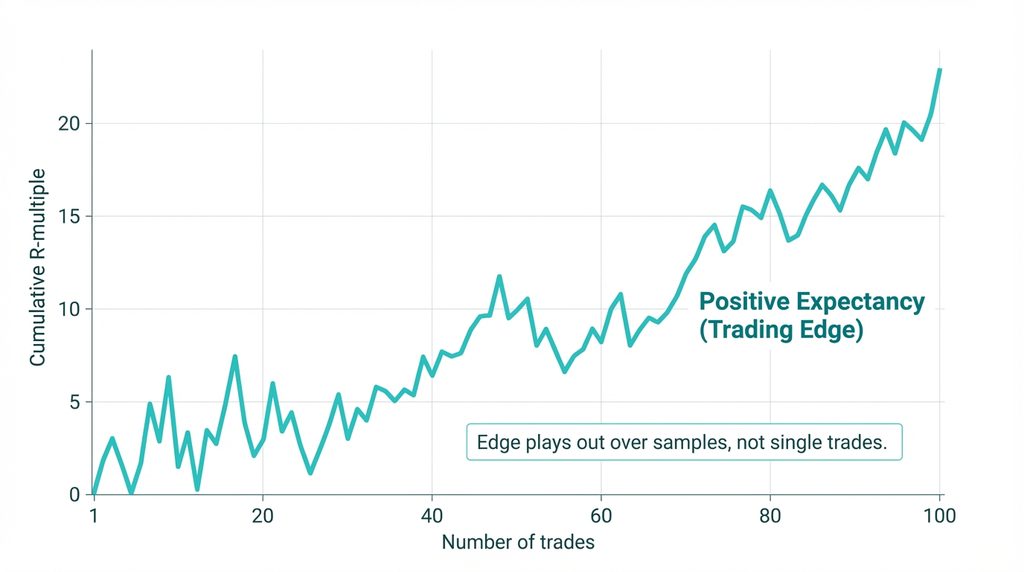
Professional traders don’t see things in black and white. They focus on expectancy and probability. Your approach tends to produce good results on average if you stick with it.
That’s why a system can still make money even if it wins less often, as long as the big wins outweigh the small ones. Expectancy isn’t just a wild guess. You calculate it by sticking to consistent risk management and using a large data sample. The practical measurement side is straight up connected to the Trading Journal Guide.
Expectancy Explained
Expectancy combines win probability, average win size, and average loss size. For example, a strategy that wins 40% of the time with a 2:1 reward-to-risk ratio can still produce a statistical edge.
When traders switch from using R to actual cash, it all gets a bit muddled. That’s why R-based tracking is key, and it’s right at the heart of Trading Edge measurement.
Why Risk Management Is Part of the Edge
A Trading Edge isn’t possible without structured risk management. Two traders can use the same setup — one sticks it out through the rough patches, while the other wipes out their account. The difference isn’t about strategy. It’s a risk structure.
Risk becomes real through stop-loss placement, position sizing, and rule enforcement. If emotions drive stop-loss decisions, the market edge disappears even when the setup looks solid. This point is backed up in the book Moving Stop Losses.
Edge-Supporting Risk Rules
Setting a fixed risk per trade, capping daily or weekly losses, sticking to a regular position size, and having a stop-loss in place ahead of time are key to ensuring a Trading Edge lasts long enough to work out over time.
If traders can’t stomach a planned loss without messing with the trade in the middle, risk management falls apart. That psychological failure point is closely tied to the Psychology of Trading.
Market Conditions and Edge Alignment
Not every Trading Edge is suitable for every situation. Some strategies perform best in trending markets with high volatility and strong momentum. Others perform better in range-bound or low-volatility environments.
That’s why understanding the context is key to trading professionally. A trader’s job is not just identifying entries — it is recognizing when their edge is active and when market conditions are unfavorable. That context discipline also reduces those forced trades, which are usually called out in the Trading Performance Explained.
Why Do Some Trading Strategies Lose Their Edge As Time Goes On
Edges can start to wear out because too many players are in the market, the economy shifts, there are fewer ups and downs, or efficiency increases across different market regimes. Retail traders usually freak out when this happens and switch up their game plans. Experts adjust their approach by tweaking exposure levels, refining filters, hitting the pause button, and double-checking their initial thoughts.
The key is in the process. Random changes destroy a statistical edge. Structured changes protect a Trading Edge through review and adjustment. That point’s laid out in the article Improving Without Strategy Hopping.
How Professionals Build a Trading Edge
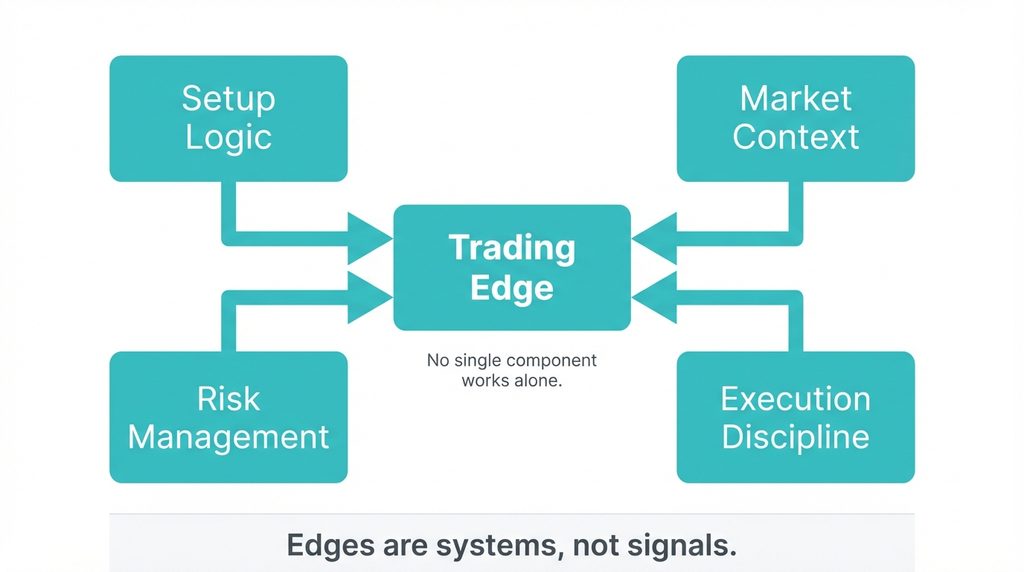
Experts don’t look for magic tricks. They refine their edge with consistent methods. They set up a system, enforce strict risk-management guidelines, monitor outcomes with a large sample size, and tweak it based on facts, not feelings.
Building a real Trading Edge needs solid review systems. Journaling and performance analysis are essential, not optional. They’re where you really hone your edge in trading, just like the Trading Journal Guide says, and they're far more important than any other strategy.
The Process
A repeatable setup is in place; risks are managed through structured risk management; we track outcomes with a large sample size; we calculate expectancy; and we tweak things without trying to make the data fit a curve.
This thing only works when things are running smoothly. If the exits aren’t consistent, the data isn’t reliable. That is why exit structure and discipline are central, and link directly to Exit Trading Strategies Explained.
What a Trading Edge Is NOT
A Trading Edge isn’t a perfect prediction; it’s not just one indicator, a bunch of signals, or a gut feeling. Plus, it’s not guaranteed.
If your “Trading Edge” relies on being right a lot, it’s pretty delicate. If it can keep making money even when it’s often wrong, thanks to probability, positive expectancy, and solid risk management, it’s legit. The gap between confidence and discipline often leaks, and it’s tied to the Psychology of Trading.
Conclusion: The Truth About Trading Edge
A Trading Edge is not discovered accidentally. You build it, test it across a meaningful sample size, and maintain it through disciplined execution. It depends on probability rather than certainty, focus rather than excitement, and structured risk management rather than prediction.
Most traders flop not because edges aren’t there, but because they’re too stubborn to think in probability and actually follow through. A true market edge comes from keeping a journal, applying disciplined risk management, and regularly checking in on progress, not from buzz, gut feelings, or quick wins.








