
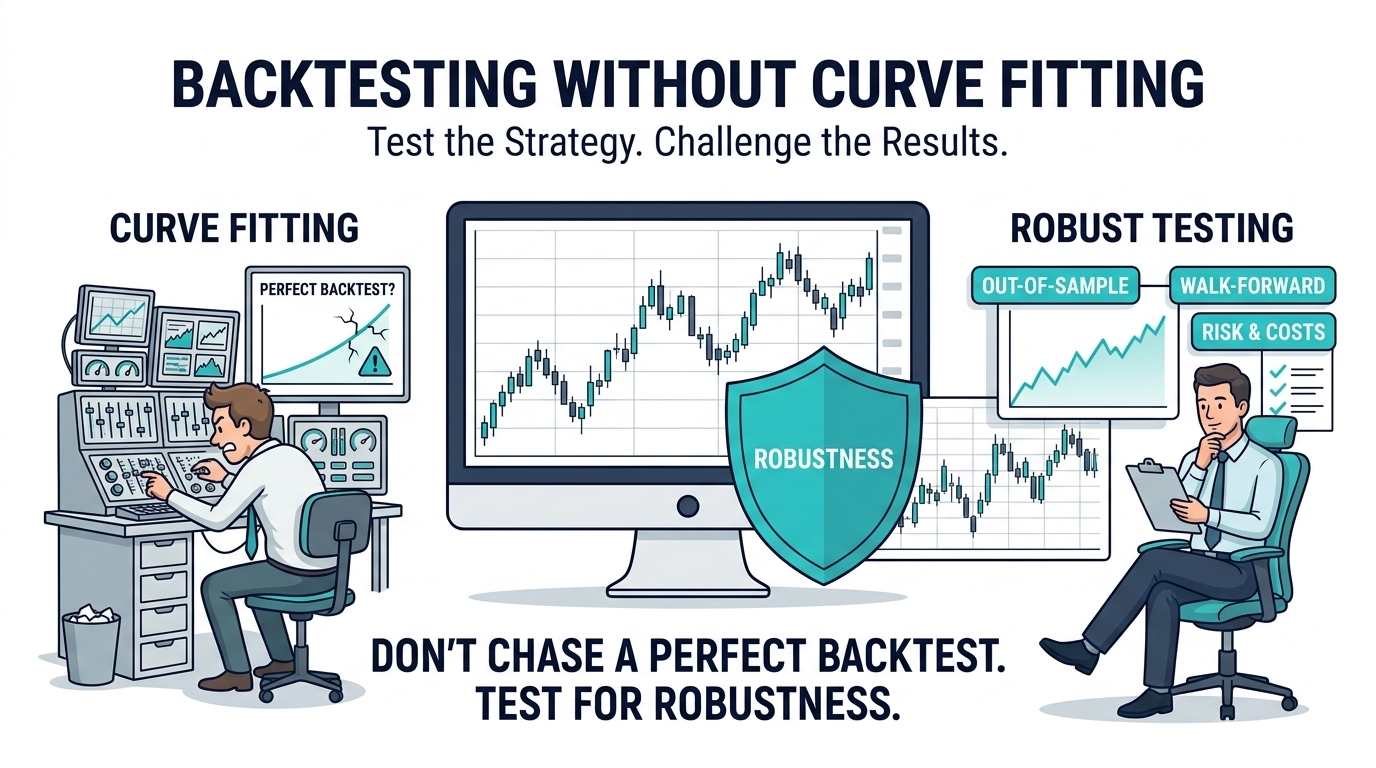
Backtesting basics without curve fitting often confuses traders. Done right, it protects you from bad ideas. Done poorly, it creates false confidence and can eventually damage your trading results.
In this guide, you’ll learn how to test trading strategies correctly, avoid curve fitting, and ensure your ideas can withstand real market conditions.
This is about real-world Backtesting, not just wishful equity curves.
What Backtesting Really Is (And What It Isn’t)
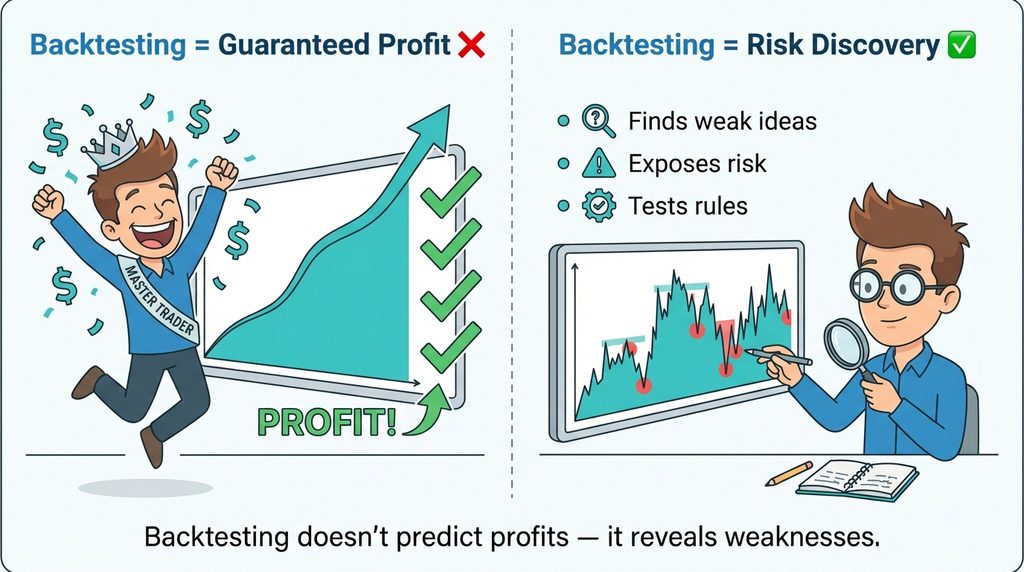
Backtesting means testing a trading strategy using historical market data to understand how it would have behaved under different market conditions.
Backtesting is not:
- A guarantee of future profits
- A way to optimize settings endlessly
- Proof that a strategy “works forever.”
Backtesting is:
- A risk-discovery tool
- A way to test rules, not outcomes
- A filter to remove weak strategies early
Key takeaway:
Backtesting doesn’t predict profits; it reveals weaknesses.
This connects directly to What Is a Trading Edge? one, since a real advantage comes from consistent, repeatable data through proper strategy validation, not just faith.
Backtesting allows traders to evaluate how a trading strategy would have performed using historical market data. As explained in Investopedia's guide to backtesting, historical results can provide useful insights into a strategy's behaviour, but they cannot guarantee future performance. Traders should also consider transaction costs, market conditions and potential testing biases when interpreting results.
What Is Curve Fitting (And Why It’s Dangerous)
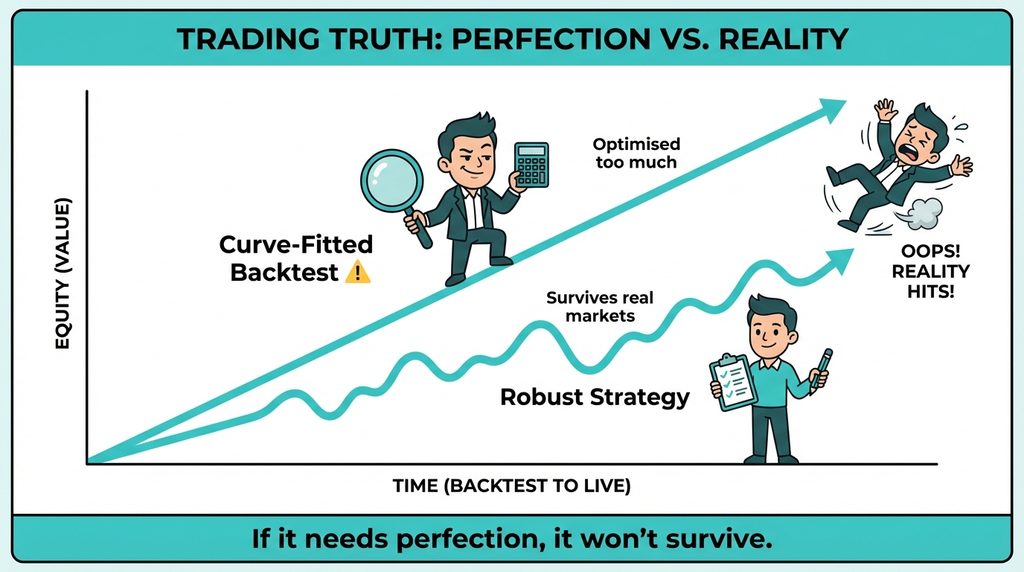
Curve fitting happens when traders over-optimize strategies to historical data, making them look perfect in hindsight but unreliable in real markets.
It usually looks like:
- Too many indicators
- Hyper-specific parameters
- “Perfect” equity curves
- Immediate failure in live markets
Why curve fitting strategies fail
- Markets change.
- Your optimized settings don’t.
- If a strategy only works in a specific setup, it’s not tough; it’s delicate.
Key takeaway: If your system needs perfection to survive, it won’t make it.
This kind of action is common when you see Improving Without Strategy Hopping, where traders are more focused on changing settings than sticking to a process or properly validating their strategy.
In-Sample vs Out-of-Sample Backtesting (Critical Distinction)
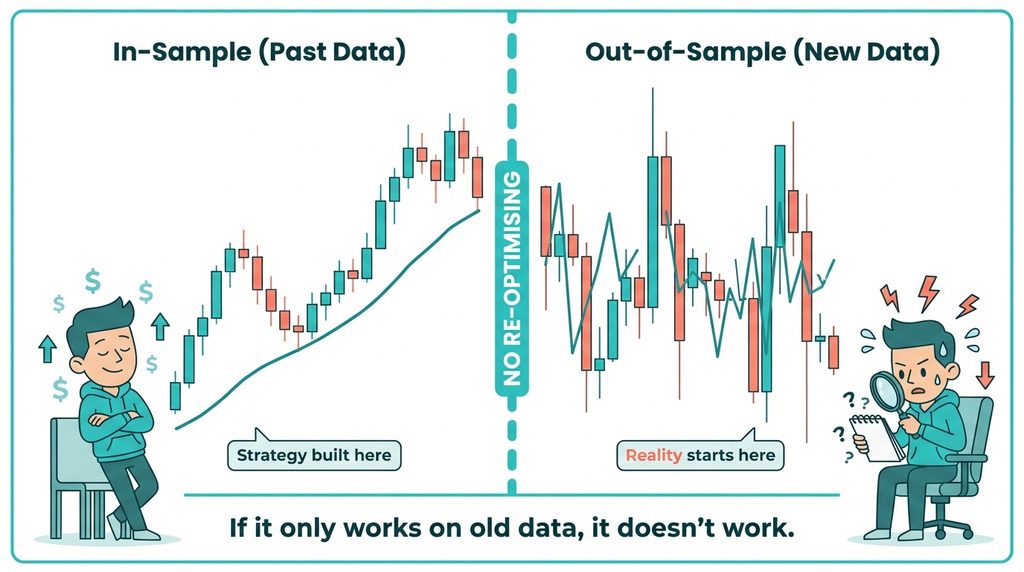
This is where most traders fail.
In-Sample Testing
- Used to build the strategy.
- Rules and parameters are developed here.
Out-of-Sample Testing
- Used to validate the strategy.
- This data has never been used during strategy development.
- If performance is only in-sample, the strategy likely reflects curve fitting.
Rule:
A strategy that survives out-of-sample testing has potential. One that doesn’t discard it. This strategy validation logic is pretty much like the discipline you’d find in Trading Performance Explained.
Walk-Forward Testing — The Reality Check
Walk-forward testing evaluates how a strategy performs as market conditions change over time.
Process:
- Test on one historical segment
- Move forward in time
- Re-test without re-optimizing
This exposes:
- Parameter fragility
- Regime dependency
- False confidence
Professional traders rely on walk-forward testing because it better reflects real-world scenarios than looking back at what happened.
Manual vs Automated Backtesting: Which One Takes the Crown
Manual Backtesting
- Best for beginners
- Builds market understanding
- Slower but educational
Automated Backtesting
- Faster
- Handles large datasets
- Easy to over-optimize
Best approach:
Manual first → automated later.
If you don’t understand why a strategy works, automating it just multiplies the errors and can increase trading bias. This learning process is strengthened through structured review systems such as the
Trading Journal Guide, which is way more important than any strategy.
Backtesting Biases You Must Avoid
Common trading bias mistakes in Backtesting include:
- Look-ahead bias (using future data)
- Survivorship bias (ignoring failed markets)
- Ignoring transaction costs
- Testing on tiny samples
- A strategy tested on 20 trades is noise.
Testing that really counts needs large samples and strict checking — the same principle used in Trading Expectancy Explained for proper strategy validation.
Metrics That Actually Matter (Not Just Profit)
Profit alone is misleading.
Track:
- Win rate
- Average R-multiple
- Maximum drawdown
- Expectancy
- Losing streak length
A strategy with stable performance is often more robust than one with extreme profit swings. These metrics are right on point with the insights from R-Multiple Trading Explained and are central to strong strategy validation.
Backtesting Checklist (Beginner-Safe)
Before trusting any Backtesting, confirm:
- Clear, fixed rules
- Risk per trade defined
- Costs included
- Out-of-sample testing completed
- Walk-forward testing validated
- No parameter obsession
If one box doesn’t work, either patch it up or toss the whole plan.
Why Backtesting Still Fails in Live Trading
Even strong Backtesting collapses when traders:
- Ignore execution discipline
- Change rules emotionally
- Overtrade after wins or losses
- Skip journaling
- Backtesting validates logic.
- Execution validates the trader.
This gap in trading behavior is closely linked to the Psychology of Trading.
Conclusion: Backtesting Is About Survival, Not Perfection
Backtesting is not about finding the “best” strategy.
Let’s weed out the weak before we get into the real money game.
- Avoid curve fitting.
- Test across conditions.
- Respect the sample size.
- Focus on robustness.
A strategy that’s not too exciting but tough enough beats a flawless test every single time because survival compounds, and aiming for perfection just falls apart.