


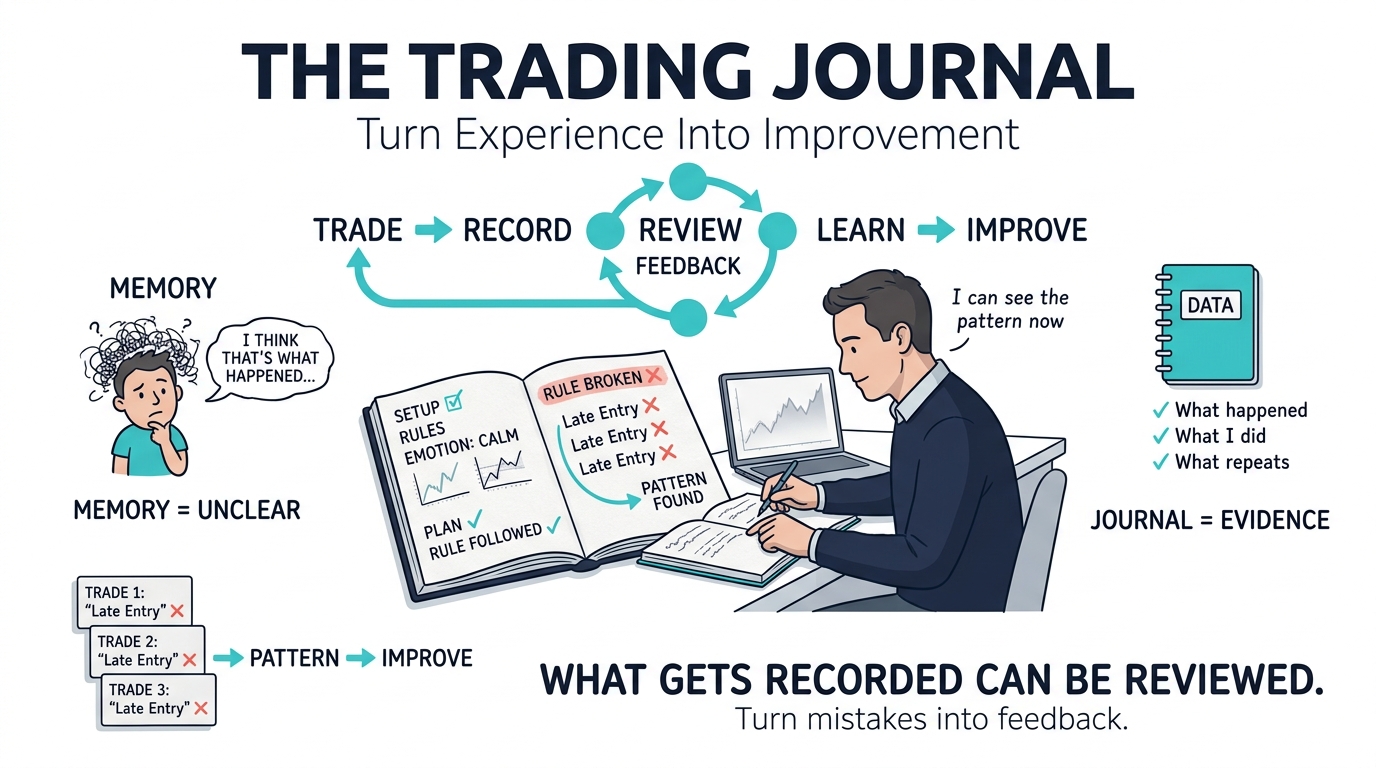
Building a trading strategy is very important, but knowing how well it is implemented is just as important.
Without analyzing your previous decisions, you will have difficulties realizing your mistakes and flaws and distinguishing between the limitations of your strategy and its poor implementation.
Keeping a trading journal is one way of doing this.
If you trade Forex, indices or CFDs, a trading journal can be used to make experience out of your trading.
Instead of looking all the time for new indicators and new strategies, you can analyze your previous experience to figure out where it could be improved.
What a Trading Journal Does That Strategies Can’t
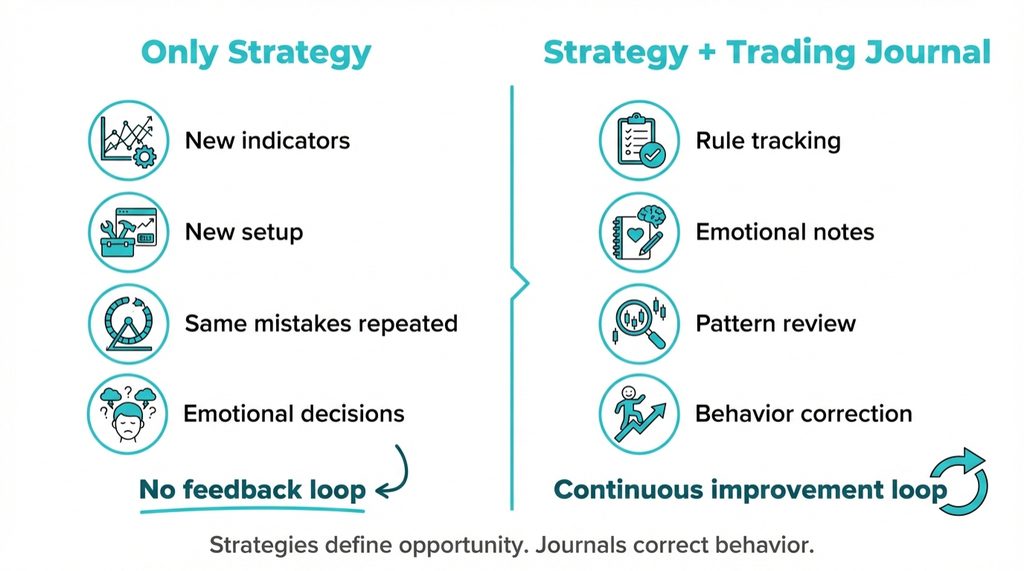
Trading strategy sets the parameters for entering, managing, and closing trades.
Trading journal captures the actual implementation process and subsequent outcome of that strategy.
In other words, the strategy might set criteria that must be fulfilled before any entry can take place. Journaling will tell whether these criteria were applied correctly or not.
Moreover, there might be patterns of behavior that are revealed by journaling such as over-trading, impulse stop losses, and entry due to FOMO.
But at the same time, not all losing trades are the product of mistakes since it is possible to lose while implementing the right strategy.
Journaling is done in order to determine the difference between regular trading, the flaws of the strategy, and mistakes in its implementation.
The Trading Journal Feedback Loop
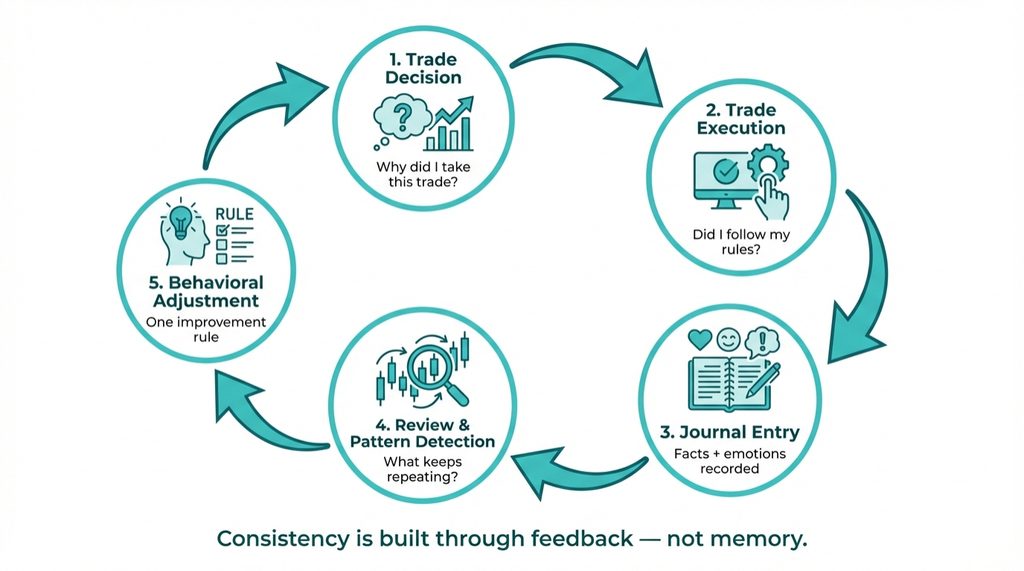
It is more beneficial for a trader to frequently look back at what they have written in their trading journal.
Capture the Decision
Write down reasons for making such a deal, the prevailing market conditions, and what was necessary according to your original plan.
Capture the Behavior
Keep record of whether the plan was adhered to, including changes in position sizing, stop-loss placement, and target profit.
Review the Pattern
Analyze completed trades to spot recurring behaviour, results of strategies applied and possible errors in execution. Gradually, one will be able to find proof regarding trading decisions and ways of improvement.
It also supports Process-Focused Thinking, where execution quality is assessed alongside financial results rather than judging every decision solely by profit or loss.
What to Track in a Trading Journal
A good trading journal needs to gather sufficient data to judge your trading decisions while not being overly complex.
The specifics of what you need will vary based on your strategy, but four types of information make a good start.
Trade Data (Facts)
Record the instrument, period, entry price, exit price, stop loss, target, trade size, and final outcome. If possible, record the outcome in terms of R multiples for easier comparisons relative to initial risk.
These records should be considered alongside the principles covered in Risk Management Fundamentals.
Decision Logic (Why)
Describe the trading setup, the rationale behind entering, the market circumstances, and the price at which the original trading premise becomes irrelevant.
Understanding Market Structure may help traders explain the technical reasoning behind their decisions.
Behavior & Psychology (The Real Edge)
Record relevant emotional reactions, whether trading rules were followed and why any deviations occurred.
This information can help identify recurring behavioral patterns, as discussed in Trading Psychology Explained.
Market Context
Consider factors like trending or range-bound prices, market volatility, the trading session, and upcoming economic news. An Economic Calendar can help traders document important scheduled events that may influence market conditions.
What Experienced Traders May Track Beyond Entries and Exits
As trading records become more detailed, traders may begin evaluating performance beyond individual profits and losses.
Useful measures include:
- Trading expectancy: The average expected result per trade, estimated from historical outcomes.
- Setup-specific performance: How different trading setups perform across recorded trades.
- Average R-multiple: The average outcome relative to initial planned risk.
- Drawdown: The decline in account equity from a previous peak.
- Rule adherence: How consistently trading decisions follow the predefined strategy.
- Market conditions: Whether results differ across particular sessions, volatility environments or market regimes.
Pre- and post-trade screenshots can also be helpful in understanding entry and exit decisions. These steps will help traders judge the results of their strategies as well as execution.
For example, reviewing decisions against predefined Exit Trading Strategies may reveal whether positions were managed consistently. However, performance statistics should be interpreted carefully. Small samples, changing market conditions and trading costs can affect their reliability.
Why Reviewing Trades Can Be More Useful Than Adding Indicators
Technical analysis indicators are used for analysing the price movement, trends, momentum and volatility. But addition of more indicators will not solve the problems associated with execution and risk management.
A trading journal brings a fresh approach by documenting the way in which decisions were taken during trading.
For instance, one can notice through a review that the trader has increased his position size after losses, takes a trade without any confirmation and books the profits before time.
Such patterns may be associated with behaviours discussed in Revenge Trading Explained and Holding Winners Without Emotion.
Recognising these patterns does not automatically eliminate them. However, it can provide a starting point for establishing clearer rules and evaluating whether subsequent changes improve execution.
Behavioural finance research has documented patterns that can influence investment decisions. For example, Shefrin and Statman's research on the disposition effect examines the tendency to realise gains relatively quickly while remaining reluctant to realise losses.
Reviewing trade records may help traders investigate whether similar behaviours appear in their own decisions, although the research does not establish that journaling itself improves trading returns.
A Simple Trading Journal Template for Beginners
Trading journals should not necessarily be complex. An easy way to record transactions would be by maintaining consistency in formatting.
Daily Preparation
Before trading, record:
- Current market conditions
- Instruments and setups being monitored
- Maximum planned number of trades
- Daily risk or loss limits
- One area of execution to focus on
Per-Trade Log
For each completed trade, document:
- Trading setup and entry reasoning
- Entry and exit prices
- Initial stop-loss and profit target
- Position size and initial risk
- Final result in R-multiples
- Whether the trading rules were followed
- Relevant emotional reactions or decision-making notes
Weekly Review
At the end of the review period, assess:
- Overall trading results and average R-multiple
- Trades that followed the plan correctly
- Trades involving execution mistakes
- Recurring behavioural patterns
- One clearly defined area for further improvement
For traders managing positions through staged exits or adjusted stop-losses, it may also be useful to review how Partial Profit-Taking and Moving Stop-Losses affected the final outcome.
Common Trading Journal Mistakes
The trading journal becomes more effective when its entries are accurate, pertinent, and reviewed regularly.
Common mistakes include:
- Recording too much unnecessary information: An overly complicated journal may become difficult to maintain.
- Tracking only profits and losses: Monetary outcomes alone may not explain the quality of trading decisions.
- Ignoring trading costs: Spreads, commissions and financing charges can affect actual results.
- Failing to review entries: Recording trades without analysing them limits the journal's practical value.
- Using vague descriptions: Notes such as “bad trade” provide less information than identifying the specific rule that was broken.
- Changing strategies too quickly: A small number of trades may not provide sufficient evidence to evaluate a strategy.
- Using the journal for self-criticism: The objective is to understand decisions and identify potential improvements, not assign blame.
How Journaling Improves Discipline Automatically
A trade journal can assist traders in identifying common execution mistakes and determining if their actions are consistent with a predetermined plan of action.
For instance, analyzing the entries in the journal might lead one to discover repetitive occurrences of overtrading, poor position sizing or frequent adjustments of the stop-loss level.
This allows traders to develop better trading rules and observe if they abide by them consistently.
Furthermore, traders are less likely to make unnecessary changes to their trading strategies due to journaling because it provides them with performance results under various conditions.
On the other hand, it does not mean that keeping a trade journal automatically makes you more disciplined.
This is only beneficial if one reviews their journal consistently, uses reasonable risk levels and analyzes their actions objectively.
Conclusion: A Trading Journal Turns Experience Into Feedback
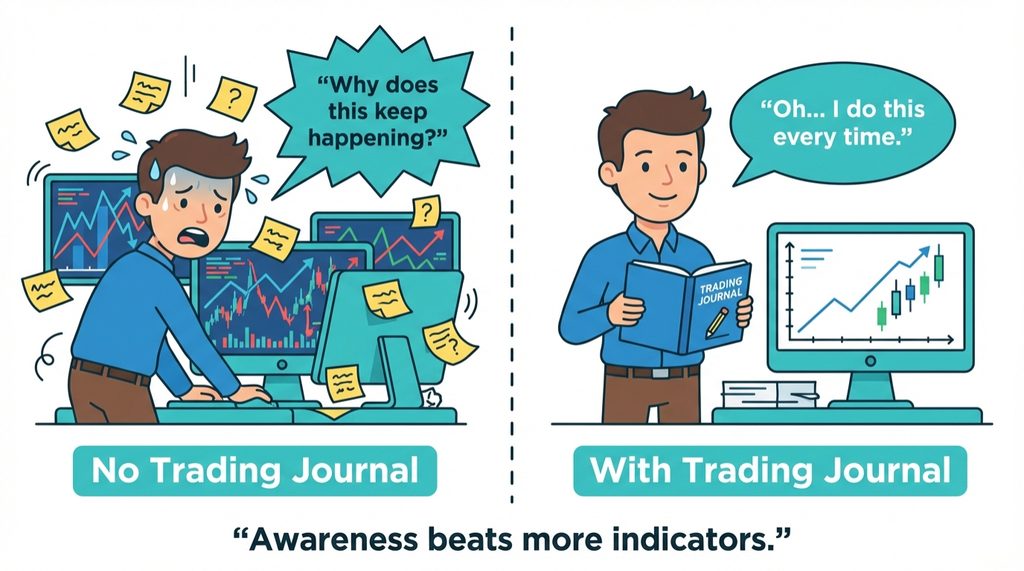
A trading journal goes beyond documenting winners and losers; it gives you structure by which to analyze, assess execution and discover patterns.
By noting trade specifics, market environment, risks and behavioral notes, a trader gains greater insight into how his or her strategy is being implemented.
Periodic reflection might help a trader distinguish between ordinary trading losses, constraints of his or her trading strategy and unnecessary execution errors.
Nevertheless, journaling is not a panacea that will ensure profit and make trading risk-free. The success of this method lies in keeping records, analyzing them and implementing lessons learned.
Before modifying your trading strategy or including more indicators in it, think about what you've learned from your trading experience.
Strategy describes the trading approach. Journal gives data to evaluate it.








