
Most traders focus heavily on strategies, indicators, and entries, yet still struggle to turn a profit. The real reason is pretty straightforward: they just don’t understand the concept of Trading Expectancy.
If you don’t understand Trading Expectancy, no strategy will remain profitable for long, no matter how promising it may appear over a small number of trades.
In this lesson, you’ll learn what Trading Expectancy means, how probability-based trading and sample size can change the game, and why many traders think they’ve got the upper hand when they might not. This isn’t just theory; it’s the framework professionals use before risking capital.
What Is Trading Expectancy?
Trading Expectancy tells you the average profit or loss per trade over time. It answers a critical question:
“If I repeat this setup hundreds of times, will it make money or lose money?”
Expectancy isn’t just about personal deals. This is about the long-term results across a large sample size in trading. This is the same reasoning applied when figuring out What Is a Trading Edge?
The Trading Expectancy Formula
The trading expectancy formula helps traders determine whether a strategy has a measurable statistical edge over time. Instead of focusing only on win rate or individual profits, it considers how often trades win or lose and the average size of those outcomes. Understanding trading expectancy helps traders evaluate risk-reward efficiency, identify strategy weaknesses, and make more informed decisions based on long-term performance rather than short-term results.
How Expectancy Is Calculated
Trading Expectancy is calculated as:
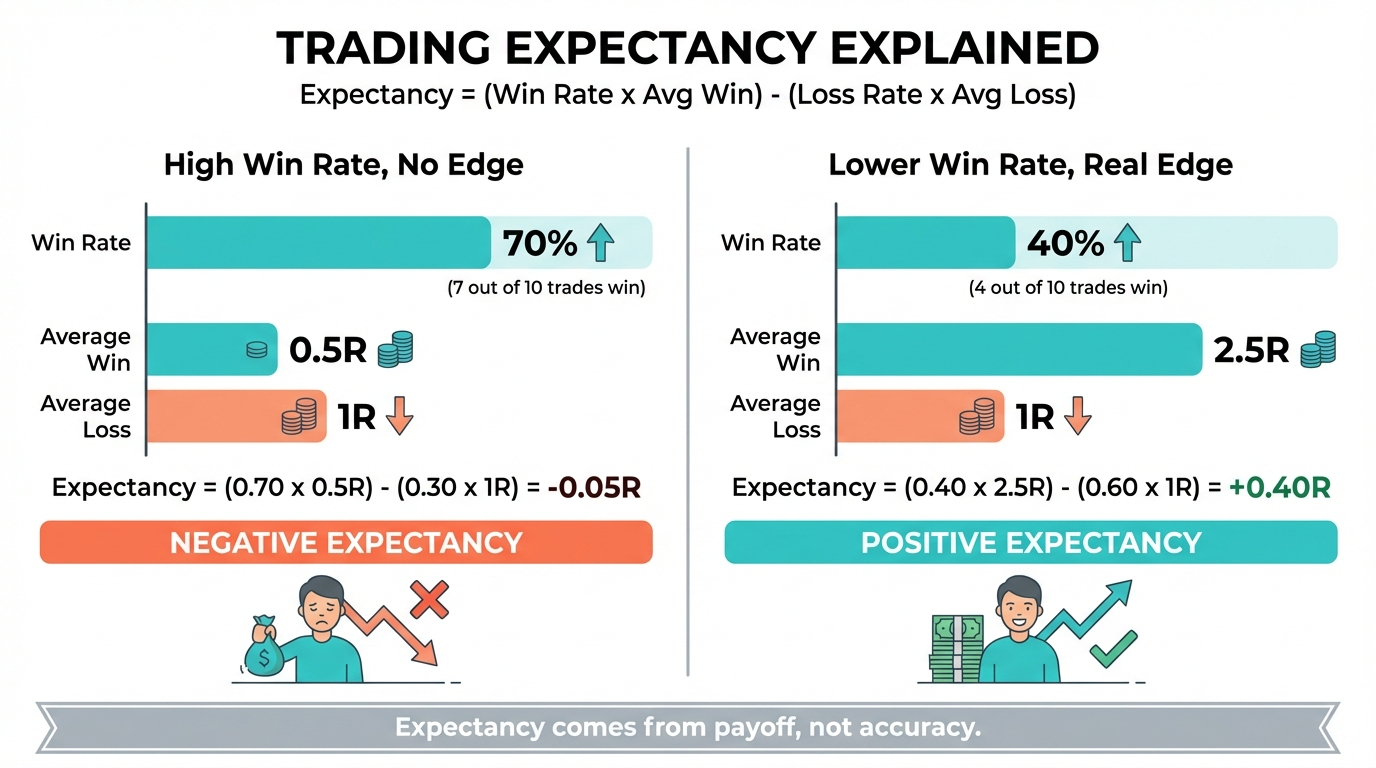
Expectancy = (Win Rate × Average Win) − (Loss Rate × Average Loss).
This formula shows the average gain or loss you’d expect from each trade — your expected value per trade, not just quick wins or losses.
Even if a strategy doesn’t win often, it can still make money.
A plan that wins a lot can still end up costing you.
Because expectancy relies on risk-adjusted data, it closely aligns with R-multiples. Trading Explained: What to Track in a Trading Journal.
Trading Expectancy vs Expected Value (EV)
In trading, expectancy and expected value (EV) are just two different terms for the same concept.
EV emphasizes probability and payoff.
Expectancy emphasizes execution over time.
Trading professionals focus on expected value per trade rather than just wins and losses. Retail traders sometimes do the reverse, which is why they tend to give up on solid strategies too soon.
Why Probability Matters More Than Accuracy
Trading is a probability-based trading activity, not a prediction game. Even a strong trading edge can still lose by chance. A setup with a 55% win rate will still lose 45 times out of 100 trades and often in bunches.
- Traders who do not accept probability tend to:
- Panic during losing streaks
- Abandon profitable systems
- Over-optimize after random losses
This is not a strategy problem. It is usually a behavioral issue related to trading psychology.
Sample Size in Trading: That’s Where Most Traders Get It All Wrong
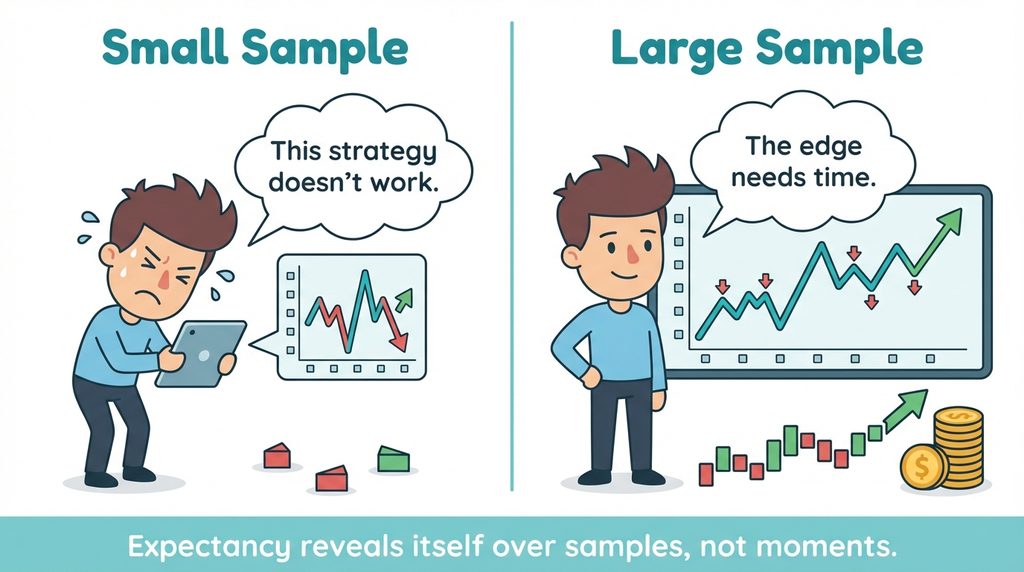
A major mistake traders make is evaluating performance using very small samples.
Why Small Samples Are Dangerous
- 10 trades tell you almost nothing.
- 20 trades are highly misleading.
- 50 trades are still statistically unreliable.
A decent sample size in trading typically starts at about 100 to 200 trades. Before that, outcomes are more a matter of luck than skill.
That’s why having a disciplined review process, like the Trading Journal Guide, is super important.
False Positives — Why Bad Strategies Look Profitable
Many traders who eventually fail believe they have a trading edge because:
- They had a strong first month
- A few large winners skewed the results
- Market conditions temporarily favored them
This is known as a false positive, where randomness looks like skill.
Without enough information, you can’t tell whether someone’s good at something, just got lucky, or is doing it right.
A profitable trading history does not necessarily demonstrate a reliable statistical edge. Research on backtest overfitting and investment strategy evaluation explains how repeatedly testing and selecting strategies using historical data can create misleading performance expectations. This highlights why traders should evaluate sample size, transaction costs and the robustness of their results before drawing conclusions about trading expectancy.
Win Rate vs Risk Reward — The Price You Pay
A higher win rate doesn’t always equal better trading.
Two Strategy Comparison
➡ Negative expectancy
- Strategy A
- Win rate: 70%
- Average win: 0.5R
- Average loss: 1R
➡ Positive expectancy
- Strategy B
- Win rate: 40%
- Average win: 2.5R
- Average loss: 1R
That’s why we have to measure how well we’re doing with R-multiples and a solid review system, not just go by how we feel. This idea is supported by the article Trading Performance Explained.
Distribution of Outcomes & Variance
Trading results are not evenly distributed.
Most profits come from a few big winners, uneven payoff distributions, and rare but strong market trends.
If traders pull out of winners too soon or get too emotional, Trading Expectancy can tank—even if they’re actually onto something good. This behavior is similar to Holding Winners Without Emotional Investing.
Why Trading Expectancy Fails for Most Traders
A bunch of traders technically have a trading edge, but they don’t see it because of:
- Poor risk consistency
- Emotional exits
- Overtrading
- Strategy hopping
- Ignoring transaction costs
Expectancy only works when execution is steady. Switching systems all the time messes up the clear stats, a topic covered in the book Improving Without Strategy Hopping.
Expectancy vs Profitability
Positive expectancy does not guarantee short-term profit. Profitability hinges on sticking to a plan, managing your risk and what you can afford to lose, and staying calm.
Expectancy tells you what should happen.
Discipline determines whether it actually does.
How Professionals Use Trading Expectancy
Professional traders and prop firms typically:
- Measure performance in R-multiples
- Review expectancy monthly or quarterly
- Ignore short-term noise
- Evaluate systems over hundreds of trades
This evaluation discipline is closely tied to rule enforcement and exit logic, as discussed in Exit Trading Strategies Explained.
How to Apply Trading Expectancy Practically
To apply expectancy correctly:
- Track R-multiples, not P&L
- Record at least 100 trades per setup
- Separate execution errors from system flaws
- Avoid changing rules until data confirms a problem.
This practical layer shines when you dive into structured journaling and review, especially with the help of the Trading Journal Guide.
Conclusion — Expectancy Is the Foundation of Real Edges
Trading Expectancy represents the mathematical foundation of long-term profitability.
Without it, trading becomes speculation rather than structured decision-making.
When you get the hang of probability-based trading, keep an eye on sample size, and stay consistent, you’ll find that Trading Expectancy quietly boosts your chances, even when things aren’t going your way.
That is how genuine trading edge survives.