


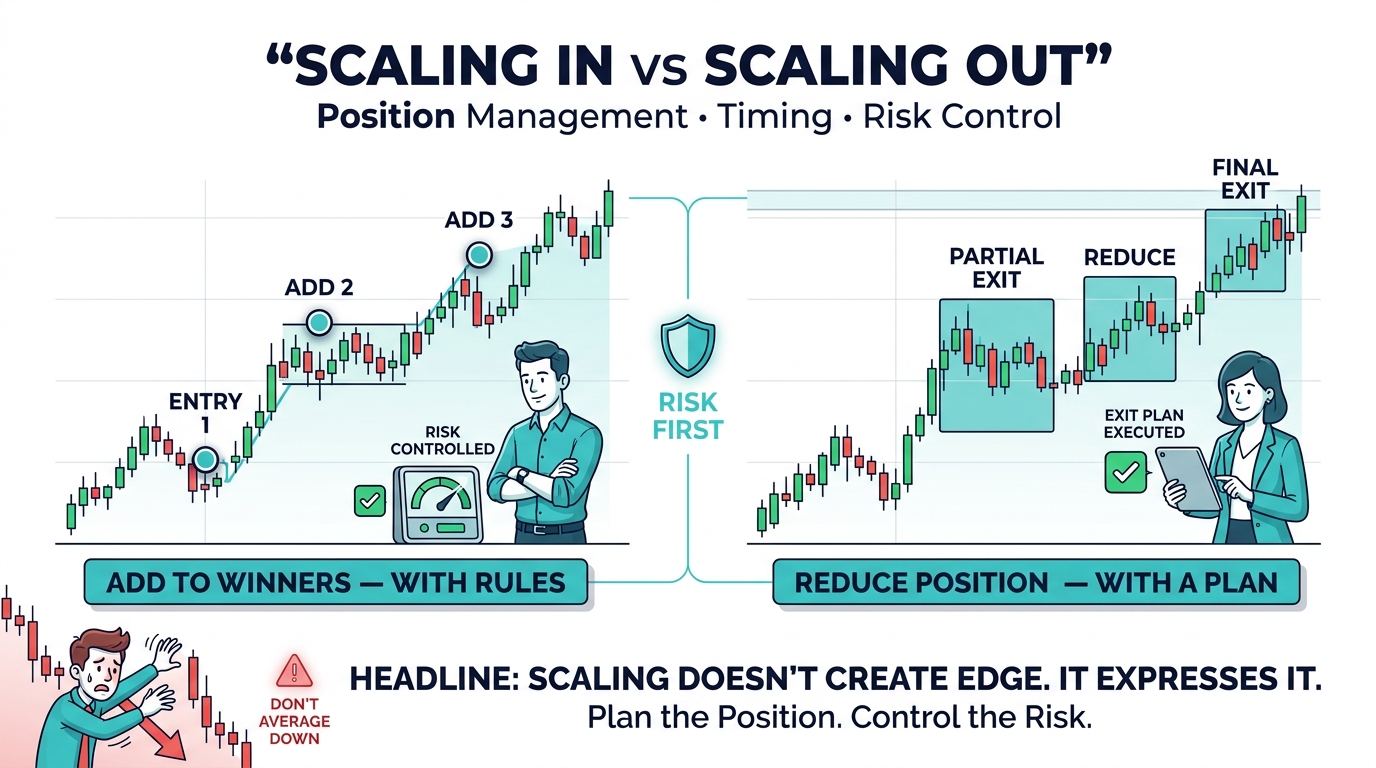
Most traders don’t lose cash just from bad trades; they lose it because they don't manage their positions well.
People often misunderstand and misuse scaling techniques, letting emotions drive decisions when scaling in or out. Many traders think scaling simply means “adding more when the price moves” or “taking profit whenever it feels right.” In reality, both techniques require predefined rules, a clear market context, and strict risk management.
Scaling isn’t a quick way to make money. This phrase is basically saying that it’s a way of managing your position based on a trading advantage that’s already there, kind of like what you’d learn in the article What Is a Trading Edge?
What Is Scaling In Trading?
Scaling in means adding to a position gradually, usually after the trade starts moving in your favor. The critical distinction: Scaling in means you’re buying more shares, not selling them off.
Scaling In vs Averaging Down
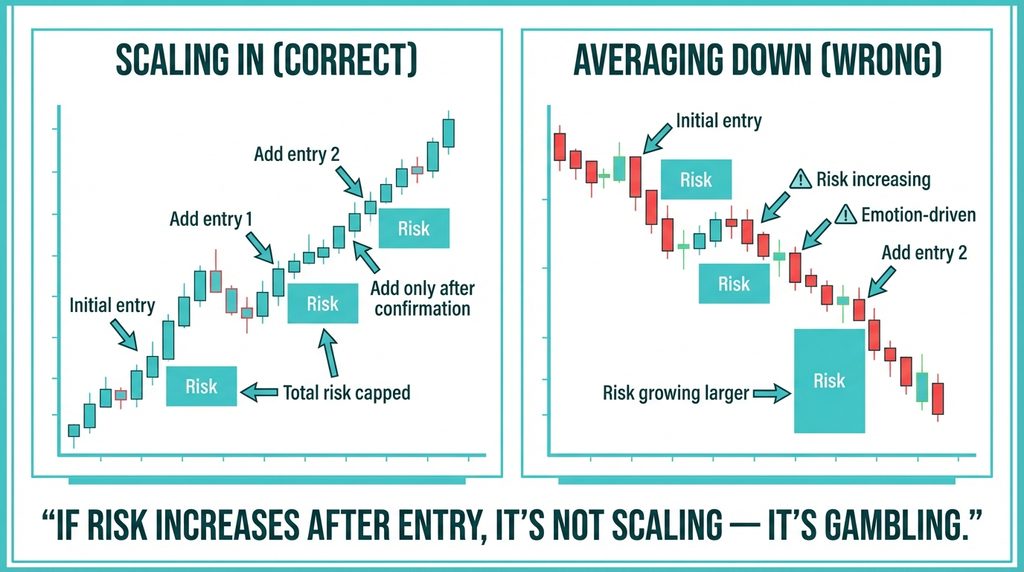
Scaling in can increase potential returns, keep risk controlled, and follow a predefined trading plan. Averaging down can worsen losing trades, increase your risk, and often comes from emotion.
If the risk goes up after you get in, it’s not scaling in trading; it’s just uncontrolled exposure, kind of like those psychological leaks we talked about in the Psychology of Trading article.
When Scaling In Actually Works
Scaling in trading only works when the structure is right, not when you’re just throwing darts at the market.
Best Conditions for Scaling In
Scaling in works best when market conditions support an established trend and you can add positions without exceeding predefined risk limits.
Traders typically look for the following conditions:
Strong trending markets: Clear upward or downward momentum supports the existing trade direction.
Well-defined market structure: Higher highs and higher lows indicate an uptrend, while lower highs and lower lows suggest a downtrend.
Price action confirmation: Breakouts, successful retests, or continuation patterns provide additional evidence that the trend may continue.
Lower portfolio correlation risk: Additional positions should not create excessive exposure to the same currency, asset class, or underlying market driver.
This approach is commonly known as pyramiding in trading, where traders gradually add to an existing position as the market moves in their favor.
However, successful pyramiding depends on disciplined position sizing, predefined entry levels, and maintaining total risk within acceptable limits. A strong trend alone does not justify increasing exposure.
What Is Scaling Out in Trading?
Scaling out refers to gradually reducing position size as price approaches profit targets. This strategy is often used to lock in profits, reduce stress, and even out the ups and downs of trading returns a key part of Equity Curve Management.
But doing it without a plan can backfire.
When Scaling Out Hurts Performance
Scaling out can help traders secure partial profits and reduce exposure, but exiting too early can limit returns, especially during strong market trends.
Common mistakes include:
- Taking profits too early out of fear: Closing profitable positions prematurely because you fear a market reversal.
- Reducing position sizes without a clear plan: Exiting portions of a trade without predefined profit targets or risk management rules.
- Cutting winning trades too short: Exiting before a trend fully develops, potentially missing further profitable price moves.
Effective scaling out requires balancing profit protection with room for winning trades to develop. Traders should base their exit decisions on market structure, predefined targets, and risk management rules rather than emotional reactions.
Scaling In vs Scaling Out — Market Context Matters
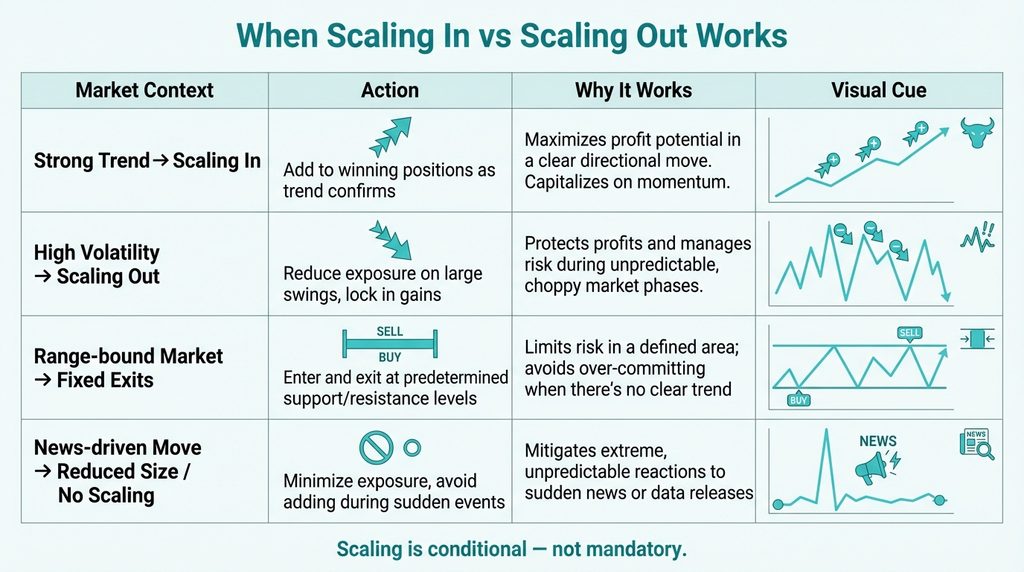
Scaling techniques are conditional, not universal. In strong trends, pyramiding may enhance efficiency. In high volatility, scaling out can stabilize equity. In ranging markets, fixed exits often outperform trade scaling.
During news-driven events, reducing position size or avoiding trades altogether may be the safer approach. Many traders apply the right technique at the wrong time, which often leads to inconsistent results a behavior discussed in Improving Without Strategy Hopping.
Risk Management Rules Professionals Follow
Whether scaling in or scaling out of trades, effective risk management requires a structured approach to position sizing, exposure, and trade execution. Without predefined rules, adjusting positions can increase portfolio risk or reduce potential returns.
Experienced traders focus on controlling total risk rather than simply increasing or decreasing position sizes, ensuring every adjustment remains consistent with their trading strategy.
Scaling in and scaling out require careful consideration of overall trading exposure, particularly when leverage is involved. FINRA's investor guidance on day trading highlights the financial risks associated with active trading and borrowing to trade. These risks reinforce the importance of predefined position-sizing rules, exposure limits and disciplined risk management.
Core Professional Risk Management Rules
- Set maximum risk per trade: Establish a predefined risk limit and ensure additional positions do not exceed the total permitted exposure.
- Avoid increasing losing positions: Do not add to losing trades impulsively in an attempt to recover losses. Any averaging strategy must follow predefined risk limits.
- Define scaling levels before entry: Plan entry points, additional position levels, stop-loss placements, and profit targets before executing a trade.
- Measure performance using R-multiples: Evaluate profits and losses relative to the initial risk taken, rather than focusing solely on monetary outcomes or emotional reactions.
The key principle is simple: Scaling decisions should follow risk management rules, not emotions. A disciplined approach helps traders control exposure, protect capital, and stay consistent across market conditions.
Psychology — Why Traders Misuse Scaling
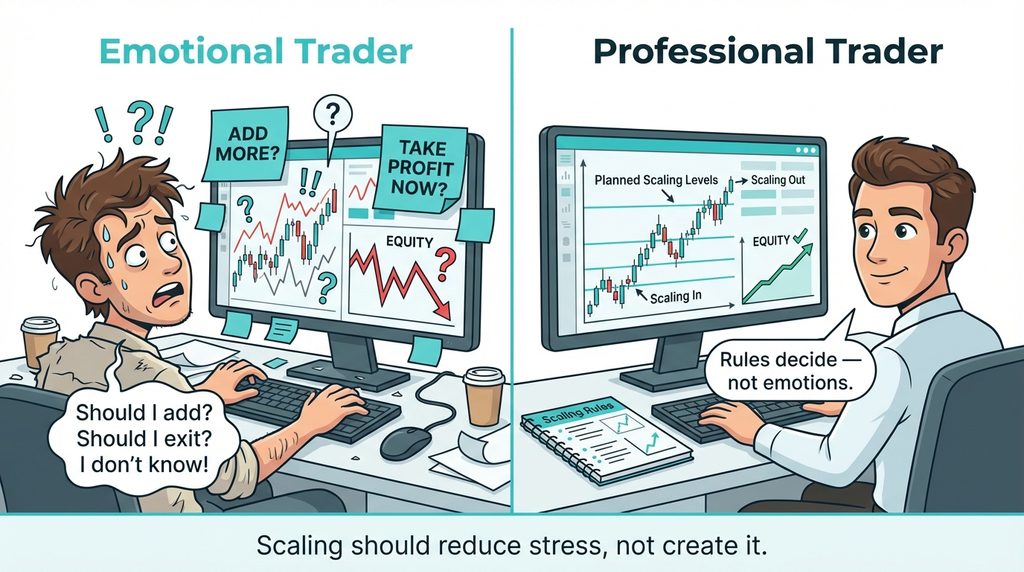
Scaling mistakes are rarely technical. They are behavioral. Here are some emotional pitfalls people often fall into: worrying about missing out on bigger plays, fretting about losing profits, getting too cocky after a few wins, and trying to make a trade flawless.
Structure solves these problems; willpower does not. This skewed thinking pops up when traders are on a losing streak and try to fix things by misusing trade scaling, as examined in the article Trading Losing Streaks Explained.
Beginner vs Professional Approach
The difference between beginner and professional traders often lies in how they manage positions, control risk, and respond to changing market conditions. While beginners may scale based on emotions or short-term price movements, experienced traders rely on predefined rules and structured risk-management strategies.
Beginners Often
- Scale emotionally: Add or reduce positions based on fear, greed, or the desire to recover losses.
- Change position sizes impulsively: Increase or decrease trading exposure without following a predefined risk management plan.
- Add positions without confirmation: Enter additional trades without clear price action signals or supporting market conditions.
- Exit trades randomly: Close positions prematurely or hold them too long without established profit targets or exit rules.
These behaviors can lead to inconsistent trading performance, excessive risk exposure, and unnecessary losses. A disciplined approach to scaling in and scaling out helps traders make more structured decisions and manage capital effectively.
Experienced Traders Typically
- Follow predefined scaling rules: Add or reduce positions according to a documented trading plan rather than emotional reactions.
- Adapt to market conditions: Consider market trends, volatility, and price action before adjusting positions.
- Measure risk before scaling: Evaluate how each position adjustment affects overall exposure, potential losses, and reward-to-risk ratios.
- Accept imperfect exits: Recognize that consistently capturing the exact market top or bottom is unrealistic.
Consistency in trading comes from disciplined execution, structured risk management, and a repeatable process not from perfectly predicting every market move.
Common Scaling Mistakes to Avoid
When you scale in during drawdowns, scale out without clear goals, don't consider how investments relate, grow your portfolio after a win, or use trade scaling to bounce back, you distort the actual performance numbers.
Traders sometimes act on gut feelings instead of solid analysis, and it’s clear when they don’t keep track of their trades.
Conclusion — Scaling In vs Scaling Out in Trading
Scaling in trading and scaling in vs scaling out are just structured ways to manage positions, not shortcuts to making more money. They work only when risk management is controlled, you respect the situation, and you follow guidelines consistently.
Scaling doesn’t create the edge; it expresses it. Master fixed-risk execution first. Then scale intelligently.








