


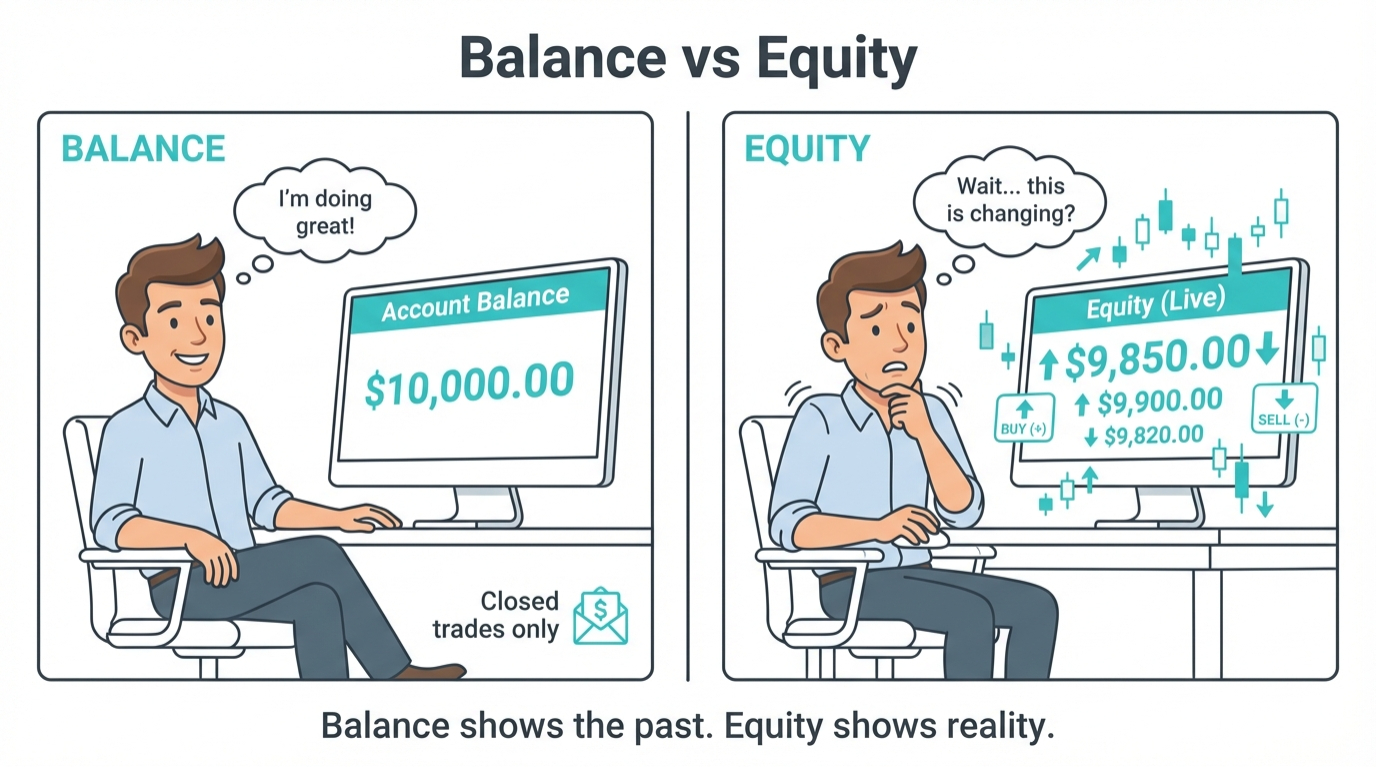
What is equity in trading? It's the current value of your trading account, including the unrealized profit or loss from any open positions. It provides a real-time view of how much your account is worth as market prices change.
For instance, when your account holds $10,000 and open positions display an unrealized drop of $500, then your total equity stands at $9,500.
Understanding the concept of equity matters since it offers traders a more clearer view of their funds compared to looking at balance by itself. This metric is likewise tightly linked to margin, available margin, leverage ratios, and potential drawdown levels.
In this guide, we explain what equity means in trading, how it is calculated, the difference between equity and balance, and why it matters when managing trading risk.
In this guide, we define what equity means in trading, how it is calculated, the difference between equity and balance, and why it matters when managing trading risk
What Is Equity in Trading?
Equity is the current value of a trading account after taking open positions into account. Generally your account balance shows finished transactions. Equity also considers the unrealized profit or loss of positions that are still open.
Consequently, equity may fluctuate at all times during open trades.
When no trades are active, your equity typically mirrors your account balance.Once you open a position, market movements can cause equity to rise or fall even though your balance remains unchanged.
This makes equity an important account metric for understanding how current market exposure is affecting your funds.
How Is Equity Calculated?
The basic equity formula is:
Equity = Account Balance + Unrealized Profit/Loss
The two main components are:
- Account balance: The value recorded in the account based primarily on completed transactions.
- Unrealized profit/loss (P/L): The current profit or loss from positions that remain open.
Depending on the broker, platform and account structure, credits, charges or other adjustments may also affect the equity displayed in a trading account.
Equity Calculation Example
Suppose a trader has an account balance of $10,000 and open positions currently showing an unrealized loss of $750.
The calculation would be:
$10,000 − $750 = $9,250
The trader's equity is therefore $9,250.
If the market subsequently moves in the trader's favour and the open positions instead show an unrealized profit of $300:
$10,000 + $300 = $10,300
Equity would increase to $10,300.
The example demonstrates an important distinction: balance can remain unchanged while equity moves with the value of open positions.
Equity vs Balance: What's the Difference?
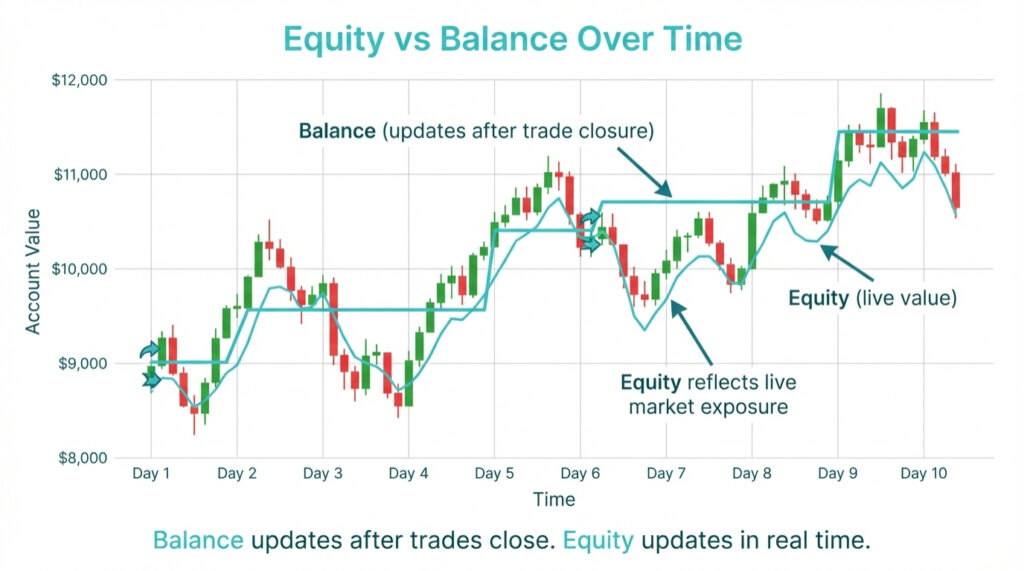
Equity and balance are related, but they represent different aspects of a trading account.
Balance generally shows the account value based on completed transactions. Equity provides a more current account value by including unrealized profits and losses from open positions.
Consider an account with a balance of $10,000.
With no open positions:
Balance = $10,000
Equity = $10,000
Now suppose the trader opens positions that show a combined unrealized loss of $2,000:
Balance = $10,000
Equity = $8,000
The balance may still display $10,000 because the positions have not been closed. Equity, however, reflects the current $2,000 unrealized loss.
This is why traders should understand both figures rather than relying on balance alone.
Why Is Equity Important in Trading?
Equity is important because it shows how open positions are currently affecting the value of a trading account.
It can help traders understand:
- Current unrealized profits and losses
- Available margin
- Margin level
- Account drawdown
- Overall market exposure
- The effect of open positions on account value
Equity becomes particularly important when trading leveraged products. Losses on open positions can reduce equity, which can also reduce the amount of free margin available within the account.
Monitoring equity alongside other account metrics can therefore provide a clearer understanding of current exposure and risk.
How Are Equity and Margin Connected?
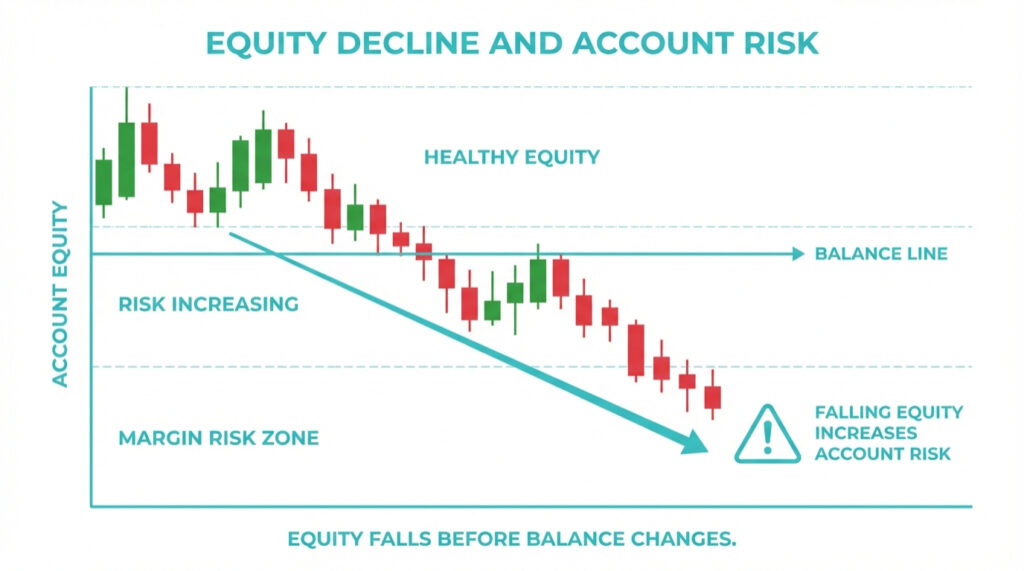
Equity and margin are closely connected when trading leveraged products.
When a trader opens a leveraged position, a portion of the account's funds is required as margin. The amount remaining after accounting for used margin is commonly called free margin.
A simplified formula is:
Free Margin = Equity − Used Margin
For example:
Equity: $10,000
Used margin: $2,500
Free margin: $7,500
If open positions move against the trader and equity falls to $7,000 while used margin remains $2,500:
$7,000 − $2,500 = $4,500
Free margin has fallen to $4,500.
This relationship explains why unrealized losses matter even before a trade is closed. Falling equity can reduce the amount of funds available to support existing positions or potentially open new ones.
To understand why margin requirements affect available funds, read What Is Margin in Trading?
What Is Equity in Forex Trading?
Equity in forex trading follows the same principle. It represents the current value of the trading account after accounting for unrealized profits or losses from open forex positions.
Forex is commonly traded using leverage. This allows traders to control a larger market exposure using a smaller amount of margin.
However, leverage can magnify both profits and losses. As currency prices change, the unrealized P/L of open positions changes with them, causing account equity to fluctuate.
Traders should therefore consider equity alongside position size, leverage, margin requirements and their broader risk-management strategy.
Learn how leverage changes market exposure and potential losses in What Is Leverage in Trading?
What Happens to Equity When Trades Gain or Lose Value?
When an open position moves into profit, its unrealized gain generally increases account equity.
For example:
Balance: $5,000
Unrealized profit: +$400
Equity: $5,400
If an open position instead produces an unrealized loss:
Balance: $5,000
Unrealized loss: −$1,000
Equity: $4,000
When a position is closed, the realized result is reflected in the account balance, subject to applicable trading costs and account adjustments.
A falling equity figure can also reduce free margin and move an account closer to applicable margin thresholds. This is one reason position sizing and risk management are important when using leverage.
If equity falls significantly, margin requirements may become harder to maintain. Learn what can happen next in Margin Calls Explained.
What Is Equity Drawdown?
Equity drawdown refers to a decline in account equity from a previous peak.
Suppose account equity reaches $10,000 and later falls to $8,000.
The monetary drawdown is:
$10,000 − $8,000 = $2,000
As a percentage:
($2,000 ÷ $10,000) × 100 = 20%
The account has therefore experienced a 20% equity drawdown.
Drawdown can help traders evaluate how significantly an account or strategy has declined over a particular period.
Losses also have an important mathematical effect on recovery. After falling 20% from $10,000 to $8,000, for example, an account would need to gain 25% on the remaining $8,000 to return to $10,000.
Common Mistakes Traders Make With Equity
A common beginner mistake is focusing only on account balance while overlooking unrealized profit and loss.
Other mistakes can include:
- Confusing balance with equity
- Ignoring significant unrealized losses
- Using excessive leverage
- Opening positions that are too large relative to account size
- Failing to monitor free margin and margin level
- Creating excessive exposure through multiple positions
- Assuming an unrealized loss is irrelevant because the trade remains open
Understanding how these account metrics interact can help traders make more informed decisions about their exposure. Many of these mistakes relate to position size, leverage and account exposure. Explore them further in Why Traders Fail in Trading?
Equity, Balance, Margin and Free Margin Compared
These terms are connected but have different meanings.
| Term | Meaning |
|---|---|
| Balance | Account value based primarily on completed transactions |
| Equity | Current account value including unrealized P/L from open positions |
| Used Margin | Funds allocated to meet margin requirements for open leveraged positions |
| Free Margin | Equity remaining after used margin is taken into account |
Looking at these figures together can provide a more complete picture of the current state of a trading account.
How Can Traders Manage Equity Risk?
There is no single equity level that is appropriate for every trader. Risk depends on factors including account size, position size, leverage, market conditions and individual risk tolerance.
Common risk-management practices include:
- Defining risk before entering a position
- Using appropriate position sizes
- Understanding how leverage affects exposure
- Monitoring total exposure across open positions
- Using risk-management orders where appropriate
- Monitoring equity, margin and free margin
- Establishing acceptable drawdown parameters
Risk management cannot remove the possibility of losses. Its purpose is to help traders understand and control the level of risk they are prepared to take.
Understanding investment risk is important when evaluating account exposure and potential losses. The U.S. Securities and Exchange Commission (SEC) provides educational resources to help investors understand financial markets and make more informed investment decisions.
Conclusion: Understanding Equity in Trading
Equity is a fundamental trading account metric because it reflects the current value of an account while open positions are active.
In simple terms:
Equity = Account Balance + Unrealized Profit/Loss
Balance primarily reflects completed transactions, whereas equity changes as the unrealized value of open positions changes.
Understanding the relationship between equity, balance, margin, free margin and drawdown can give traders a clearer view of their account exposure and help them make more informed risk-management decisions.
Continue learning through the VARIANSE Academy with related guides covering balance, margin, leverage, free margin, margin level and risk management.








