


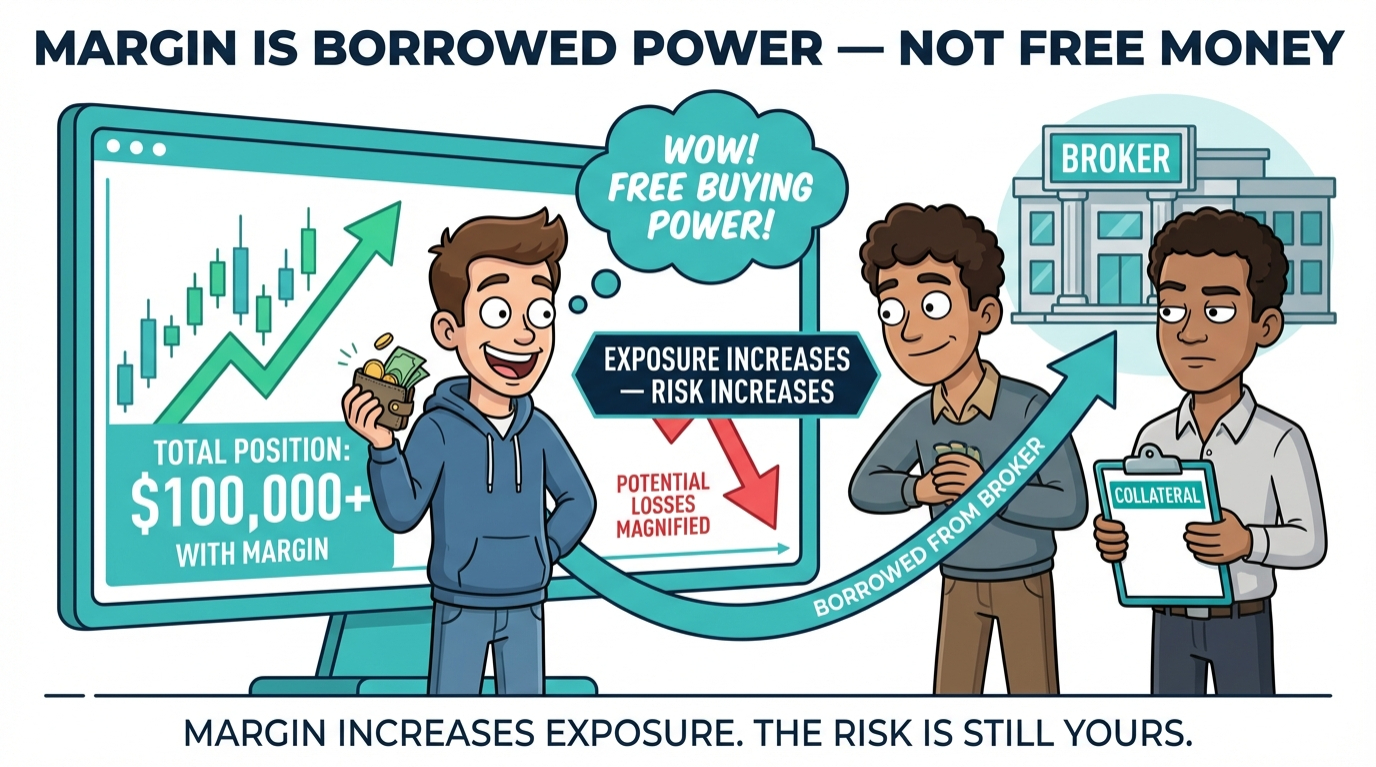
What is margin in trading? It is an essential concept in leveraged trading, yet beginners often misunderstand it. There are some traders who open positions using leverage but they do not understand the effect of margins on their capital, account equity, and exposure to risk in the market.
Margin is the capital or collateral needed in order for some trades to be opened or maintained. Margin is not extra money and it does not provide protection against losing money.
With margin trading, traders are able to gain exposure in the market without having to put down the full amount of money of the position.
Grasping the concept of margin is key before you dive into using leverage, just as the article What Is Leverage in Trading? Leverage ups the risk, but margin helps keep it in check
What Is Margin in Simple Terms
The margin is the capital or collateral needed for opening or maintaining a leveraged position. Instead of putting up the total nominal value of a position, the trader might be asked to put up a portion of that value as margin.
Thus, if a position is valued at $10,000 and has an initial margin of 10%, then the initial margin required will be $1,000.
It must be noted that both profit and loss will be determined by the position exposure as well as market fluctuations rather than the margin alone. This implies that even small changes in prices can result in significant gains or losses relative to the initial margin.
There is no assurance that the margin allows the account to endure market fluctuations.
That's why a higher margin can lead to bigger wins or bigger risks. The nuts and bolts of this process fit into the wider trade system outlined in Trade Mechanics & Execution Basics: How Trades Really Work?
How Margin Trading Works
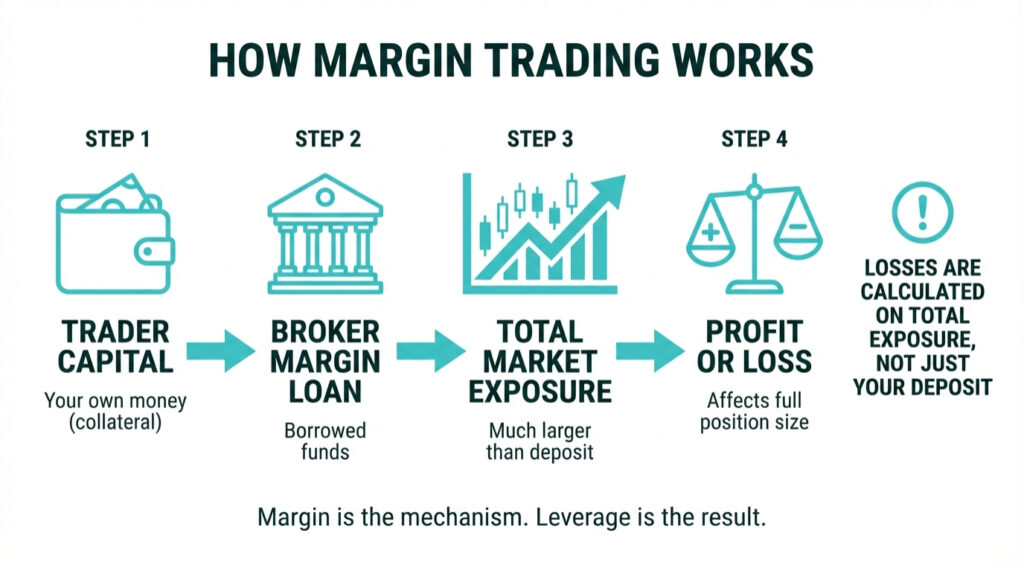
Cash account essentially entails investors paying the full purchase cost of stocks through available money. Margin accounts enable suitable investors to borrow against securities or open leveraged trades under terms of the margin account provider.
However, margin trade agreements vary between securities accounts and leveraged derivatives such as CFDs.
Both cash and margin accounts are risky, yet margin accounts entail extra risks due to borrowing, leveraging, funding costs, and forced selling.
Margin Account vs Cash Account
In a cash account, you can only trade with the money you've put in. Your exposure cannot exceed your balance.
In a margin account, you've got some of your cash set aside as collateral, which is an asset pledged to secure a loan, but you're still able to hold a bigger stake in the market. This lets people get into markets they'd usually need a ton of cash for
Handle this exposure with care, following the position-sizing principles outlined in Position Sizing Explained, where you adjust trade size to keep your account safe.
Initial Margin Explained
Initial Margin is the total amount of money needed to open up a position. For instance, if a trading instrument has an initial margin requirement of 10%, a $10,000 position will need an initial margin of $1,000.
The remaining $9,000 of the position is exposure without any initial margin; it does not have to be a traditional loan. Margin levels vary depending on the specific instruments, account rules, and regulations.
Before a trader opens up a position, he/she needs to think about the losses involved. This setup ties right into risk planning, as detailed in Risk Per Trade Explained, which lays out the risk before you even dip your toes in. Margin enables exposure, but risk management controls survival.
Margin vs Leverage: What’s the Difference
Margin and leverage are closely related, but they measure different aspects of a trading position.
Margin is the amount of funds or collateral required to open or maintain a position.
Leverage describes the relationship between a position's market exposure and the capital committed to establish it.
For example, a 10% initial margin requirement corresponds to 10:1 leverage in a simplified calculation.
A lower margin requirement can allow a larger position to be opened with the same amount of committed capital. However, the availability of higher leverage does not mean that using it is appropriate.
Why Traders Use Margin
Margin structures enable market players to access financial assets using less than the total face value. The type of use of margin will depend on whether the asset is being hedged, managed as part of a portfolio, traded as an investment strategy or used in speculation.
While margin structures have the potential to optimize capital utilization through reduction of the capital needed to make trades, it also has the potential to create financial risks especially where the margin is used to hold positions that are significantly larger compared to account equity.
Different margin and collateral rules exist in retail trade, institutional markets and derivatives cleared markets.
Institutional and retail markets worldwide operate on profit-driven models. Organizations like the Bank for International Settlements (BIS) have published frameworks that show how margin helps keep things stable by ensuring everyone can cover their exposure. Margin is a tool, not an advantage by itself.
The Risks of Trading on Margin
Leverage through margin trading increases profits and losses in comparison to the amount of capital invested in a trade.
In case the market takes an unfavorable direction for a position with leverage, the losses incurred will be unrealized and will decrease the amount of equity in an account and the margin.
If the equity in an account falls below a certain level, the trading system can generate a margin alert, block new trades or automatically liquidate a position.
Other dangers involved are market fluctuations, slippage, interest charges and executing the trade at worse than anticipated prices.
A stop loss order can determine the exit point of a trade, but does not ensure execution at the specified price.
This is why stop-loss planning, as outlined in Take Profit & Stop Loss Explained, is crucial when you're trading on margin. Margin doesn't create risk it just makes the unmanaged risk bigger.
What Is a Margin Call
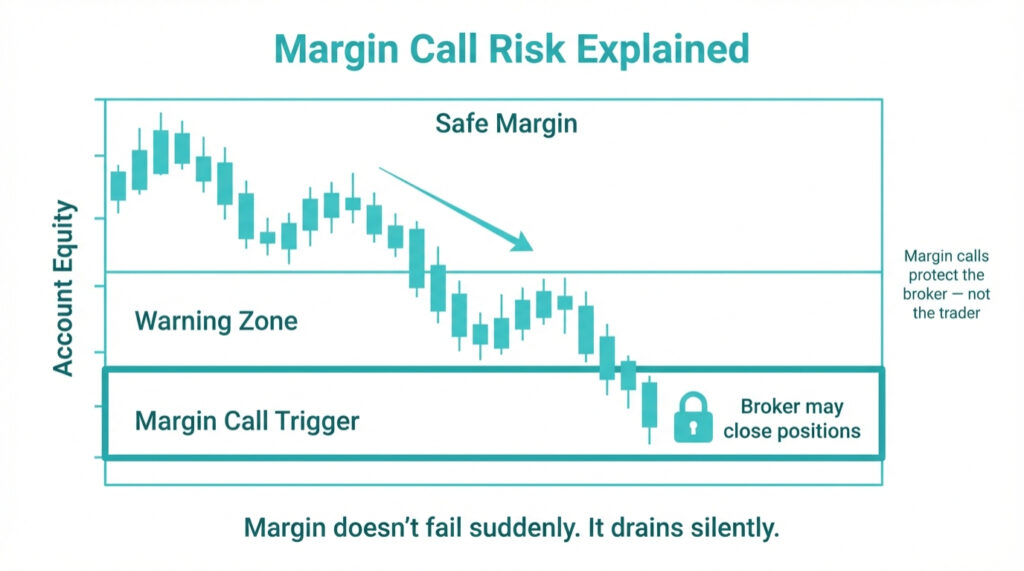
A margin call is the result of failing to meet the required margin criteria set forth by the broker or any other financial trading platform.
This is due to either a reduction of unrealized loss in the account or changes in the required margin level.
Depending on the asset and the margin account, a margin call could be a request for more money, a warning, or even reducing the exposure.
Nevertheless, there are leveraged trading platforms that automatically close the position when certain margin levels are met.
Margin calls are a safety net in the world of trading, as detailed in Margin Calls Explained, where brokers step in to cap risk and keep your account from dipping into the red.
How Margin Calls Work
When the margin level in the account is lower than the minimum required by the broker, the latter might do something based on his policies. The actions could range from asking for extra collateral, limiting opening trades or even closing current trades.
A forced closure of trades is known as stop-out in retail leveraged trading. Sometimes, due to volatility in the market, trades will be closed at a price that was not expected.
There is no guarantee that a stop-out will not lead to large losses. The full liquidation process is laid out in Margin Calls & Stop-Outs Explained, where a forced closure helps shield both the account and the broker from additional losses.
Margin systems enforce risk discipline automatically.
Margin Requirements and Maintenance Margin
Margin rules can apply for both opening of a position and during its existence. The initial margin is the amount of money/collateral needed to open a certain position.
The maintenance margin is usually understood as the minimal margin/equity required to keep a position open, but calculations and definition can differ.
In certain retail leveraged trading platforms, the margin level can be expressed as the percentage of account equity compared to the margin being used.
In case the margin level is below a certain threshold, trading operations will be limited by the platform or positions closed automatically.
It is important for traders to know the exact margin rules on their accounts. Keeping an eye on equity is super important, as teh article What Is Equity?, since equity mirrors your account's current status.
Margin in Forex Trading
Forex trading often uses leverage because currency prices tend to fluctuate in small steps relative to their overall value. Margin allows traders to enter the currency market without committing all their capital up front.
However, Forex markets can experience volatility spikes, liquidity shifts, and execution gaps, as explained in Market Gaps and Slippage Explained.
How Much Margin Should Beginners Use
There is no one size fits all when it comes to the margin amount or ratio. The appropriate exposure can be dictated by the personal finances, risk taking ability, experience, instrument being traded and even the effect of unfavorable price movements.
A large exposure through margin can make the account prone to loss and margin requirements. The beginners must be aware of position sizing, account equity and margin call.
This structured approach is explained in Survival Rules in Trading: What You Must Never Do in Trading?, where excessive margin use is one of the primary causes of account failure.
Common Beginner Mistakes With Margin
The impact of margin requirements on trading exposure and equity is one concept that newbies get wrong most of the time.
Examples of misconceptions that people have include taking on too large positions based on their account balance, ignoring margin requirements and thinking that available margin equals maximum loss.
People might also be making larger positions after losing money or ignoring the impacts of market gaps and slippage. Nevertheless, margin losses do not always result from a lack of discipline in people.
These slip-ups are part of the wider behavioural risks discussed in Common Risk Management Mistakes Beginners Make, where gut feelings trump methodical risk management. Margin problems are usually discipline problems, not technical problems.
Margin and Trading Psychology
Margin trading is prone to putting people under mental stress, especially when there are heavy losses in leveraged positions which have not been realised. Mental states such as fear, frustration and over-confidence may affect decision-making regarding opening, keeping or closing of positions.
However, different people react differently mentally and not all losses in trading are attributed to emotions.
Structured learning and guided experiences help traders develop discipline step by step with lessons at the VARIANSE Academy. Emotional stability comes from controlled exposure, not maximum exposure.
Conclusion: Understanding Margin in Trading
The margin is the amount of money or collateral needed to enter into specific trading positions. Through margin trading, one can create leveraged trading positions without paying the entire value of the trade.
However, margin trading can lead to higher losses compared to the amount of capital used and may be characterized by margin calls, forced liquidations, and extra trading costs.
Therefore, it is vital to know the connection between margin, leverage, equity, and position size. New traders can test their margin trading skills in virtual trading using demo accounts.
Nevertheless, demo trading cannot provide traders with the same environment as actual trading since there is no risk involved.
Before engaging in live trading with margin, individuals need to familiarize themselves with the terms of the trade and possible financial losses.
Before upping your exposure, really get the hang of how margin works and how you're keeping risk in check. In trading, survival always comes before growth. Trying out Margin Trading in a virtual setup with VARIANSE trading page lets traders get the hang of it without risking real cash.








