


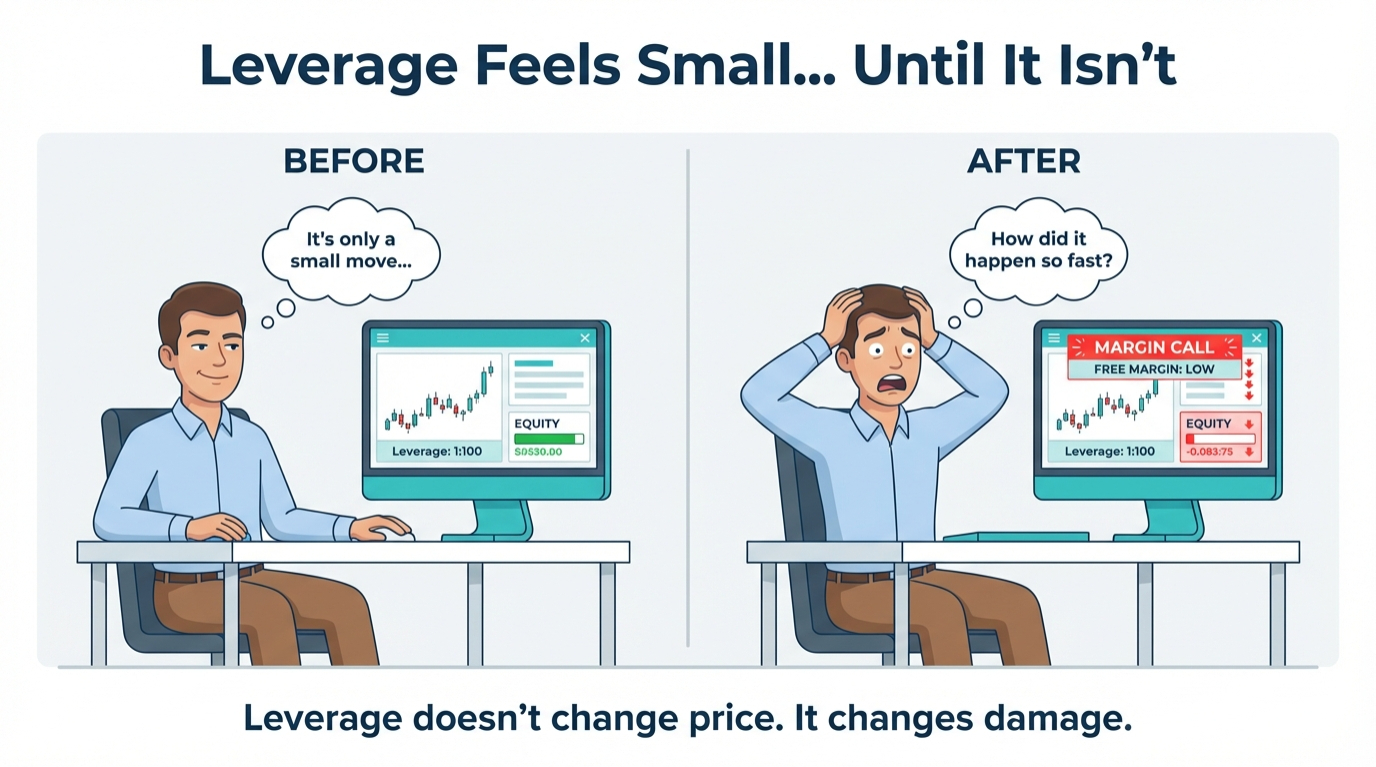
Why leverage is the #1 account killer isn't an opinion; it is a consistent pattern across global financial markets.
It enables traders to manage positions that are larger than the amount they use as the margin. Even though this increases the probability of achieving higher returns in relation to the initial margin, it may result in greater financial loss in case it is applied for increasing market exposure.
Inexperienced traders may suffer a lot financially because of the high use of leverage, combined with improper position sizing and emotional decision-making.
Knowing how the use of leverage impacts position size, account equity and margin is very important.
The following article will explain why the use of too much leverage can cause trading losses and how it is related to margin call and stop-out situations.
Leverage Is Not the Problem; Misuse Is
Leverage is neutral by itself. It's just a way to boost market visibility, not a measure of how big your account is. The danger lies in how we use that tool.
How Leverage Affects Your Trading Account
The leverage cannot make the trading strategy more accurate or predict price movements.
What is being done through the use of leverage is the alteration of the relationship between the amount of funds allocated and the position in the market.
When traders use leverage to increase their position size, the financial impact of market movements can become greater relative to their initial margin.
Thus, traders can achieve larger potential profits and losses from trading. Nevertheless, increased leverage does not, by itself, lead to increased losses.
The Psychological Trap of Leverage
Leverage can influence trading behaviour when traders focus on potential returns without fully considering the associated risks.
Why High Leverage Feels Like Opportunity
For traders with smaller accounts, leverage may make larger market positions appear more accessible.
Early profitable trades can sometimes encourage overconfidence, particularly when gains are evaluated without considering the exposure required to achieve them.
Some traders may respond by increasing position sizes, overlooking risk limits or holding losing positions in anticipation of a recovery.
These behaviours can increase financial exposure and make decision-making more emotionally challenging.
This behavior is closely linked to Trading Psychology Explained, where emotional decision-making replaces process-driven thinking. Leverage rewards luck early and punishes inexperience later.
How Leverage Can Contribute to Margin Calls and Stop-Outs
Using leverage to increase position size can create greater financial exposure to adverse market movements.
Understanding the Margin Call and Stop-Out Process
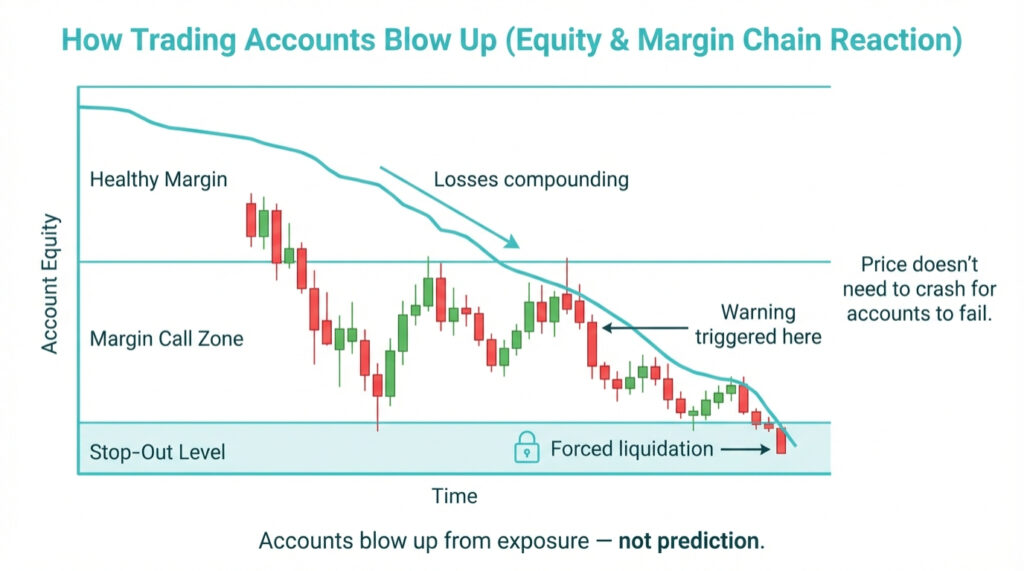
In case a leveraged position goes against the interest of the trader, then the unrealized losses result in lower equity within the trading account.
In the event that equity becomes lower, it will be accompanied by lower amounts of the margin.
In the event that the trading account attains a certain threshold for margin, then the broker might ask for extra funding or reduction in the position.
If the account hits a stop-out threshold, which is set by the provider, then it may result in the automatic closure of some or all the open positions within the trading platform.
Notably, the occurrence of a margin call is not always a precursor to a stop-out.
This process gets the lowdown in Margin Calls Explained, where they show margin meltdown as a slow burn, not a bang-out. Accounts don't just disappear; they hit their spending limit.
Why Beginners May Be More Vulnerable
Beginners may be less familiar with the relationship between leverage, position size, margin requirements and potential financial losses.
Experience Develops Slower Than Leverage Damage
Beginners may be less familiar with the relationship between leverage, position size, margin requirements and potential financial losses.
Experience Develops Over Time
Understanding trading risk requires more than knowing how to open and close a position.
Traders also need to understand how market movements affect account equity, how margin requirements operate and how trading costs influence results.
Some beginners may underestimate these factors or increase exposure after experiencing losses.
However, these behaviours are not universal, and experienced traders can also suffer substantial losses.
This behavior is reinforced by the common blunders mentioned in the article Common Risk Management Mistakes Beginners Make where things get riskier when people don't follow a plan. Leverage amplifies mistakes before learning, which stabilizes performance.
How Experienced Traders Assess Leverage and Risk
Experienced market participants may evaluate leverage according to their trading strategies, financial resources, market conditions and risk-management requirements.
The Professional Approach to Leverage
Rather than evaluating leverage solely by the size of the position it makes possible, traders may consider the potential financial impact of adverse market movements.
Risk-management practices can include monitoring total exposure, assessing margin requirements, maintaining additional available funds and establishing position limits.
Some professional traders use substantial leverage, while others maintain lower exposure depending on their strategies.
Professional experience does not eliminate the possibility of margin calls, stop-outs or significant financial losses.
This method fits with the organized systems we learn in Risk Management Fundamentals, where staying afloat and steady matter more than just growing big. Professionals control leverage. Beginners are controlled by it.
How Excessive Leverage Can Undermine Risk Management
When traders use leverage to increase their positions beyond their planned risk limits, adverse market movements may have a greater financial impact.
Why Position Size Matters
A larger position generally produces a larger monetary gain or loss for the same price movement in the same instrument.
Trading costs, including spreads and commissions, may also increase with position size.
Stop-loss orders can help traders establish intended exit levels, but they do not guarantee execution at a particular price, particularly during market gaps or periods of limited liquidity.
This ties in with the concept of Position Sizing Explained Without Confusion for Beginner Traders, where you adjust position size to manage risk, not increase exposure. Leverage does not replace risk management; it overrides it.
How to Manage the Risks of Leveraged Trading
Understanding leverage is an important part of evaluating the risks associated with leveraged financial instruments.
Practical Risk-Management Considerations
Before opening a position, traders should understand the relationship between their position size, margin requirements and account equity.
Using less than the maximum available leverage may help limit exposure when it results in smaller positions.
Monitoring available margin and total exposure can also help traders understand how changing market prices affect their accounts.
Traders should consider the possibility of slippage, market gaps and unexpected changes in margin requirements.
Practising with virtual funds in a demo environment can help beginners become familiar with platform mechanics without risking real capital in those simulated trades.
However, demo trading does not fully reproduce live market execution or the psychological effects of trading with real money.
Practicing these principles in a controlled environment, such as VARIANSE account, allows traders to understand leverage behavior without financial risk. Control comes from limitation, not maximization.
Conclusion: Why Excessive Leverage Can Increase Trading Risk
Leverage allows traders to obtain greater market exposure relative to the capital committed as margin, but it also introduces important financial risks.
When leverage is used to increase position size, adverse market movements can generate substantial losses and place additional pressure on account equity and available margin.
For beginners, understanding leverage is therefore closely connected to learning about position sizing, margin requirements and risk management.
Excessive leverage is not the only reason trading accounts experience losses, and using lower leverage does not guarantee profitable or consistent results.
The important lesson is to understand the financial exposure associated with each position and the potential consequences of adverse market movements before trading.








