


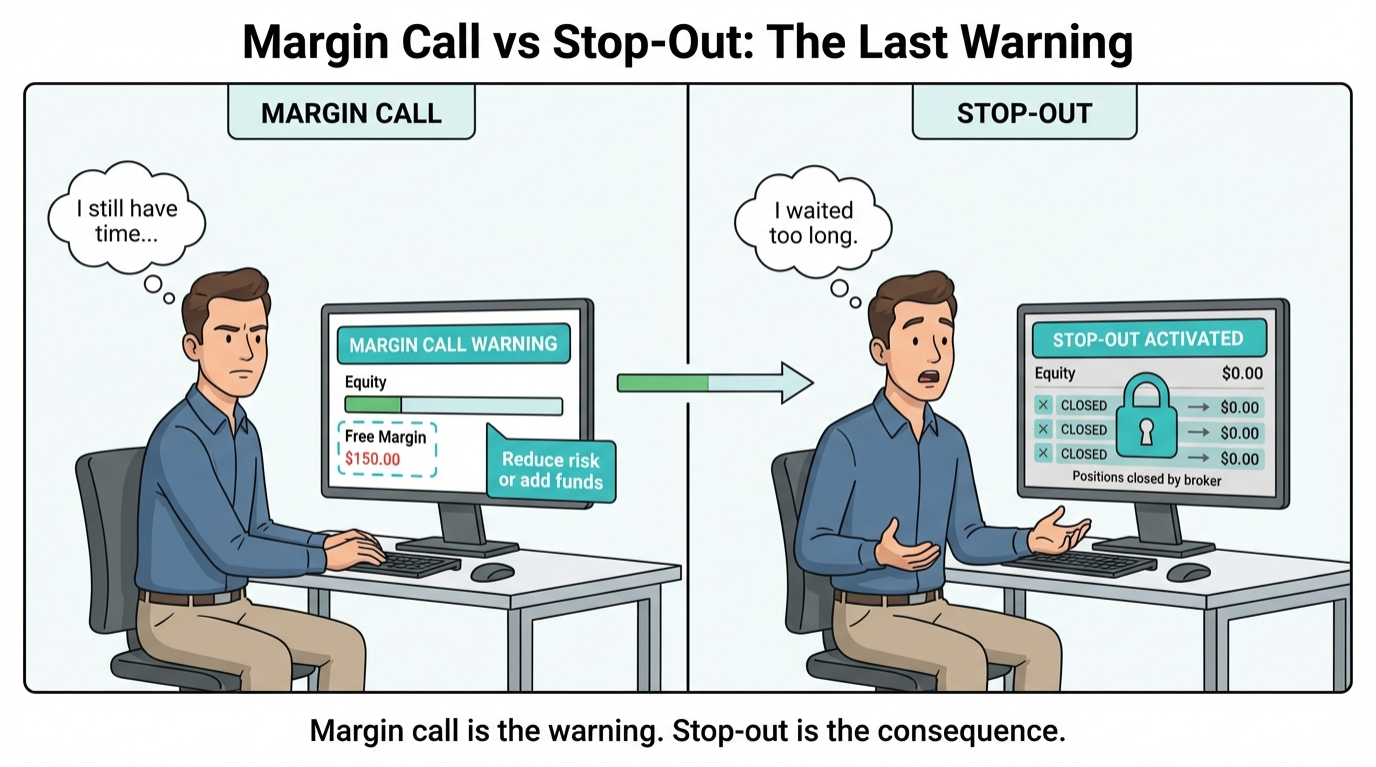
Margin calls and stop-outs are important risk-management mechanisms in leveraged trading, yet many beginners do not fully understand how they work.
Should the leveraged trade move against the trader, the potential losses could lead to reduction in the account equity and margin.
This could happen due to several reasons including excessive position, unexpected market movements, change in margin requirements and many others.
Knowledge of the interaction between margin, leverage and account equity can allow traders to understand the dangers that come with trading on leverage.
In this article, we take a look at the differences between margin calls and stop-outs, what causes them, and what traders should know prior to engaging in leveraged trading.
Why Trading Accounts Can Experience Substantial Losses
Trading accounts can experience substantial losses for different reasons, including excessive exposure, adverse market movements, execution conditions and inadequate risk management.
How Risk Structure Affects Trading Accounts
The effect of leverage is that traders can have an influence on positions of greater value than the actual capital that is being used as margin.
Whenever leverage is employed in order to raise the size of positions, slight movements in the market can cause major profits or losses relative to the margin.
If the open positions are experiencing unrealized losses, then there could be a reduction in the equity as well as margin.
This could make it easier to reach the margin call or stop out level. But problems related to margin do not always stem from bad trading.
This pattern's pretty much the same as in Why Leverage Is the 1 Account Killer for New Traders, where using leverage just speeds up the blunders that traders can't fix.
Margin calls and stops: Unexpected events aren't surprises; they're just what you'd expect when you don't handle risks properly.
What a Margin Call Really Means
A margin call occurs when a trading account no longer meets the margin requirements established by the broker or trading provider.
Margin Calls Explained in Plain Terms
As a result of the unrealized loss, the equity of the account may have less margin to maintain the open positions.
In case the equity reaches a certain margin level, the firm may issue a warning, ask for more collateral or make the client reduce positions.
However, some leveraged trading platforms may automatically exit from the trade without any prior warning about margin call. It all depends on the instrument, the broker and the account status.
This idea is fleshed out in Margin Calls Explained, which presents margin calls as a safety net rather than a penalty. You've got one last shot to get things back on track before you're stuck with no choice but to act.
What a Stop-Out Actually Is
A stop-out occurs when a trading platform automatically closes open positions after an account reaches a predefined margin or liquidation threshold.
Forced Liquidation Explained
In cases where the amount of unrealized loss causes an account balance to drop, it could cause the margin of the account to go down.
In the case where the margin drops to the level of the stop-out of the broker, the platform may choose to close all or part of the open positions.
This is done in order to minimize the exposure and also the margin shortfall.
Nonetheless, liquidation does not necessarily mean that losses will not exceed the initial margin or even close positions at a particular price.
Execution prices could actually be worse than anticipated during high volatility or low liquidity periods.
Margin Call vs Stop-Out: The Critical Difference
Understanding this distinction is essential for survival.
Experience and Understanding of Trading Risk
A trader can open a leveraged position relatively quickly, but understanding its potential financial consequences requires knowledge of position size, margin requirements and market conditions.
Some beginners may underestimate the effect of relatively small price movements on larger leveraged positions.
Others may overlook available margin, misunderstand stop-out thresholds or increase exposure after experiencing losses.
However, these behaviours are not universal, and experienced traders can also make mistakes or suffer substantial losses.
Learn more in Common Risk Management Mistakes Beginners Make.
Margin Call vs Stop-Out: The Critical Difference
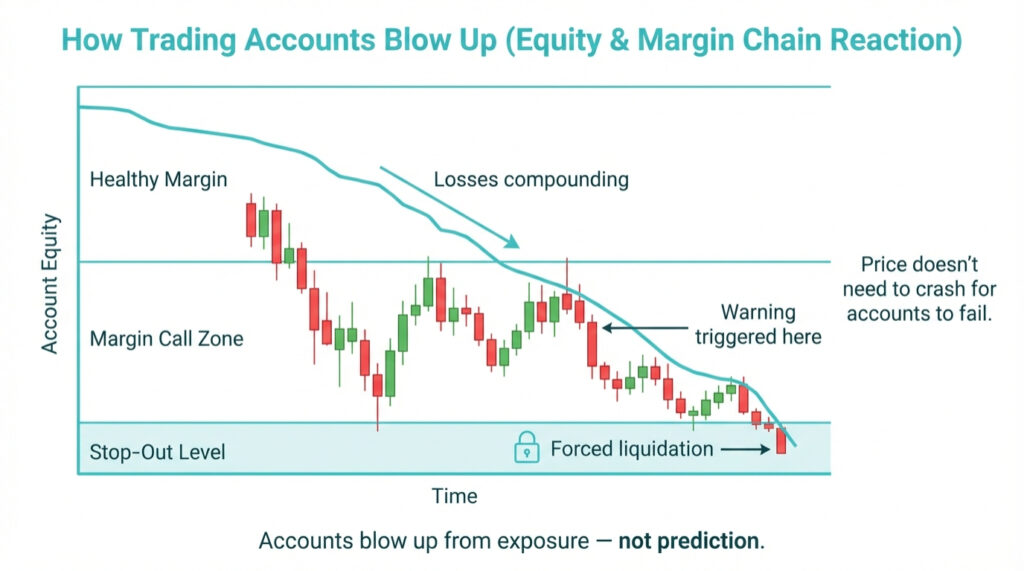
Margin calls and stop-outs are closely related, but they are not the same event.
How the Process Unfolds
It usually starts with heavy leverage to accelerate potential gains. When a trade goes south, it's worse than the risk they planned for, but instead of cutting their losses, the trader sticks around, hoping for a comeback.
As we continue to lose ground, our equity declines, and the pressure on our margins intensifies. This situation usually triggers a margin call, which can lead to emotional decisions such as taking on more risk or stubbornly holding on to positions. Eventually, when equity falls below the required level, the system initiates the process of closing positions at the most inconvenient moment.
This pattern pops up in a ton of accounts, not because of a bad game plan, but because of a structural risk mess-up.
Why Beginners Are Most Vulnerable
Beginners face a timing disadvantage in leveraged markets.
Experience Develops Slower Than Risk
Taking advantage gives you instant attention, but it's all about staying in control and playing it safe, which takes a bit of time to get the hang of. This imbalance makes us more susceptible.
New traders usually go all-in with leverage, pump up their bets after a loss, and see dips as just hiccups, not the end of the road. This results in increased exposure at the most unfavourable moment.
These actions align with what the article Common Risk Management Mistakes Beginners Make discusses: feelings taking over instead of careful thinking.
Without a clear plan for managing risks, the danger is like a ghost it's there, but you don't see it until it's too late.
How Professionals Avoid Margin Calls and Stop-Outs
Professional market participants may use structured approaches to monitor financial exposure and margin requirements.
The Professional Approach to Risk Assessment
Depending on their trading techniques, professional traders and organizations might impose exposure limitations, keep track of account equity, maintain excess collateral, or estimate possible losses under various scenarios.
Some also employ stress testing for evaluating portfolio performance under adverse price shifts.
Nevertheless, being a professional does not preclude them from facing margin calls, forced closures or even significant financial losses.
Volatility, liquidity factors and other unforeseen developments can influence professional and private traders equally.
Knowledge of the process of planning, execution, monitoring and closure of positions could assist in understanding the link between trading and financial risk.
This way of thinking is supported by Risk Per Trade Explained, which sets the risk level before you even start trading and keeps it constant no matter what happens.
Practical Principles for Managing Margin Risk
Margin calls and stop-outs cannot always be prevented, but understanding the risks of leveraged trading may help traders make more informed decisions.
Risk-Management Considerations
Any leveraged transaction should be done with awareness of the margin and potential financial losses in addition to stop out. The size of the trade is an important consideration since generally, larger trades create more financial risk related to changes in the instrument price.
It is possible to monitor your account equity, margin and exposure of various trades. With stop loss, you may set up the required level of getting out of the transaction but this doesn't mean that your stop loss will always be executed at the specified price.
Various risks should be considered in the process of risk management such as gaps, volatility, liquidity, and others.
Understanding the risks of leveraged trading is essential before committing capital. The Financial Conduct Authority (FCA) provides educational guidance on investment risks and potential financial losses.
VARIANSE demo trading can offer a possibility of practicing margin management with virual money.
Nevertheless, demo trading does not recreate the real trading environment, including psychological risks.
Conclusion: Understanding Margin Calls and Stop-Outs
Margin calls and stop-outs are two aspects of margin trading and margining.
Margin call concerns a lack of margin in an account while stop-out relates to an automatic closure of all trades when the specified liquidation level is reached.
They can be provoked by unrealized loss, margin requirement change, high position size, and other factors.
Understanding of the meaning of leverage and how to work with margin, account equity and position size can help in assessing risks associated with trading.
Nevertheless, even the most effective trading approach and risk management system cannot guarantee that margin calls, stop-outs and other kinds of losses can be avoided.
For beginners, this information becomes an important part of their margin trading education.








