


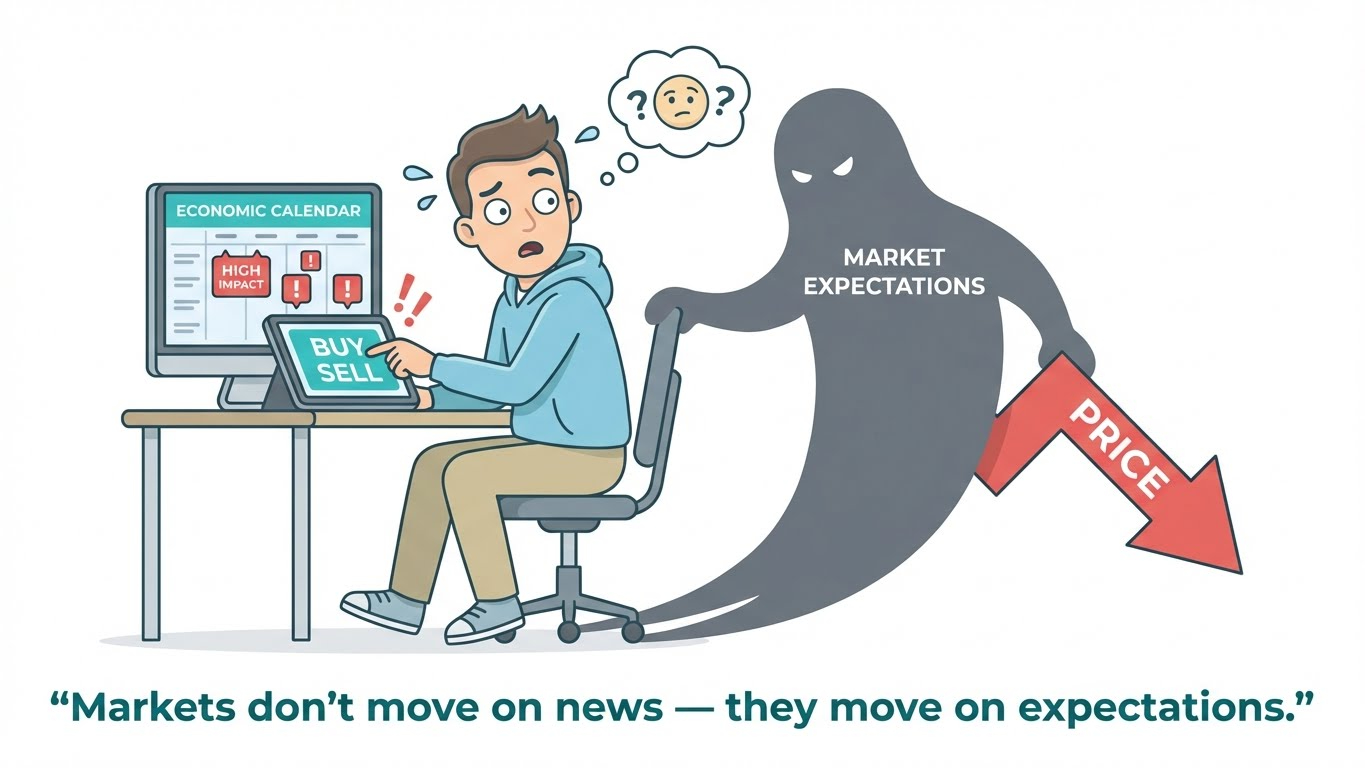
Economic calendar trading in Forex and CFD markets can be challenging for beginners.
The markets react not only to economic information but also to expectations, changes in monetary policy, and changes in liquidity.
Knowledge of all these aspects will enable you to make better use of the economic calendar not just in search of opportunities but in preparation for uncertainty and risk management.
This guide will teach you how to analyze the economic events, compare their outcome with the forecast, and evaluate the possible market reaction independently from the headlines.
What Is Economic Calendar Trading?
Economic calendar trading includes keeping track of scheduled economic news releases to be able to identify future periods of volatility and the effect of information on the financial markets.
In an economic calendar, the release date and time, expected impact, past readings, forecast, and actual values once the data has been released will be included.
By making use of the economic calendar, traders can be able to identify future market risks and price movements that could result from future economic developments.
The economic calendar will not help predict the market reaction.
Why Most Economic Calendar Trading Traders Lose Money
The most common mistake in economic calendar trading is assuming that “big news equals instant opportunity.”
That assumption ignores how markets price information.
Markets Move on Expectations, Not Headlines
Prices often move before official numbers are released. Retail traders often react after institutions have already positioned themselves.
That’s why traders sometimes see strong data triggering sell-offs, weak data pushing prices higher, or, sometimes, little reaction after major news releases.
Markets react to surprises: the difference between actual data and expectations (actual vs. forecast).
The Only Economic Events That Consistently Move Markets
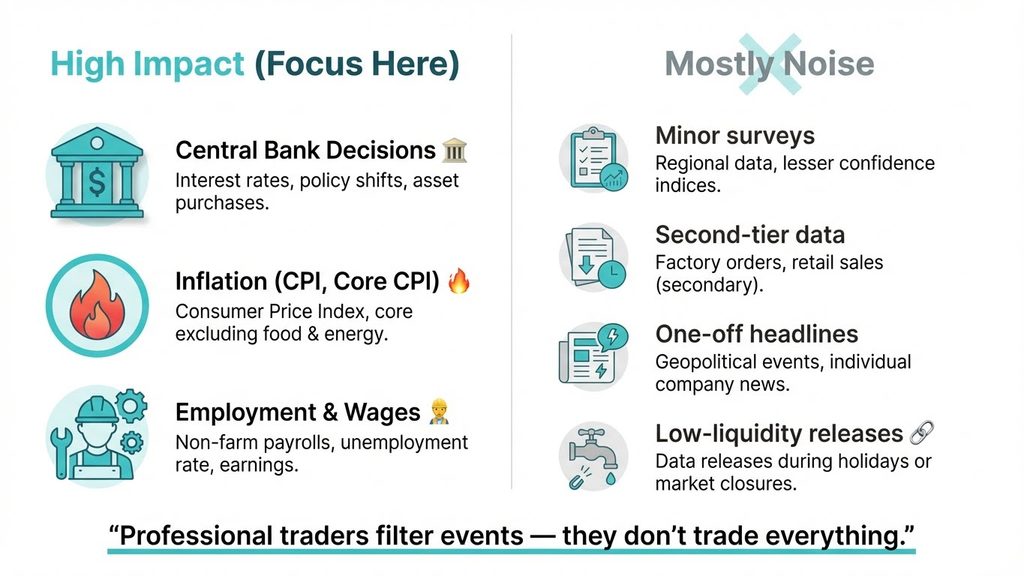
Not every economic report has the same impact. Professional macro traders focus on events that influence expectations about monetary policy.
Central Bank Decisions (Highest Impact)
Central bank decisions shape liquidity conditions and interest-rate expectations, which can drive currency movements and shift risk sentiment.
High-impact central bank events include interest rate decisions, policy announcements, press conferences, and updates on future forward guidance.
Even when the rates stay the same, small wording changes or policy signals can cause major market movement.
Inflation Data (CPI & Core Inflation)
Inflation data are critical because they influence central bank policy decisions.
Markets react strongly when inflation surprises expectations, shifts what people thought policy would do, or when bond yields and yield-curve expectations start to move.
Inflation’s influence on policy aligns with the IMF's definition of price stability.
Employment Data (NFP, Unemployment & Wages)
Employment data can trigger significant market reactions because it reflects economic strength, wage pressure, and potential inflation.
However, headline job numbers rarely tell the full story. Wage growth, participation rates, and revisions are typically more important than the initial headline statistic.
The Bank for International Settlements closely monitors job-market tightness as part of its overall financial-stability assessment.
Actual vs Forecast — The Core of Economic Calendar Trading
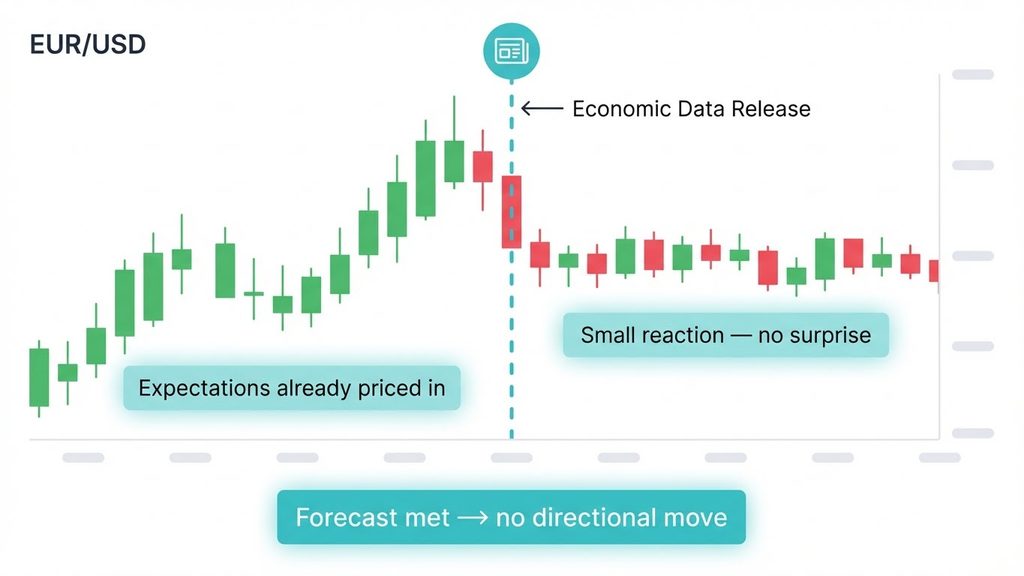
Economic calendar analysis often begins by comparing three figures:
- Previous: The result reported for an earlier period.
- Forecast: The consensus estimate before the announcement.
- Actual: The figure published when the economic data are released.
The gap between the actual outcome and the predicted number is often referred to as an economic surprise.
Let us assume that the prediction for US inflation is 2.8%, while the actual outcome is 3.1%. This would give a reason for investors to reconsider their views on interest rates set by the US Federal Reserve Bank.
Based on the current market situation, such reconsideration will affect yields on US Treasury bonds and the US dollar along with other financial assets.
Nevertheless, there is no way that an economic surprise of this kind guarantees any kind of price change.
Why “Better Than Expected” Still Fails
Price can move against data when expectations were even higher, positioning is overcrowded, liquidity thins during releases, or broader macro themes dominate.
Without an understanding of expectations, economic calendar trading becomes guesswork rather than disciplined analysis.
Liquidity, Volatility & Execution Risk
High-impact economic news can drive high market volatility, including wider spreads, slippage, erratic price fluctuations, and false breakouts.
These risks increase in CFD trading because leverage can amplify both gains and losses. That’s why experienced traders usually cut back on risk or hold off until the market settles after the event.
Economic Calendar Trading Checklist: A Beginner-Friendly Approach
Before diving into any economic news, traders ought to check
- What event is scheduled? Identify whether the release concerns inflation, employment, economic growth or central bank policy.
- What does the market expect? Compare consensus forecasts with previous readings and current market expectations.
- How important is the event? Assess whether the announcement could influence interest rates, currency valuations or broader market sentiment.
- What is the market doing beforehand? Review recent price movements, market structure and relevant support and resistance levels.
- What are the execution risks? Consider wider spreads, slippage, reduced liquidity and sudden volatility.
- Does the event fit your trading plan? Check your position size, risk limits and whether your strategy permits trading during major announcements.
If the risk factors are unknown or the market environment does not fulfill your trading requirements, then you can opt out of the deal.
How Professionals Actually Use the Economic Calendar
Professional traders use the economic calendar to manage risk, not to chase market volatility.
They avoid overtrading when things are uncertain, wait for the market to settle after the initial reaction, focus on broader market shifts rather than one-off data, and ensure their investments align with the broader economic picture.
This approach works best when combined with “Market Structure Explained: HH, HL, LH & LL” and “Break of Structure & Market Regime Shifts.”
Common Beginner Mistakes in Economic Calendar Trading
Sometimes people make big mistakes, like treating every major event as a big trading opportunity, not adjusting position sizes when things get volatile, and ignoring the bigger context.
A single data point rarely changes monetary policy or the overall market structure.
How to Use the Economic Calendar Safely in Forex & CFD Trading.
For beginners, the economic calendar is more suited as a risk filter than a signal generator.
Mark high-risk periods. Take your time during uncertain times, let the market settle after news breaks, and trade only when volatility aligns with your structured strategy.
Make sure you’ve checked the right conditions before jumping into risky trading, using the Variance Trading Account page link.
Conclusion: Economic Calendar Trading Is About Preparation, Not Speed
Trading off the economic calendar is not all about being faster than your competitors when responding to the news. Trading off the economic calendar requires an awareness of the expectations, analysis of economic statistics and an understanding of how changing market situations impact prices.
Economic calendar trading can be especially beneficial for novice traders as a form of risk management. Anticipating events in advance helps traders prepare for volatile situations, assess their positions and refrain from making any rash decisions during the uncertain periods.
It is not about predicting every market move and eliminating the possibility of any losses, but rather about making better decisions.








