


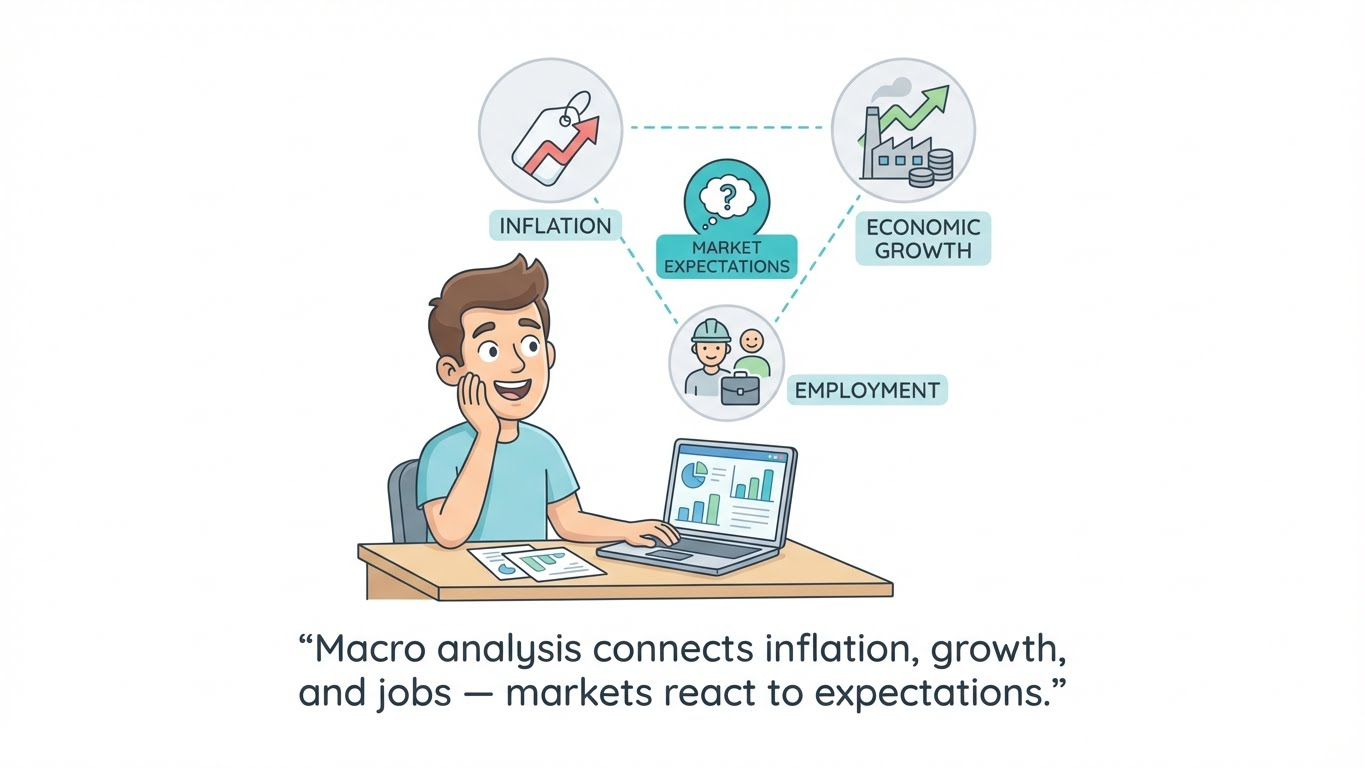
Macro analysis isn’t just about forecasting market trends. It is about understanding the economic conditions and expectations that can influence financial markets.
When trading forex and CFDs, price movements depend on a range of things, such as inflation, economic growth, employment levels, changes in monetary policy and shifting market sentiment.
From a trader's perspective, macro analysis helps understand how these variables relate and why, at times, markets react differently to economic news.
In this tutorial, we will learn about the effects of inflation, GDP and labor market indicators on currency pairs and indices.
What Is Macro Analysis in Trading?
Macroeconomic analysis evaluates economic indicators and financial conditions in order to assess the environment which affects the financial markets.
Unlike business analysis, the focus of macro analysis is on economy-wide factors such as inflation, economic growth, unemployment, interest rates, etc.
The traders can employ macro analysis to evaluate both the long-run economic trends and short-run reactions to key economic information releases.
However, macroeconomic indicators are not a perfect predictor of future prices.
The Macro Triangle: Inflation, Growth, and Employment
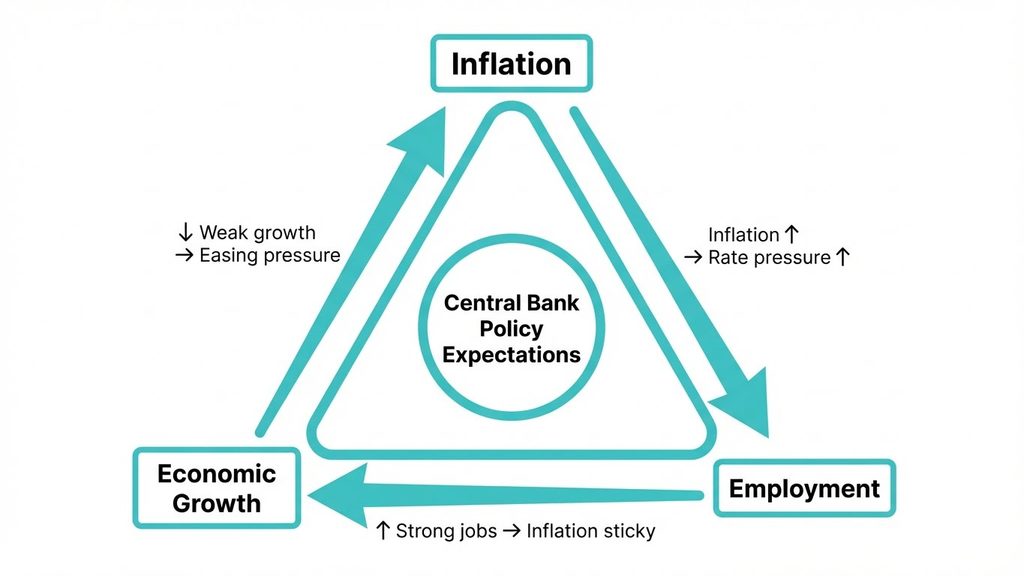
Most macroeconomic data fit into three core categories. Understanding how these interact gives traders a structured framework for interpreting market reactions.
Inflation — Understanding Price Pressures
Inflation refers to a sustained increase in the general price level of goods and services within an economy.
For traders, inflation data matters because it can influence expectations about central bank interest rates and broader financial conditions.
Common inflation indicators include:
- Consumer Price Index (CPI): Measures changes in the prices of a representative basket of consumer goods and services.
- Core CPI: Typically excludes selected volatile categories, such as food and energy, although definitions vary by country.
- Producer Price Index (PPI): Measures changes in prices received by producers for goods and, depending on the measure, services.
Higher-than-expected inflation may increase expectations of restrictive monetary policy, while weaker inflation data may support expectations of future rate cuts.
However, central banks also consider economic growth, employment and the wider inflation outlook when making policy decisions.
Importantly, falling inflation does not necessarily mean prices are falling. It may simply mean that prices are rising more slowly.
Economic Growth — Measuring Expansion and Slowdown
Economic growth refers to the changes that occur in the production of goods and services in an economy.
Gross Domestic Product (GDP) is among the most common measures of economic performance.
Another factor traders keep track of when assessing economic performance includes such measures as Purchasing Managers' Index (PMI), retail sales, and industrial production.
Economic growth that is robust can help foster hopes for an increase in interest rates in cases where such growth is contributing to rising inflation.
On the contrary, weakening economic growth can lead to expectations of monetary policy easing, especially in instances where inflation is falling.
Yet again, the connection is not always certain, and central banks take into account various economic indicators.
Employment — Understanding Labour Market Conditions
Employment indicators provide information about the strength of the labour market and wider economic activity.
Important releases include:
- Non-Farm Payrolls (NFP): Measures changes in US non-farm payroll employment.
- Unemployment Rate: Indicates the proportion of the labour force that is unemployed and actively seeking work, according to the relevant statistical definition.
- Wage Growth: Measures changes in employee earnings over time.
Strong employment conditions can support household spending, while rising wages may contribute to inflationary pressures.
However, wage growth does not automatically cause inflation. Productivity, business costs, profit margins and other economic conditions also matter.
For traders, employment releases can influence expectations about future interest rates, particularly when the figures differ from market forecasts.
Employment data is an important part of macroeconomic analysis. The US Bureau of Labor Statistics (BLS) publishes official employment statistics, including non-farm payroll employment, unemployment rates and average hourly earnings. These reports help traders assess labour market conditions and understand how economic releases may influence monetary policy expectations.
How Markets Interpret Macro Data: Why Expectations Matter
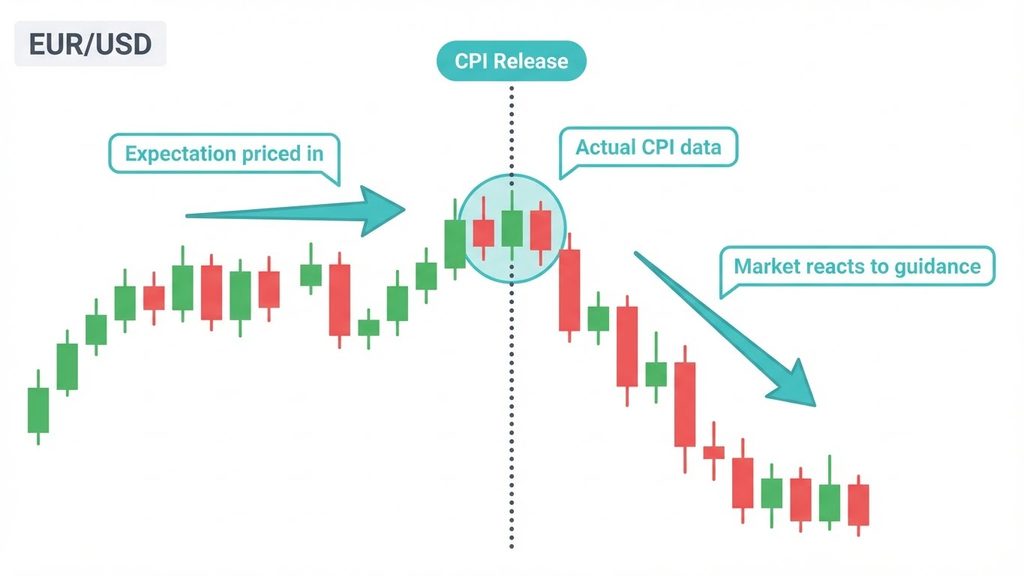
Financial markets often respond to the difference between economic data and what investors had previously expected.
When an economic report is released, traders may compare the actual result with market forecasts, previous readings and any revisions to earlier data.
For example, suppose US inflation falls slightly, as expected, but wage growth remains stronger than anticipated.
Investors might interpret the wage data as a reason for the Federal Reserve to maintain restrictive monetary policy for longer. This could support the US dollar if it leads markets to expect higher US interest rates relative to other economies.
However, the reaction is not guaranteed. Exchange rates also respond to broader economic conditions, market positioning and changes in risk appetite. The important distinction is that economic data should be interpreted relative to expectations rather than in isolation.
Macro Scenarios and Typical Market Reactions
Different combinations of inflation, economic growth, and employment conditions create different market environments.
When inflation is rising alongside strong growth and employment, markets often expect tighter policy and stronger currencies. When inflation falls while growth remains stable, markets often shift toward a neutral or slightly dovish outlook. During economic slowdowns, expectations for rate cuts usually increase. In stagflation environments where inflation stays high while growth weakens, markets can become volatile, and currency reactions may vary.
Understanding these scenarios helps traders avoid reacting emotionally to single data releases.
| Scenario | Inflation | Employment | Growth | Typical Market Reaction |
| Overheating economy | High | Strong | Strong | Hawkish pricing, FX strength |
| Cooling expansion | Falling | Stable | Moderate | Neutral to dovish bias |
| Economic slowdown | Falling | Weakening | Weak | Rate cut expectations |
| Stagflation | High | Weak | Weak | Volatility, mixed FX reaction |
Why Macro Analysis Matters for Forex and CFD Traders
The macroeconomic trends may affect the volatility of the market, interest rate expectations, and sentiments.
In the case of Forex and CFD trades, it is beneficial to know about the macroeconomic trends in order to be able to make sense of the market moves and assess the risks associated with trading.
For instance, the release of unanticipated inflation data or job figures may provoke quick changes in prices especially in the case where the markets have reevaluated the upcoming decisions made by the central banks.
However, macro analysis does not ensure that there will not be any unexpected price movements or losses.
This becomes crucial when you combine it with Monetary Policy Explained and Market Structure Explained: HH, HL, LH & LL, where the big picture and pricing structure go hand in hand.
A Practical Macro Analysis Workflow for Traders
A systematic approach can be followed by traders to understand economic developments without having to predict all market moves.
Step-by-Step Macro Framework
- Monitor inflation: Examine CPI and other inflation indicators over time.
- Assess economic growth: Review GDP, PMI surveys and other measures of economic activity.
- Evaluate employment: Consider payroll data, unemployment and wage growth.
- Compare results with expectations: Identify whether economic releases differ from market forecasts.
- Monitor central bank communication: Examine how policymakers interpret the economic outlook.
- Consider market context: Evaluate how macroeconomic developments relate to price behaviour, volatility and risk exposure.
Other traders make use of both technical and macroeconomic analysis in assessing their trading opportunities.
But both these methods do not ensure accuracy and success.
This approach also connects with the Break of Structure & Market Regime Shifts thing, and you can try it out safely on the VARIANSE trading account page.
Common Macro Analysis Mistakes Beginners Make
It can be quite challenging for beginners to analyze economic statistics especially if the information seems to contradict itself.
Common mistakes include:
- Reacting to headlines without examining the underlying figures.
- Focusing on one economic release while ignoring broader trends.
- Overlooking market expectations and revisions to previous data.
- Assuming that strong economic data will always strengthen a currency.
- Taking excessive risk during volatile market conditions.
- Confusing short-term price reactions with lasting economic changes.
Macro analysis provides context for understanding economic developments, but it should not be treated as a standalone prediction system.
Conclusion: Macro Analysis Provides Context, Not Certainty
Macroeconomic analysis enables traders to determine the impact of inflation, economic growth, and employment status on the financial markets.
With the help of macroeconomic indicators and monetary policy expectations, traders can form a clearer picture of the economic situation influencing the performance of currencies, indexes, and other financial instruments.
Economic indicators, however, do not give exact trading signals and do not ensure future market performance.








