


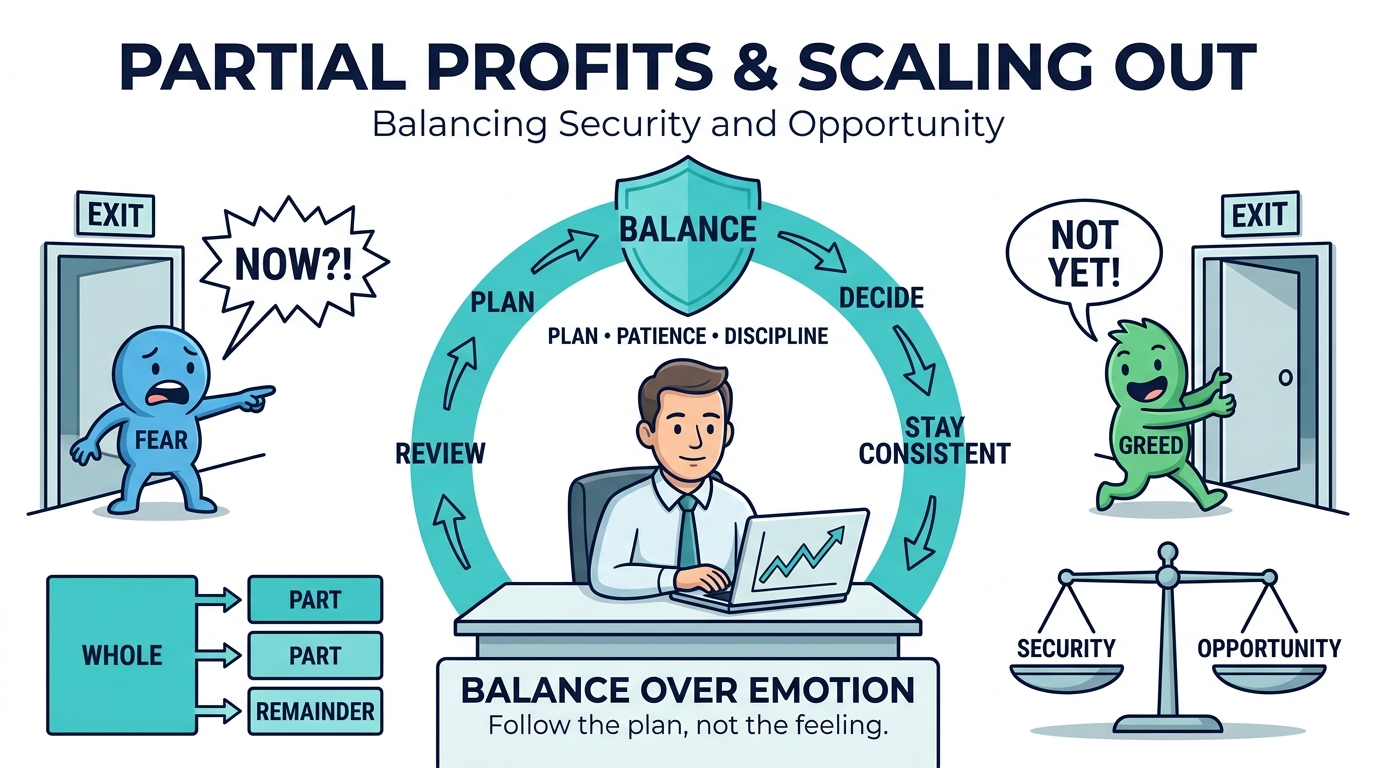
Trading doesn’t always hinge on flawless entry points. It is about managing trades once they are active. That’s where we start talking about taking partial profits and scaling out
Many traders lose money not because their market predictions are off, but because they get scared and sell too soon, or they can’t let go and end up losing their gains. A well-organized Partial Profit Strategy can tackle both issues, as long as it’s done right and follows a clear plan
This guide explains what partial profits are, when scaling out pays off, when it backfires, and how seasoned traders handle them without compromising their win rate. These choices are right at the heart of trade management, just like the ideas in Holding Winners without Emotional Investing.
What Is Partial Profit in Trading?
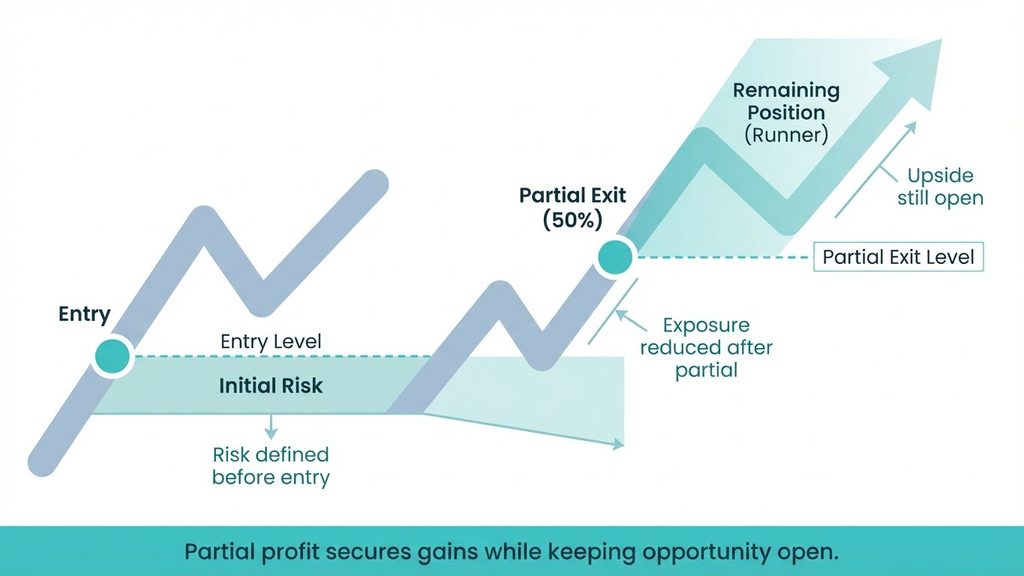
Partial profit means closing a portion of an open position at predefined levels while keeping the remaining position open under clear rules.
Instead of an all-or-nothing exit, partial profits create multiple controlled outcomes. Some profits are locked in, the risk is dialed down, and we’re still sitting on that upside potential. This setup helps cut down on emotional mess-ups when a trade starts making money, something they talk about in the article Trading Psychology Explained.
This method is common in Forex, CFDs, indices, and futures trading, where things can get really volatile, and leverage can ramp up the stress.
Partial Profit vs Scaling Out: What's the Difference?
Partial profit-taking means closing a portion of an open position to realise some of the gains while keeping the remaining position active.
Scaling out is the process of gradually reducing a position through one or more partial exits, often at predefined price levels or when specific market conditions occur.
For example, a trader might close 50% of a position at the first profit target, another 25% at a second target and leave the remaining 25% open under a separate exit rule.
Both can be incorporated into a strategic trade management system, but neither assures an increase in profitability.
Why Do Traders Take Partial Profits
Reducing Psychological Pressure
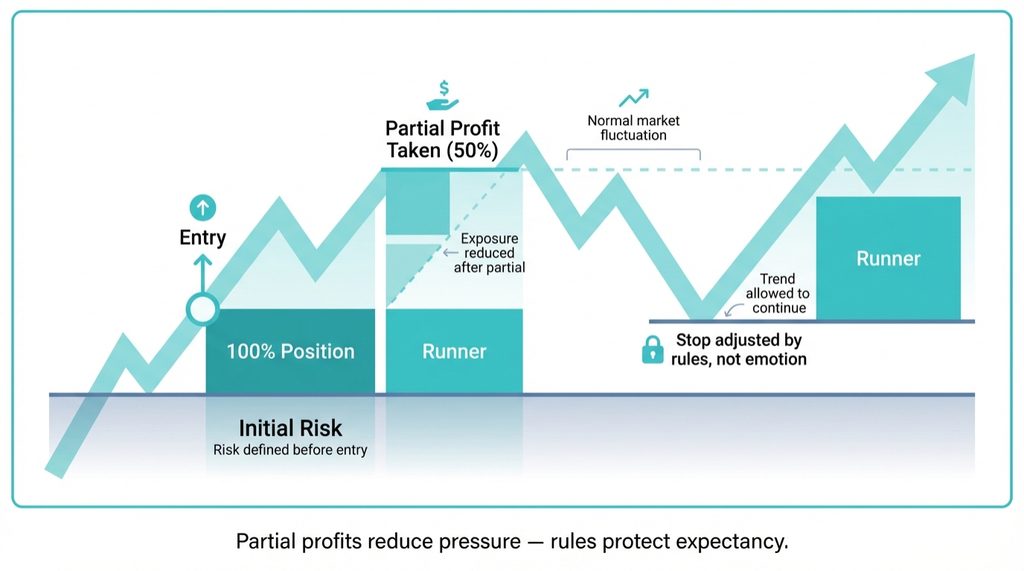
Once traders secure partial profits, they are less likely to panic during normal pullbacks or interfere emotionally with a trade. Reducing the urge to micromanage winners is an important behavioral improvement in active trade management.
Smoothing the Equity Curve
Scaling out reduces the impact of sudden market reversals, particularly in volatile CFD markets where retracements can be sharp. This doesn’t eliminate danger, but it spreads the results more evenly over time.
Adapting to Market Conditions
Markets don’t just go in a straight line. Partial exits allow traders to adapt to uncertainty without abandoning structure. Importantly, partial profits are not designed to increase win rate — they are designed to improve execution discipline and behavioral stability.
When Partial Profits Hurt Trading Performance
Partial profits can quietly damage your expectancy when you take them too early without logic, use them to compensate for oversized positions, apply them the same way in every market condition, or combine them with premature break-even stop losses.
If average winners shrink faster than you control losses, scaling out becomes a hidden cost rather than an advantage. This problem often appears alongside poor stop-loss discipline, as described in Moving Stop Losses.
The Top Three Scaling-Out Strategies (And Their Guidelines)
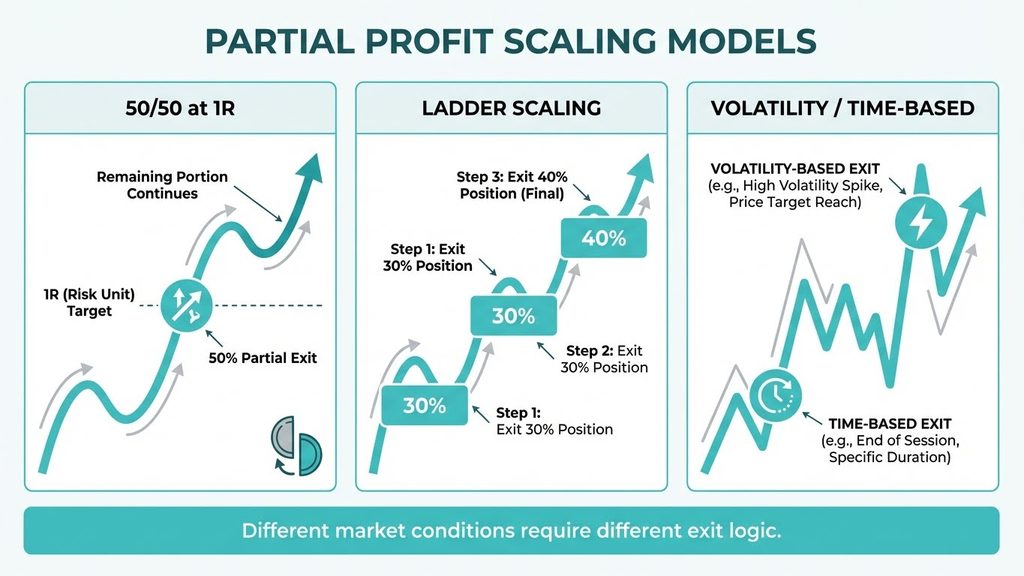
Model 1 — 50/50 at 1R (Beginner-Friendly)
Half the position is off the board at +1R, based on a predefined R-multiple. The other half becomes a runner position handled with a bit of setup or following reasoning. The stop loss doesn’t shift on its own and only gets tweaked when the market’s trend keeps going.
This model is great for newbies getting into the discipline, staying aware of expectancy, and managing their emotions.
Model 2 — Ladder Scaling (Professional Approach)
A part shuts down at 1R, another at 2R, and the rest remains a runner position. This is how trends usually go: they start slow, then they pick up speed
This method shines when paired with directional cues from Market Structure Explained: HH, HL, LH & LL for Traders and a clear understanding of trading regimes from Break of Structure & Market Regime Shifts
Model 3 — Volatility & Time-Based Scaling
Exits aren’t pegged to price targets. Instead, you choose based on volatility, periods without forward movement, or a drop in the flow of progress.
This model shines in markets that don’t swing wildly, especially when big economic news hits, as explained in the Economic Calendar Trading guide.
How Partial Profits Affect Trading Expectancy
Trading expectancy estimates the average profit or loss a strategy may produce per completed trade over a sufficiently large sample.
Expectancy = (Win Rate × Average Win) − (Loss Rate × Average Loss)
In case of partial exit strategies, it is important to sum up all gains from partial exits, the rest of the positions, as well as expenses connected with the trading activity.
The use of scaling out can increase the number of profitable trades, however, the amount of money earned on them will be smaller. In such a way, higher winning percentage does not always correspond to higher profitability. Traders need to compare different exit strategies based on accurate data.
Partial Gains In Forex And CFD Trading
In markets where leverage is used, things like spreads, commissions, and overnight swaps can eat into your overall profits. When you scale up too much in CFD trading, costs can rise and hurt your profits.
Professional CFD traders aim to make steady profits over time, weighing costs against potential returns rather than just following a set exit plan.n Risk control needs to be clear before you dive in; that’s a key point in the Risk Management Fundamentals for Traders.
Practicing the scale-out strategy safely and testing it in a controlled environment are best done through the VARIANSE Trading Account page.
Common Partial Profit Mistakes That Damage Accounts
Taking Profits Just to Feel Safe
Comfort isn’t a game plan. If you take partial profits to calm your nerves, it’s more about how much you’re betting or whether you're sticking to your plan than how you’re handling the trades.
Scaling Out Without a Meaningful Runner
If the remaining runner position is too small, large market moves will not materially affect results. Anticipation quietly fades away.
Using Partial Profits to Avoid Risk Management
If scaling out is required because a trade feels uncomfortable, the original risk was wrong.g Partial gains are meant to improve risk-reward, not just make up for it
Partial profit-taking should be considered alongside stop-loss placement and execution risk. The US Securities and Exchange Commission (SEC) explains how stop orders work and why execution prices can differ from the specified stop price during volatile market conditions.
Partial Profit Planning Checklist: Before Entering a Trade
Before applying a scaling-out strategy, consider the following:
- Entry conditions: Is the trade setup clearly defined?
- Initial risk: Have you established the stop-loss level and position size?
- Partial exit targets: At what prices or conditions will portions of the position be closed?
- Position percentages: How much of the position will be closed at each stage?
- Remaining position: How will the rest of the trade be managed?
- Trading costs: Have you considered spreads, commissions and other applicable charges?
- Performance review: How will you measure whether scaling out improves or weakens your strategy?
Conclusion: Partial Profits Are a Tool, Not a Shortcut
Partial profits provide a systematic means for traders to take some profits and still maintain a portion of their trade open.
Scaling down could be an effective technique in managing your remaining exposure to the markets. On the downside, scaling down could reduce your profitability by either closing your trades prematurely or incurring more transaction costs than benefits.
The success of taking partial profits relies on your strategy, trading environment, position size, and exit criteria among other things.
As opposed to assuming that scaling down always improves your results, you need to assess how it impacts your expectancy, wins, and risk management.








