


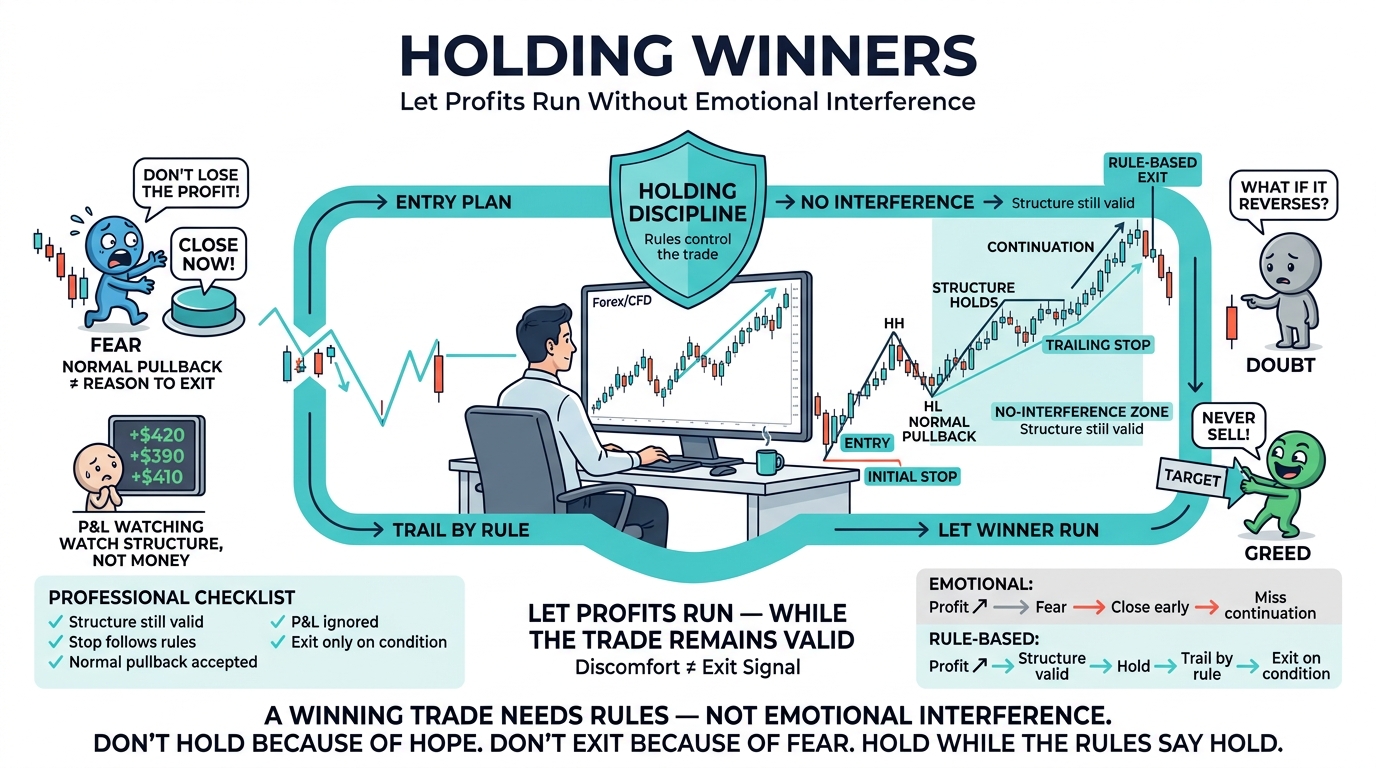
If you’ve ever closed a winning trade too soon and then saw the price keep moving your way, you’ve felt emotional investing kick in.
In Forex and CFD trading, the real challenge isn’t just about spotting the right entry points. It’s holding winners without fear, greed, or doubt interfering with execution. Most traders don’t lose because their strategy is weak. They lose because emotional trading interferes once a trade becomes profitable.
This lesson explains why holding winners feels psychologically uncomfortable, how emotional investing quietly sabotages profitable trades, and how professional traders use rule-based trade management to let profits run without stress. This behavioral clash ties in with the concept of Trading Psychology Explained.
Why Holding Winners Is Harder Than Taking Losses
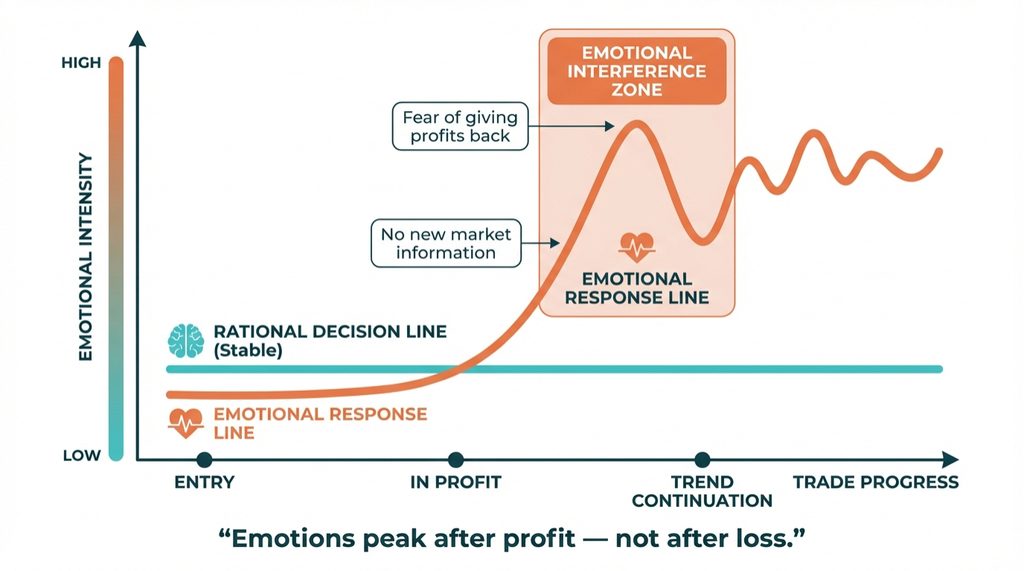
Managing a profitable trade can be surprisingly difficult. As unrealized profit grows, traders may become more focused on protecting what they have gained than on following the original trade plan, creating pressure to exit earlier than intended.
The Disposition Effect in Trading Psychology
Disposition effect is one of the behavioral anomalies where investors and traders have a tendency of selling their investments faster after registering gains and are less inclined to sell those positions that are losing money.
In trading, the disposition effect could be seen in the scenario where an investor would close out a profitable trade early due to fear of losing those unrealized profits but keep on holding a loss-making trade in the expectation of turning it into a profit-making one.
The above behavior could harm a trader in the execution of his/her trading strategy where the disposition effect contradicts the risk and reward profile of the said strategy.
Nevertheless, booking profits early does not necessarily imply a wrong decision since some trading strategies are meant to have short holding period and modest profit levels.
How Emotional Investing Shows Up When Trades Go in Your Favor
Emotional decision-making often becomes more noticeable once a trade moves into profit. Watching unrealized gains fluctuate can create pressure to lock in profits, even when the original reason for holding the position remains valid.
Common Emotional Triggers
When a trade starts making money, traders often fear losing gains they haven’t yet realized, feel anxious after recent losses, get caught up in day-to-day profits and losses, and doubt the trade might go the other way.
These reactions lead to emotional trading, which runs counter to structured execution and disciplined Process-Focused Thinking for Consistent Trading in Forex & CFDs.
Why Holding Winners Feels Uncomfortable
Letting a profitable trade run means accepting that some unrealized gains may disappear before you close the position. That uncertainty can feel uncomfortable, but exiting just to remove it can interfere with a predefined trade-management strategy.
Why Unrealised Profits Create Psychological Pressure
Seeing an active trade move up and down can induce doubt. The trader might start to view their paper profits as actual gains, and any movement in the market will seem to be a loss.
It can lead to early closing of positions as the trader looks more at the profits made by the trade than what makes the trade successful in the first place.
In some trend following trading plans, holding onto the profitable trades becomes crucial since any big moves in the market can become important to profits.
However, all plans do not require holding on to positions for longer durations. Range and mean reversion plans can have different criteria for exiting trades.
What traders should aim to achieve is staying in trades while their conditions are still true.
Professional traders accept this as part of strong Forex discipline and structured execution explained in Market Structure Explained.
Emotional Investing vs. Rule-Based Trade Management
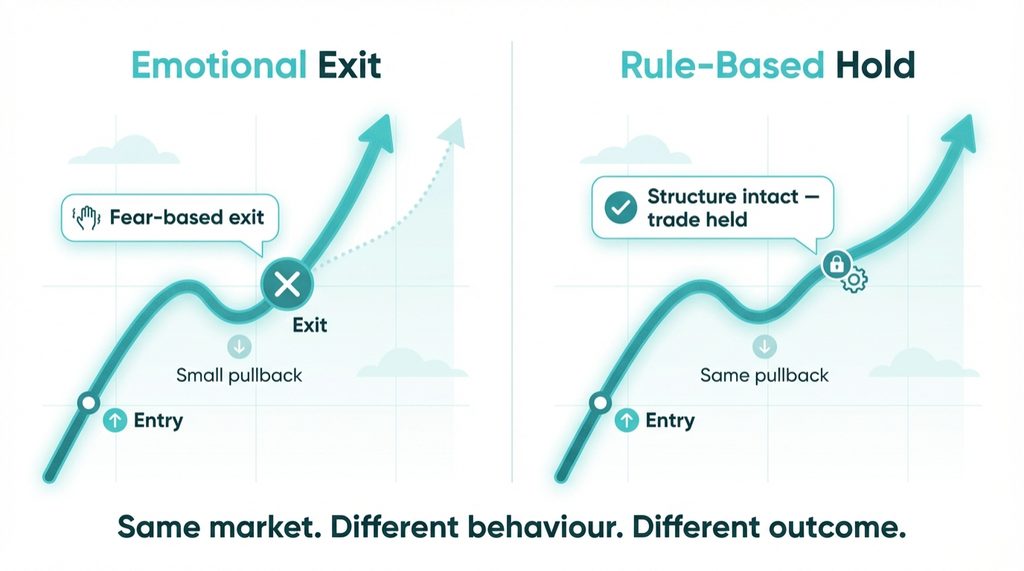
The key difference is what determines the exit decision. Emotional trade management reacts to changes in profit and loss, while rule-based management uses predefined conditions to decide when to reduce, adjust, or close a position.
The Real Fix Is Structure, Not Willpower
You can't fix emotional trading with willpower alone. The solution is structured rules.
Rule-based exits commonly include structure-based trailing stops, predefined exits, partial profit frameworks, or time-based invalidation. These methods remove discretion once the trade is active, a principle reinforced in Moving Stop Losses.
How Experienced Traders Manage Winning Positions
Experienced traders generally focus on the quality and consistency of their decision-making rather than expecting every trade to produce the desired outcome. The goal is to manage each position through a repeatable process while accepting that individual results remain uncertain.
What Consistent Traders Do Differently
Consistent traders accept open-profit drawdowns as a normal part of trading. They focus on execution quality rather than floating P&L. They evaluate performance using expected value across large samples.
This mindset reflects strong Forex discipline and advanced CFD psychology.
Letting Profits Run Without Losing Control
Letting profits run does not mean leaving a winning trade unmanaged. The objective is to give a valid trade room to develop while maintaining clear rules for risk, exits, and structural invalidation.
Practical Techniques That Reduce Emotional Interference
When traders stop constantly monitoring P&L and instead focus on price behavior and structure, emotional investing decreases. Stops are adjusted only when justified by market structure, not by discomfort.
Other useful practices include defining no-interference zones, journaling emotional exit impulses, and reviewing prematurely closed winners to improve trade management.
When you use partial exits, they must still support letting profits run.
When Closing a Winning Trade Makes Sense
Holding winners isn't a rule for staying in every profitable trade as long as possible. When the conditions supporting the original trade change, closing or reducing the position may be consistent with the trading plan rather than an emotional decision.
When Should You Stop Letting Profits Run?
Holding a profitable trade does not mean ignoring changes in market conditions.
A position may need to be reduced or closed when:
- Market structure changes: Price behaviour no longer supports the original trading setup.
- An exit target is reached: The trade meets its predefined profit-taking conditions.
- A trailing stop is triggered: Price reaches the stop level established by the trading strategy.
- Volatility conditions change: Market behaviour meets a predefined volatility-based exit rule.
- Economic event risk increases: An upcoming announcement creates exposure that exceeds the trader's planned risk tolerance.
These conditions should be considered within the context of the individual strategy rather than treated as universal exit signals.
The aim is to distinguish a justified trading decision from an impulsive reaction to temporary market fluctuations.
Key Insight for Traders
- Losses are controlled through predefined risk.
- Profits are built through discipline.
- Emotional investing undermines both.
Conclusion: Holding Winners Requires Discipline, Not Emotionless Trading
Maintaining winning positions can prove to be difficult, especially as the amount of profits that have not yet been realised begins to vary and there is more temptation to get out of the deal.
When trading in foreign exchange and contracts for difference, it is possible for emotional decision making to result in early exits and changes, even if there is no need for such actions.
It should be noted that maintaining winning trades does not always mean that profitability will increase. There are certain things that should influence the choice of a trader.
With a good plan in place, traders can figure out whether market movements should be considered as usual and do not serve as an excuse to exit the market.








