


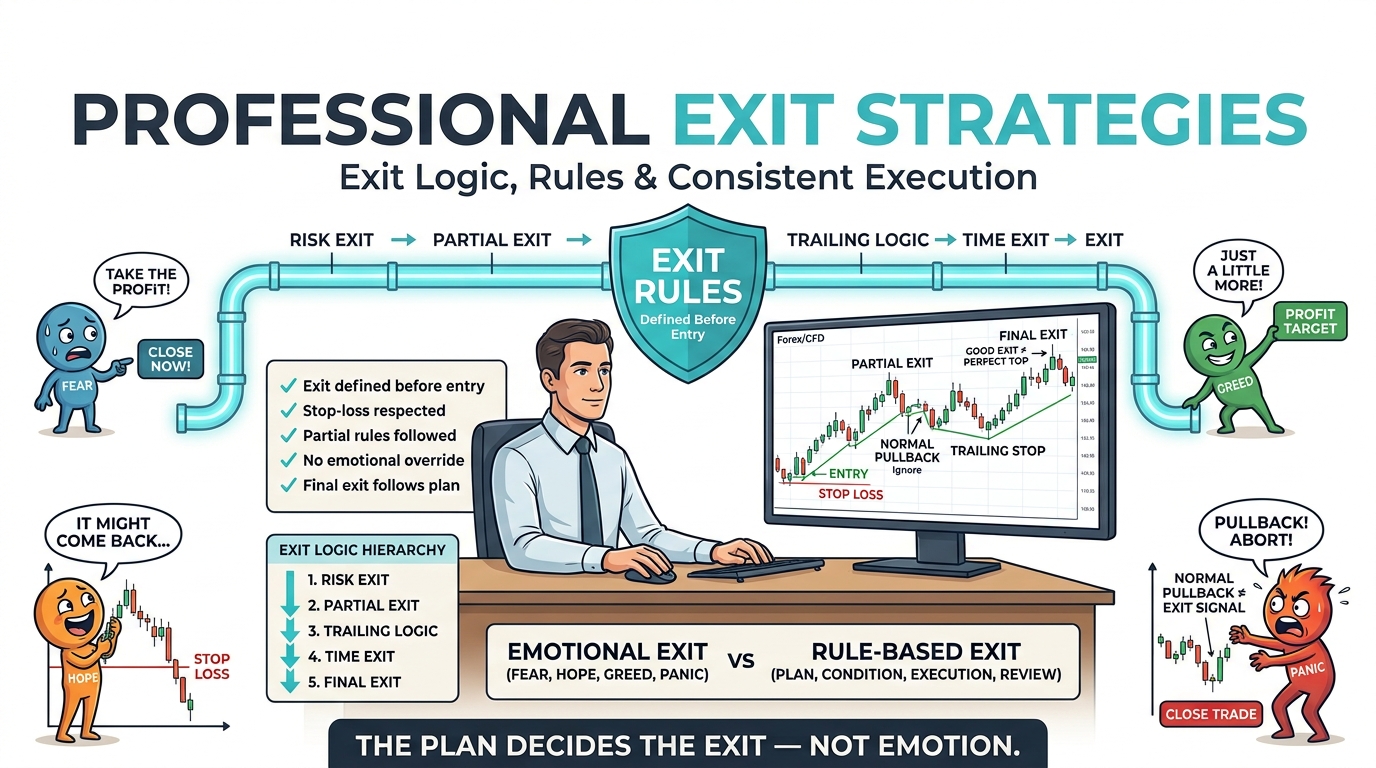
Entering a trade is only one part of trading. Every open position eventually requires an exit decision.
This type of exit may be for gaining profit, preventing possible losses or closing positions due to change in market environment. In case of lacking the plan in advance, traders will find themselves in a situation of making the decision while being influenced by emotional and financial aspects.
A well-defined exit strategy is a process that enables traders to decide on how and when to exit a trade position. The use of a proper exit strategy in Forex and CFD trading will assist in the management of risks and reduce impulsive reactions depending on whether the market goes in favor or against the initial trade strategy.
This guide explores seven common exit methods, how they work and how traders can develop a more disciplined approach to managing open positions.
What Is an Exit Strategy in Trading
A trading exit strategy consists of specific rules or conditions that decide when a trader will close one or more active positions.
An exit does not have to occur because the trade has gone wrong. Traders may exit because they reach a profit target, market structure changes, volatility shifts, or the conditions supporting the original setup are no longer present.
A complete trading strategy should therefore answer two questions before entry:
- What happens if I am wrong?
- What happens if I am right?
The first relates primarily to controlling downside risk. The second determines how you will manage a profitable position.
This is why exit planning is closely connected to risk management rather than being something considered only after a position has been opened.
Why Should Traders Plan an Exit Before Entering
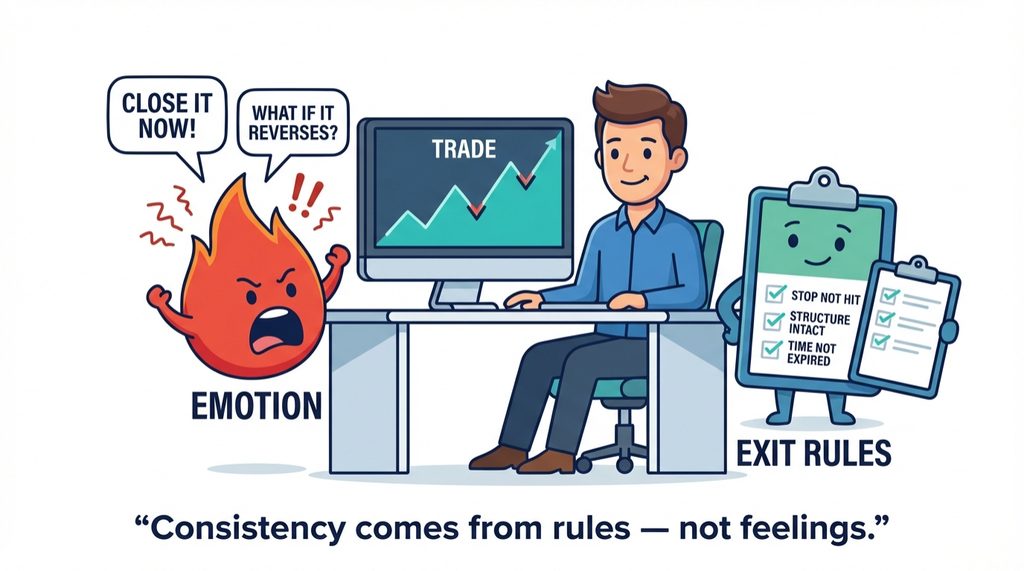
When the position becomes open, changes in market prices can have an impact on the trader's feelings as well as account equity.
In a losing position, the hope that the market will rally might arise. In a winning position, the contrary feeling of fear of losing unrealized profits can arise.
Such reactions can lead to the timing of closing positions, especially when no conditions for exiting have been planned beforehand.
It is better to plan the exit strategy before opening the trade in order to minimize the decisions taken under pressure.
For example, before entering a trade, a trader might determine:
- Where the trading idea becomes invalid
- How much capital is at risk
- Whether a fixed profit target will be used
- Whether profits will be allowed to run
- Whether part of the position can be closed
- What market conditions would justify changing the exit
The purpose is not to predict exactly how the trade will unfold. It establishes a framework for responding to different outcomes.
Stop-Loss Exits: Defining When the Trade Is Wrong
Stop-loss is the most commonly used mechanism for controlling downside risks in Forex and CFD markets.
Instead of determining the amount of tolerable loss after a move against them has started, a trader can define an exit point that will help protect him before getting into the trade.
This type of stop-loss can be set up based on market structures or predetermined risks levels.
Suppose a trader buys after price forms a higher low within an uptrend. If price subsequently breaks below a key structural level, the original bullish reasoning may no longer apply.
A stop could therefore be placed based on that invalidation logic rather than at an arbitrary distance.
This approach is closely connected to Market Structure Explained, where traders examine higher highs, higher lows, lower highs and lower lows to understand how price trends develop.
Importantly, a stop price does not necessarily guarantee the exact execution price. In fast-moving markets, execution can occur away from the stop level depending on the order type, available liquidity, and market conditions.
However, a stop loss order does not always ensure that the trade will be executed at the particular stop price since during volatile markets, there is a chance that it may not be.
The US Securities and Exchange Commission's guidance on stop orders explains this execution risk and how short-term price fluctuations can trigger stop orders.
Traders should understand these limitations when establishing protective exits, particularly when using leveraged instruments such as Forex and CFDs.
Profit Targets: Planning Where to Take Profit
A profit target defines a price or market condition at which a trader will close some or all of a profitable position.
One approach is to use a predetermined risk-to-reward relationship. If a trader risks 50 points, for example, a trading plan might identify a potential target 100 points away.
That represents a potential reward of twice the initial price risk — but it does not mean the trade has a greater probability of succeeding.
Targets can also be based on market structure.
Previous swing highs and lows, support and resistance zones, or other technically relevant areas may help traders identify locations where price could encounter increased buying or selling interest.
The important point is that a target should have a reason behind it. Choosing an arbitrary target simply because it produces an attractive risk-reward ratio does not make the target realistic.
Trailing Stops: Letting the Exit Move With Price
Trailing stop refers to a way of getting out which changes the value of the stop as the market moves favorably.
For a long position, the normal trailing stop would move up as price goes up but stay unchanged at its last level if the price goes down.
This works vice versa for short positions.
The order for platform trailing stop may be based on a constant price or percentage from the market price, depending on the nature of the order.
It could also be adjusted by the trader as the trader wishes depending on the market structure, moving average and volatility, etc.
However, although this is the case, a manually adjusted stop loss does not always equate to trailing stop order. This can balance protecting part of an open gain with giving the trade room to continue.
Trailing stops can be based on:
- A fixed price or percentage distance
- Market structure
- Moving averages
- Volatility measures such as ATR
However, tighter does not automatically mean safer.
Placing a stop too near the prevailing market price may result in normal market movement causing an invalidation of what might have been a valid trade.
There is no need for a judgment call; this must be done according to a predetermined guideline. For a more detailed explanation, explore Moving Stop-Loss Levels and how different adjustments may affect trading risk.
Structure-Based Exit Strategies
Not every exit needs to be based on a fixed number of points.
A structure-based exit uses changes in price behavior to determine whether the original reason for holding a position still exists.
Imagine an uptrend producing a sequence of higher highs and higher lows.
Rather than closing simply because a predetermined profit amount has been reached, a trader may continue managing the position as long as that structure remains intact. If a key higher low is subsequently broken, the trader reassesses whether the bullish premise is still valid.
This method enables traders to have their exit depend on changes in market behaviour rather than force every trader to trade with the same target distance.
Nonetheless, structure-based exit methods demand some form of definition. Traders must understand which swing points count, the timeframe that counts and what constitutes structural change.
Otherwise, traders may end up using small price movements as their basis for exit decisions.
Volatility-Based Exits Using ATR
Markets do not move at the same speed every day.
A fixed 20-point stop, for example, may provide plenty of room during quiet conditions but sit inside normal price fluctuations when volatility increases.
The Average True Range (ATR) can provide context about recent market volatility.
Some traders utilize ATR to come up with the optimal stop-loss distance prior to going into a trade, as well as to come up with volatility-based trailing stops.
Higher values of ATR point out to higher price fluctuations recently, while lower ATRs show low volatility.
Nevertheless, the rise in ATR value alone is not enough reason to adjust the current stop-loss distance. This will just result in increasing the initial risk unless there are specific rules in place to deal with this situation.
In the same way, a fall in volatility does not always mean that the trader needs to reduce his stop distance.
ATR indicates only the size of price fluctuations, not their direction. It measures volatility, which makes it more useful for adapting risk and exit distances than predicting direction.
Partial Exits: Closing a Position in Stages
Traders do not always have to choose between holding the entire position and closing everything.
A partial exit, sometimes called scaling out, involves closing part of a position while leaving the remainder open.
For example, a trader may reduce some exposure when price reaches an initial objective while managing the remaining portion according to market structure.
This will shrink the exposure that remains but will still allow participation in case of an even bigger move in the same direction as originally seen in the market.
However, scaling out has its drawbacks as well.
Early closing of part of a position may limit profits from strong trends.
Frequent scaling out may impact the transaction costs and the average position size for profitable positions.
Thus, the choice must be made considering what is expected from the trading strategy in terms of risk/reward ratio. This approach is explored further in our guide to Partial Profit-Taking and Scaling Out, including how staged exits can influence trading expectancy and remaining exposure.
Closing positions too early can change a strategy's expected payoff. The decision should therefore fit the broader trading plan rather than provide temporary emotional comfort.
Time-Based Exit Strategies
Sometimes the reason to exit is time, not price.
A trader may expect a setup to develop within a particular period. If price remains stagnant and the expected move does not occur, holding the position may no longer fit the original strategy.
A time-based exit could mean closing:
- At the end of a trading session
- Before a predetermined event
- After a setup fails to develop within a defined period
- According to the holding period of the strategy
This is especially relevant when the original trading idea depends on short-term momentum.
Time-based exits should still be predefined. Otherwise, "I've held this long enough" simply becomes another discretionary reaction.
When Should Traders Change an Exit Plan?
An exit plan should provide structure, but that does not necessarily mean it can never change.
The key question is why you're changing it.
Adjusting an exit because market structure has evolved, according to predefined rules, differs from moving a stop because the trader does not want to accept a loss.
Potentially relevant changes might include a structural break, a significant change in volatility, or conditions specifically defined within the trading strategy.
By contrast, repeatedly widening a stop as price approaches it can increase the original risk and undermine the purpose of defining the stop in the first place.
Any adjustment should be consistent with the strategy's risk limits and documented trade-management rules. For further guidance, explore Moving Stop Losses: When It Helps and When It Hurts Traders.
Common Exit Strategy Mistakes
Exit mistakes often happen when traders manage a position based on current profit or loss rather than the original trading logic.
Common examples include:
- Moving a stop further away to avoid taking a loss
- Closing a profitable trade solely because the unrealized gain feels too valuable to risk
- Setting unrealistic profit targets
- Moving a stop too aggressively after a small favorable movement
- Ignoring changes in market structure
- Taking partial profits without predefined rules
- Holding indefinitely because the trader expects price to recover
These behaviors can make it hard to tell whether a trading strategy is effective because the execution rules keep changing.
How to Build a Trading Exit Strategy
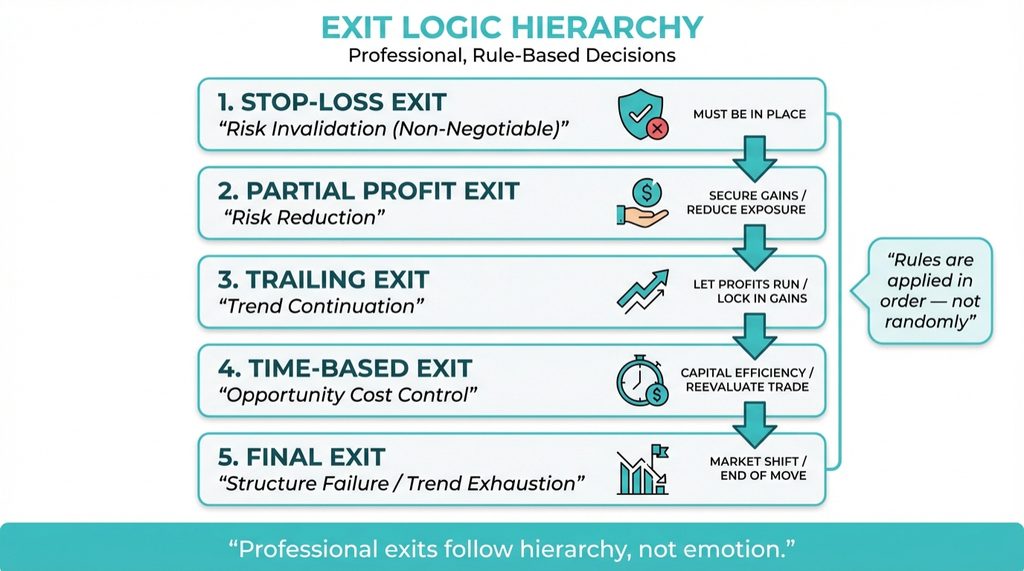
A practical exit strategy does not need to combine every technique.
It needs to answer the important questions consistently.
1. Define Invalidation
Before entering, identify what would show that the original trading idea is no longer valid.
2. Define Initial Risk
Determine the distance to the protective exit and use it alongside appropriate position sizing.
3. Decide How Profits Will Be Managed
Choose whether the strategy uses fixed targets, structure-based exits, trailing stops, partial exits or another predefined method.
4. Define When Adjustments Are Allowed
Specify what must happen before a stop or target can change.
5. Review the Process
After the trade, assess whether you followed the exit rules rather than judging the decision solely by the amount of profit or loss.
Reviewing whether exit decisions followed the original plan is an important part of Process-Focused Trading. This helps traders evaluate execution quality rather than judging every decision solely by its financial outcome.
Exit Strategies and Trading Psychology
Exit decisions are closely connected to trading psychology because an open position continuously provides new information about profit and loss.
A losing position may encourage hope. A winning position may create fear of giving money back.
Neither feeling determines what price will do next.
Predefined exit rules can help traders distinguish between an impulsive reaction and a decision supported by the trading strategy.
However, structured rules do not eliminate emotions or guarantee consistent execution. Understanding Trading Psychology can help traders recognise how fear, uncertainty and the desire to protect unrealised gains may influence their decisions.
The objective is to reduce unnecessary emotional interference while maintaining the flexibility permitted by the original trading plan.
Conclusion: A Good Exit Starts Before the Trade
Knowing different types of exit strategies does not mean looking for a universal method for exiting trades.
Various trading methods could use stop losses, target profits, trailing stops, partial exits, market analysis, volatility or time factors.
The key thing is the ability of the exit strategy selected by you to serve the defined purpose and fit into your overall trading system.
The key exit decisions must be taken before entering the market.
Set up when your initial trading idea fails. Determine the amount of money you are ready to risk. Set rules for managing profitable positions and define what kind of conditions allow you to modify or exit the trade.
Then analyze whether those rules have been respected or changed due to every market move.
An exit strategy developed in advance cannot ensure profitability or eliminate all risks. However, it allows improving your risk management and decision-making and making your trading process more measurable.
The task is not to exit every trade correctly but make decisions in an orderly, disciplined way.








