


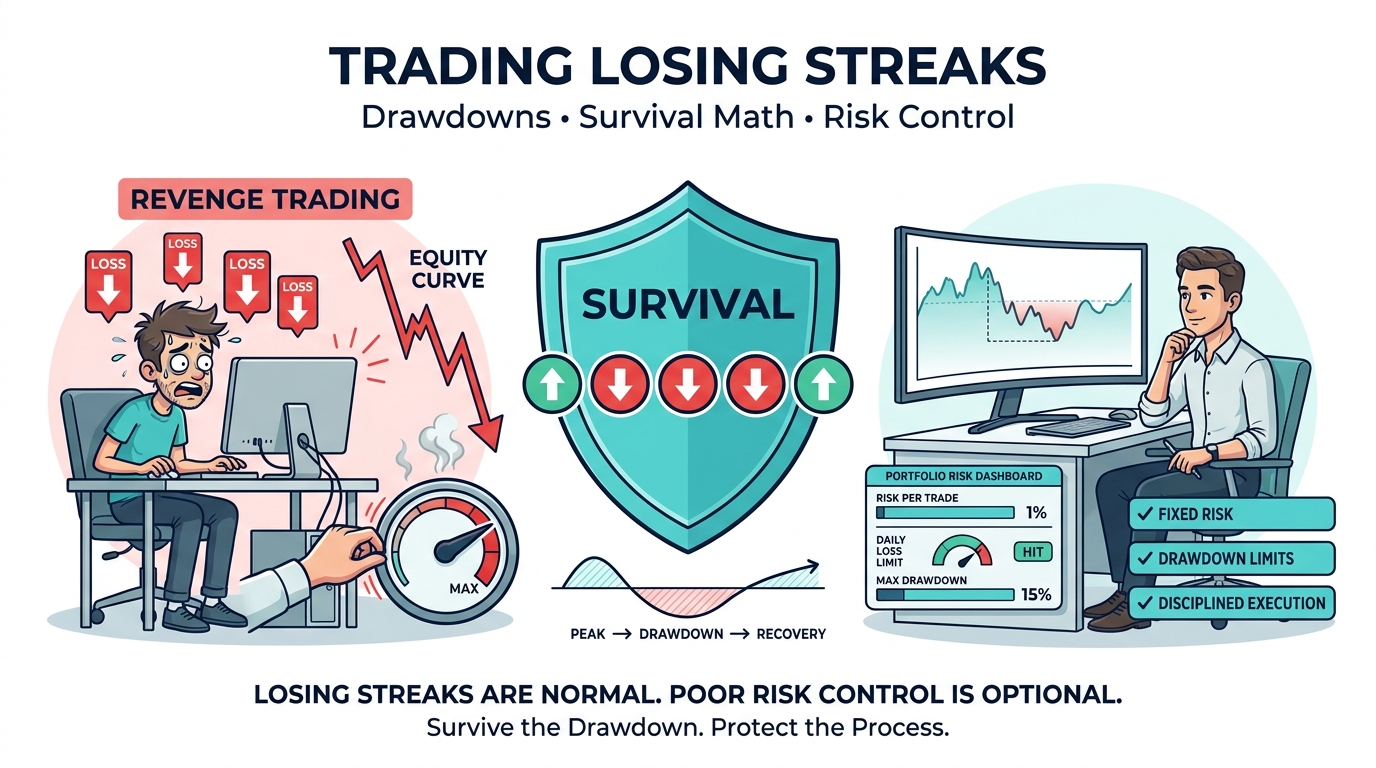
Every trader experiences a trading losing streaks. They’re not unskilled, but it’s just a matter of probability.
Most traders don’t tank because their game plan goes south. They mess up because they don’t get the hang of drawdown trading, losing-streak math, and staying alive.
A trading system might give you an edge, but it can still lead to some rough stretches with back-to-back losses. What really sets long-term traders apart from those who jump in and out of the market is not how well they guess the future it’s about sticking around and making it work.
What Is a Trading Losing Streak (And Why It’s Normal)
A trading losing streak occurs when a trader experiences several consecutive losing trades. While frustrating, losing streaks are a normal part of trading and can occur even when a strategy has a positive long-term expectancy.
Financial markets are unpredictable, and no trading strategy wins every time. Understanding why losing streaks happen helps traders manage drawdowns, maintain discipline, and avoid making emotional decisions.
Even a strategy with positive long-term expectancy can experience consecutive losses. Understanding Trading Expectancy helps explain why short-term losing streaks do not necessarily indicate that a trading strategy lacks a statistical edge.
Natural Causes of Losing Streaks
Several factors can contribute to consecutive trading losses:
- Statistical variance: Short-term trading results naturally fluctuate around a strategy's expected performance.
- Market regime shifts: Changes in volatility, trends, or liquidity can temporarily reduce a strategy's effectiveness.
- Random distribution of wins and losses: Winning and losing trades do not necessarily occur in a predictable sequence.
Even a historically profitable trading strategy can experience:
- Five to eight consecutive losses, or more, depending on its win rate and trading frequency
- Significant equity drawdowns during unfavourable market conditions
- Extended recovery periods before previous equity levels are restored
Key takeaway: A losing streak does not automatically mean your trading strategy is broken. However, repeated losses should prompt traders to review their execution, risk exposure, and market conditions to determine whether the results reflect normal statistical variation or a genuine deterioration in strategy performance.
Drawdowns — The Silent Account Killer
Drawdowns are an unavoidable part of trading, but poor drawdown management can turn temporary losses into serious threats to trading capital. As an account declines, recovering those losses becomes increasingly difficult, often requiring proportionally larger gains just to return to the previous balance.
Understanding trading drawdowns, recovery mathematics, and risk management helps traders recognise when to reduce exposure, protect remaining capital, and avoid emotional decisions that could lead to further losses.
What Is a Drawdown?
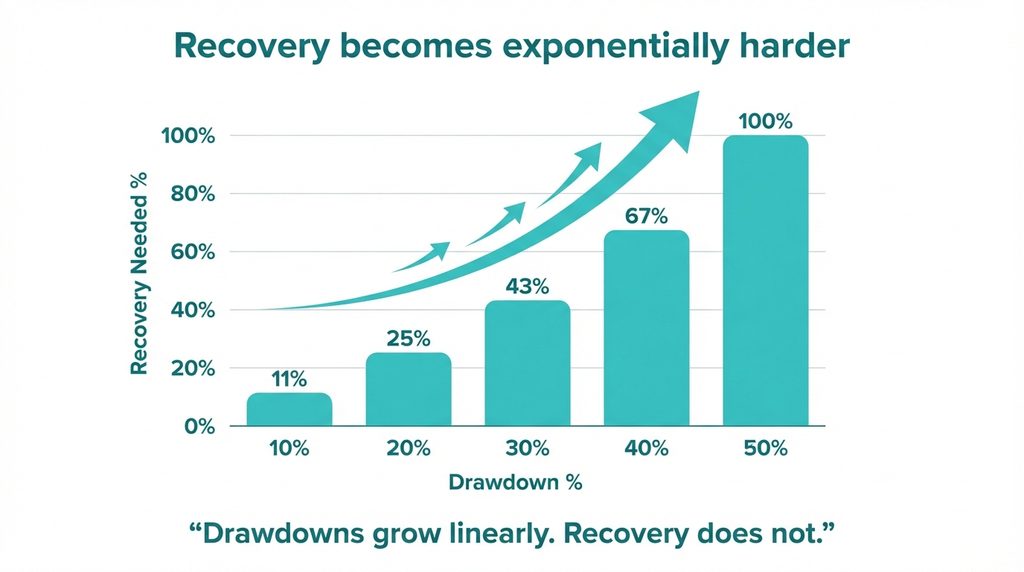
A drawdown in trading refers to the decline in an account's equity from its previous peak to a subsequent low. It measures how much trading capital has been lost during a period of declining performance.
The deeper the drawdown, the greater the percentage gain required to recover the lost capital.
- 10% drawdown: Requires an 11.1% gain to recover.
- 25% drawdown: Requires a 33.3% gain to recover.
- 50% drawdown: Requires a 100% gain to recover.
This is known as drawdown recovery mathematics, and it highlights why protecting trading capital is essential for long-term survival.
Traders who underestimate this relationship may increase position sizes or overtrade in an attempt to recover losses quickly, potentially exposing their accounts to even greater drawdowns.
Key takeaway: The deeper the drawdown, the harder the recovery. Effective risk management focuses on controlling losses before they become difficult to recover.
Survival Math: Why Risk Control Matters More Than Winning
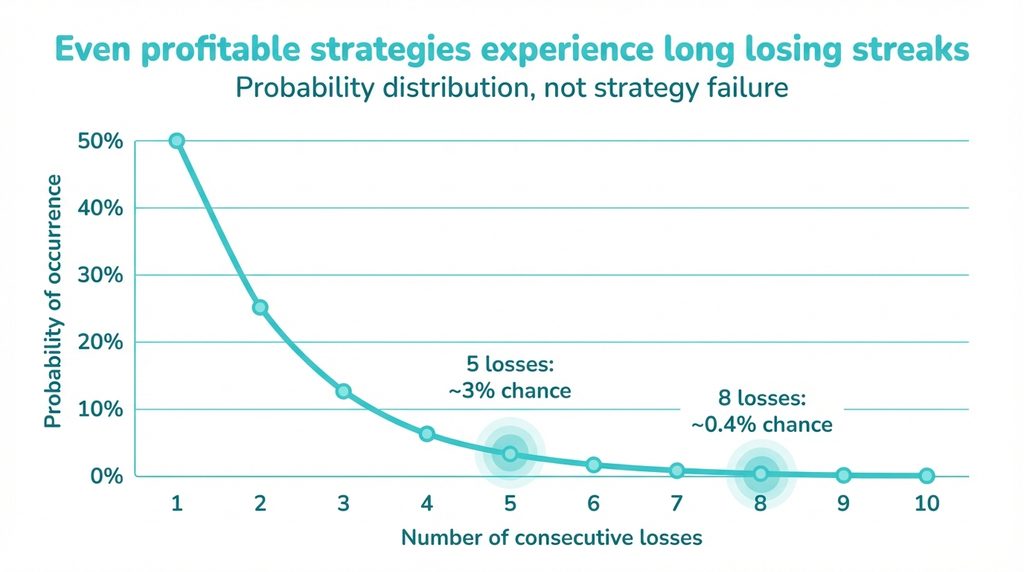
Successful trading is not just about how often you win, but how effectively you manage losses when the market moves against you. Even profitable strategies experience losing streaks, drawdowns, and periods of unpredictable performance.
This is where survival math in trading becomes essential. By controlling position sizes, limiting portfolio exposure, and establishing clear risk management rules, traders can reduce the impact of consecutive losses and improve their chances of preserving capital over the long term.
Losing Streaks Are a Mathematical Reality
Even a trading strategy with a positive long-term expectancy can experience consecutive losses. A profitable system does not guarantee consistent short-term results because trading outcomes are influenced by statistical variance and changing market conditions.
For example, a strategy may have:
- 45–55% win rate: A reasonable proportion of winning trades, depending on the reward-to-risk ratio
- Positive expectancy: Average expected profits exceed average expected losses over a sufficiently large sample
- Consistent execution: Trades follow predefined entry, exit, and risk management rules
Despite these characteristics, the strategy can still experience extended losing streaks.
What determines a trader's ability to withstand these periods is not simply how often they are right, but how effectively they manage:
- Risk per trade: Limiting the amount of capital exposed to each position
- Maximum drawdown tolerance: Establishing acceptable loss thresholds before reducing exposure
- Capital preservation rules: Applying structured risk controls to prevent excessive account losses
This is the foundation of survival math in trading: designing a risk management strategy that helps an account withstand unavoidable losses and market fluctuations without exposing trading capital to unnecessary risk.
Risk of Ruin: The Real Threat During Losing Streaks
Risk of ruin in trading refers to the probability that a trading account loses all its capital or reaches a predefined loss threshold that makes continued trading impractical.
It depends on several factors, including position sizing, trading expectancy, win rate, reward-to-risk ratio, and available capital.
Higher risk per trade can lead to:
- Faster and deeper drawdowns
- Increased emotional pressure
- Greater likelihood of abandoning a trading strategy
Lower risk per trade can help support:
- More manageable drawdowns
- Reduced financial and psychological pressure
- Greater potential for long-term capital preservation
Risk of ruin does not always result from one catastrophic trade. It can develop gradually through consecutive losses, excessive leverage, and poor position sizing.
Consecutive losses can become particularly damaging when traders use excessive leverage or increase position sizes during drawdowns. The Financial Conduct Authority (FCA) highlights the risks associated with leveraged CFD trading and outlines regulatory protections designed to limit retail investor losses. This reinforces why controlling exposure, understanding leverage and following predefined risk limits are important during trading losing streaks.
Key takeaway: Controlling risk per trade is essential because even a profitable strategy can experience enough consecutive losses to seriously damage trading capital.
The Hidden Psychological Damage of Losing Streaks
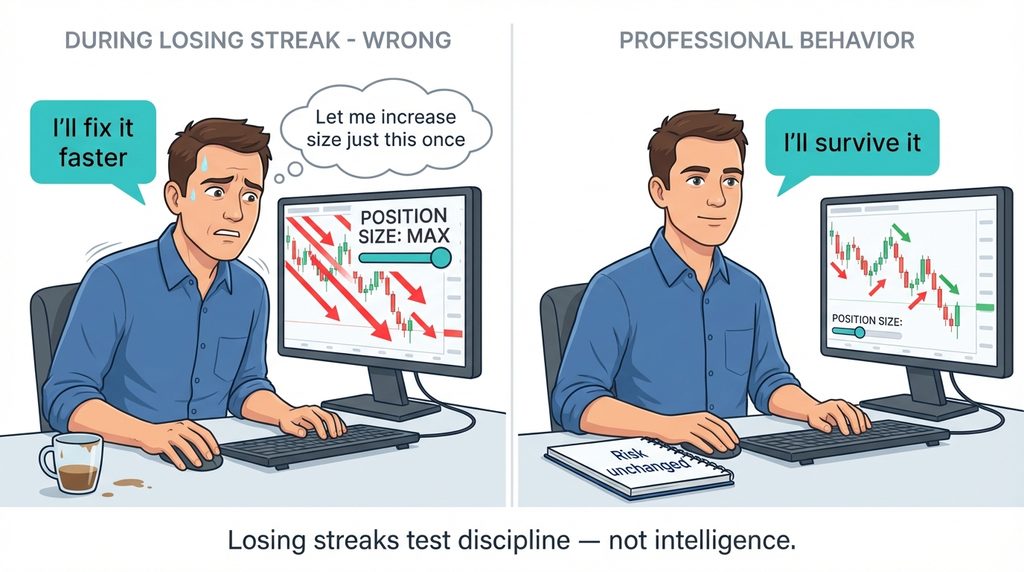
Losing streaks affect more than account balances. They can also undermine trading psychology, confidence, and decision-making, particularly when traders become focused on recovering losses quickly.
Common behavioural mistakes include:
- Increasing position sizes to recover losses faster
- Removing or widening stop-loss orders to avoid accepting losses
- Strategy hopping after a short period of poor performance
- Revenge trading driven by frustration rather than a valid trading setup
These behaviours can increase risk precisely when greater discipline is needed.
Losing streaks may trigger emotional responses that influence trading decisions, including attempts to recover losses through larger or more frequent positions. These behaviours are explored in Revenge Trading Explained, which examines how frustration can affect trading discipline and risk management.
Key principle: Avoid changing your trading strategy impulsively during a drawdown. Any adjustments should follow predefined risk management rules or be supported by objective performance analysis, not emotional reactions.
How Professionals Survive Losing Streaks
Professional traders understand that consistent trading performance is not about avoiding losses, but managing them effectively. Even profitable strategies experience losing streaks, making disciplined risk management essential for protecting trading capital.
Rather than reacting emotionally to consecutive losses, experienced traders follow predefined rules for position sizing, drawdown control, and performance evaluation. These measures help limit unnecessary exposure, maintain trading discipline, and reduce the risk of significant account losses.
Professional Risk Management Rules
Experienced traders recognise that losing streaks are unavoidable and establish risk management rules before they occur.
Common practices include:
- Limiting risk per trade: Some traders use 0.5%–1% of account equity as a conservative guideline, depending on their strategy and risk tolerance.
- Defining maximum drawdown limits: Establishing thresholds that trigger reduced exposure or a performance review.
- Pausing trading after predefined losses: Using daily, weekly, or consecutive-loss limits to control further exposure.
- Tracking trading expectancy: Evaluating long-term strategy performance instead of reacting to individual trade outcomes.
This approach prioritises capital preservation and disciplined risk management rather than attempting to avoid every losing trade.
Survival is treated as a strategic requirement because protecting capital allows traders to continue evaluating and executing their strategies over time.
Account Survival Paths: Risk vs Discipline
The way traders respond to consecutive losses can significantly influence their account's long-term performance.
High-Risk Path
A trader experiences several losses and increases position sizes to recover quickly. As exposure grows, further losses create deeper drawdowns and greater emotional pressure. This behaviour can lead to excessive leverage, impulsive decisions, and potentially severe capital depletion.
Controlled-Risk Path
A trader follows predefined position-sizing rules, respects maximum loss limits, and reduces exposure when necessary. Drawdowns may still occur, but controlled exposure can help limit their severity and preserve more trading capital.
Although disciplined risk management cannot guarantee recovery, it reduces the likelihood that a temporary losing streak becomes a devastating financial loss. The difference is not whether losses occur, but how effectively risk is managed when they do.
How to Trade During a Losing Streak: Actionable Rules
Trading during a losing streak requires patience, discipline, and a clear risk management strategy. When consecutive losses occur, the temptation to increase position sizes or recover losses quickly can lead to emotional decisions and greater financial risk.
Instead of chasing losses, traders should focus on protecting capital, reviewing trading performance, and following predefined risk limits. A structured approach helps reduce unnecessary exposure and supports more consistent decision-making during challenging market conditions.
Practical Survival Guidelines
Managing consecutive trading losses requires a structured approach rather than emotional reactions.
- Reduce trading frequency temporarily: Avoid unnecessary trades taken solely to recover previous losses.
- Maintain predefined risk limits: Keep position sizes within your trading plan and reduce exposure when established thresholds are reached.
- Stop trading after predefined loss limits: Apply daily, weekly, or drawdown-based circuit breakers.
- Focus on execution quality: Evaluate whether trades followed your strategy rather than judging performance by individual outcomes.
- Review performance data objectively: Analyse win rates, trading expectancy, drawdowns, and changing market conditions.
Following these principles can help traders protect capital, maintain discipline, and make more informed decisions during difficult trading periods.
Remember: Surviving a losing streak is not about recovering every loss immediately. It is about preserving enough capital and discipline to continue trading responsibly.
Conclusion — Trading Losing Streaks Explained
A losing streak in trading isn’t a sign of failure. This is a test of structural discipline. Traders don’t usually tank because of just one rough week. They stumble because they never planned for tough times.
If you can handle the inevitable ups and downs, the numbers will start to show their advantage. Long-term success in trading isn’t about always winning; it’s about managing your losses.








