



Understanding financial market foundations is an important starting point for anyone interested in trading or investing.
Financial markets unite buyers and sellers, offering an arena where financial assets are traded and responding to the changes in economic environment and investors’ behavior.
For a beginner, the price movement on a chart can be visible while its driving forces may remain hidden.
The basics of financial markets can help traders to understand the process of market functioning and its possible risks.
This article will give you an insight into the basics of financial markets and why they are so important for trading or investment analysis.
But financial literacy does not guarantee successful trading outcomes.
What Financial Market Foundations Actually Means
The term "financial market fundamentals" relates to the basic principles of how the financial markets function.
Such principles comprise participants in the markets, trading mechanisms, price making, liquidity, financial tools and the economy factors affecting supply and demand.
Having learned about these principles, a beginner in finance may try to answer some interesting questions regarding the changeability of market prices, trading costs, and behavior of various financial tools.
Understanding financial markets is an important part of making informed investment decisions. The U.S. Securities and Exchange Commission (SEC) provides educational resources covering investing fundamentals, financial risks and investor protection.
If you're looking for a clear-cut rundown of the financial scene before diving in, check out Financial Markets Explained. That piece gives us a peek at the ecosystem. This piece helps explain the fundamental components of the financial system.
How Financial Markets Work

Financial markets offer avenues whereby individuals can either purchase or sell financial assets such as currencies, stocks, bonds, and commodities.
Price is affected by the dynamics between buyers and sellers, liquidity, expectations in the market, and economic conditions.
For instance, economic information, interest rates, and company news may influence valuation of certain financial assets.
The reaction to the same piece of information may vary according to the expectations, positions taken, and conditions prevailing.
This can be helpful for individuals who are beginners in interpreting markets although future prices cannot be predicted.
Market Structure: Understanding How Trading Takes Place
Market structure is the description of how financial markets are organized and how trading is carried out in these markets through buying and selling financial assets.
Trading in any market can be done through exchanges, electronic trading systems, or over-the-counter operations.
The participants in such activities can be banks, investment funds, corporations, institutions, market makers, and individual traders.
They have different interests, which affect the order flow, liquidity, and other market conditions.
While price charts show market data historically, understanding market structure helps to get more information on how trading is done.
To get a clear picture of this, check out Who Really Moves the Stock Markets? Recognising who drives sustained movements transforms how you interpret trends and breakouts.
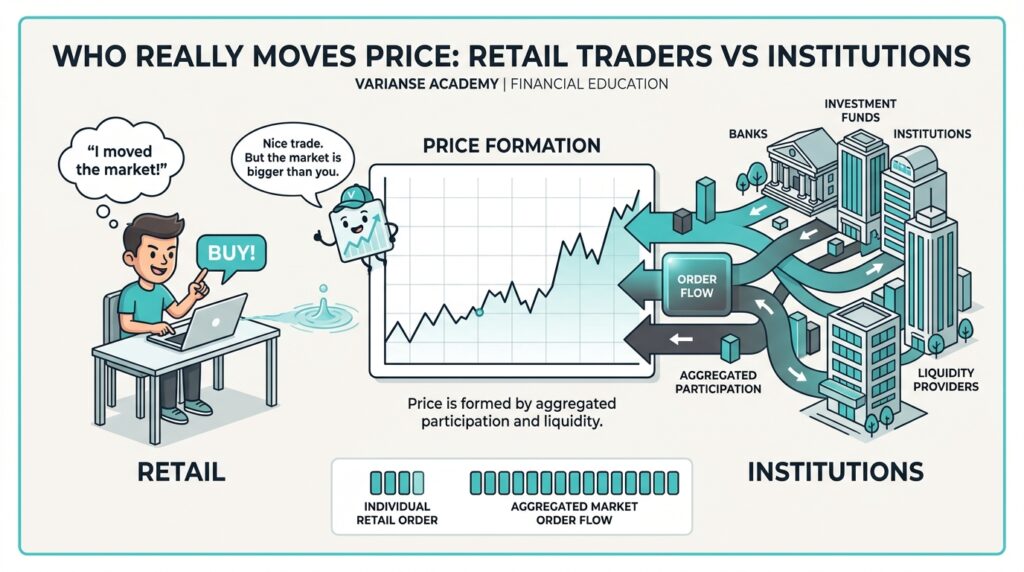
Who Really Moves Price: Retail Traders vs Institutions
Financial markets have various types of market players with differing sizes of capital.
Some institutional traders like banks, pension funds, and investment houses can make transactions that involve large sums of money.
Depending on the liquidity in the market, a large transaction can affect prices and trading conditions in the market.
The retail traders trade using relatively smaller individual capital positions.
No type of player decides everything that happens in the market.
New traders should not make assumptions that the trading moves made by institutions always provide good trading signals.
Liquidity Providers and Why Trade Execution Can Vary
Liquidity is defined as the ability of a financial asset to be purchased and sold easily without having a considerable impact on the price of that asset.
Liquidity providers and market makers can be a source for the creation of trading volume through providing buy/sell quotes.
In cases where liquidity is fairly abundant, spreads might be smaller and large orders may be easier to be executed.
Yet, spreads and conditions under which orders are executed do not only rely on liquidity.
In times where liquidity is poor or markets move fast, spreads might become wider and the execution of orders may encounter some slippage.
Slippage takes place when the price at which the order is actually executed does not match the expected price.
Such knowledge will be helpful for beginners in setting realistic expectations regarding the execution of their trades.
To fully understand this concept, review What Is Liquidity?
Asset Classes: Understanding Different Market Characteristics
Financial instruments vary depending on their intrinsic qualities, participants involved, liquidity, and sensitivity to economic developments.
Examples of common financial instruments are stocks, bonds, currencies, and commodities. Examples of financial indexes are a collection of financial instruments, whereas cryptocurrencies are virtual currencies.
Various financial instruments may have different reactions to interest rates, economic news, variations in demand, and general market dynamics.
For instance, a large currency pair will likely exhibit varying levels of liquidity and volatility as compared to a thinly traded stock.
Such information can guide beginners in determining whether a certain market suits their knowledge, finances, and risk profile.
Before diving deep into the specifics, check out Asset Classes Explained for a solid foundation.
Why Market Prices Move
Price changes occur as a result of interaction between buying and selling sentiments with existing liquidity in the markets.
The participants can alter their behavior based on economic news, company performance, interest rates, geopolitical events and expectations.
For instance, an economic surprise may affect the valuation of a currency or financial instrument by the traders.
Nevertheless, price changes will be influenced by how much news has been expected and prevailing market conditions.
This knowledge may help understand the situation, but it is not helpful in predicting future market moves.
Supply and Demand: The Simplest Lens That Still Works
Supply and demand are basic principles of finance.
When there is more demand than supply interest, prices tend to increase. When there is more supply than demand interest, prices tend to decrease.
It should be noted that there are other factors involved in the formation of price, such as market structure, liquidity and prices at which transactions can take place.
Sometimes technical analysts look for support and resistance levels, where buying and selling interests have previously affected prices.
They may offer historical information, but they do not indicate future reversal or continuation of the price movement.
To bridge theory with chart application, check out Support & Resistance Explained and Chart Reading Basics. Structural interpretation really helps deepen our grasp of the basics.
Market Volatility: Understanding Price Fluctuations and Risk
Price volatility is a measure that determines how much the price changes within a certain time frame.
The higher the price volatility is, the more price changes happen; the lower the price volatility, the fewer price changes.
Volatility depends on economic news, the level of uncertainty in the markets, liquidity, and other factors.
Larger price changes may be seen as both advantages and disadvantages for traders.
High price volatility may lead to higher spreads, slippage, and uncertainty of the execution price.
Knowledge of price volatility may help newbies to determine their financial risks and whether the certain market situation matches their risk profile.
This ties right into the basics of risk management and solidifies the key takeaways from Why Traders Fail?
Trading Fundamentals: Common Risks Beginners Should Understand
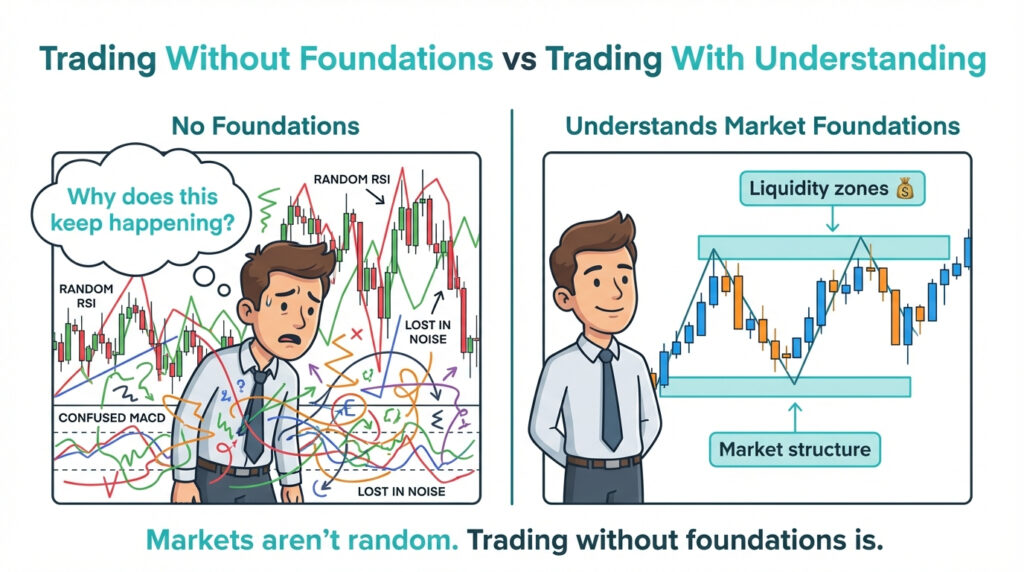
Some of the reasons why beginner traders may face financial losses include the unfavorable movement in the market, over leverage, underestimating risks and trading costs.
Lack of experience may also contribute to difficulties in order execution, changes in liquidity, and the risks involved in market volatility.
Typical errors might be the following:
- Joining a market without comprehending the financial instruments used.
- Over-leveraging and neglecting the risks associated with it.
- Choosing too big positions, considering one’s own financial position.
- Acting spontaneously in case of loss.
- Changing trading methods without assessing the assumptions behind them.
However, awareness of the above-mentioned risks might help make better decisions, yet neither education nor preparation will be able to avoid financial losses.
Conclusion: Financial Market Foundations Support Informed Trading Decisions
An analysis of the basics of financial markets will assist the novice to form a better understanding of the processes that govern the trading of financial securities and fluctuations in prices.
The basics include such notions as market structure, liquidity, supply and demand, types of assets and volatility.
All of these will also provide an explanation for the changing conditions under which trades are conducted as well as uncertainty involved in financial decisions.
Nevertheless, being aware of market mechanics does not imply profitable trading or absence of risks related to investments.
For a beginner, acquiring financial skills before making any trading decisions will be a good starting point.








