


Understanding asset classes is an important part of learning how financial markets work.
Financial instruments are unique in different ways such as their intrinsic worth, level of liquidity, volatility, conditions of trade and vulnerability to economic trends.
For new traders, understanding these differences will help clarify why currencies, stocks and other financial assets react differently to changes within the market environment.
This lesson builds on where you left off in Financial Market Foundations, diving deeper into how markets operate at a structural level. Different types of investments show us how markets are set up and why prices can differ across them.
Understanding asset classes can support more informed financial decisions, although it cannot eliminate uncertainty or guarantee favourable outcomes.
Asset Classes Explained: What Beginners Need to Know
An asset class is a group of investment vehicles with shared economic attributes, ownership/contractual rights, and risk/reward structure. Some of the commonly used traditional asset classes are equity, fixed income, cash, and some alternative assets.
Currencies, commodities, and digital assets are often also discussed as separate markets for trading education purposes. Various asset classes tend to react differently to economic events and may have different liquidity, volatility, and costs.
This knowledge will allow you to evaluate how some financial instruments function. For more information about order placement and execution, explore Trade Mechanics & Execution Basics. Grasping the different types of investments can help traders set realistic goals.
For additional information about different investment products and their risks, the U.S. Securities and Exchange Commission's Investor.gov website provides educational resources covering common financial instruments and investment considerations.
Why Asset Classes Matter for Beginners
Understanding different asset classes can help beginners evaluate:
- The financial instruments available within each market.
- Typical sources of price volatility.
- Liquidity and trading conditions.
- Market trading hours.
- Economic factors that may influence prices.
- Risks associated with leverage and financial exposure.
Liquidity can influence spreads, slippage and execution conditions, although the relationship varies across markets.
You'll find out more in What Is Liquidity? Understanding different investment types helps traders make decisions based on strategy rather than luck.
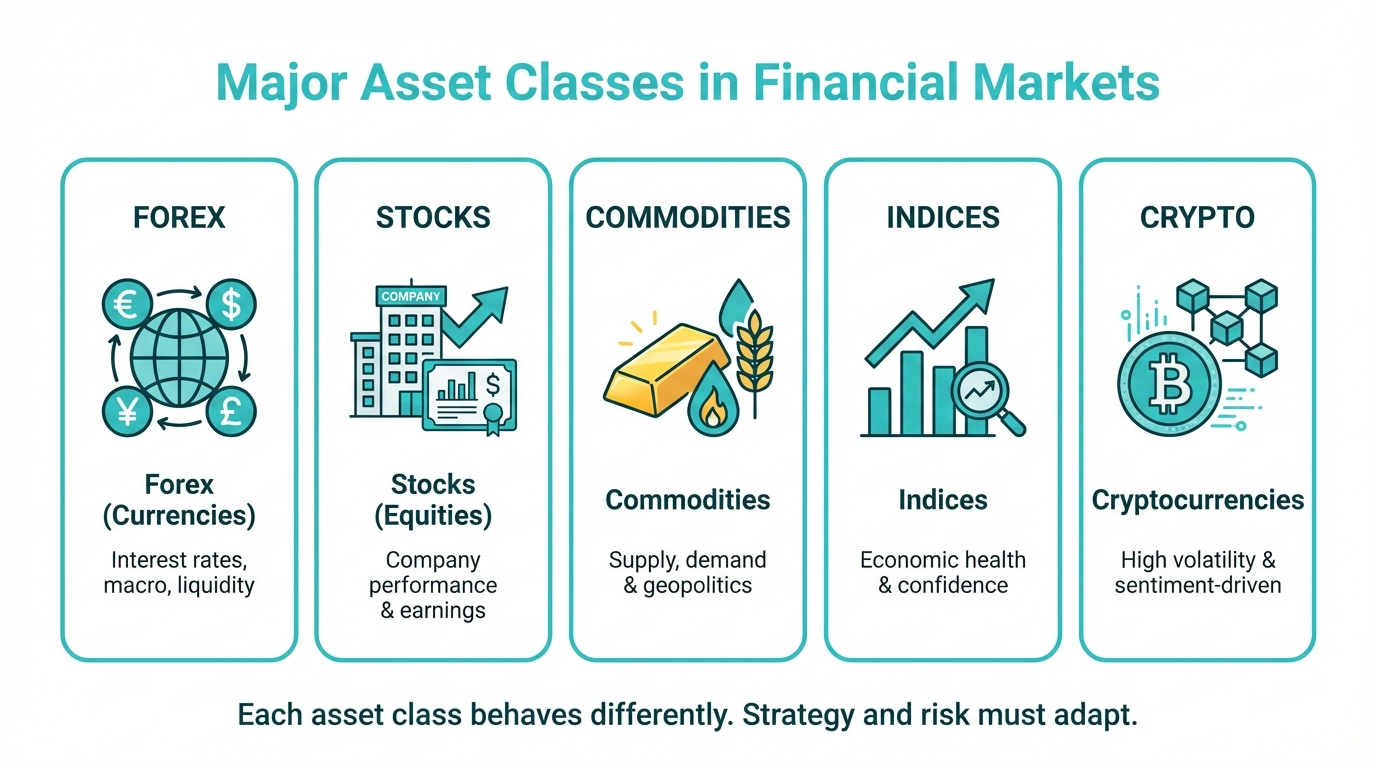
The Main Asset Classes in Financial Markets
A beginner trader should know the main types of investments. Everyone's got their setup, people involved, and risks.
Forex (Foreign Exchange Market)
Foreign exchange market, also referred to as Forex, is about exchange and trading of currencies.
Currencies are priced against each other, e.g., EUR/USD and GBP/JPY; they represent the value of one currency compared to another.
Regular Forex trading usually takes place 24 hours a day, 5 days a week using an interbank network and other market participants.
Main currency pairs could experience high trading volumes, although liquidity and trade execution could differ according to the time of the day, market volatility and economic news releases.
Foreign exchange rates could react to interest rate changes, monetary policy decisions, economic statistics, political events and market sentiments.
The use of leverage could be beneficial when making profits, although it also increases losses. Therefore, it would be useful for novices to get familiar with their financial exposure prior to leveraged Forex trading.
Explore Why Traders Fail in Trading? for related information about common trading risks.
Stocks (Equities)
Equity investments, which are also referred to as stocks, shares, and equities, normally involve owning a stake in a company.
The factors that affect the price of stocks include company performance, performance of the firm, industry developments, economic conditions, and even investor expectations.
There is variability in the degree of volatility and liquidity among various firms.
For instance, the share of a big and actively traded company may not necessarily trade under the same conditions as those of a small firm.
While institutional investors impact the performance of the equity markets, they do not control all movements of price.
Figuring out who's really behind these market shifts is explained in Who Really Moves the Stock Markets?. The essential fact every trader should grasp is the significant influence of institutional money in the game.
Commodities
Commodities are raw materials and primary goods, such as gold, silver, oil, gas, and agricultural products.
The value of commodities can be affected by supply and demand, production factors, political developments, weather conditions, and economic outlooks.
For instance, the price of gold can be affected by interest rate outlooks, exchange rates, and investors' demands when there is uncertainty.
Yet, there can be significant swings in the price of commodities, and they exhibit different behaviours in different commodities.
It is also necessary for traders to know about the features of the financial instrument they use to trade commodities.
Understanding stop-loss placement and risk control in volatile markets is covered in Take Profit & Stop Loss Explained.
Indices
An index in finance is used to assess the performance of selected securities or market components.
Market indices, such as those of large publicly held corporations, give investors an idea about the performance of certain segments of markets. An index does not necessarily reflect the performance of a whole economy.
Investors cannot usually buy an index itself. Rather, they may be exposed to an index through certain types of instruments, such as index mutual funds, ETFs, futures or other derivative instruments. These differ from each other in terms of structure, cost and risk.
Cryptocurrencies
Cryptocurrencies are virtual currencies that utilize cryptographic technology and exist under different technical and economic models. The crypto market can display high levels of volatility, which include varying levels of liquidity and regulations.
While stocks and bonds offer ownership and rights of future payments respectively, cryptocurrencies offer neither. Their prices are affected by the demand for them and other variables such as technology and financial regulations.
The trading of crypto-related assets exposes traders to high financial risks such as sudden price movements and difficulties with execution of trades. Newcomers need to know what they are getting into in terms of the product itself and the related costs involved.
How Different Asset Classes Behave in Financial Markets
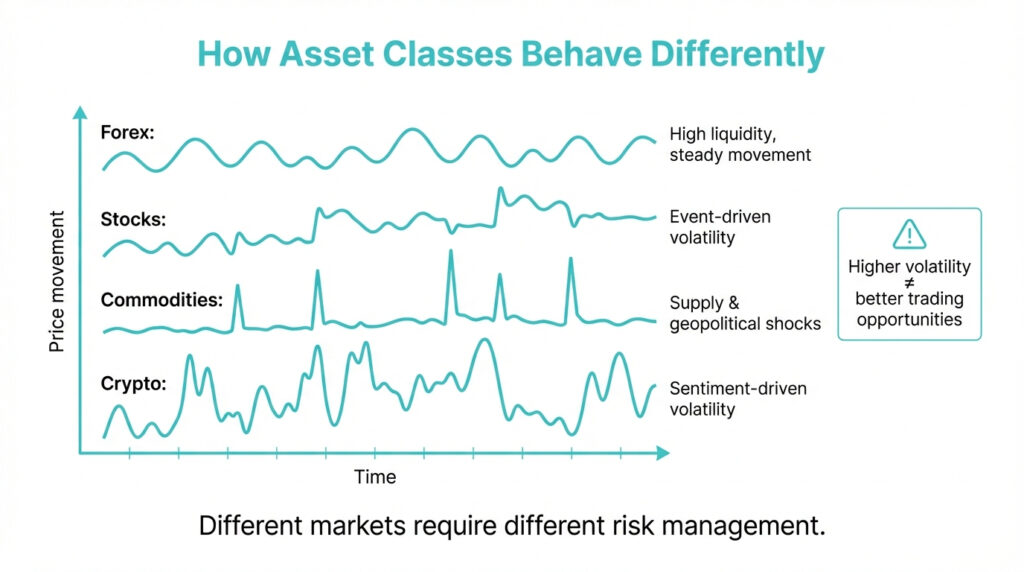
The reactions to the same economic event may differ for various asset classes. For instance, the interest-rate statement could affect currency exchange rates, bonds, stocks and commodities differently.
The reactions would be based on existing market expectation, market conditions, market positions and liquidity. The forex markets could have a lot of transactions during major sessions, but the execution conditions would not necessarily remain the same.
Liquidity of stocks differs from company to company and stock market to stock market, while commodities may react sharply to any supply and demand.
There could also be drastic price changes in the cryptocurrency markets affected by sentiment, liquidity and regulations. It would assist the newcomers in evaluating the various aspects of financial instruments.
However, the market behavior of an asset class cannot be predicted with certainty.
Choosing an Asset Class as a Beginner
No single class of assets is suitable for everyone. The appropriateness of financial instrument depends on the individual factors like objectives, experience, time period, tolerance for risk, and capital.
Beginners should look at parameters like liquidity of markets, volatility, trading hours, costs of transaction, and the level of complexity of the financial instrument. While major currency pairs offer high liquidity, it does not mean that losses incurred by leveraged Forex trading would not be huge.
In a similar way, stocks, commodities, indices, and cryptocurrencies have their own risks that need to be considered before making any financial decision. For those who are inclined towards active trading, simulation tools may allow exploring the behavior of the market and placing orders with virtual money.
But demo trading would not replicate all real market conditions.
Educational resources are available through VARIANSE Academy.
Common Mistakes Beginners Make When Trading Different Asset Classes
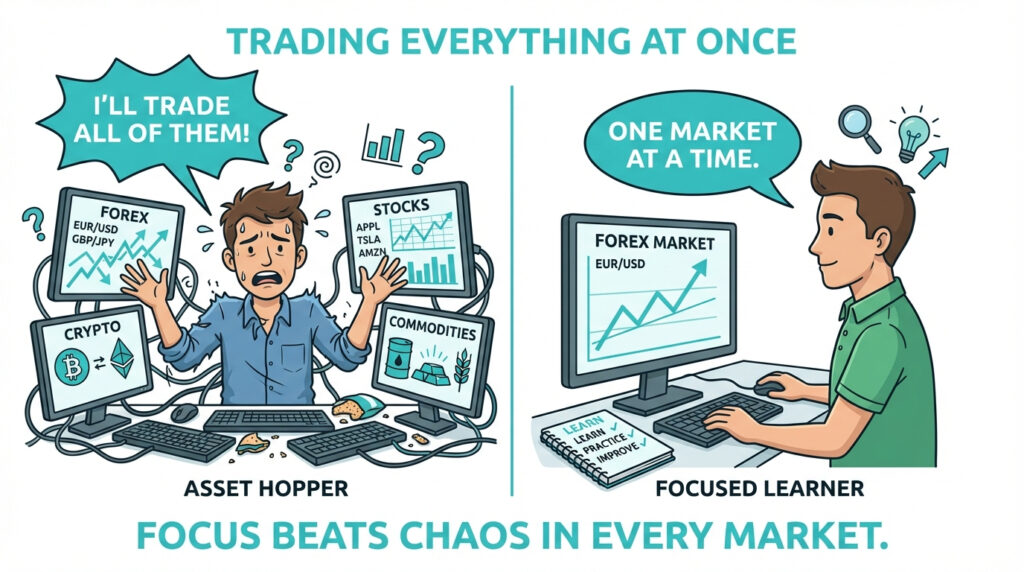
Beginners may encounter difficulties when trading financial instruments without understanding their underlying characteristics.
Common mistakes include:
- Switching frequently between markets without understanding their differences.
- Assuming all financial instruments have similar liquidity and volatility.
- Using excessive leverage or inappropriate position sizes.
- Ignoring transaction costs, trading hours and execution conditions.
- Reacting impulsively to sudden market movements.
- Applying the same trading approach to instruments with substantially different risk characteristics.
These mistakes can increase financial exposure or contribute to poorly informed decisions.
However, losses can also occur because of adverse market movements, even when an individual follows a considered strategy.
These actions often stem from a lack of a clear plan, which is one of the main reasons traders tend to lose money, as explained in Why Traders Fail? Focused learning improves long-term consistency.
Asset Classes and Risk Management
Different asset classes require consideration of their particular risks and trading characteristics. Volatility, liquidity, leverage, trading hours and transaction costs can influence the financial exposure associated with a position.
For active traders, position sizing, potential losses and exit strategies should be evaluated in relation to the instrument being traded. A position size or stop-loss distance that is appropriate for one financial instrument may not be appropriate for another.
However, stop-loss orders do not guarantee a maximum loss, and adverse market conditions can produce slippage or execution at an unfavourable price.
Risk-management practices can help individuals assess and manage financial exposure, but they cannot eliminate investment risk.
Explore educational resources through VARIANSE Academy.
Asset Classes and Developing Market Knowledge
There are some active traders who would prefer to focus their efforts of research and trading on a few financial instruments. It can enable them to get acquainted with trading hours of that market along with its liquidity, volatility and economic factors.
But there is no assurance that specialising in a market would result in better trading outcomes. It is essential to distinguish specialisation from diversification.
In the case of diversification, there is an allocation of investment exposure to different types of assets or securities so as to limit certain concentration risks. A person could specialize in a particular market without being diversified at all.
Conclusion: Understanding Asset Classes Supports Informed Decisions
Asset classes provide a framework for understanding the different financial instruments available across global markets.
Currencies, shares, commodities, indices and digital assets have distinct characteristics, including differences in volatility, liquidity, trading conditions and exposure to economic developments.
Understanding these differences can help beginners evaluate financial instruments more carefully and recognise the risks associated with particular markets.
However, knowledge of asset classes does not eliminate uncertainty or guarantee profitable trading outcomes.
For beginners, developing a clear understanding of financial markets and the characteristics of individual instruments is an important part of financial education.








