


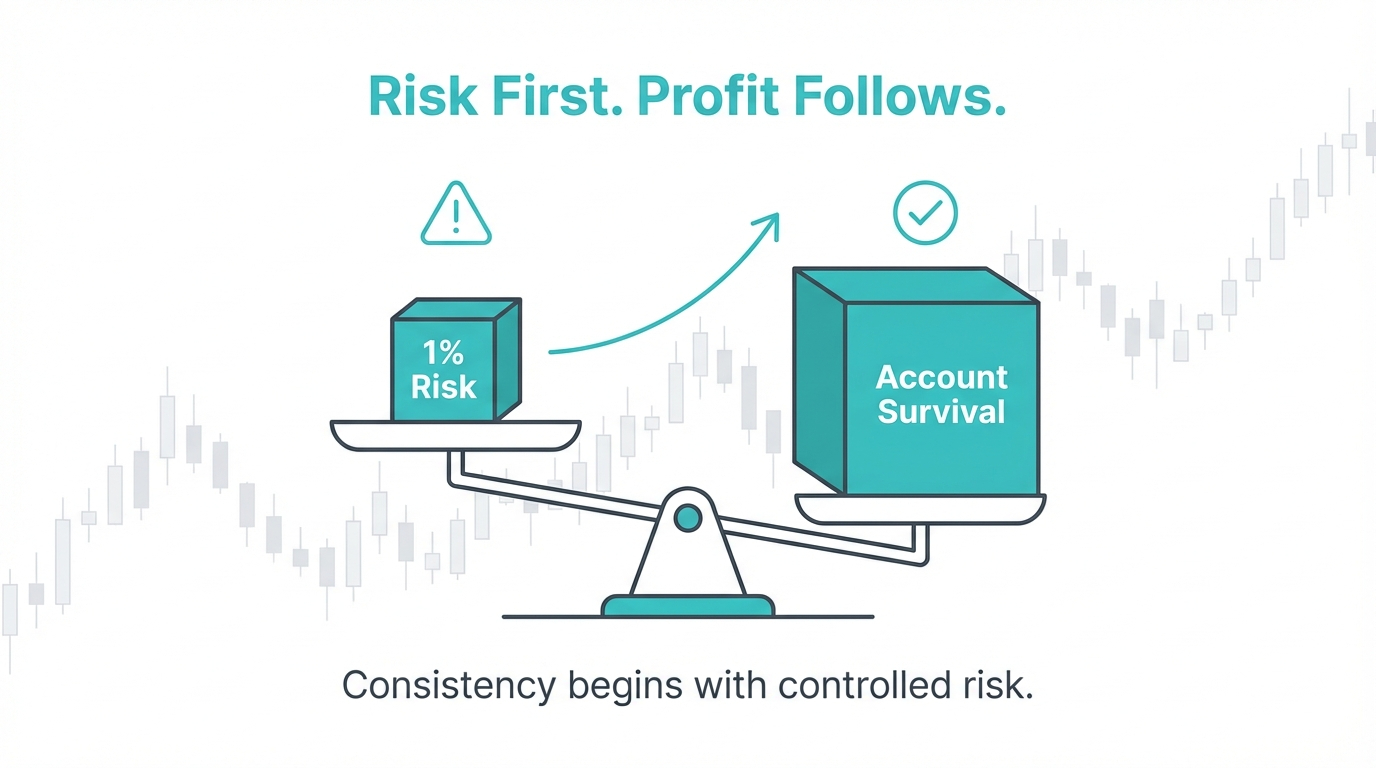
Risk per trade is one of the fundamental concepts of trading risk management. It helps traders determine how much capital they plan to risk on an individual position before entering the market.
While many traders are obsessed with entries, indicators, or setup, it's not about them alone. It is about the entire game that keeps them in the game. They survive through it all because they remain in control.
The fixed-percentage risk strategy is a disciplined way of assessing the amount of risk one intends to plan against one's account balance/equity.
However, no risk-management method can eliminate losses or guarantee that actual losses will remain within the planned amount.
This principle builds directly on Take Profit & Stop Loss Explained, where exits define the maximum loss before the trade begins.
What Does Risk Per Trade Actually Mean?
The definition of risk per trade is the portion of trading capital that will be risked by the trader in a single trade.
It is normally established before taking a position and can be represented in terms of the percentage of account equity or balance.
For instance, a trader having £5,000 in his or her account equity and willing to risk 1% per trade would establish the amount of risk to be £50.
This value is considered the planned loss for the trade based on the planned entry and stop level positions and not taking into consideration any possible execution discrepancies and trading costs.
Losses could even surpass the planned value due to such factors as market gaps and slippages.
Without a set risk per trade, you can lose a lot fast. With defined risk, losses remain controlled, predictable, and survivable. This organized method is part of the wider process detailed in Trade Lifecycle Explained, where we plan for risks before we dive in.
Define Risk Before the Trade Starts
It is essential to determine a planned risk before opening a trade in order to know if the level of risk is right considering the trader's situation.
Setting a limit of risk, however, cannot ensure that the market or the trading platform would accept an order at the specified price.
What Is the Fixed Percentage Risk Model?
The fixed-percentage risk method is a strategy for determining how much of the account to invest on any particular trade.
For example, a trader using 1% of account equity as their planned risk would recalculate the monetary risk amount as equity changes.
If there is an increase in equity, the risk amount will increase. On the other hand, if there is a decrease in equity, the risk amount will decrease.
How the Model Works in Practice
Consider a trader using a 1% risk model:
- Account equity of £10,000 produces a planned risk amount of £100.
- Account equity of £9,000 produces a planned risk amount of £90.
- Account equity of £11,000 produces a planned risk amount of £110.
The percentage is always constant, although the sum of money depends on account equity.
Such strategy may prove useful for traders to keep their risk management plan consistent. Yet, it is by no means guaranteed that losses won’t exceed this sum or that equity will keep rising.
Position sizing gets tweaked based on how far you're willing to let a trade go south, like in the book Position Sizing Explained where you match your risk to how much you're putting on the line.
Why the Fixed Percentage Model Shields Your Trading Accounts
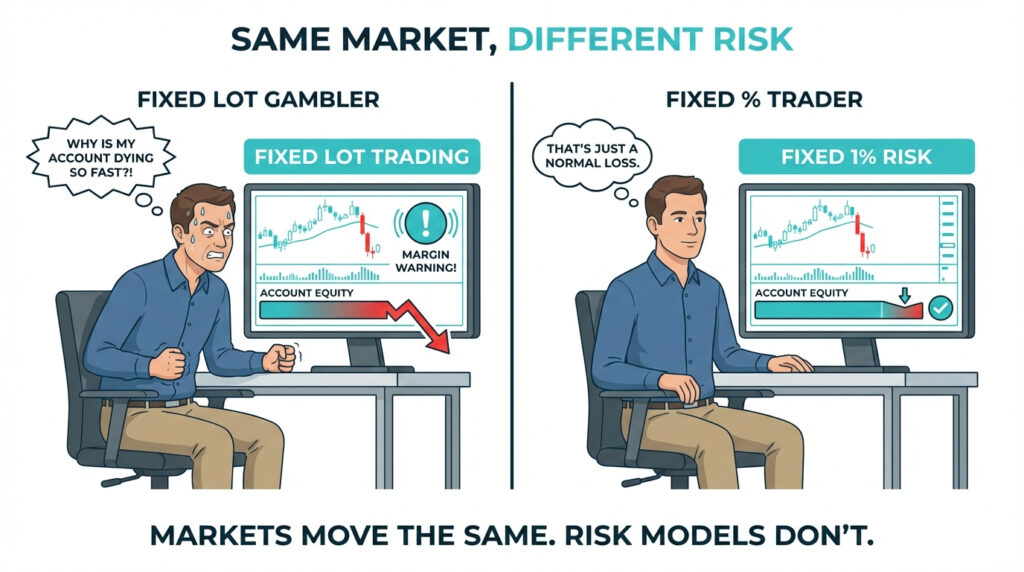
The main goal of this model is survival. By regularly keeping risk in check, traders prevent one-off losses from wrecking their accounts for good.
Small, managed losses help traders stay in the game, learn from their blunders, and tweak their strategy. This directly supports the survival framework explained in Beginner Survival Rules, where excessive exposure is identified as the primary cause of account failure.
Risk control gives traders the precious time they need to hone their skills.
The Mathematics of Survival
When traders take a small risk per trade, they can handle losses better. Losing streaks do not immediately threaten the account’s existence, and recovery remains mathematically achievable.
Cutting down on exposure lowers the chances of having to sell off assets quickly, as explained in Margin Calls Explained, where too much risk can trigger a forced sell-off
Controlled risk prevents structural account failure.
Example of Risk Per Trade Using the Fixed Percentage Model
Suppose a trader has $10,000 in account equity and chooses a planned risk of 1% per trade.
The calculation is:
$10,000 × 1% = $100
This means the trader plans to risk $100 on the position.
The trader can then use the distance between the intended entry price and stop-loss level, together with the instrument's contract specifications, to calculate an appropriate position size.
However, $100 is not a guaranteed maximum loss. Actual losses may be higher because of slippage, market gaps, trading costs or other execution conditions.
The fixed-percentage model provides a consistent method for calculating planned exposure, not certainty about trading outcomes.
Risk Per Trade vs Position Size (Common Confusion)
Risk per trade and position size are related but represent different concepts.
Risk per trade is the amount of capital a trader plans to put at risk.
Position size is the quantity of a financial instrument being traded.
When the planned monetary risk and instrument specifications remain unchanged:
- A wider stop-loss distance generally requires a smaller position.
- A narrower stop-loss distance generally allows a larger position.
On the other hand, a smaller stop-loss is not automatically going to mean lower risk for the trade, because even regular movements can activate the order.
Leverage and margin requirements must also be considered separately from the planned stop-loss amount.
This relationship connects directly to What Is Leverage in Trading?, where leverage increases exposure but must remain subordinate to risk management.
Why Beginners Struggle With Risk Per Trade
This strategy may be simple to follow, but it takes discipline to apply. A lot of beginning traders tend to take bigger risks after losses, in order to gain back their losses more quickly.
These emotional shifts can really shake things up and speed up the decline. Emotional risk adjustment is a key behavioral issue addressed in Trading Psychology Explained, which turns our choices into knee-jerk reactions rather than thought-out plans.
Consistency requires rule-based exposure.
Fixed Percentage Model vs Fixed Lot Trading.
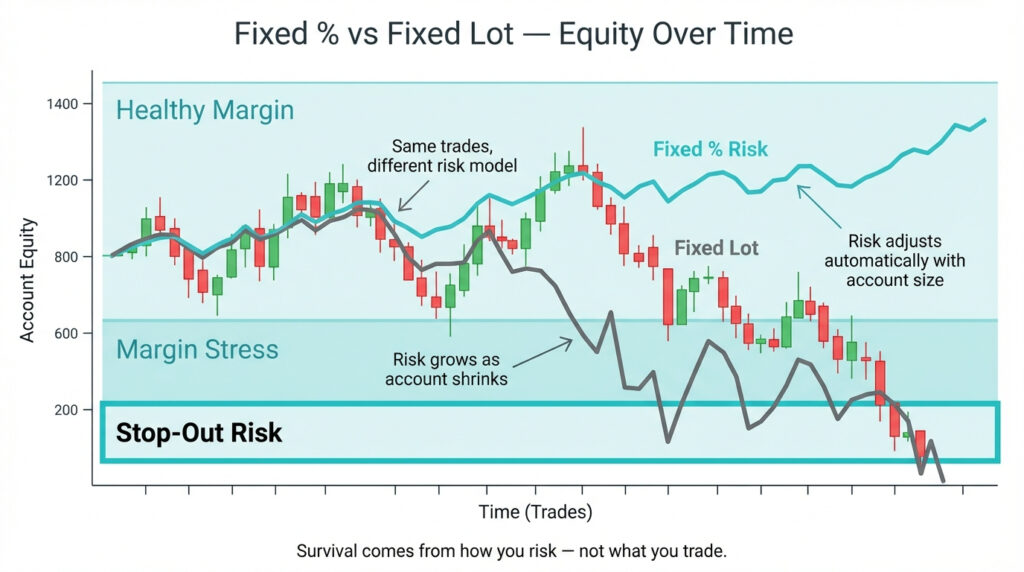
Position sizing can be achieved using two different techniques. The two techniques are: fixed lots and fixed percentage risk management.
In the case of fixed lots, the same trade size is used by the trader regardless of the fluctuations in the equity level of the account.
On the other hand, in the case of fixed percentage risk management, the risk amount is calculated based on the fluctuations in the equity or account balance, but the position size is based on the stop loss distance.
For example, using the same lot size after a decrease in the equity level increases the risk exposure level for the same price movements.
This method enables planned risk exposure but fails to guarantee that any losses made fall within the selected percentage level.
These methods should take into account market volatility as well as the properties of the asset used.
How Risk Per Trade Connects to Leverage and Margin
Margin, risk per trade, and leverage are connected concepts, but each of them addresses a different aspect of market risks. Risk per trade is a certain sum of money that a trader expects to lose in the event of a move opposite to the trading idea.
Leverage increases the risk of a trader in the market more than the margin required for opening a trade. Margin is a capital needed for opening a trade.
In some cases, a trader can have a low risk per trade owing to the use of the stop-loss level while having a high risk in terms of margin.
Unexpected changes in prices, price gaps, or spreads can cause losses larger than expected.
You are more likely to receive a margin call when your margin rapidly declines due to excessive risk. The article What Is Margin in Trading? lays out these trading mechanics and explains how exposure and collateral determine account stability.
You can safely try out fixed risk models in a demo setup by signing up for a VARIANSE trading account
How Professional Traders Use Risk Per Trade
Risk per trade is essential for professional traders. Losing does not increase their confidence or make them disciplined. Their main priority is to remain consistent rather than making single trades successful.
Structured learning programs, like those at VARIANSE Academy, focus on setting clear risk parameters as the foundation for long-term trading success. Risk discipline supports long-term consistency.
Conclusion: Why Risk Per Trade Matters
Risk per trade is another systematic approach that can be adopted by the traders in determining how much risk they will take on before initiating their positions. With fixed percentage risk approach, the traders will be able to evaluate their risks in relation to their equity.
In using predetermined risk levels, position size and the concept of leverage and their performance evaluation in an ongoing manner, a systematic risk management strategy can be adopted by the traders.
However, any predetermined risk level will not be of any help to the traders in terms of minimizing losses or avoiding margin calls. Risk per trade is essential for newbies for making sound trading decisions.








