
Monetary policy is one of the principal economic factors that affect financial markets.
The rate decisions and liquidity actions taken by the central bank may impact currency values, bond prices and stocks as well as the markets behind CFDs. Yet, market responses will not only depend on the news themselves, but also on what investors have been expecting to happen.
For a beginner investor, having knowledge of monetary policy will give additional insight into trading in Forex and CFD markets.
This lesson introduces you to the concept of monetary policy, central bank impact on economic state and the importance of interest rates and inflation expectations in price interpretation.
What Is Monetary Policy?
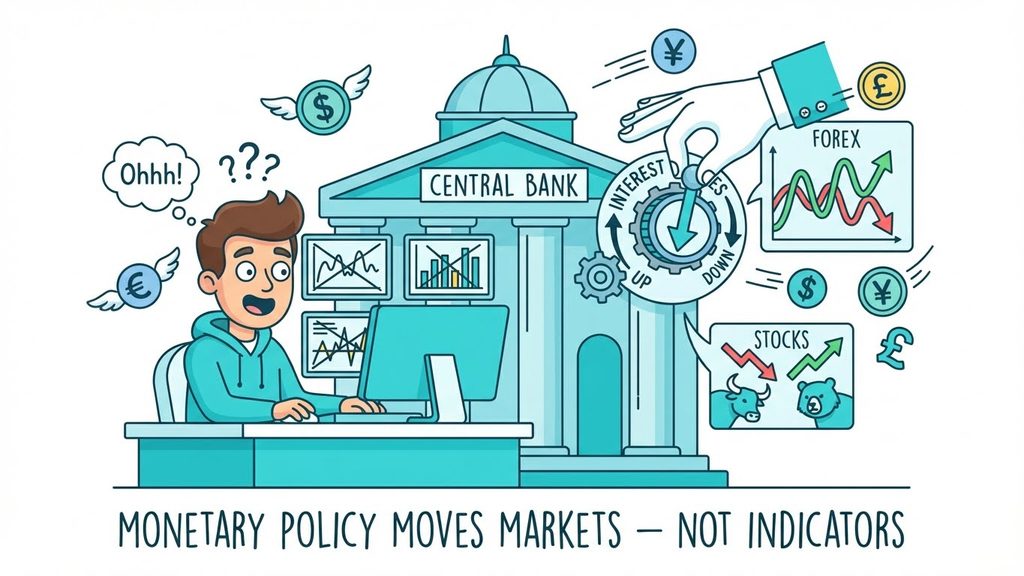
Monetary policy is defined as the measures employed by the central bank in order to manage monetary and financial conditions, which include short-term interest rates and liquidity.
The aim of the policy varies depending on the mandate of the central bank.
As an illustration, the European Central Bank mainly considers the objective of price stability; however, the US Federal Reserve takes up two mandates: price stability and full employment.
In order to achieve monetary policy goals, the central bank employs tools such as the policy interest rates and asset purchases among others, thereby influencing borrowing, spending, investments and inflation.
For traders in Forex and CFD market, the monetary policy forms an integral part of the fundamental analysis process.
The Role of Central Banks in Financial Markets
Financial conditions are influenced by central banks through their monetary policy actions and economic forecast communications.
The important central banks are the Fed in America, the ECB in Europe, and the BoE in Britain.
What Central Banks Can Influence
Central banks can influence:
- Short-term interest rates through their policy frameworks.
- Financial-system liquidity through market operations.
- Market expectations through policy statements and forward guidance.
- Broader borrowing costs and financial conditions through monetary policy transmission.
Central banks do not have direct control on all interest rates, exchange rates, and asset prices.
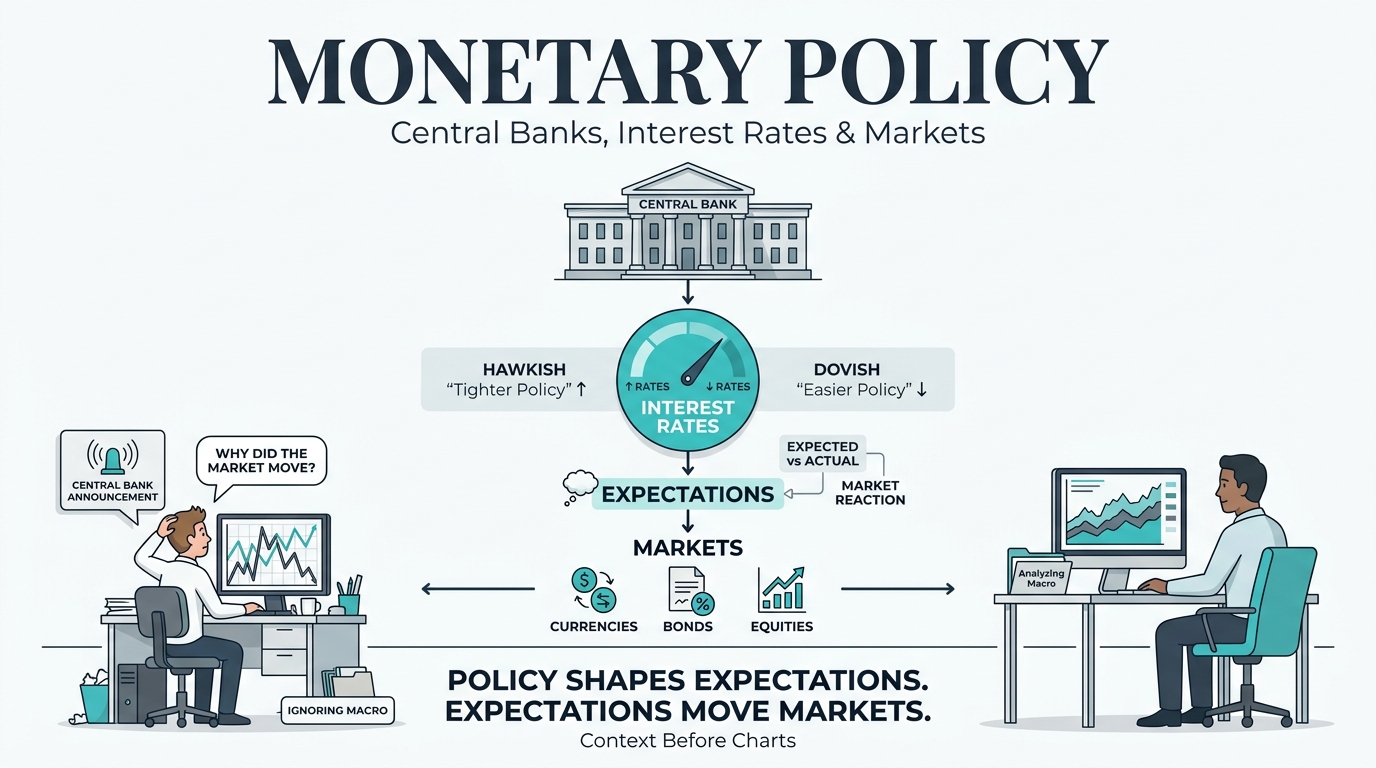
The reaction of financial markets can depend not only on the decisions of the central bank but also on the anticipation of future policies. Thus, unexpected announcements can have a different effect than anticipated decisions.
Interest Rates Explained Simply
Interest rate is either the cost of borrowing funds or the income earned from lending or depositing funds, depending on the type of financial instrument.
The central bank can control short-term borrowing costs through its interest rates.
An increase in interest rates usually makes short-term borrowing costly, while a reduction usually makes borrowing less costly.
Why Interest Rates Matter for Traders
Interest rates impact currencies, bond prices, stock prices, and other financial factors.
In Forex trading, interest rates disparities from one country to another may play a role in how appealing a currency is to investors.
But high interest rates don’t automatically imply that a currency will appreciate in value.
There is no denying that exchange rates are influenced by anticipated future interest rates, inflation rates, economic growth, political news, and risk appetite of investors.
The reason for which a currency might fall despite rising interest rates is that markets expected that move.
How Monetary Policy Is Transmitted to Markets
The monetary policy will affect the financial market and the overall economy through what is referred to as the monetary policy transmission mechanism.
A change in the monetary policy by the central bank might be felt via different transmission channels such as:
- Interest rates: Changes in policy rates influence borrowing costs and returns on savings.
- Credit conditions: Lending rates and access to finance may change for households and businesses.
- Spending and investment: Changes in financing costs can affect consumption and business investment.
- Exchange rates and asset prices: Monetary policy expectations may influence currencies, bonds and equities.
- Inflation and economic activity: Changes in demand and financial conditions can gradually influence economic growth and inflation.
Financial markets react immediately to policy information, but the real economic implications can take time to materialize.
Since investors look ahead and make expectations about future actions, changes in asset prices can happen even before an official adjustment in interest rates by the central bank.
The Policy Transmission Process
Central banks signal hints about their plans, and markets start guessing what interest rates might do next. Money moves between different currencies and investments, and prices usually change before we see the actual numbers backing the change.
Markets often jump the gun on official rate decisions. Investors usually anticipate policy moves before they are formally announced.
Hawkish vs Dovish Monetary Policy
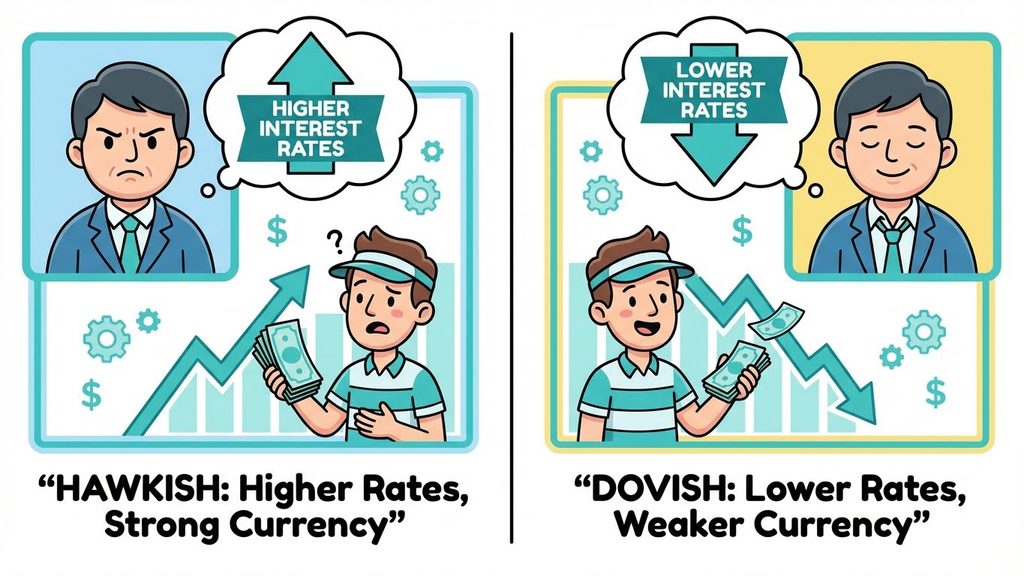
The terms hawkish and dovish describe the relative direction or emphasis of a central bank's monetary policy stance.
Hawkish Policy
A hawkish outlook normally gives more importance to fighting inflation and may entail having relatively high interest rates or even increasing interest rates.
Hawkish rhetoric helps to strengthen a currency if it shows more tightening of monetary policies than what was expected from the market.
However, there is no guarantee of such an effect on the currency.
Dovish Monetary Policy
The dovish position typically places more weight on the promotion of economic activity or a reduction of money tightness, especially if the threat of inflation is diminished.
It can take the form of reducing interest rates or indicating that monetary policy can become less tightening.
Dovish language may lead to depreciation of the currency if it implies future interest rates that are lower than what the investors expected.
Why Central Bank Language Matters
The reaction of markets may be based on expectations regarding future monetary policy, and not on current interest rate policy.
A central bank can maintain the status quo on interest rates but send a hawkish or dovish message to the financial markets.
Why Market Expectations Matter
Financial markets frequently react based on the gap between the expectation of investors and what the central bank announces.
Example
If the central bank hikes rates by a quarter of a percent as predicted but hints at a more gradual pace ahead, the currency might still take a hit. This action shows a shift in expectations, not just a single decision.
Rate hikes themselves can elicit only a partial response. Nonetheless, where the central bank indicates that future hikes will not occur as frequently as before, the currency might weaken even though there was a rate hike.
On the other hand, where the interest rates are left at their current levels, but the associated guidance hints at monetary policy staying tight longer than expected, the currency can be boosted.
This is why the traders analyze both policy statements and outlooks along with the decision on interest rates.
Real Interest Rates & Financial Conditions
Nominal interest rates show the stated rate of interest before accounting for inflation.
Real interest rates adjust nominal rates for inflation and provide a clearer indication of the inflation-adjusted cost of borrowing or return on lending.
A simplified approximation is:
Real Interest Rate ≈ Nominal Interest Rate − Inflation Rate
For example, if the nominal interest rate is 5% and inflation is 3%, the approximate real interest rate is 2%.
For forward-looking financial decisions, expected inflation is often more relevant than past inflation.
Real interest rates can influence borrowing, investment decisions and currency valuations, but their market impact depends on expectations and broader economic conditions.
Central banks also monitor financial conditions, including credit availability, asset prices and signs of financial stress.
Monetary Policy Cycles and Market Trends
Monetary policy usually follows a number of stages during which monetary authorities act on inflation and economic growth.
Common Monetary Policy Phases
- Tightening: A central bank raises interest rates or otherwise restricts monetary conditions, often to address inflationary pressures.
- Holding: The central bank maintains its current policy stance while monitoring economic developments.
- Easing: The central bank lowers interest rates or introduces measures intended to make monetary conditions less restrictive.
These stages can affect money values, interest rates, and stock markets, but their impacts on the markets are not always consistent.
For instance, when the economy is going through a tightening stage, it can weaken the value of a certain currency since it is anticipated that economic conditions will weaken.
It would be useful to understand monetary policy cycles because they provide a context for understanding the economy as a whole.
Why Monetary Policy Matters for Traders
The statements by central banks can have an impact on market volatility especially if such a statement or guidance differs from the expected outcome.
This could also mean that for the Forex and CFD trader, a surprise in monetary policy will affect their open positions or create volatility or alter the market expectation.
The technicals might not also be very useful in situations where the price is experiencing fast revaluation even if monetary policy is just one of many other determinants of price action.
Knowing the monetary policy along with the market structure can give a different viewpoint while analyzing the market.
Nevertheless, knowing about central bank statements doesn't mean that there is no trading risk or that one is going to make better predictions.
This macro alignment gets clearer when you mix it with Market Structure Explained and Break of Structure & Market Regime Shifts.
You can safely try out macro awareness in a demo setting through the VARIANSE trading account page.
How to Use Monetary Policy in Forex and CFD Trading
It is possible for traders to consider monetary policy within their market analysis process without predicting every central bank decision.
Practical Considerations
Monitor economic calendars: Identify upcoming central bank meetings, interest rate decisions and major economic releases.
Understand market expectations: Consider whether a policy decision is already anticipated.
Review central bank communication: Examine statements, forecasts and forward guidance for changes in the policy outlook.
Consider volatility: Recognise that unexpected announcements may lead to rapid price movements and slippage.
Combine analytical approaches: Use monetary policy as economic context alongside technical analysis and predefined risk-management rules.
Conclusion: Understanding Monetary Policy and Market Behaviour
This is because monetary policies have an effect on interest rates and the general market situation including inflation expectations and sentiments.
When one is trading forex and CFDs, it would be essential for one to understand monetary policy since it helps in analyzing the financial assets.
However, central banks cannot control everything that happens in the financial markets; interest rates do not generate consistent results.