


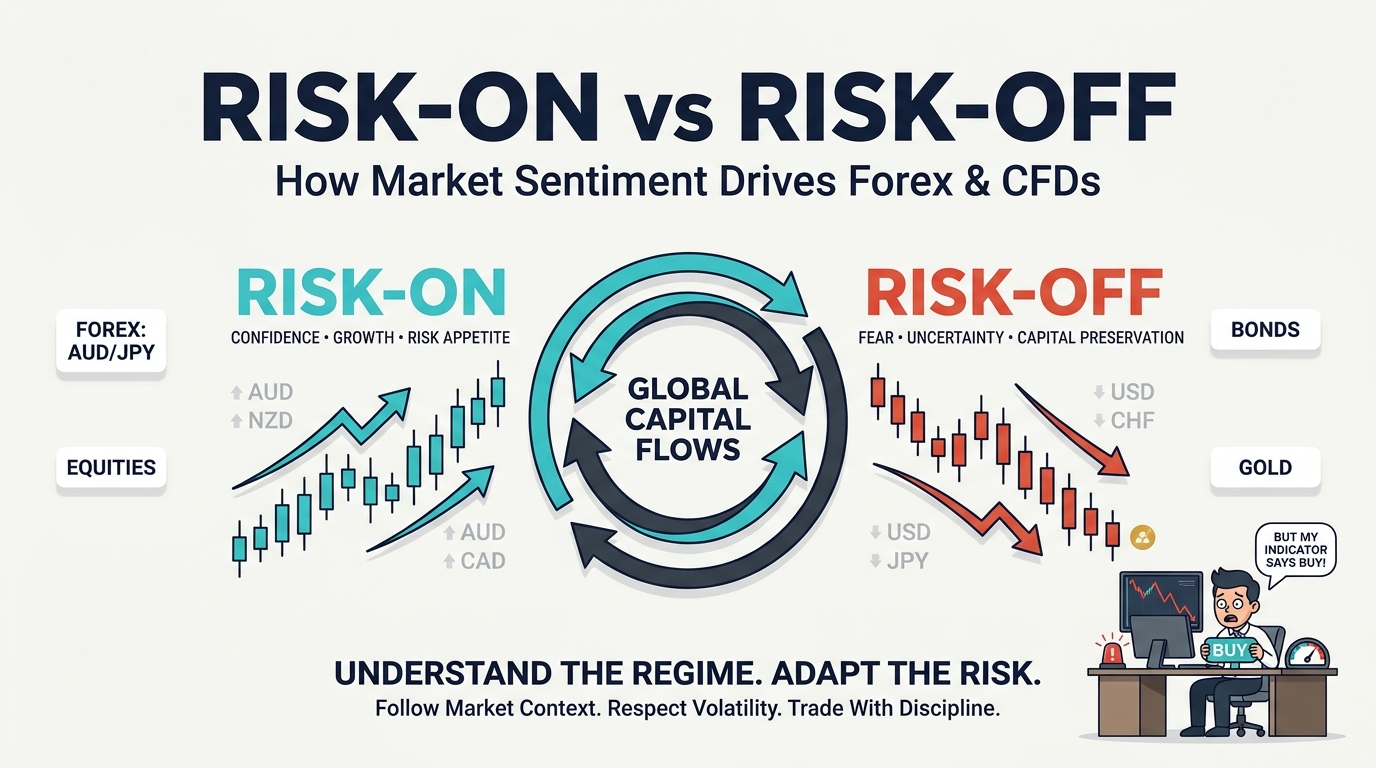
Taking risks can be a big deal in global finance, but it’s often less straightforward than people think.
Many traders get caught up in charts, indicators, or single news headlines, but they often miss the bigger market picture that really moves capital.
Markets tend to shift together before they start to change on their own. Grasping the risk on and risk off market environment regime helps traders align with institutional flows, avoid trading against the crowd, and recognize when correlations between markets like Forex, stocks, metals, and CFDs begin to change.
This guide breaks down the risk-on, risk-off framework clearly and practically, helping you understand why markets behave the way they do rather than just observing price movements.
What Does Risk On Risk Off Mean in Trading
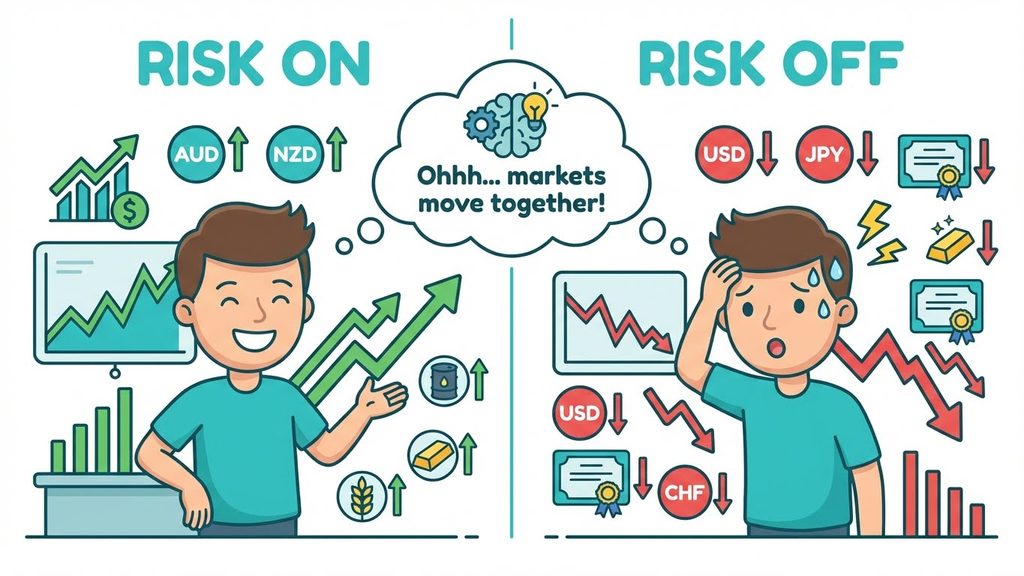
When investors are feeling confident, they tend to take more risks, while uncertainty pushes capital toward safer assets.
Risk-On — When traders and institutions feel comfortable with risk, capital flows into growth-oriented and higher-yielding assets, reflecting stronger risk appetite.
Risk-Off — When capital prioritizes safety, liquidity, and capital preservation, markets shift toward defensive positioning. This behavior appears across multiple asset classes, including equities, bonds, commodities, and currency markets. Risk-On/Risk-Off is not a trading strategy; it describes overall market sentiment.
Risk-On/Risk-Off Market Environments (In a Nutshell)
Risk-On Environment
- Optimistic market mood
- Capital flows into growth and yield
- Equity markets rise
- Volatility remains low
- Risk-sensitive currencies strengthen
Risk-Off Environment
- Fear or uncertainty dominates
- Capital flows into safety
- Equity markets decline
- Volatility rises
- Safe-haven currencies strengthen
These shifts explain why correlations suddenly change during periods of market stress.
What Causes A Move From Risk-on To Risk-off
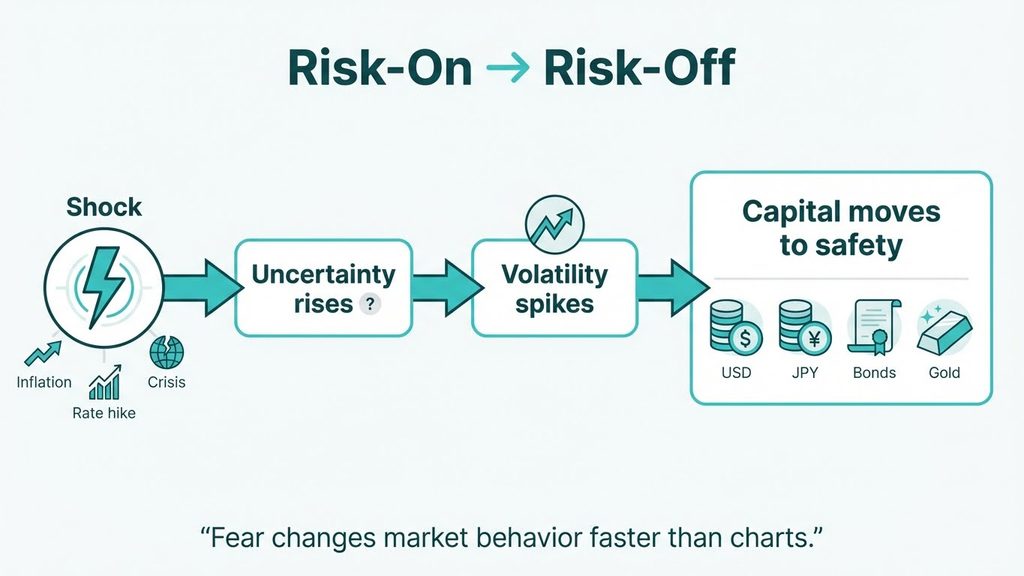
Market regimes do not change randomly. They respond to major economic, financial, or geopolitical developments that alter investor expectations.
Common Risk-Off Triggers
Risk-off environments often emerge during unexpected inflation spikes, sudden shifts in monetary policy, recession fears, liquidity stress, geopolitical tensions, or rapid increases in market volatility.
When things get shaky, money doesn’t just sit around waiting for the all-clear; it jumps into action right away. This behavior matches how people’s expectations shift with policy and growth.
How Risk On Risk Off Affects Different Asset Classes
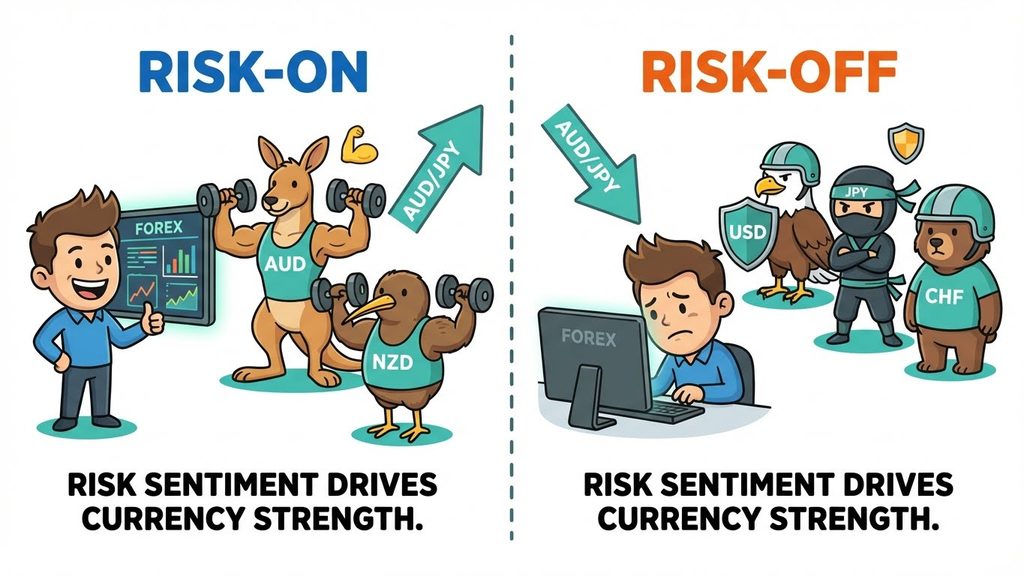
Market regimes affect all major investments, but how fast and how much they react varies.
Forex Markets
Forex reacts fastest to changes in market sentiment.
In Risk-On environments, currencies like the Australian dollar, New Zealand dollar, and Canadian dollar usually get stronger.
In Risk-Off environments, capital typically flows into the US dollar, Japanese yen, and Swiss franc. Currencies like AUD/JPY are often used as live risk-appetite indicators because they reflect the balance between how much risk people are willing to take and the need for a safe bet.
Stock Indices
Equity markets broadly reflect changes in market sentiment.
Risk-On environments typically support rising stock indices, while Risk-Off periods often trigger broad sell-offs, particularly in growth-heavy markets.
Technology-heavy indices are particularly sensitive to changes in investor risk appetite.
Bonds and Yields
Bond markets frequently signal regime shifts before equities.
In Risk-On phases, bond prices tend to fall, and bond yields rise as investors shift money into riskier assets.
In Risk-Off phases, investors tend to buy bonds, pushing prices up and yields down as they seek safer investments. This behavior matches how the Bank for International Settlements evaluates global financial conditions.
Commodities and Gold
Industrial commodities tend to perform better during Risk-On environments tied to growth expectations.
Gold often strengthens during Risk-Off periods as investors seek safety.
Signs We Look For To Spot When Markets Are Bullish Or Bearish
Traders don’t rely on a single signal to determine the risk-on/risk-off market regime. They watch how different markets interact.
VIX index
When the VIX Index rises, it typically signals increasing fear and reduced risk appetite. When it declines, markets generally reflect stronger confidence and risk-taking behavior.
Bond Yields
Sharp declines in sovereign bond yields often indicate a flight to safety and emerging Risk-Off conditions.
Currency Correlations
When the US dollar, yen, and Swiss franc rise at the same time, it usually signals investor nervousness, especially if stocks are also falling and safe-haven currencies are strengthening.
Risk-On/Risk-Off Trading: How Traders Really Use It
Professional traders rarely try to predict changes in market sentiment. They adapt to them.
Risk-on/risk-off trading helps traders adjust how much they’re betting, choose which markets to play, avoid going against the flow, and keep their expectations in check for how wild things might get and how they’ll keep going.
During Risk-Off conditions, trend reliability decreases, and volatility expands rapidly a critical consideration in leveraged CFD trading.
Common Mistakes Traders Make With Risk-On/Risk-Off
Many traders treat risk-on/risk-off as a quick signal rather than recognizing it as a broader market regime that can persist. Some continue using the same strategies even when market conditions have clearly changed.
Overleveraging during Risk-Off periods can wreak havoc, especially since it makes losses even bigger. These behavioral slip-ups are pretty much what we’re talking about in Trading Psychology Explained.
Practical Rules for Trading Risk-On/Risk-Off Environments
Understanding the risk-on/risk-off regime means aligning trades with prevailing market sentiment rather than fighting it. Reduce exposure when regimes change. Expect higher volatility during Risk-Off periods. Use multi-market confirmation to validate sentiment shifts.
Before we dive into the execution part, it’s crucial to understand the structure, just like in the article Market Structure Explained.
Make sure you’ve got the right conditions checked out before you try these out in unpredictable situations, using the link to the Varianse Trading account page.
Conclusion: Why Risk On/Risk Off Matters More Than Just Looking At The Numbers
Charts do not move markets. People do.
Risk-on/risk-off dynamics explain why assets move together and why correlations break down during periods of stress. Traders who understand the risk-on/risk-off market regime avoid pointless losses, focus on fewer but better trades, and keep up with big-time investors.
If you’re not sure if the market’s feeling Risk-On or Risk-Off, you’re just guessing, no matter how solid your game plan seems.








