


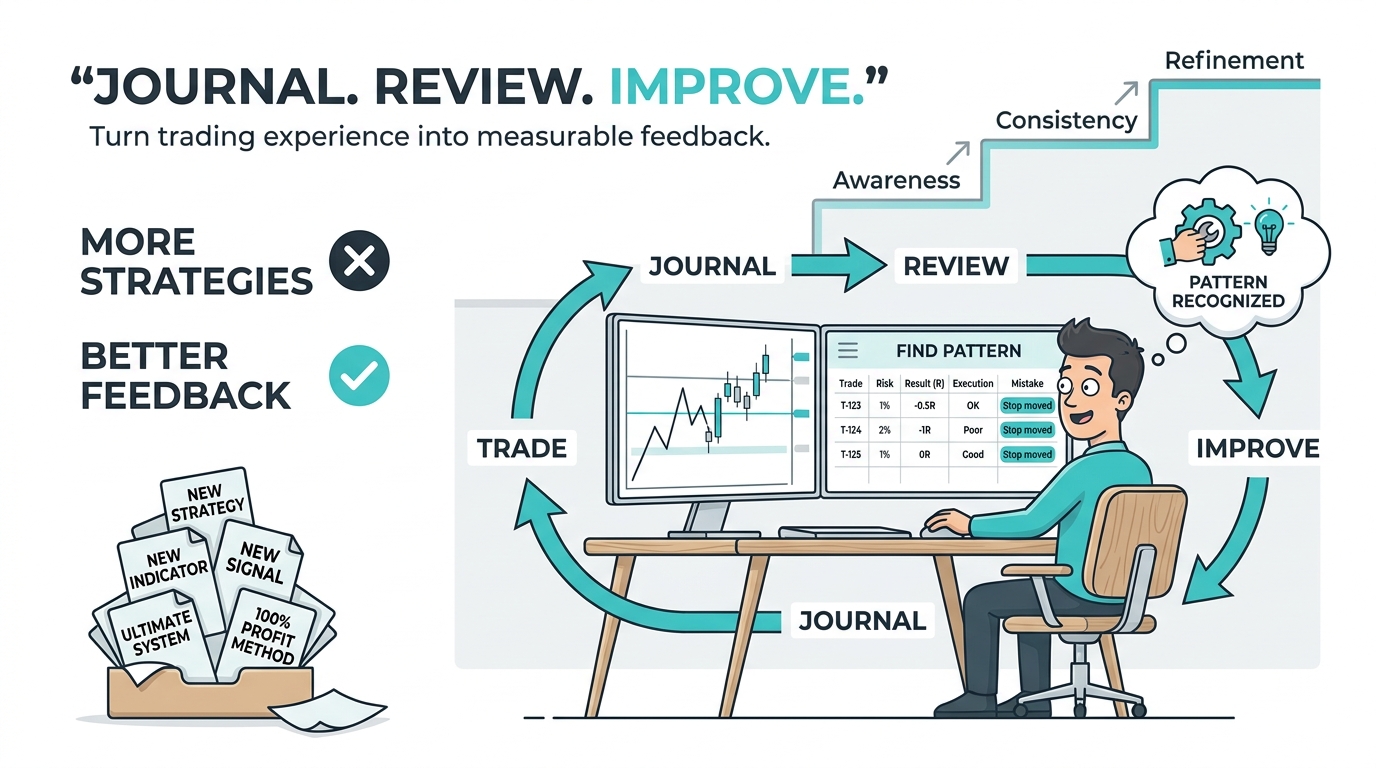
Developing a trading strategy is only one part of improving as a trader. Understanding how that strategy performs, how consistently it is executed and where mistakes occur is equally important.
Without proper documentation and reviews, traders will face difficulty in discovering common patterns of error, analyzing their decisions or distinguishing whether the problem is in strategy or its implementation.
The use of a trading journal and performance review process creates a way to document trades, to evaluate the results and to find patterns.
It is especially important for Forex and CFD trading due to the high levels of leverage that can make it possible to win big money or lose it all.
This guide covers five different aspects: trading journaling, R-multiples, performance evaluation, psychology patterns and strategy improvement without changing it.
What Does Journaling and Performance Review Mean in Trading?
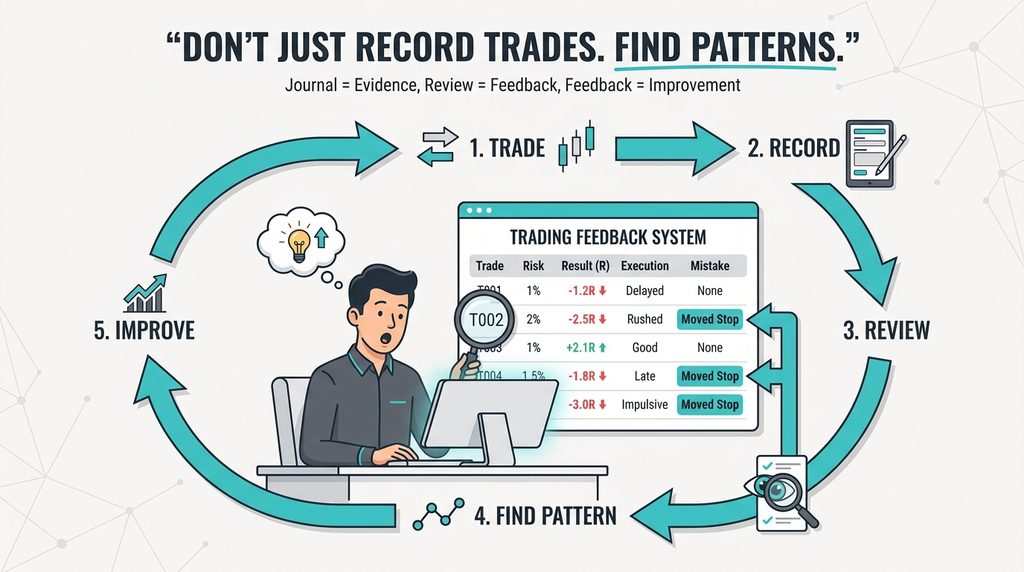
Journaling and Performance Review is the system that turns experience into structured improvement. A trading journal captures data, and a performance review for traders turns that data into decisions. Performance reviews utilize the above-mentioned data to identify patterns, assess the quality of implementation, and determine the efficiency of the trading strategy.
Together, these practices can help traders:
- Understand what is actually driving results
- Measure risk-adjusted performance without money bias.
- Identify execution mistakes vs. valid losses.
- Spot emotional trading patterns that quietly drain expectancy
- Improve a strategy through process-driven improvement instead of switching.
The idea is not just to obtain more data about the trading process, but to use it to make wiser choices.
The Foundation: Why a Trading Journal Matters
A trading journal is more than just a profit and loss account. It serves to document your decisions, analyze the execution of those decisions and recognize repeated trends.
When trading in the Forex market and CFDs, a journal can help one to identify behaviors such as over trading, unconsistent position sizes, impulse stop loss adjustments or early exits.
A journal will not necessarily make one a better trader, however. It all depends on the quality of information that is documented and analyzed.
Start with our Trading Journal Guide to understand what information to record, how to organise trade entries and how to turn observations into a structured review process.
Track Results Properly: R-Multiple Tracking
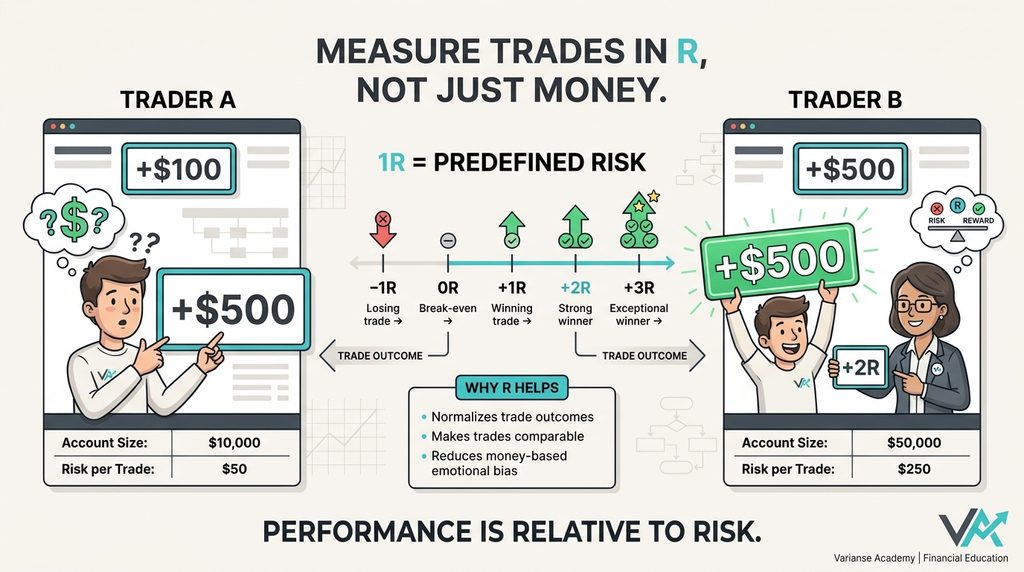
Trading performance measurement using money alone makes the comparison between trades with differing amounts of positions or risk hard.
R-multiple tracking is done in relation to the amount of initial risk for each trade.
For example, if a trader risks £100 on a position:
- A £100 loss represents −1R.
- A £150 profit represents +1.5R.
- A £200 profit represents +2R.
It enables the trader to make comparisons between outcomes as compared to the amount put at stake.
Nonetheless, R-Multiples do not automatically incorporate variations in account risk, execution or statistical validity of a trading approach.
The traders need to document the intended risk levels as well as realized outcomes. Our guide to R-Multiple Trading Explained explores how to calculate R-multiples and use them when reviewing trading performance.
Measuring Trading Performance Beyond Profit and Loss
Profitability and losses represent financial results, while performance analysis is focused on the process by which the result was obtained.
Profitable trading in one week does not mean that all trading decisions have been done according to the strategy.
In the same way, the week with losses does not imply poor performance. One can follow an appropriate trading strategy and still have losses. A structured review should therefore consider several performance measures:
Use structured performance metrics for traders, including:
- Average R per trade: The average result relative to initial planned risk.
- Drawdown: The decline in account equity from a previous peak.
- Win rate: The percentage of completed trades that produce a positive result.
- Average win and average loss: The typical size of profitable and losing trades.
- Rule adherence: How consistently trades follow the predefined plan.
- Risk-adjusted performance: Returns evaluated alongside the amount of risk taken.
These indicators offer various angles on the outcomes of the trading activity.
None of these metrics alone can serve as proof of a trader’s sustainable competitive edge. Proper evaluation of performance is to be done based on a sufficient number of trades.
The Psychology Layer: Strengths, Weaknesses, and Hidden Gaps
Performance in trading depends on the quality of the strategy used as well as how this strategy is implemented. Sometimes certain persistent issues could be behavioral rather than technical.
For instance, a trading journal could expose the issue where a trader constantly increases the size of a trade following losses, fails to get into a good setup or close a profitable trade too soon.
The identification of such issues is sometimes tricky. Therefore, a good performance evaluation considers not only financial results but also the context of each trade.
Our guide to Psychology of Trading explores how emotional triggers, decision-making habits and behavioural biases may influence trading execution.
Goal is to recognize those patterns that can be assessed and fixed with the help of better rules, realistic risk limitations, and proper reviews.
Behavioural finance research has identified patterns that can influence trading and investment decisions. For example, Shefrin and Statman's research on the disposition effect examines why investors may realise profitable positions too early while remaining reluctant to close losing positions.
Reviewing these behavioural tendencies alongside trading journal records may help traders recognise similar patterns in their own decision-making.
Avoiding Unnecessary Strategy Hopping
Strategy hopping refers to cases where the trader keeps on changing his trading strategy without proper evaluation of how well that strategy works.
This happens either following a short period of losing in the market or where other strategies look better or the traders get frustrated with the performance of the strategy.
Such frequent changing makes it difficult to evaluate the performance of the strategy due to lack of consistent data for a particular strategy.
The use of a trading journal would enable the traders to separate the performance issues from the problem within the strategy.
But then again, sticking to an inefficient trading strategy does not mean discipline in trading.
Use Improving Without Strategy Hopping to apply a structured refinement approach: fixed testing windows, controlled changes, and review scheduling.
Trading Journaling and Review: A Five-Step Workflow
A practical workflow keeps this system usable and repeatable. The aim isn’t to write more. The aim is to keep a trading journal and review it more effectively.
Step 1 — Document Each Trade
Record the entry and exit prices, position size, initial risk, market conditions, trade rationale and final result. Record the entry and exit prices, position size, initial risk, market conditions, trade rationale and final result.
The Trading Journal Guide provides a framework for organising these records.
Step 2 — Evaluate Execution Quality
Review whether each trade followed the predefined strategy. Any deviations should be recorded, for example entering without confirmation, changing a stop without justification, and taking money off the table not according to the pre-planned exit rules.
One can make a profitable trade in an improper manner and vice versa.
It is important to document results with actual R-multiple outcomes and not just gains or losses.
Mark every trade as either executed correctly or with an execution issue. Traders shouldn’t mix up bad results with bad actions. The framework for tagging is detailed in the link titled R-Multiple Trading Explained.
Step 3 — Review Trading Performance Regularly
Set a consistent review schedule, such as weekly or after a predefined number of completed trades.
Examine:
- Average R per trade
- Win rate and average win-to-loss relationship
- Drawdown and changes in account equity
- Frequency of rule violations
- Market conditions associated with different outcomes
- Recurring execution problems
A weekly review may assist in finding operational problems, but for determining the performance of a strategy using statistical methods, a sample size is needed.
Explore Trading Performance Explained for a closer look at evaluating trading results.
Step 4 — Identify Recurring Mistakes and Emotional Triggers
Make use of journal entries to detect repetitive behaviour patterns that might impact decision-making when trading.
For instance, see if there is an occurrence of increasing the size of positions after losses, prematurely exiting positions that yield profits, or if there are specific market environments that result in inconsistent trading performance.
This shifts psychology from just “feelings” to actual evidence. The leak framework is in Psychology of Trading.
Step 5 — Test Improvements Systematically
Choose an area of improvement that can be made clear from the collected data.
It may relate to position sizing, the discipline in entry or stop loss placement or when to review the trades.
When possible, modify only one major factor in order to assess its impact.
Write down the modification, set the duration of the review and compare it to the original way of doing things.
The idea is to implement controlled and measurable changes instead of continuously tweaking the trading strategy after a few trades.
The difference between optimization and chaos is highlighted in the article Improving Without Strategy Hopping.
Common Mistakes Traders Make With Journaling and Performance Review
Maintaining a trading diary can be helpful only if the entries in it are accurate and relevant.
Common mistakes include:
- Recording trades without reviewing them: Collecting data without analysis limits the journal's practical value.
- Focusing only on monetary profit and loss: This can overlook differences in initial risk, position sizing and execution quality.
- Ignoring trading costs: Spreads, commissions and financing charges can affect actual performance.
- Changing strategies after a few trades: Small samples may not provide enough evidence to assess a strategy reliably.
- Using vague emotional descriptions: Notes such as “bad trade” provide less insight than recording the specific rule that was broken.
- Overlooking market conditions: A strategy may behave differently across trending, ranging or highly volatile markets.
- Making too many changes at once: Multiple simultaneous adjustments can make it difficult to identify what affected the results.
A good diary will facilitate objectivity in one’s thinking, and not serve as a diary of anger or self-doubt. The idea is to try and understand what occurred, what went on in people’s minds and what the facts suggest.
Conclusion: Turning Trading Experience Into Measurable Feedback
Journaling and performance review give traders a framework to reflect on their decisions, analyze outcomes and spot trends.
Trading journal describes what has occurred.
Performance review determines why it has occurred and whether the trader's decisions were consistent with his/her initial trading plan.
All of this could help a trader analyze execution of trades, risk positions and see where he/she could improve.
Nevertheless, having all the records does not necessarily mean that a trader will earn money or has an edge in his/her trading strategy.
Progress will be made based on the quality of the strategy, reasonable risk management, efficient execution and analysis of trading performance.
Instead of continuously wondering which strategy to try next, traders should start with analyzing the information they have about themselves, risks and decisions they have made.
The goal is not to make every trade profitable, but to build a trading process that is more structured, measurable and open to evidence-based improvement.








