


Most traders think they can fix bad results by trading more, spending more time on the screen, and working harder.
In reality, the opposite is usually true. A well-designed, reducing risk trading strategy focuses on capital preservation, not constantly jumping in and out of the market. Pro traders get ahead by reducing trading risk when things are unpredictable, not by pushing themselves to do more.
This lesson explains why reducing trading risk beats trading more and how sticking to fewer trades usually delivers better results over time. This principle works only when you can measure it and keep an eye on it, as discussed in What Is a Trading Edge?
Why Trading More Increases Risk
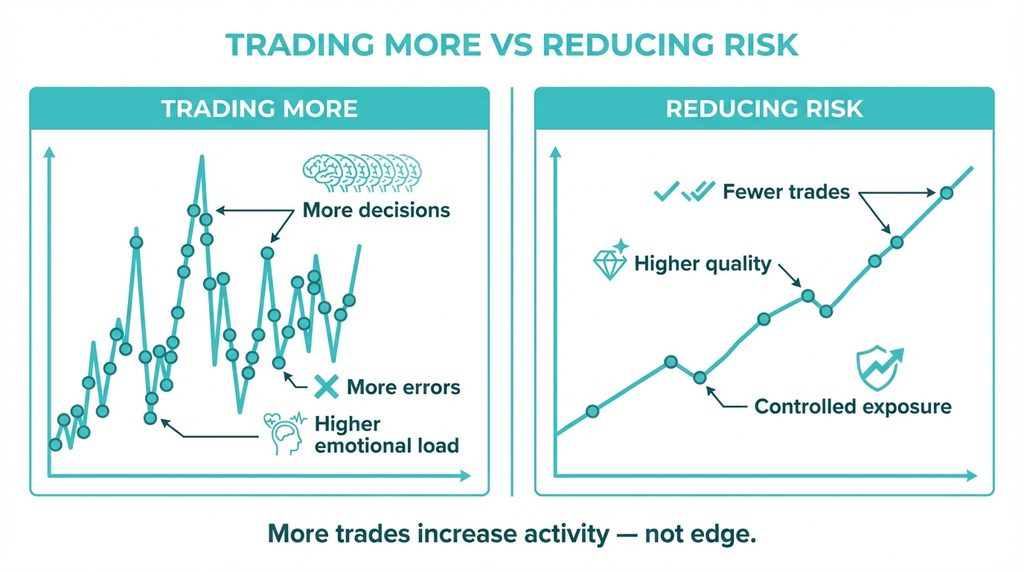
Trading can feel more rewarding, but it also gradually increases your exposure.
Every additional trade introduces:
- Execution risk
- Emotional interference
- Overlapping exposure to volatility
More trades don’t boost your advantage; they just increase the chance of execution errors. When the market’s not doing so well, trading more often just means you lose capital faster.
That’s why traders who overlook the importance of expectancy logic damage otherwise effective systems, as detailed in Trading Expectancy Explained.
Frequent trading can increase transaction costs, market exposure and the potential for significant losses, particularly when leverage is involved. FINRA's investor guidance on day trading highlights the risks associated with active trading and the importance of understanding potential financial losses. Although the guidance focuses on securities trading, these risk considerations are also relevant to Forex and CFD traders evaluating whether additional trades are justified by their strategy.
Risk vs Opportunity: What Traders Often Misunderstand
Many traders confuse trading activity with genuine market opportunities. However, trading more frequently does not necessarily lead to better results. Financial markets don't consistently offer high-quality setups, and forcing trades in unfavorable conditions can increase unnecessary risk. Many traders confuse activity with opportunity.
Taking positions without clear confirmation or a valid trading setup can lead to:
- Lower trading expectancy: Poor-quality setups may reduce the average expected return per trade.
- Weaker risk-adjusted returns: Taking unnecessary risks can reduce the returns generated relative to the level of risk.
- Accelerated drawdowns: Frequent losses and excessive exposure can cause trading capital to decline more quickly.
A risk-reducing trading strategy emphasizes trade quality over trade quantity. This shift in thinking also helps traders avoid jumping between strategies and letting emotions take over, concepts discussed in Improving Without Strategy Hopping.
When Reducing Risk Is the Correct Decision
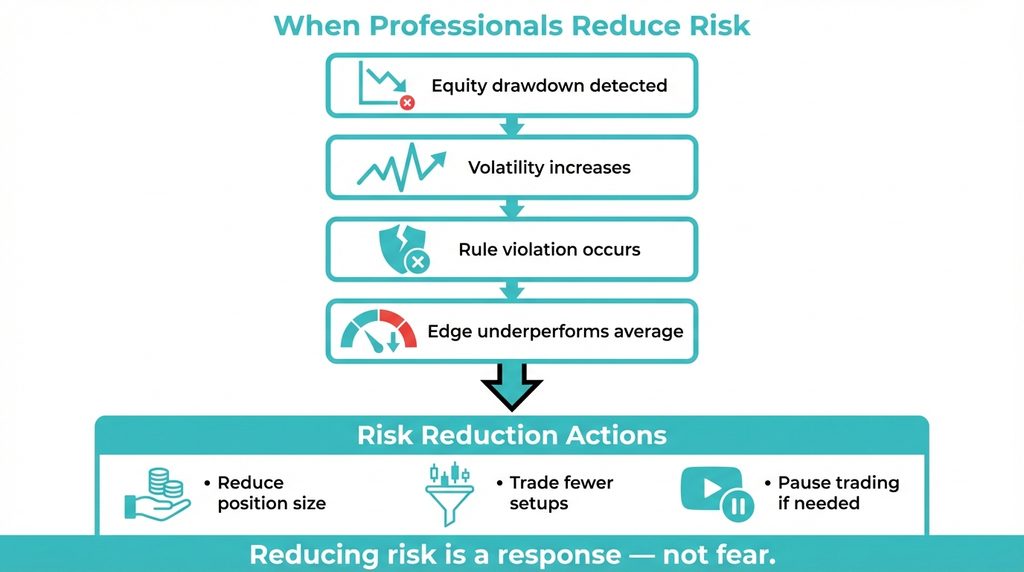
Reducing trading risk is not a sign of weakness or giving up. It is a strategic decision that helps traders protect capital, manage exposure, and adapt to changing market conditions.
Traders should consider reducing risk when:
- Equity curve drawdowns increase: Account performance declines beyond predefined thresholds, signaling the need to reassess exposure.
- Market volatility becomes unpredictable: Sudden price movements, economic announcements, or news-driven events increase uncertainty and execution risk.
- Trading rules are repeatedly violated: Inconsistent execution or emotional decision-making suggests that a temporary reduction in trading activity may be necessary.
- Trading expectancy deteriorates: Actual strategy performance falls below historical expectations, potentially indicating changing market conditions or a weakening trading edge.
Effective risk management is not just about knowing when to enter a trade. It is also about recognizing when to reduce exposure or step away from the market. Protecting capital in unfavorable conditions helps traders stay disciplined and preserve flexibility for future opportunities.
Capital Preservation Comes First
Capital preservation underpins sustainable trading and effective risk management. While generating profits is an important objective, protecting trading capital is essential to manage losses and stay able to participate in future market opportunities.
When trading capital is significantly reduced:
- Position sizing becomes restricted: A smaller account balance limits the capital available for new trades while maintaining consistent percentage-based risk limits.
- Psychological pressure increases: Significant losses can trigger fear, frustration, and emotional trading decisions.
- Recovery becomes mathematically harder: Larger drawdowns require disproportionately higher percentage gains to return to the original account value.
For example, a 20% drawdown requires a 25% gain to recover, while a 50% drawdown requires a 100% gain just to break even.
The key principle is simple: Protecting capital comes before pursuing profits. Disciplined traders prioritize controlled exposure, consistent position sizing, and predefined loss limits to reduce the risk of severe drawdowns and support long-term trading sustainability.
Trading Less Improves Decision Quality
Trading more frequently does not necessarily lead to better results. In fact, cutting unnecessary trades can help traders make better decisions, avoid emotional reactions, and focus on high-quality market opportunities.
A selective trading approach can strengthen:
- Patience: Waiting for favorable market conditions instead of forcing trades.
- Discipline: Following predefined trading rules and avoiding impulsive decisions.
- Setup selectivity: Prioritizing trades that meet established entry criteria and offer an acceptable reward-to-risk ratio.
- Execution clarity: Making trading decisions based on a structured plan rather than market noise or emotional pressure.
The goal is not simply to trade less, but to trade with greater purpose. By focusing on quality over quantity, traders can reduce unnecessary exposure, improve decision-making consistency, and maintain better control over trading risk.
Less trading gives us more room to think. We make better choices consistently, and impulsive decisions decrease. Journaling and organized reflection boost this behavioral consistency, which naturally ties in with the Trading Journal Guide.
The Professional Risk Reduction Framework
Effective trading risk reduction requires a structured approach to managing exposure, protecting capital, and maintaining discipline during unfavorable market conditions.
Instead of reacting emotionally to losses, experienced traders set predefined rules for when to reduce position sizes, limit trading activity, or temporarily step away from the market.
Risk Reduction Checklist
- Reduce position sizes during drawdowns: Lower trading exposure when account losses reach predefined drawdown thresholds.
- Trade only high-quality setups: Focus on A-grade opportunities that meet established entry criteria and reward-to-risk requirements.
- Limit trading frequency: Set daily or weekly trade limits to discourage overtrading and unnecessary exposure.
- Pause trading after rule violations: Temporarily stop trading when repeated execution mistakes or emotional decisions compromise discipline.
- Prioritize execution over profits: Monitor trading discipline, rule adherence, and execution quality rather than focusing solely on short-term profit and loss (P&L).
This framework helps traders control downside risk while preserving flexibility for future trading opportunities.
Professional risk reduction is about exposure control, not hesitation. The goal is to manage risk systematically, not let market volatility or emotional pressure dictate trading decisions.
Risk-Adjusted Returns Matter More Than Profits
Higher profits don't always mean better trading performance. Two traders can earn identical returns while taking significantly different levels of risk.
For example, one trader may achieve a 20% return with a 10% maximum drawdown, while another earns the same return but experiences a 40% drawdown. Although their profits are identical, the first trader has achieved those returns with substantially less downside exposure.
Experienced traders therefore evaluate performance using:
- Risk-adjusted returns: Measuring profitability relative to the amount of risk taken, using metrics such as the Sharpe ratio or Sortino ratio.
- Drawdown stability: Monitoring the depth, frequency, and duration of account declines to assess downside risk.
- Equity curve smoothness: Evaluating how consistently account equity develops over time without excessive fluctuations or concentrated losses.
The goal is not simply to maximize profits, but to generate returns while keeping risk within acceptable limits. A strategy with controlled drawdowns and consistent risk management may be more sustainable than one producing similar profits through excessive leverage or volatile performance.
A risk-reducing trading strategy can produce more stable, consistent results. Without proper exposure control, even the most robust systems can crumble under volatility.
This risk worsens when traders overlook correlation clusters, as detailed in the article Correlation & Risk Management.
Why Trading Less Feels Hard
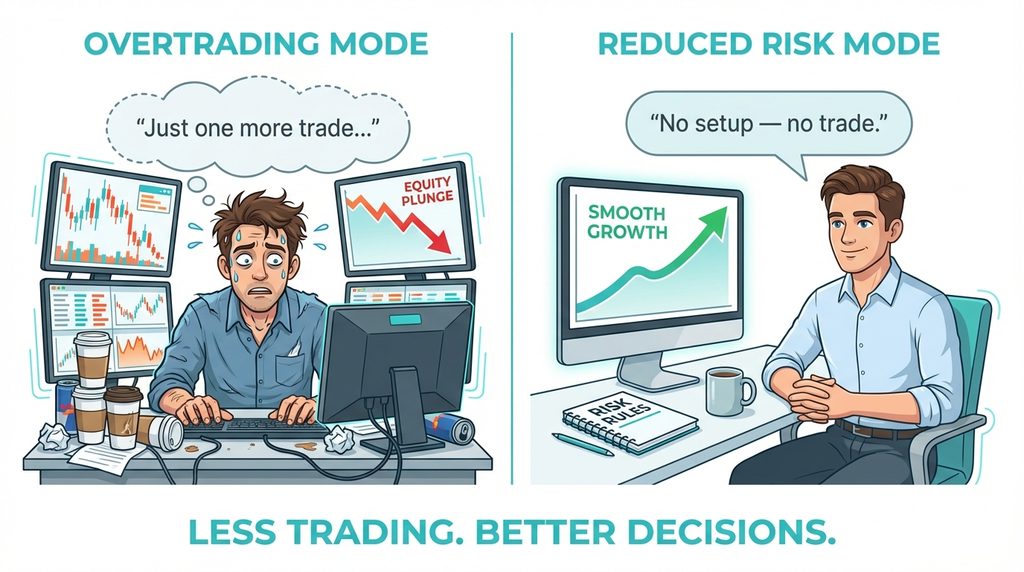
Trading less can be psychologically challenging, especially for traders who associate frequent market activity with progress and profitability. Even when no high-quality setups are available, the urge to act can lead to unnecessary trades and higher risk.
Several psychological factors contribute to this behavior:
- The brain seeks action: Constant market movement tempts traders to trade, even when conditions don't meet their strategy.
- The ego seeks validation: Traders may feel pressured to prove their skills through frequent trades rather than disciplined decision-making.
- Patience can feel like inactivity: Waiting for the right opportunity can feel unproductive, even though avoiding poor-quality setups is a key part of risk management.
The key mindset shift is understanding that not trading is also a trading decision. Disciplined traders recognize that protecting capital, waiting for favorable conditions, and avoiding unnecessary exposure are essential parts of a sustainable trading strategy.
But long-term profitability comes from discipline, not aggression. Traders who think constant motion means progress might end up making emotional decisions, over-trading, or revenge trading. These are all signs of a psychological leak, discussed in Psychology of Trading.
Conclusion — Reducing Risk Trading Strategy
Trading more does not always mean trading better. Knowing when to reduce trading risk shows disciplined risk management.
A structured risk-reduction trading strategy helps preserve capital, limit drawdowns, and maintain control of exposure during challenging market conditions.
The goal isn't to capture every market move, but to protect trading capital and stay ready for high-quality opportunities. Trading less is not a weakness. It is a disciplined decision that supports long-term trading sustainability.








