


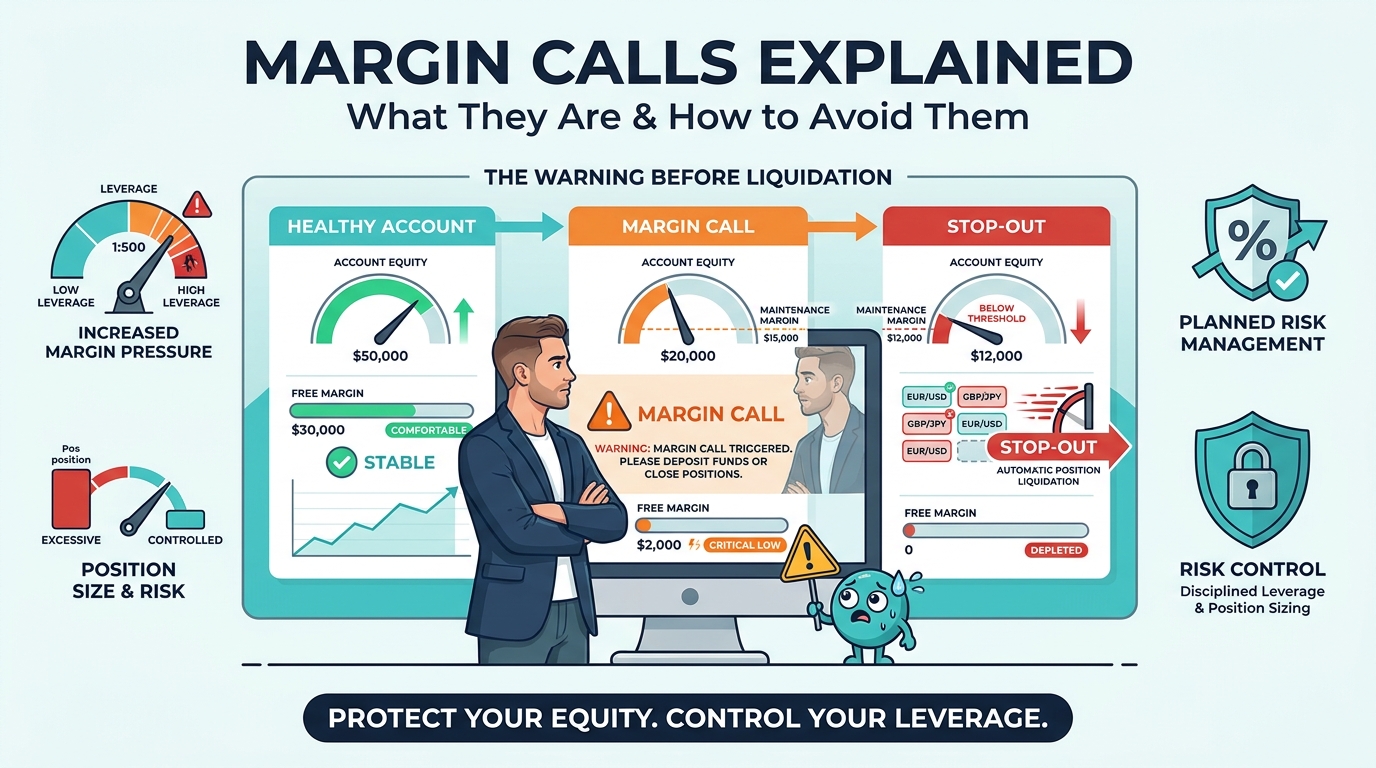
Margin calls are an important part of leveraged trading, yet many beginners do not fully understand how they work or what triggers them.
If a position taken on margin turns out to be losing one for a trader, his unrealised losses will lower his equity and available margin in his account.
A margin call is not always an indication of punishment or manipulation by a broker. It is one of the steps in the margin management system aimed at dealing with the lack of collateral or equity.
Nevertheless, neither margin calls nor stop-outs give any guarantees against financial losses.
The knowledge of margin requirements, leverage and account equity may allow a trader to realise these risks prior to taking a position.
Start with What Is Margin in Trading? to understand how margin supports leveraged exposure.
What Is a Margin Call in Simple Terms?
Margin call refers to the situation where the margin requirements of the broker or any trading provider are no longer met in the trading account.
This could be caused by unrealized losses that bring down the account's equity, increased margin requirements, or insufficient available margin in the account.
Depending on the trading product and trading provider, the margin call can be an alert, a demand for more money, or the need to reduce position size.
There are certain leveraged trading platforms which automatically close open positions based on predefined margin levels without giving any prior notification.
Conclusion: A margin call is an indication that the account has failed to meet the necessary margin requirements. This does not mean that the account has already hit the highest level of loss that it could make.
What Happens During a Margin Call?
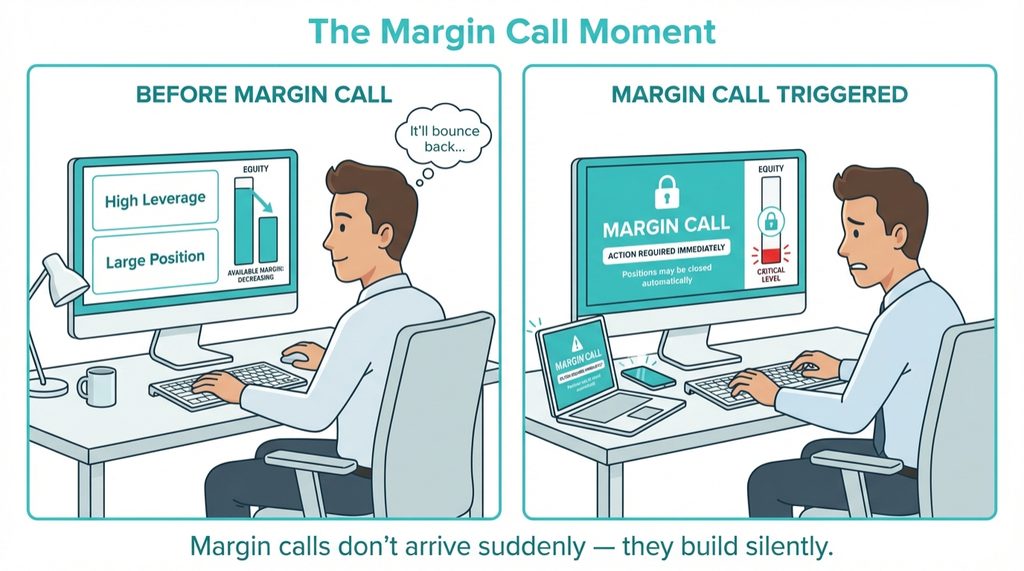
When an account reaches a margin-call threshold, the provider may notify the trader, request additional collateral or restrict new positions. If margin requirements remain unmet, the provider may close some or all open positions according to its rules.
During volatile market conditions, positions may be closed at prices different from those expected.
This forced-closure process is laid out in Margin Calls & Stop-Outs Explained, where stop-outs occur when you hit those margin limits. Margin calls are warnings.
Why Margin Calls Happen
A margin call arises when the account cannot meet the margin requirement for the current trading positions. Various reasons include large unrealized losses, too much market exposure, increased margin requirements, and unfavourable market movements.
Leverage increases the effect of price movements on the invested money relative to the total margin used.
It should be noted that margin calls do not only arise from over leveraging and bad trading practices. Changes in the market can also lead to margin calls. Position sizing and expected losses are very critical elements to consider in such cases.
Not so great at handling risks, as explained in Risk Per Trade Explained, is another big deal. Trading people who bet big on each trade hit their risk limits quicker when the market's just doing its usual ups and downs. Margin calls usually happen because of exposure, not just bad luck.
Market Volatility and Margin Pressure
Periods of high volatility may lead to fast price changes in the market, leading to an increase in the unrealised loss and lower equity levels in the account.
Gaps, low liquidity, and slippage may also affect the execution price. This may lead to faster achievement of the margin level compared to expectations.
Even the positions that have been traded using the trading plan may incur huge losses during sudden market moves.
Execution risks like gaps and slippage, as detailed in Market Gaps and Slippage Explained, can push positions past the intended risk thresholds in a flash.
Margin Calls vs Stop-Out Levels
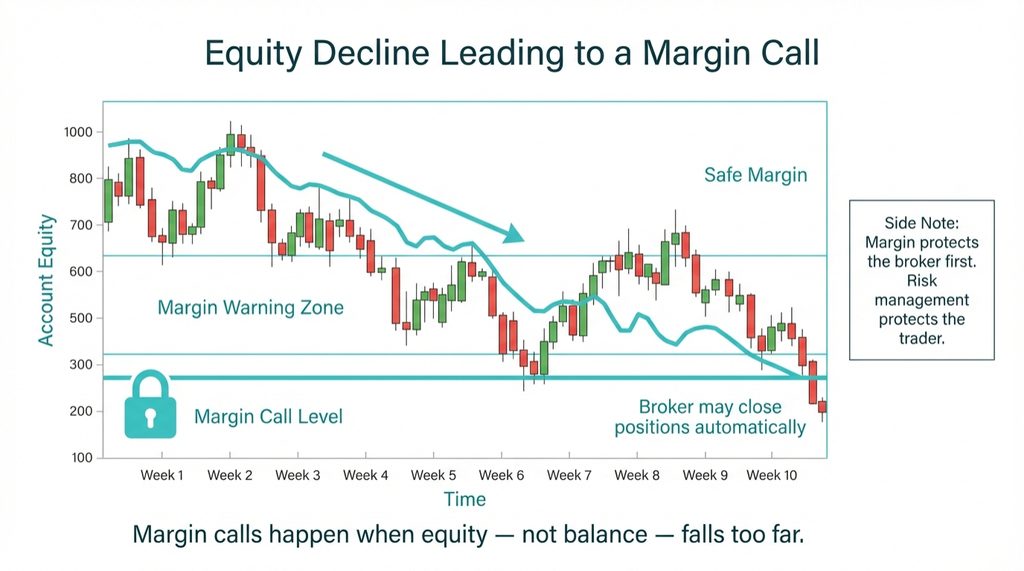
Margin calls and stop-outs are related, but they are not identical.
A margin call generally refers to a warning, notification or requirement arising when an account no longer meets applicable margin requirements.
A stop-out refers to the automatic closure of positions when an account reaches a predefined liquidation threshold.
For example, a platform may notify traders when their margin level reaches one threshold and automatically close positions at a lower threshold.
However, the precise thresholds and procedures depend on the provider, product and account conditions.
Not every platform provides an advance margin-call warning, and a stop-out does not guarantee that losses will be limited to a particular amount.
How Margin Calls Affect Beginner Traders
For newbies who lack knowledge regarding the concepts of leverage, account equity, and margins, margin calls could be very challenging.
Big positions in relation to the account’s capital make a bigger influence on the trader’s finances due to unfavorable conditions in the markets.
Furthermore, margin calls can put extra stress and affect decisions regarding exiting from positions, injecting money or leveraging even more.
Nevertheless, margin calls cannot be considered an indicator of a trader’s bad trading behavior since they can be caused by various aspects, such as decision-making, market fluctuations and change in margin rules.
Leverage, equity and position size can help traders better manage their financial risks.
This emotional cycle is part of the broader behavioral risks explained in Beginner Survival Rules, where excessive leverage and emotional decisions are primary causes of account failure. Margin calls often reflect risky behaviour, not market unpredictability.
How to Reduce the Risk of Margin Calls in Trading
There is no way that margin calls can always be prevented, but with some knowledge about the account exposure and margin requirement, one can try to minimize the risk of reaching critical levels.
Position size is another important factor. The smaller the position, the less exposure to the market it gives.
Position sizing, as detailed in Position Sizing Explained, makes sure that your losses stay in line with how much you've got in your account. Keeping positions smaller and more in check lowers the chance of running into margin issues.
Traders should also understand the margin requirements that apply to their positions and monitor account equity, used margin and available margin.
Stop-loss orders may help establish an intended exit level, but they do not guarantee execution at the requested price, particularly during market gaps or periods of limited liquidity.
Using stop-loss orders, as detailed in Take Profit & Stop Loss Explained, helps prevent your losses from exceeding the limits you set. Margin safety starts before you even make a trade, not when you're down.
Understanding the risks of leveraged trading is essential before opening a position. The Financial Conduct Authority (FCA) provides guidance on investment risks and potential losses, helping traders make more informed financial decisions.
Trading simulations offer chances to learn about margin level management and trading platform operation using simulated funds.
On the other hand, demo trading does not completely emulate real market environment or the psychological implications of actual risk.
You can safely try out margin trading in a demo account by following this link to Varianse's trading page, so you can see what happens without risking any cash.
The Role of Leverage in Margin Calls
Leverage enables traders to create market exposure greater than the amount invested as margin.
With increased position sizes because of leverage, even small changes in the market price can result in huge profits or losses relative to the margin invested.
In case the leveraged position turns out unfavorable to the trader, the unrealized loss will bring down equity and margin in the account.
This may make it easy for margin calls or stop-outs to be triggered.
But the real risks involved are determined by other factors such as position size, market movement, margin requirement, and trading conditions, among others.
This relationship is discussed in the article What Is Leverage in Trading?, where using leverage can boost profits and losses at the same rate.
Cutting back on leverage means you're less sensitive to market swings and your investments are safe.r
Even when they can, most traders don't go all-in with leverage
How Professional Traders Manage Margin Risk
Market professionals could take various methods into consideration for keeping track of their margin requirements and financial exposure.
These could be based on placing an upper limit on exposure, keeping track of account equity, evaluating the liquidity of the markets, and having more collateral available where necessary.
Certain market players also make use of stress testing to assess the reaction of their portfolios in unfavorable market conditions.
But margin calls and losses are something that even market professionals could be subject to.
The full, organized method for managing trades is laid out in Trade Lifecycle Explained. You plan your risks before you actually make the trade. Margin calls are considered mishaps in risk management, not just part of regular trading.
Conclusion: Margin Calls Are a Risk Warning, Not a Strategy
Margin calls occur when a trading account no longer meets applicable margin requirements.
They may result from unrealised losses, increased margin requirements or other changes affecting account equity and available collateral.
Although margin calls and stop-outs form part of the account's margin-management process, they do not guarantee protection against substantial losses.
Understanding leverage, monitoring account equity and evaluating position size can help traders recognise margin-related risks before they become critical.
However, no risk-management approach can guarantee that a margin call will never occur.
For beginners, understanding these mechanisms is an important part of learning how leveraged trading works.








