


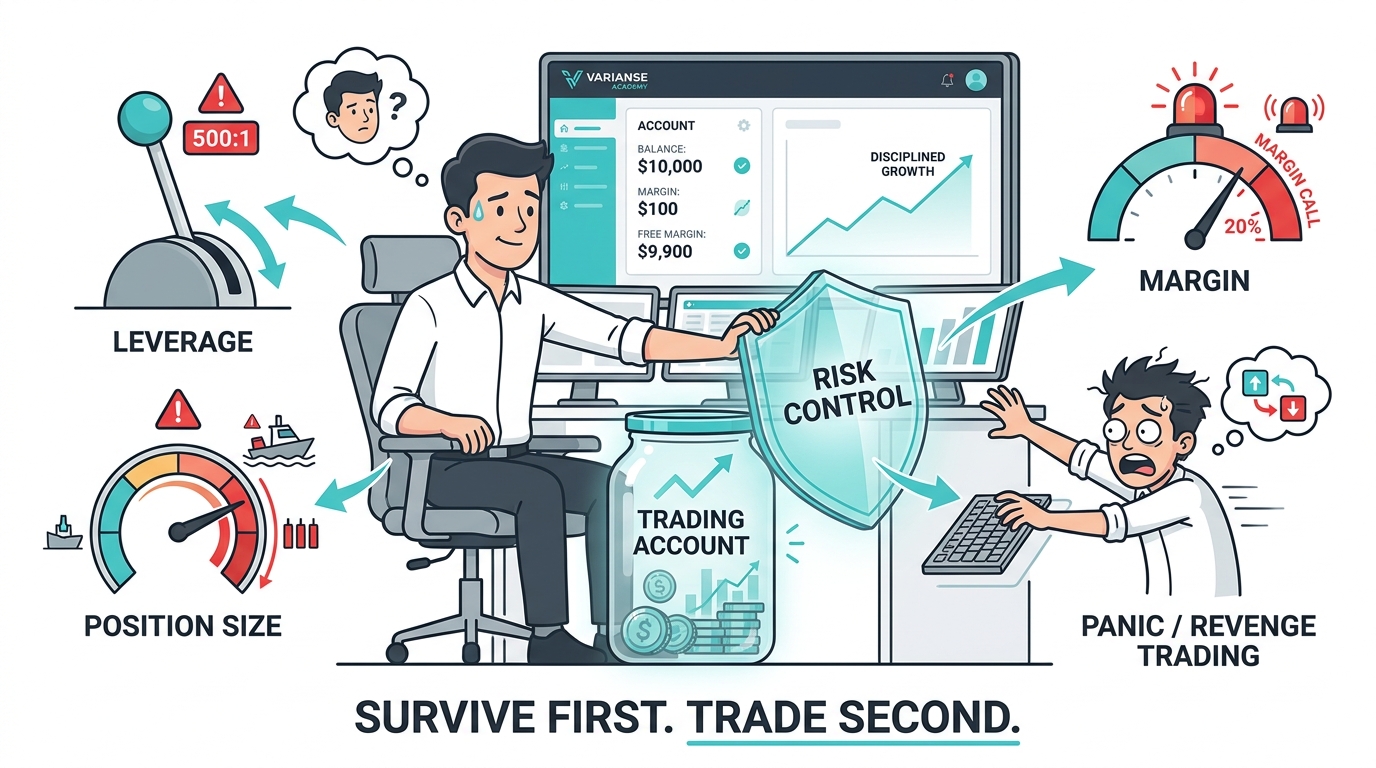
For beginners, one of the most important considerations in trading is understanding how to manage financial risk and they must know survival rules in trading.
Trading carries risks of significant losses, especially in case of leverage usage. Over-exposure, poor risk management, ignorance of margin rules and emotion-driven decisions can amplify the risks mentioned above.
Leverage-trading accounts can have fast changes in their equity due to the movement of markets against the positions held by the trader. Due to the margin rules in force at the trading platform and the amount of funds present in the trading account, margin calls or position closings can be triggered.
Knowledge about leverage, margins, equity and stop-out rule can help traders understand how the trading account reacts to changes in market conditions.
This article highlights nine risk management rules that are important for beginners. It should be noted that none of them can eliminate financial risk or ensure safety of trading capital.
These principles are based on the same ideas as the ones in Financial Market Foundations, where getting to grips with the surroundings is key to getting by.
Rule 1 — Never Treat Leverage as a Shortcut to Profit
Leverage means having more power to control a bigger position in the market relative to the capital employed in it.
This leads to greater risks and greater potential gains and losses.
But one thing is sure that leverage does not help in making any predictions about the market or the way to trade in it.
When the leveraged position goes against the trader, he will find himself losing money fast relative to his equity balance in the account.
This leverage concept is laid out clearly in the article What Is Leverage in Trading?, where leverage is essentially a factor that can make your profits or losses bigger, not just boost your performance.
Understanding the risks associated with leveraged trading is essential before committing capital. The Financial Conduct Authority (FCA) provides guidance on investment risks and returns, including the possibility of losing money.
Rule 2 — Never Use Maximum Available Leverage by Default
Just because higher leverage is available does not mean that its usage is correct in all cases.
Positioning big positions compared to the account equity in relation to smaller changes in the market would cause an amplified effect.
This could lead to margin reduction and approaching the margin limits of the trading platform.
Nevertheless, such risk factors depend on the real size of the position, volatility of the market, the margin required and available funds in the account.
Newbies need to get to know the connection between leverage, exposure and risk rather than believe that maximum leverage is suitable.
This predictable pattern of failure is laid out in Why Leverage Is the 1 account Killer for New Traders?, where using too much leverage can really speed up the loss of your investment and make your margin account a bit shaky.
Rule 3 — Never Trade on Margin Without Understanding Margin Mechanics
The margin is the sum of money or assets needed to enter into or sustain a leveraged trade.
It is not extra money that the trader receives as earnings or freely disposable.
When a leveraged trade is made, some of the available funds from the trading account might be used to cover the margin.
In case there are losses on the open trades, the total equity and margin will decline.
When the margin falls below specific levels in an account, the system may prevent opening new trades, give a warning or liquidate the trades automatically based on the platform's settings.
It is critical to know about such features since different platforms have distinct margin needs and stop-out rules.
These trading mechanics are laid out in the article What Is Margin in Trading?, where we see margin as a must-have feature, not just a nice-to-have
Margin determines whether positions can remain open.
Rule 4 — Monitor Your Trading Account Equity, Not Just Balance
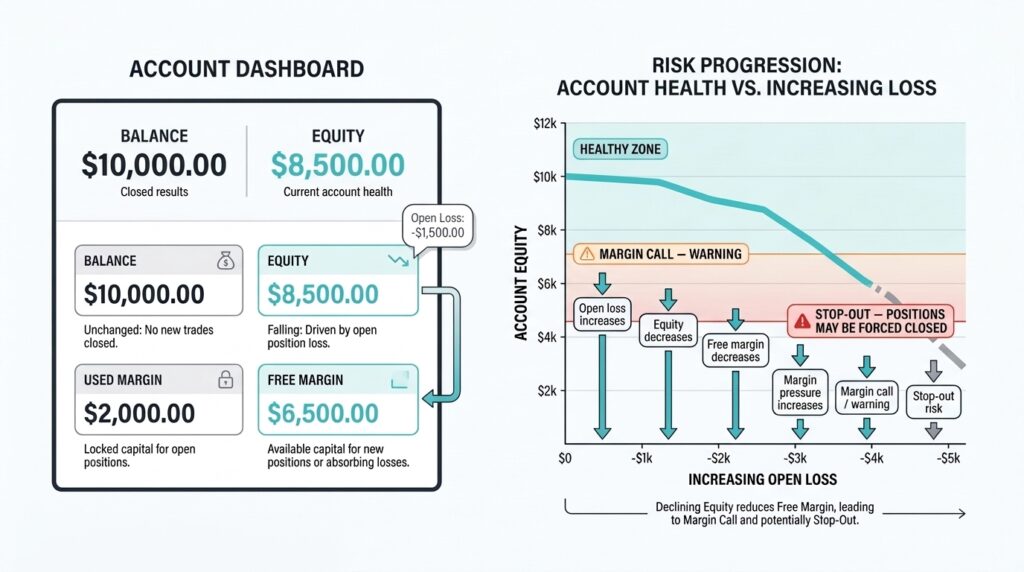
There exists a difference between account balance and account equity.
Balance usually gives an idea about the funds in an account after transactions have been completed, with consideration of deposits, withdrawals and fees charged, without including any unrealised gains or losses from open positions.
Equity gives the value of the account after inclusion of any unrealised gains or losses. It depends on the accounting rules of the system being used.
The general equation is:
Equity = Balance + Unrealised Gain - Unrealised Loss
In case an account has a balance of £1,000 and there exist unrealised losses of £200, then the equity will be around £800 without considering any other factors.
Following equity and margin, traders will gain more insight into their account.
Equity's the real deal when it comes to keeping accounts steady, as explained in What Is Equity?, where equity decides how risky it is to sell off assets.
Rule 5 — Never Hold Losing Trades to Avoid Being Wrong
A losing position does not need to be inappropriate as long as it still fits the carefully planned out trading strategy and risk management of the trader.
Nevertheless, avoiding analysis of a position solely to prevent a loss is likely to lead to an increased exposure to money.
As the unearned losses become larger, the equity in the trading account shrinks, and the margin requirement becomes higher.
Setting possible exit points prior to opening a trade can serve as the ground for assessing the risk.
However, stop-loss orders cannot guarantee that your position will be closed at the requested price level, especially in case of market gaps.
Exit planning, as detailed in Take Profit & Stop Loss Explained, makes sure that losses stay under control and predictable
Rule 6 — Never Wait for a Margin Call to Manage Risk
The occurrence of a margin call is mostly dependent on the fact that an account does not meet some specific margin conditions.
The margin call might come through in the form of a warning, a need for more money to be deposited, or restriction in trade execution.
This is not always the case because some trading platforms will automatically close an open position if some predetermined levels of margins are met.
There are many reasons why a margin call happens, such as poor market performance, high exposure, or change in margin requirements.
In Margin Calls Explained, margin calls are laid out as safety nets in systems where you're trading with borrowed money
Margin calls signal structural instability.
Rule 7 — Never Confuse Margin Calls With Stop-Outs
Margin calls and stop-outs are related concepts, but they are not identical.
A margin call generally refers to a situation in which an account fails to meet specified margin requirements and may trigger a notification or other action.
A stop-out generally refers to the automatic closure of one or more open positions when an account reaches a platform's predefined margin threshold.
The precise conditions depend on the broker, account type, financial instrument and applicable regulations.
Importantly, traders should not assume they will always receive a margin-call warning before automatic liquidation.
Forced position closures may occur at unfavourable prices, particularly during volatile or illiquid market conditions.
The full liquidation process is laid out in Margin Calls & Stop-Outs Explained: How Trading Accounts Blow Up?, showing how exposure, equity drop, and forced closure unfold step by step.
Rule 8 — Never Increase Position Size to Recover Losses
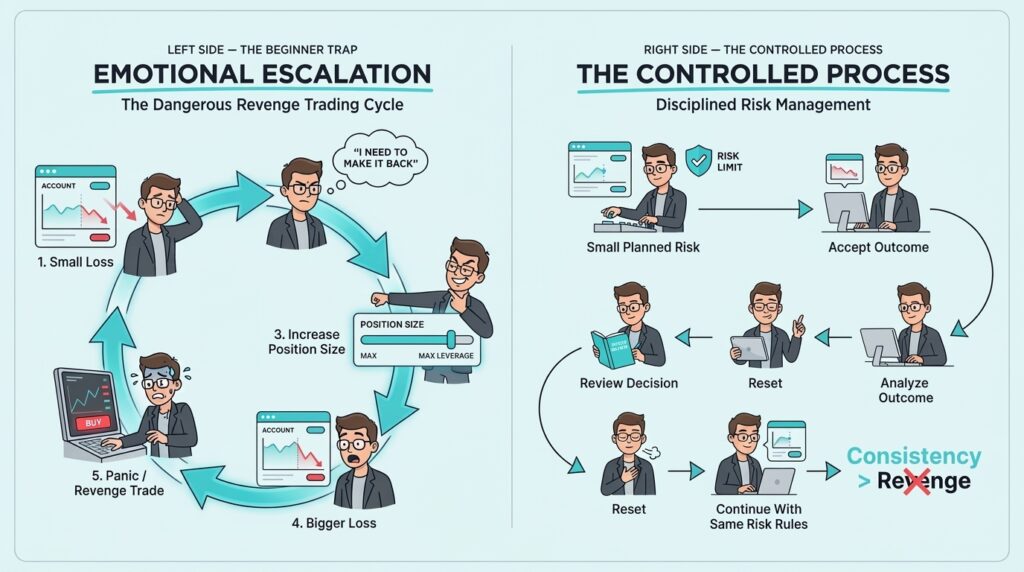
Increasing the size of one’s position after losses has incurred will put their trading account at further financial risk.
If such a strategy is based on anger and urgency to get back one’s money, then this is revenge trading. Bigger positions have a potential for bigger losses and can increase pressure on account equity and margin.
Position sizing must be based on financial risk, market environment, and risk levels predetermined by a trader, not emotional responses to previous trades. But any position sizing strategy cannot protect traders from losses.
Position sizing principles laid out in Position Sizing Explained make sure your exposure stays steady, no matter what happened before
Exposure must follow structure, not emotion.
Rule 9 — Never Trade Live Until You Can Control Execution Calmly
Before thinking about live trading, beginners need to be familiar with order placement and execution processes.
Key concepts are bid-ask spread, market and limit orders, slippage, leverage, margin and possible order execution delay.
While traders may choose their own order types, they have no full control over the order execution results.
Market circumstances and available liquidity might affect the final price of an order execution.
Practicing in simulated trading environments will help beginners gain experience in using trading platforms and placing orders with imaginary money.
However, demo trading is unable to create realistic execution environment and stress of trading with real money.
Execution mechanics like how orders get placed, how costs are spread out, and the risks involved are laid out in Trade Mechanics & Execution Basics: How Trades Really Work?, where trading is seen as a step-by-step process instead of just a knee-jerk reaction.
Structured learning at VARIANSE Academy helps traders link up the nuts and bolts of trading, the psychology behind it, and the discipline needed to manage risk.
Practice builds execution stability.
Conclusion: Survival Rules in Trading
Newcomers to the trading world can incur quite a few financial risks, especially through the use of leverage or trading without any knowledge about the margin requirement.
Too much exposure, poor risk management, and being ruled by emotions are just a few things that could potentially lead to big losses.
The knowledge about leverage, margins, account equity, stop-out procedures, and order execution will help traders understand how risks relate to one another.
Nevertheless, no trading technique and no risk management system will ensure that capital remains safe and no losses occur in the trading process.
As for newcomers, gaining some financial expertise and knowing the risks associated with trading is an important step to take.








