


Leverage is one of the first concepts new traders encounter, yet it is also one of the most misunderstood. If you have ever thought, What is leverage in trading? How it can magnify both potential profits and losses, understanding the relationship between leverage, margin and market exposure is an important starting point.
Leverage makes it possible for traders to operate on positions which exceed the amount set aside as the margin. This is quite usual when engaging in the Forex and CFD markets where even small changes in the prices have a significant impact on the equity in the account.
Leverage does not enhance trading analysis and decision-making. It exposes the trader to more financial risk as much as increasing gains.
Understanding leverage is key to getting by. Misusing it is one of the primary reasons explained in Beginner Survival Rules, where excessive exposure leads to predictable account failure. You must understand leverage before you use it.
What Is Leverage in Simple Terms?
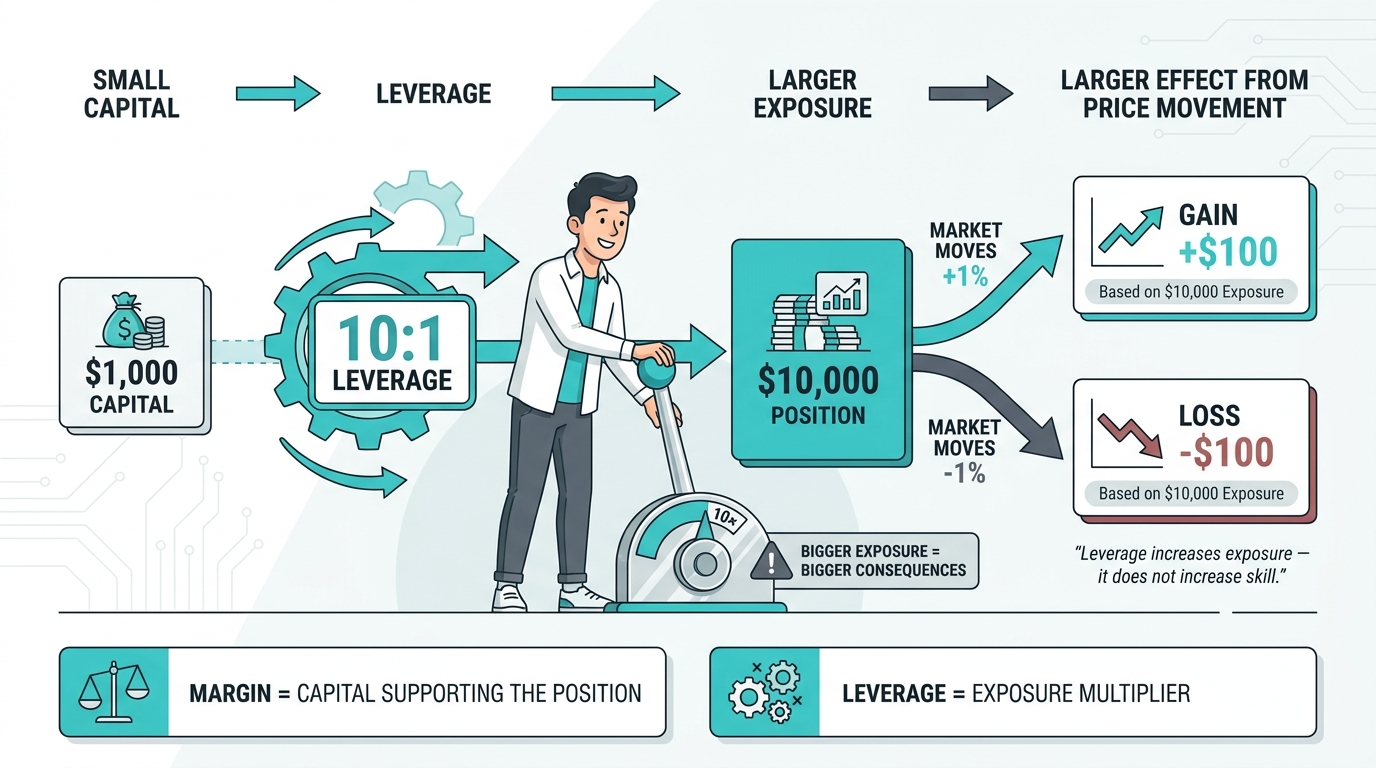
Leverage helps traders to be exposed to a trading position which is bigger compared to the amount needed to take that position.
As an illustration, a leverage of 10:1 implies that the trader can control a trading position ten times the margin required to trade the position.
With CFD leveraged trading, it is important to note that traders usually post margin instead of posting the full notional value of the underlying exposure.
Leverage is mostly connected to derivatives and includes Forex, Indices, Commodities, and other financial instruments.
Nevertheless, leverage increases the sensitivity of the trader to the movements in the market because profits and losses are calculated based on the exposure of the trading position.
A Simple Leverage Example
Assume that an individual establishes a position worth $10,000 with a leverage of 10:1. The initial margin will be $1,000 if no further margin call is required for the trade.
If the value of the position appreciates by 1%, the profit will be around $100. If the value of the position depreciates by 1%, the loss will be around $100.
This implies a gain or loss of 10% of the initial $1,000 margin, excluding spreads, commissions, cost of financing and other costs.
This connection between exposure and trade mechanics becomes more obvious when you look at Trade Mechanics & Execution Basics where how trades are executed directly affects your position size and the market's liquidity.
How Leverage Works in Trading?
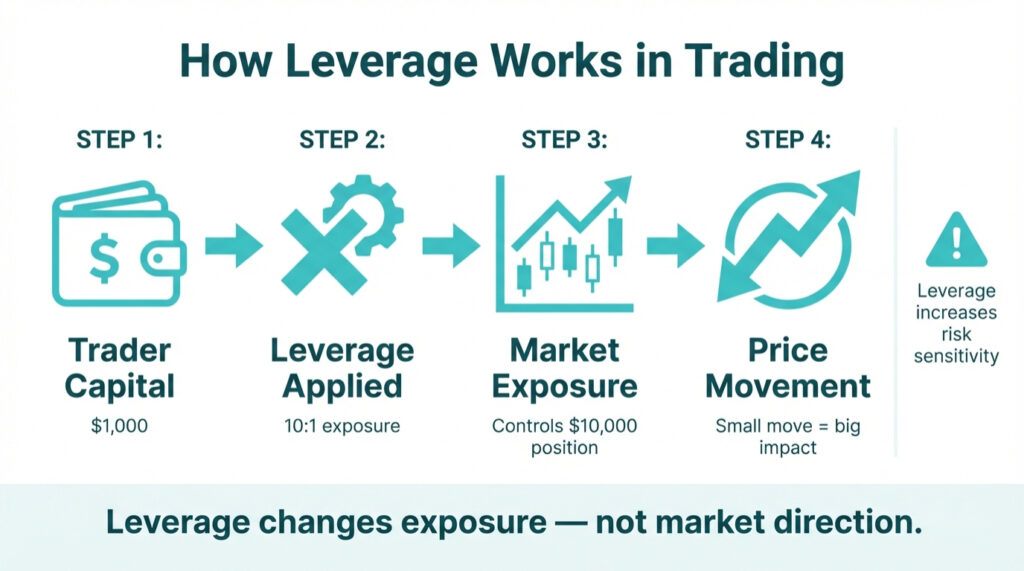
Leverage allows traders to establish market exposure by committing a portion of the position's notional value as margin.
Margin is the amount of funds or collateral required to open or maintain a leveraged position. When the market moves, the resulting profit or loss is determined by the position's size and the extent of the price movement.
Unrealised profits and losses can affect account equity, while margin requirements influence how much available margin remains.
If account equity falls below certain thresholds, the trading platform may issue a margin warning, restrict trading activity or automatically close positions, depending on its rules.
Leverage can therefore magnify financial gains and losses while increasing the importance of monitoring account exposure and margin requirements.
The connection between margin and exposure is laid out in What Is Margin in Trading?, where margin is described as security rather than extra funds.
Margin enables leverage, but also limits it.
Leverage vs Margin: Understanding the Difference
Leverage and margin have a lot in common, yet they refer to entirely different things when it comes to trading.
The leverage term denotes the ratio between the size of a position on the market and the amount of money that should be used in order to establish it. The margin is the amount of money or collateral necessary for the opening and maintaining of the leveraged position.
For instance, a 10:1 leverage ratio would mean a 10% margin in case of a simplified formula.
Also, there is such notion as account equity that should be taken into consideration. It denotes the account value after all unrealized gains and losses have been accounted for under the rules of the trading platform.
As the amount of unrealized losses grows, the equity level and available margin can become smaller.
This relationship is outlined in the chapter What Is Equity?, which decides if trades stay open or get closed out
Why Leverage Exists in Financial Markets
Leverage is a tool that allows market participants to gain financial exposure to an instrument without using the entire amount of its notional value. The tool can be applied in various situations such as hedging, investments, portfolios management and speculation.
While some entities might apply the tool to manage their financial exposures or develop an investment strategy, others might use leverage to grow the size of their speculative positions.
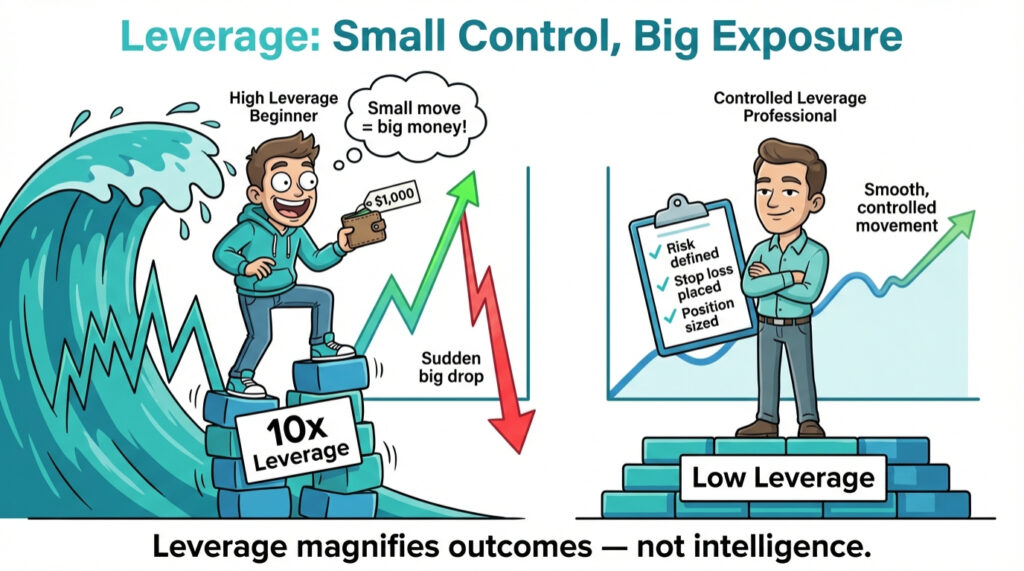
Nevertheless, the risks related to the application of leverage arise due to the fact that even slight fluctuations in the market might greatly affect the capital of the position.
It means that the risks and possible advantages vary depending on the type of the instrument, market environment, financing terms, and entity's financial status.
This principle closely aligns with the research on the global market setup by the Bank for International Settlements (BIS), showing that borrowing power helps keep things flowing smoothly and makes the whole financial system run better.
The Risks of Leverage Every Beginner Must Understand
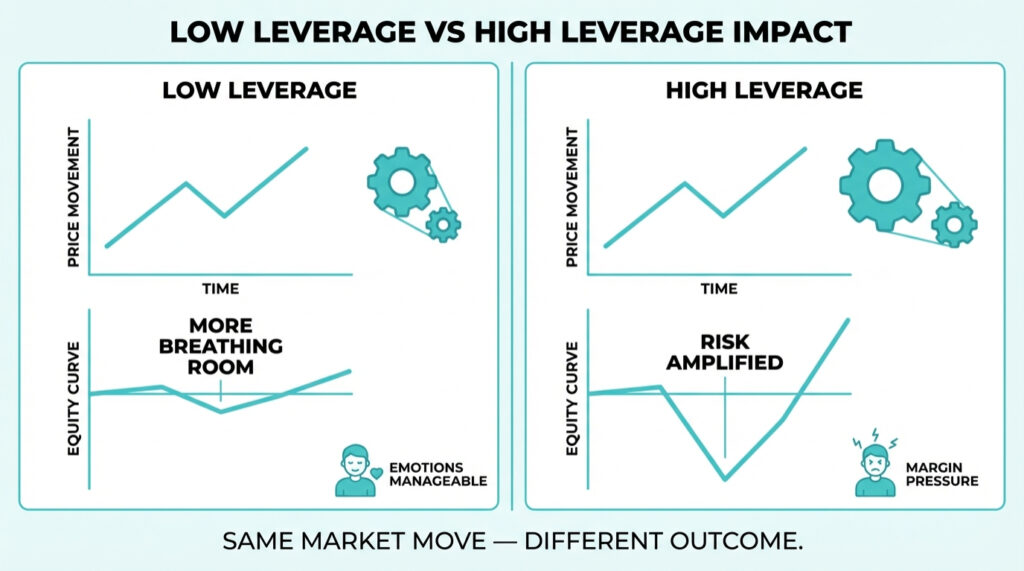
Leverage creates an enhanced financial impact of price changes compared to the amount of capital invested as margin.
In case the leveraged trade moves in a direction opposite to the trader, potential losses will cause losses of the capital and lower the margin in the trading account.
This occurs when certain levels of margin are reached for particular brokers, account types, financial instruments and regulation. Sometimes in the period of high volatility and low liquidity, positions can be closed at unfavorable prices.
In Margin Calls Explained, it's clear that margin calls are actually there to keep risks in check, not just random glitches on the trading platform
Emotional and Psychological Risk
Increased financial exposure may lead to higher emotional response, especially where there are large unrealized losses.
Emotional states such as fear, overconfidence, and frustration can affect trading decisions, possibly leading to irrational decisions about their positions and trying to recoup losses.
Nevertheless, emotions differ from person to person, and not all trading losses have emotional causes. Decreased financial exposure may aid in managing pressure for some traders, but it will not prevent emotional and market risks.
How Much Leverage Should Beginners Use?
There is no one leverage ratio that is suitable for all beginners.
Suitability of leveraging depends on many things such as financial condition, risk tolerance, experience and nature of trade and its size. Leverage allows the financial effect of price change be larger in relation to the trade that was done with leverage.
Beginners should have an idea about position size, leverage, margins and possible losses in relation to each other before engaging into leveraged trading. Position sizing allows individuals to analyze financial risk associated with trading but cannot protect them from losses.
Simulated trading provides the opportunity to get familiar with the process of placing orders and see how leverage and margin work in practice with imaginary money.
Nevertheless, simulated trading cannot reproduce the process of execution of orders and stress associated with real money trading. There is no necessity to move from simulated to live trading.
This method aligns with the idea in Position Sizing Explained Without Confusion for Beginner Traders: figure out how much to invest based on how much you're willing to lose, not just how much you can handle.
You can safely watch how leverage and margin work together in a simulated setting using VARIANSE trading account page before you actually put any real money on the line.
Leverage in Forex and CFD Markets
Leverage may be utilized in Forex and CFD transactions, although the maximum leverage that is allowed varies depending on the type of asset, the broker, the regulation of the jurisdiction in which the broker operates and the trader's status as a client.
For instance, retail maximum CFD leverage ratios in the UK for major currencies, other currency pairs, commodities, stocks and cryptos are all different.
The fact that leverage may be used does not imply that the use of the maximum leverage allowed may be appropriate for every investor. Execution costs and conditions should still be considered.
Even with execution risk, spreads, and liquidity conditions still playing a role, leveraged trades are affected, as detailed in Bid-Ask Spread Explained, where spreads and liquidity directly influence the entry cost and execution stability.
Common Beginner Mistakes With Leverage
Leverage might be misinterpreted by novices regarding financial exposure and possible losses due to leverage.
There are common errors such as using excessive position sizes, missing the margin requirements, not considering the costs of transactions, and increasing exposure after sustaining losses.
In addition, there could be assumptions about the low margin requirement implying the financial risk is confined to the margin initially set.
Nonetheless, losses in leveraged trades will be dependent on market exposure and prices, according to the product’s terms.
These patterns are part of the account-failure sequence explained in Why Leverage Is the 1 Account Killer for New Traders, where too much exposure can quickly lead to a drop in your equity.
Leverage should support risk management—not replace it.
How Professional Traders Use Leverage
Leverage is used by professional market participants for various reasons, such as protection (hedging), portfolio management, and speculation.
Their considerations may involve the size of the position, market volatility, liquidity, funding costs, and the effect of unfavorable price changes.
Some organizations change their leverage or unwind positions in case of increased uncertainty in the market environment.
Nevertheless, professional traders do not share one and the same strategy, and professional level does not preclude big losses.
This structured approach aligns with regulatory risk disclosures published by the Financial Conduct Authority (FCA) and the U.S. The Securities and Exchange Commission (SEC) stresses that using leverage can seriously increase the financial risk for individual investors.
Conclusion: Leverage Is an Exposure Tool, Not a Trading Advantage
Leverage enables traders to take a greater financial position as compared to the money used as margin. It increases the chance of making higher gains, but at the same time, it may result in higher financial losses.
The knowledge of how these factors interrelate will enable newbies to know the financial implications that come with trading using leverage.
Nevertheless, the level of financial literacy, experience and risk management do not reduce uncertainty nor guarantee profit.
Newbies should learn about possible financial losses before venturing into trading using leverage.








