
Trading psychology plays an important role in how traders respond to uncertainty, manage emotions and make decisions in financial markets.
In Forex and CFD trading, reading charts and technical indicators is just one aspect of the learning process. Feelings of fear, frustration, overconfidence, and the need to recover losses may impact a trader’s ability to stick to his plan and observe his risk levels.
To newbies, trading psychology implies gaining knowledge about the above-mentioned emotions and creating good trading habits. It doesn’t take away the risks of the market or ensure profitable trades.
What Is Trading Psychology?
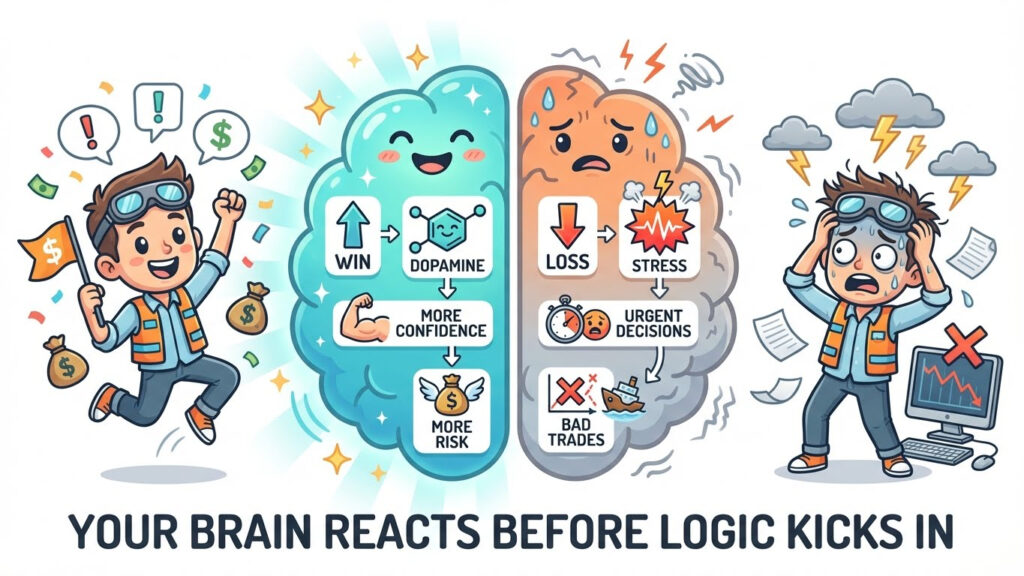
Trading psychology refers to the emotional and behavioral factors that influence how traders make decisions.
Every trading decision involves uncertainty. A trader can analyze a market carefully and still lose because markets do not offer guaranteed outcomes.
The difficulty is that real money can make uncertainty feel personal.
A trader may understand intellectually that losses are possible but respond very differently when watching an open position move against them. This gap between knowing the rules and following them under pressure is where trader psychology becomes important.
Common emotions and behavioral tendencies include:
- Fear and Greed
- FOMO
- Loss aversion
- Overconfidence
- Revenge trading
These influences can affect when traders enter or exit positions, how much risk they take, and whether they continue following their original trading plan.
Why Does Psychology Matter in Trading?
A trading strategy can define when to enter, when to exit, and how much capital to risk. But the trader still has to follow those rules.
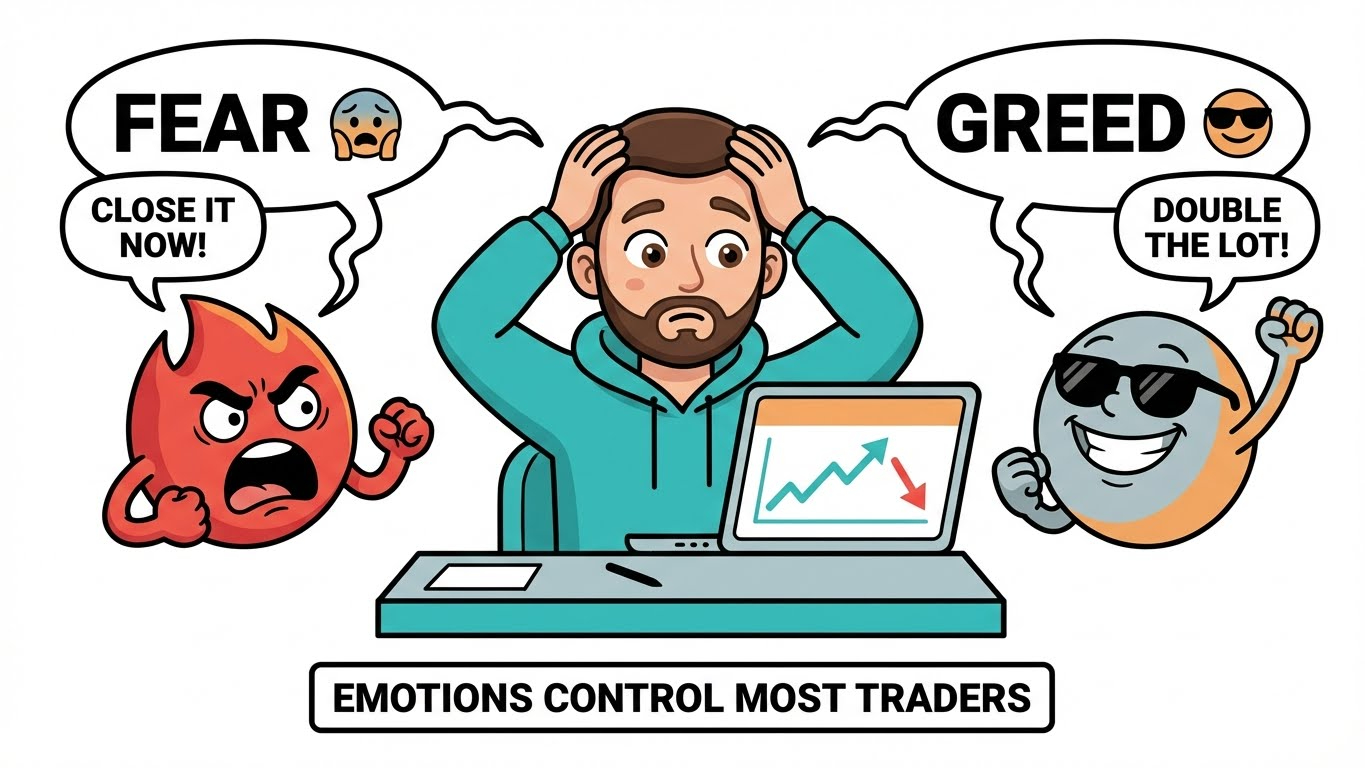
Imagine a trader normally risks a predefined amount on each position. After several losing trades, they decide to double their position size to recover the losses quickly.
Their strategy did not tell them to increase the risk. Their emotional response did.
This is why trading psychology and risk management are closely connected. A risk-management plan establishes boundaries, while discipline helps the trader remain within them.
Psychology matters not because successful traders are emotionless, but because emotions can affect whether a trader follows a process consistently.
How Do Emotions Affect Trading Decisions?
Emotions are normal. The objective is not to eliminate them completely but to recognise when they begin influencing decisions.
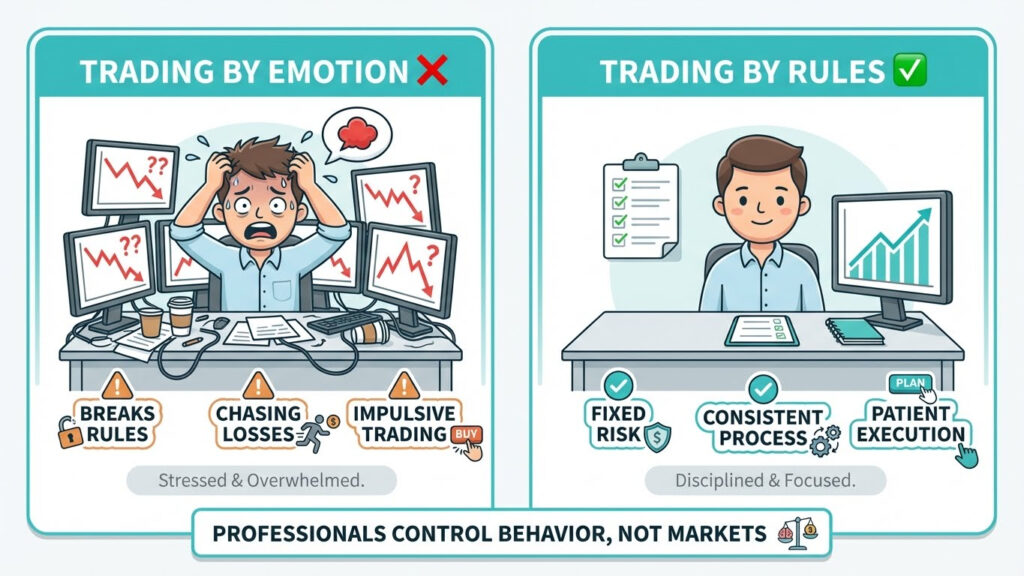
Consider two traders who both experience a losing position.
The first closes the position according to the trading plan, records the outcome, and waits for another valid setup.
The second immediately opens another position with a larger lot size because they want the money back.
Both traders experienced the same event: a loss. What changed was their response to the loss.
That response can affect position sizing, entry timing, stop-loss decisions, and the number of trades taken.
1) Fear and Greed in Trading
Fear and greed are among the most commonly discussed trading emotions because they can push traders in opposite directions.
Fear in Trading
Fear can make traders more cautious, which is not automatically negative. Problems arise when fear begins overriding predefined trading rules.
For example, a trader might close a position too early because of a small adverse move or avoid a valid setup after several losses.
Fear may also cause traders to constantly check positions, move stop losses, or hesitate even when their planned trading conditions are present.
Greed in Trading
Greed can encourage the opposite behavior.
After a profitable period, a trader may increase position sizes, take more trades than usual, or hold a position beyond the original exit plan because they want a larger gain.
The problem is not the emotion itself. It is letting the emotion change risk without a clear reason.
2) FOMO and Impulsive Trading
FOMO, or fear of missing out, can occur when traders see a market moving quickly and feel pressured to participate before a perceived opportunity disappears. Suppose a currency pair rises sharply. A trader with no planned entry watches the move and worries they are missing an opportunity.
Instead of assessing the current price, market structure, and risk, they enter because of urgency. This is sometimes called chasing the market.
A useful question is:
Would I still take this trade if I had not just watched the price move?
If the answer is no, the decision may be driven more by FOMO than by the original trading strategy.
3) Loss Aversion and Trading Losses
Losses and gains of the same monetary size do not necessarily feel psychologically equal.
Loss aversion describes the tendency for losses to have a stronger psychological impact than equivalent gains.
In trading, this can appear when someone refuses to close a losing position because doing so would make the loss final. The trader may move their stop loss or continue holding despite the original reason for the trade no longer being valid.
Loss aversion can also affect profitable positions. A trader may close a winning trade earlier than planned because they fear seeing an unrealized gain disappear.
In both cases, emotional discomfort begins influencing the decision.
4) Overconfidence After Winning Trades
Trading psychology is not only about dealing with losses.
Profits can influence behavior too.
Imagine a trader has five profitable trades in succession. They may begin to believe they have become particularly good at predicting the market and increase their risk on the next position.
However, previous winning trades do not determine the outcome of the next one.
Overconfidence can lead to larger position sizes, unnecessary trades, reduced attention to risk, or a belief that normal trading rules are temporarily unnecessary.
A profitable period can therefore require just as much discipline as a losing one. This highlights the importance of Motivation vs Discipline in trading, particularly when confidence begins influencing position sizing and risk-taking.
5) Revenge Trading After a Loss
Revenge trading happens when the desire to recover a loss begins driving the next trading decision.
The pattern can develop quickly:
Loss → frustration → immediate new trade → increased risk → another loss
Instead of analyzing the next opportunity independently, the trader is reacting to what happened previously.
Common warning signs include entering immediately after a loss, increasing lot size without recalculating risk, ignoring stop-loss rules, or trading outside the normal strategy.
A loss does not require another trade.
A more structured response is to pause, review what happened, and wait until another setup meets the trading plan's conditions.
To understand how frustration after a loss can lead to impulsive decisions, explore Revenge Trading Explained, which covers common warning signs and ways to manage emotionally driven trading.
How Can Leverage Increase Emotional Pressure?
Forex and CFD trading can involve leverage, allowing traders to gain market exposure greater than the capital required as margin.
The use of leverage will increase market exposure in comparison to the capital used as margin, which means that there is a chance for either profit or loss to be maximized. This implies that even small movements in the market can affect the account equity.
For some traders, rapid changes in unrealized profit or loss may increase psychological pressure. A trader watching equity decline quickly may become more tempted to close a position impulsively, move a stop loss or take another trade to recover the loss.
Understanding leverage should therefore come before using it.
Position size, available capital, and potential loss should be considered before opening a trade rather than after the market begins moving.
Common Trading Psychology Mistakes
Psychological mistakes often overlap rather than occurring separately.
FOMO might cause an unplanned entry. The position then moves against the trader, creating frustration. That frustration leads to revenge trading, followed by an oversized position intended to recover the original loss.
Common warning signs include:
- Increasing risk after losing trades
- Moving stop losses to avoid accepting a loss
- Entering because a market is moving quickly
- Taking trades outside a predefined strategy
- Trading excessively after winning or losing
- Looking only for information that supports an existing view
- Constantly changing strategies after a few losses
- Focusing on recovering money rather than evaluating the next setup
Recognizing these patterns is the first step towards separating emotional reactions from planned trading decisions. One behaviour worth examining more closely is Overtrading Explained, which can occur when traders take unnecessary positions because of boredom, frustration or the desire to recover losses.
How to Develop a Disciplined Trading Mindset
Trading discipline is not simply about having strong willpower. It is easier to follow a process when you've made key decisions before money is at risk.
Define Risk Before Entering
Decide how much capital you are prepared to risk before opening a position. Position size and stop-loss placement should reflect that predefined risk, not the trader's emotional state.
Understanding Position Sizing can help beginners see how trade size, stop-loss distance and predefined risk limits work together.
Follow a Trading Plan
A trading plan can set the conditions for entering and exiting a trade, acceptable risk, and when not to take a trade.
Written rules provide an objective reference when emotions begin influencing decisions.
Keep a Trading Journal
A journal can record more than profit and loss.
Traders can note why they entered, whether the position followed their strategy, how much they risked, and how they felt before and after the trade.
Over time, this can reveal recurring behavioral patterns.
Focus on Decisions, Not Individual Outcomes
A profitable trade is not automatically a good decision, just as a losing trade is not automatically a bad one.
A poorly planned trade can make money because the market moves favourably. A carefully managed trade can still lose.
Evaluating whether the process was followed correctly can therefore be more useful than judging every decision solely by its financial outcome.
For a deeper explanation, explore Process-Focused Thinking for Consistent Trading, which examines why evaluating trading decisions involves more than looking at individual profits and losses.
Trading Psychology and Risk Management Work Together
Good psychology cannot eliminate market risk, and good risk management cannot guarantee profitable trading.
They support different parts of the same process.
A trader may understand position sizing but abandon those limits after a frustrating loss. Another trader may remain calm but still take excessive risk because the original position size was inappropriate.
A structured approach can be thought of as:
Trading plan → predefined risk → position size → execution → review
The objective is to reduce the number of important decisions you make while emotions are already involved.
Trading discipline can support better decision-making, but it cannot remove financial risk. The Financial Conduct Authority (FCA) provides guidance on investment risks and the relationship between risk and potential returns, helping beginners understand why risk assessment matters before making financial decisions.
Conclusion: Trading Psychology Is About Managing Decisions
Understanding trading psychology means recognizing that market decisions can be influenced by more than technical or fundamental analysis.
Fear can cause hesitation. Greed can increase risk. FOMO can encourage traders to chase price. Loss aversion can make losses difficult to accept, while overconfidence can develop after a successful period.
The goal is not to remove emotion completely.
Instead, traders can create a structured process that reduces the influence emotions have over individual decisions. A trading plan, predefined risk limits, appropriate position sizing, and regular review can all contribute to that structure.
You cannot control what the market does next, but you can define how you respond. Yes. Leverage amplifies emotional reactions, making discipline in trading essential.