
Most traders don’t fail because they’re not intelligent; they often struggle because they lack the right tools or the right information. They mess up because they focus on the result, not the steps they take to get there.
In trading, especially in Forex and CFD markets, short-term results can be pretty unpredictable. What really separates steady traders from erratic ones isn’t just how often they win, but how consistently they stick to their trading plan.
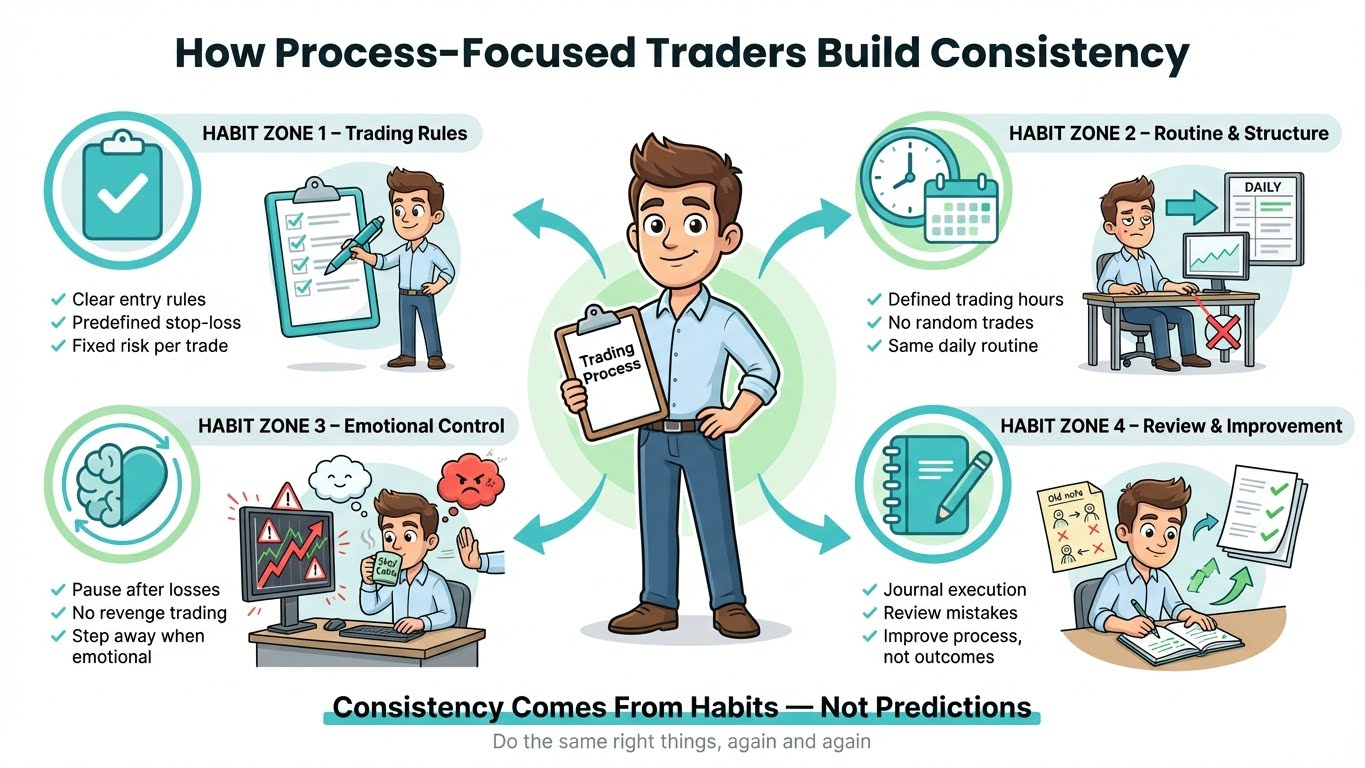
Process-focused thinking shifts attention from day-to-day profits and losses to actions we can manage, repeat, and refine. This mindset is key to trading psychology and is a core idea in the article Trading Psychology Explained. Instead of asking, “How much did I make today?” process-focused traders ask, “Did I follow my rules correctly today?” That single shift changes everything.
What Is Process-Focused Thinking in Trading
Process-focused thinking means evaluating your performance by how well you followed your trading rules, not by whether a trade made or lost money. It’s about the quality of the decision, not just the result. When it comes to trading, the real power lies in carefully selecting trades, applying strong risk management, sizing positions correctly, sticking to your plan, and keeping emotions under control. You cannot control what the market does. Even well-planned trades can lose.
Consistent trading emerges when you define success by rule execution rather than short-term profit. This principle supports the framework we discussed in the Motivation vs Discipline in Trading, which digs into what keeps traders consistent and strengthens trading discipline.
Why Outcome-Focused Thinking Can Mislead Traders
Outcome-focused thinking measures success primarily by profits. While this seems logical, it can be mentally taxing in unpredictable environments such as financial markets.
Markets Are Probabilistic, Not Predictable
Trading in financial markets involves some level of uncertainty, and a good trading system cannot be evaluated using just one trade.
This is because a profitable trade can happen due to positive movement in the markets, rather than the correct decision-making process, and vice versa, a non-profitable trade may still be the result of good decision-making.
Thus, evaluation of trading involves analyzing decision-making and outcomes through a series of trades.
Outcome Obsession Amplifies Emotional Trading
When traders focus too heavily on outcomes, their emotions can swing dramatically. Losses often trigger overtrading, wins can lead to overconfidence, and frustration may push traders to revenge trade. Traders may also switch strategies simply to avoid the discomfort of short-term losses.
This behavior gets a thorough breakdown in the book Revenge Trading Explained where traders let their feelings take over instead of sticking to a logical plan rooted in trading discipline
How Process-Focused Thinking Supports Consistent Trading
Process-focused thinking keeps behavior stable because rules, rather than emotions, guide decisions.
It Anchors Decisions to Rules, Not Emotions
Process-oriented traders check to see if they have stuck to their entry criteria, kept their predetermined risk levels and followed their trading plan as planned.
This can help minimize impulsive moves during both winning and losing streaks. Nevertheless, sticking to the rules does not guarantee success in trading.
It Reduces Cognitive Bias
The trader may also be affected by some cognitive biases like the effect of loss aversion, recency, overconfidence, and confirmation.
Using a structured trading system can help traders ask questions, take notes, and analyze facts more objectively.
While this may help eliminate some of these biases, it does not eliminate them.
Process vs Results – A Practical Comparison
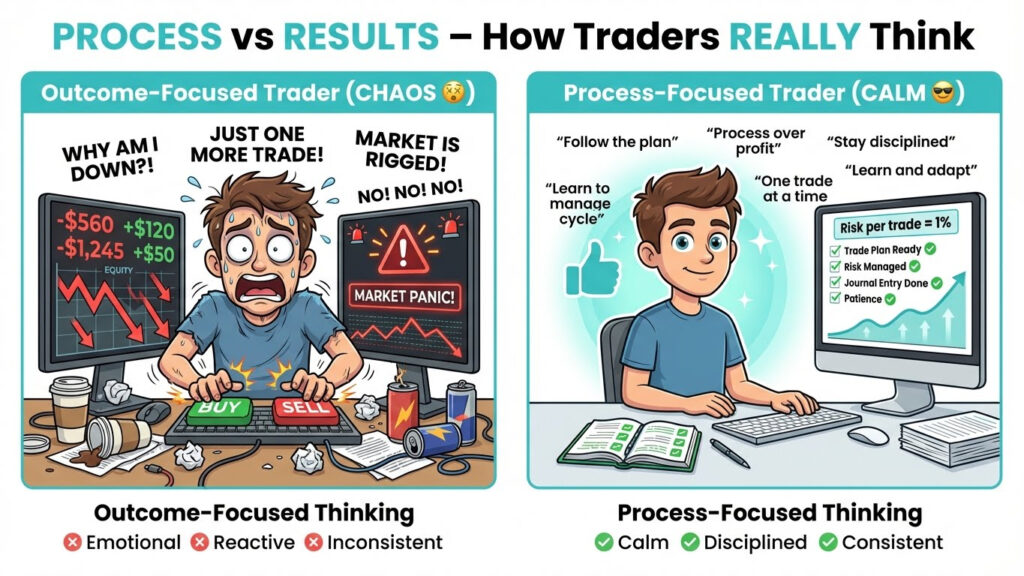
Trading results can be misleading when viewed in isolation. This creates unstable equity curves and inconsistent behavior.
Consistent behavior ultimately leads to more consistent results and strengthens trading discipline.ade at a time. A well-planned trade can result in a loss, while a poorly planned trade can still make money if the market moves favorably.
This is why it can be more useful to evaluate how a trading decision was made, rather than judging its quality solely by whether it produced a profit or loss. The distinction between result-driven and process-driven behavior helps make this clearer.
Result-Driven Trading Behavior
Result-Driven Trading Behavior: Their actions vary based on their mood and the latest scores. This often leads to overtrading and poor risk management.
This creates unstable equity curves and inconsistent behavior.
Process-Driven Trading Behavior
Process-driven traders understand that losses are part of trading's statistical nature. They evaluate trades based on execution quality rather than results, maintain consistent risk exposure, and gradually improve through structured review.
Their equity curve may not rise in a straight line, but their behavior becomes increasingly stable. Consistent behavior ultimately leads to more consistent results and strengthens trading discipline.
Why Process-Focused Thinking Matters in Forex and CFD Trading
In Forex and CFD trading, leveraging is often used, and it allows increasing the exposure to the market compared to the invested margin. Both profits and losses will be increased in such a way.
Rapid fluctuations in prices as well as in account balance may generate additional stress especially in case the trader employs large position sizes.
Process-oriented trading implies the development of a trading plan and risk management strategies, but not just focusing on the outcome after each trade.
Nevertheless, discipline alone will not solve the problem of inefficiency of trading strategy or the risks related to leveraging.
That is why professional traders treat trading as a structured business activity, not a game of prediction. Practicing these principles safely is best done on the VARIANSE trading account page where traders can build habits without financial pressure and learn when not to trade.
Process-focused trading also requires understanding the risks associated with financial markets. The Financial Conduct Authority (FCA) provides guidance on investment risks and the relationship between risk and potential returns, reinforcing why traders should assess potential losses before making financial decisions.
How to Build a Process-Focused Trading Mindset
A process-oriented trading mentality requires creating rules, controlling risk, and making unbiased evaluations. Traders should not focus only on gains and losses but can form habits that will enable them to analyze their behavior and notice their weak spots.
The following steps will allow novices to build a process-oriented attitude to trading without having the illusion that the process will ensure success.
Define What Good Trading Means
Good trading decisions involve following a considered strategy, managing risk appropriately and evaluating the information available at the time.
A profitable outcome does not automatically mean a decision was sound, and a loss does not necessarily mean the process was flawed.
However, traders should still review longer-term performance to assess whether their strategy remains appropriate.
Measure Execution, Not P&L
Review whether trades followed entry and exit rules, position-sizing limits and the original trading plan.
Profit and loss remain important measures of performance, but they should be considered alongside decision quality, risk exposure and trading costs.
This provides a more balanced picture than evaluating each trade solely by its financial outcome.
Use Routine to Reduce Decision Fatigue
A regular routine can assist traders in preparing for the market environment, assessing their plans and avoiding hasty decisions due to the stress situation.
For instance, a trader may analyze significant market events, determine risk limitations and note his/her observations prior to placing the trade.
Such routines can provide more systematic approach, although they will not ensure better trading results for certain.
Common Misunderstandings About Consistent Trading
Process-focused thinking is sometimes misunderstood as ignoring profits, following rules without question or expecting consistent returns.
In practice, it involves reviewing both the quality of trading decisions and the effectiveness of the strategy being followed.
Consistency Does Not Mean Constant Profits
A disciplined trader can experience losing trades, drawdowns and extended periods of underperformance.
Following a process consistently does not guarantee positive returns. It simply provides a framework for evaluating decisions and managing risk.
Following Rules Does Not Mean Never Changing Them
Rules for trading have to be reassessed in case there is evidence that those rules have become ineffective or outdated.
The aim here is not to make arbitrary changes based on personal gains and losses but rather to be flexible about the changing environment of the market.
Conclusion: Why Process-Focused Thinking Matters
The process-oriented mind-set promotes traders to assess their actions, abide by preset risk parameters and analyze their trading activities without concentrating solely on profits and losses.
A well-defined system can assist traders to make decisions in an orderly manner and avoid making decisions based on impulse. Nonetheless, it does not assure profitability or financial security.