


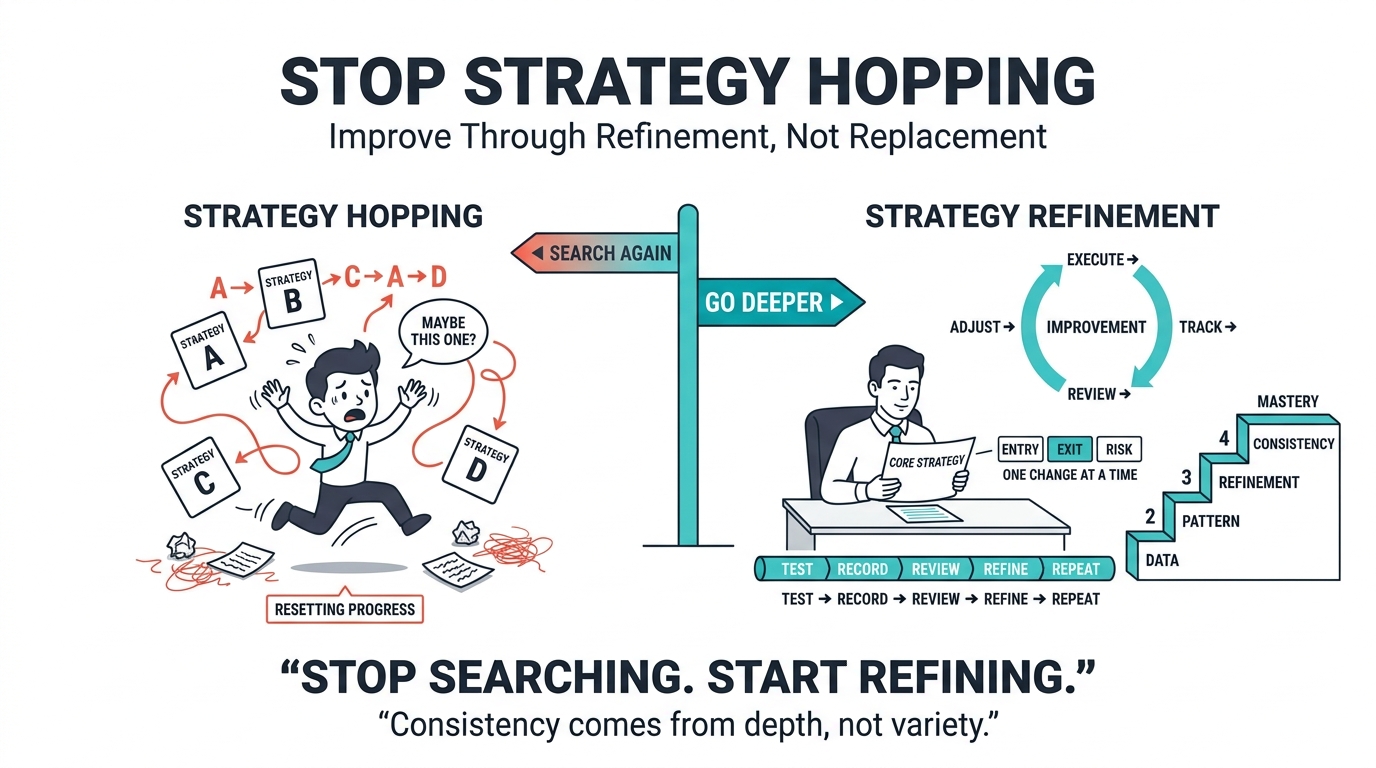
Building a trading strategy is not all there is to do. In order to understand the performance of the strategy under various market conditions, it needs to be implemented consistently, recorded properly and evaluated periodically.
Unfortunately, many traders switch to another trading system after just several losses. This makes it unclear whether the reason for such results was the strategy or the manner of its implementation.
Such an approach is referred to as strategy hopping.
Constant switching between trading strategies without solid evidence may hinder tracking the performance of the strategy, managing risks and spotting errors that keep appearing.
This lesson explains what causes strategy hopping, what influence it may have on your trading and how you can assess and optimize your strategy without changing anything unnecessary.
What Is Strategy Hopping in Trading?
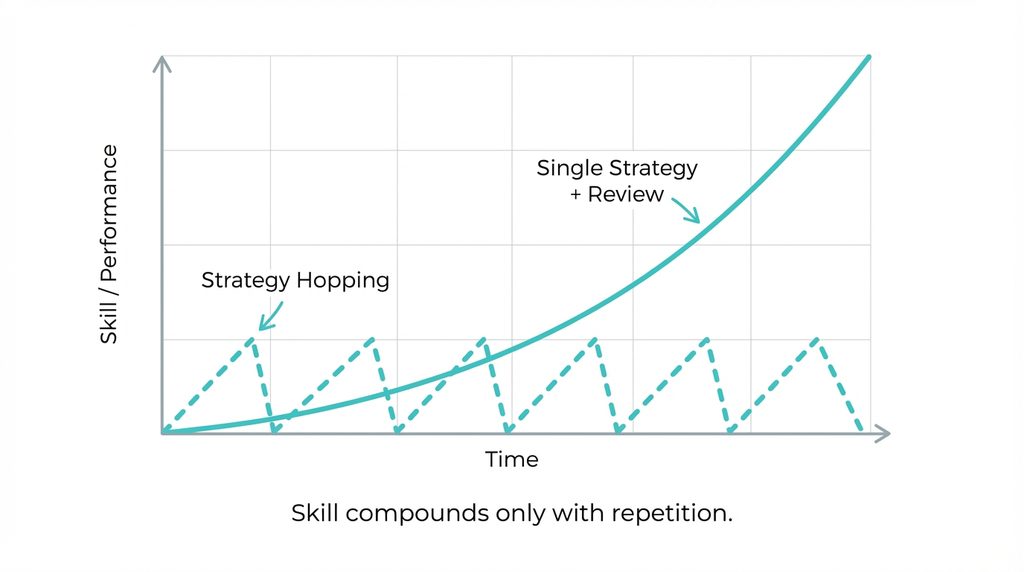
Strategy hopping is where people keep switching from one trading system to another without doing an evaluation process or enough information that supports the change.
It may involve:
- Abandoning a strategy after a short losing streak.
- Frequently changing technical indicators or entry rules.
- Searching continuously for a supposedly better trading setup.
- Combining multiple trading systems without a consistent framework.
- Replacing an approach based on recent results rather than a structured performance review.
Exploring different strategies is not inherently a problem. Testing alternative approaches can be part of developing trading knowledge.
The concern arises when traders make repeated changes without documenting their reasoning, assessing risk or evaluating previous results.
Why Strategy Hopping Can Feel Logical
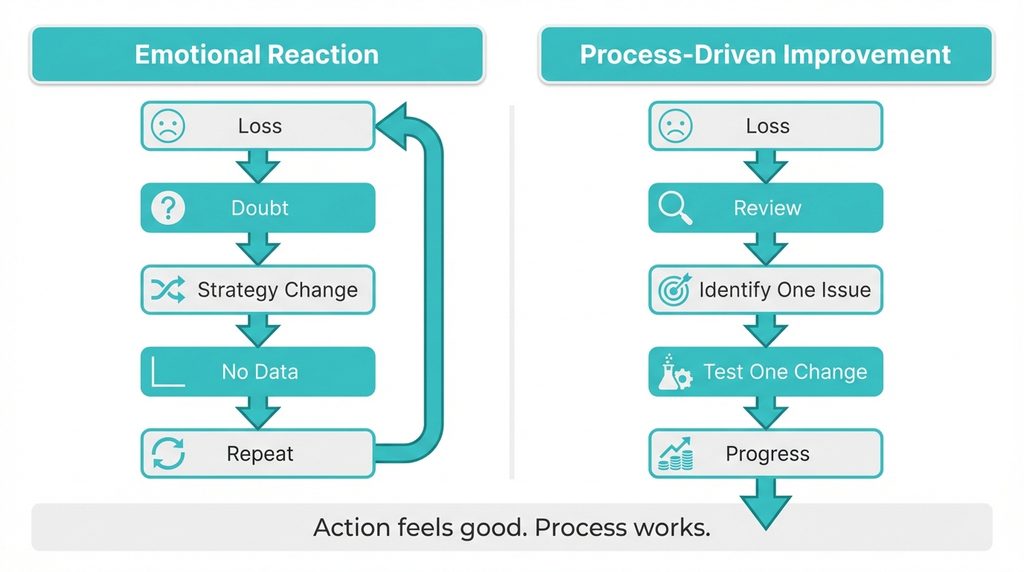
It may appear a sensible approach to change one's strategy following a less than satisfactory outcome.
Nonetheless, there are various psychological and informational considerations that can affect these choices.
Emotional Discomfort After Losses
A loss trade may cause frustration, confusion or lack of confidence in a trading strategy.
The trader may then switch the trading method without knowing if the losses were due to the natural volatility or simply errors.
This emotional reaction pattern is closely related to Trader Psychology.
The Search for a Perfect Strategy
Traders believe that adopting another strategy will help them eliminate losing trades.
This belief is incorrect since no trading strategy guarantees that profits are made or losses avoided regardless of the market environment.
It is advisable to find out if the strategy being considered has a solid rationale behind it.
Social Media and Information Overload
Knowledge of trading methods available via online sources may lead to constant comparisons.
However, the results made public might not necessarily show the full picture of transaction costs, drawdowns, and risks involved.
Prior to implementing new methods of trading, it is important to evaluate them based on credible information.
How Strategy Hopping Can Affect Trading Performance
Strategy hopping prevents improvement in three critical areas
1. Limited Evidence for Evaluating a Strategy
A trading system needs enough observations to calculate its historical performance accurately.
Changing strategies too often may result in having too few and irregular samples for comparison. This may affect the evaluation of trading expectancy, drawdown, and other measures, which you can learn more about in Trading Performance Explained.
2. Difficulty Identifying Recurring Patterns
A consistent trading strategy gives traders an idea about how certain setups work under various market conditions.
When entry criteria, indicators, or exit strategies are often changed, it may be difficult to know what has actually caused the outcome.
3. Reduced Clarity in Decision-Making
Repeatedly changing strategies will create ambiguity on what rules should be followed.
It becomes difficult to differentiate between normal trading losses, errors in execution, and the limitations of the strategy itself.
But sticking with an ineffective strategy just to avoid strategy hopping is also dangerous.
How Experienced Traders Evaluate Strategy Changes
Trained traders can use structured evaluations to determine if their trading strategies are still meeting the predetermined criteria for performance and risk.
As opposed to reacting to recent trades only, they may consider:
- Historical performance across different market conditions.
- Trading expectancy and drawdown.
- Changes in volatility, liquidity or execution costs.
- Consistency with the original trading rules.
- Whether observed weaknesses relate to the strategy or its execution.
This approach does not mean continuing with an ineffective strategy indefinitely. A strategy may need to be modified, paused or discontinued when evidence suggests that its assumptions are no longer valid or its risks are unacceptable.
The principles of Process-Focused Thinking for Consistent Trading can help traders distinguish between evaluating decisions and reacting emotionally to individual outcomes.
Strategy Hopping vs Structured Strategy Improvement
Not every strategy change represents strategy hopping.
The key difference is whether the adjustment is supported by a clear reason and an evaluation process.
Strategy Hopping May Involve
- Changing trading rules immediately after a losing streak.
- Adding indicators without understanding their purpose.
- Switching between setups without recording results.
- Making changes without a clear hypothesis.
- Abandoning a strategy based on a small number of trades.
Structured Improvement Looks Like
- Reviewing historical trading data.
- Identifying a specific weakness or limitation.
- Documenting the reason for a proposed change.
- Testing adjustments using appropriate methods.
- Evaluating the effect on performance and risk.
- Monitoring whether the revised approach remains consistent with the trading plan.
Whenever possible, testing one variable at a time can help simplify the interpretation of results.
There are some changes to strategy that will involve a number of changes together.
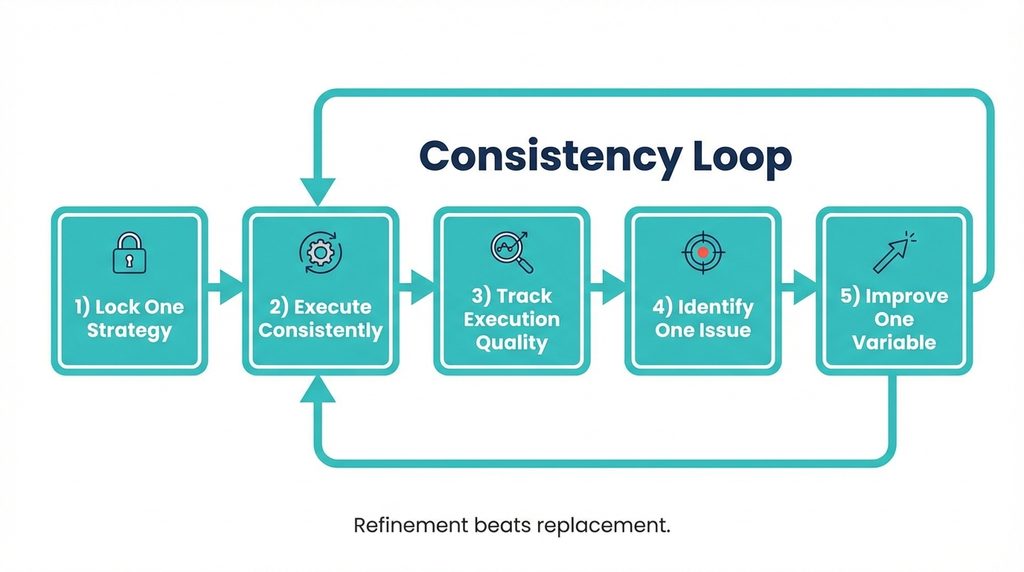
A Step-by-Step Framework to Improve Without Strategy Hopping
Step 1 — Define the Strategy and Evaluation Criteria
List down the conditions that have to be met for entering into a trade and exiting from the same. Determine what will be the basis of judging the performance of the strategy.
This will depend on the type of strategy, variance in its results and the conclusions that are going to be drawn.
In case needed, one can conduct historical or demo trading tests prior to live trading.
Step 2 — Track Execution, Not Outcomes
Focus on rule adherence, entry timing, risk consistency, and emotional state. Useful information includes:
- Execution mistakes.
- Entry and exit reasoning.
- Initial planned risk.
- Realised R-multiple.
- Position sizing.
- Rule adherence.
- Relevant market conditions.
This clarifies the difference between strategy success and trader skill and helps you spot execution errors, in line with the journaling advice in the Trading Journal Guide.
Step 3 — Identify a Specific Area for Improvement
Instead of changing everything, let’s focus on one specific mistake, inefficiency, or behavioral issue. Sort it out first before adding anything else. This is a strategy refinement.
Step 4 — Test Proposed Changes
Formulate your hypothesis prior to tweaking the strategy. For instance, a trader can test the effect of some exit rule on average realized profits.
Where possible, apply different changes one by one to simplify their interpretation.
Step 5 — Review the Results Objectively
Regular check-ins, whether weekly or monthly, swap gut feelings for data-driven progress. This structured performance review ties right into the insights from R-Multiple Trading.
Common Mistakes That Can Lead to Strategy Hopping
- Expecting immediate profitability: A small number of trades may not provide reliable evidence of a strategy's effectiveness.
- Ignoring drawdown: Traders may abandon a strategy without understanding its historical risk characteristics.
- Over-optimising limited data: Repeatedly adjusting rules to fit past results can increase the risk of overfitting.
- Confusing boredom with poor performance: A strategy may produce relatively few opportunities without necessarily being ineffective.
- Comparing strategies without considering risk: Higher returns may be accompanied by greater exposure or larger drawdowns.
- Seeking confirmation from social media: Promotional claims may not reflect the complete performance or risk profile of a trading approach.
Knowing all of these will assist traders in making informed decisions on whether to stick to, change or revise their trading strategies.
Repeatedly modifying trading rules to fit historical results can increase the risk of overfitting. Research on backtest overfitting and investment strategy evaluation discusses how selecting strategies based on historical performance can produce misleading expectations about future results. This highlights why strategy changes should be evaluated carefully rather than judged solely by their performance on past data.
How Long Should You Stick With One Trading Strategy?
There is no universal number of trades or fixed period that determines whether a trading strategy is effective.
The appropriate evaluation period depends on factors such as:
- Trading frequency.
- Variability of returns.
- Strategy complexity.
- Market conditions.
- Transaction costs.
- Drawdown and risk exposure.
- The amount and quality of available historical data.
Strategy leading to multiple trading activities within a day will probably provide more observations than those producing a few signals per month.
Nevertheless, an increased number of observations does not always mean reliability of the findings especially when market conditions change and findings are extremely unstable.
It is also necessary for traders to set certain rules of stopping or abandoning a particular strategy when risks exceed permissible limits.
The idea is to accumulate enough evidence to be able to make a wise choice and not to stick to a certain number of trading activities irrespective of the associated risks.
Why Consistent Evaluation Matters More Than Frequent Changes
A well-defined strategy acts as a basis for the recording of results and for decision-making in order to spot any trends. Being consistent with the rules within a certain time of evaluation can make the comparison of trading results easier.
But consistency does not mean lack of flexibility. The market situation can vary, and the strategies that used to work before may cease working now.
That is why traders should combine a strict approach to trading with objective evaluations. The goal is not to make unnecessary changes but to be ready to evaluate a strategy again if needed.
Conclusion: Evaluate Before You Change Your Strategy
Strategy hopping can make it difficult to understand trading performance when strategies are changed repeatedly without sufficient evidence.
A more structured approach involves defining trading rules, recording results, reviewing execution quality and testing proposed adjustments.
This can help traders distinguish between normal trading losses, strategy limitations and avoidable execution mistakes.
However, maintaining a strategy does not guarantee profitability, and changing an approach is sometimes necessary when its risks or assumptions are no longer acceptable.
The goal is not to follow one strategy indefinitely. It is to make trading decisions and strategy changes based on evidence rather than short-term emotional reactions.








