


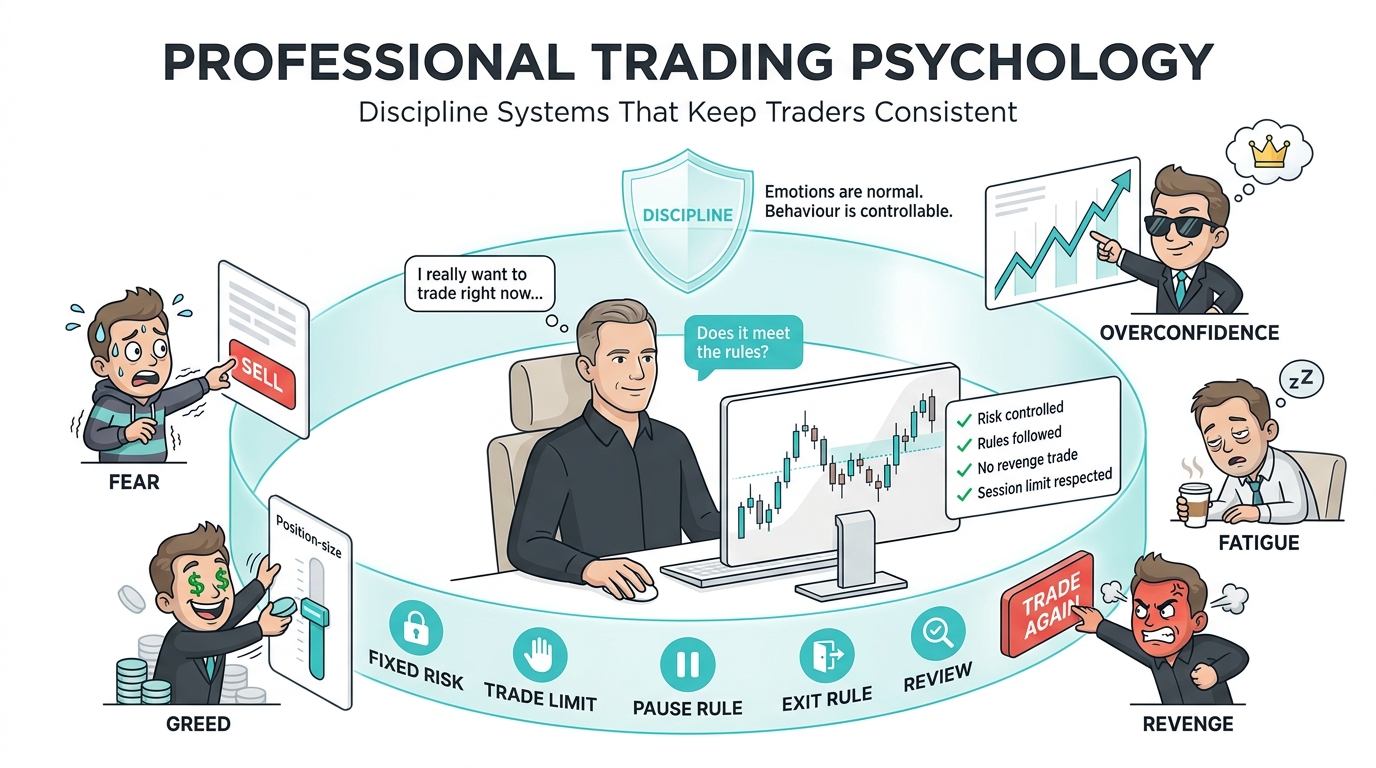
Professional Trading Psychology isn’t about always being fearless, positive, or super strong mentally
It’s about building systems that keep our choices sharp when things get tough.
Most traders don’t lose out just because they don’t have a game plan. They lose because their game plan falls apart under normal conditions like a losing streak, a winning streak, fatigue, frustration, or trying to force trades. Experts thrive by seeing psychology as a form of risk management.
This parent lesson connects the most important psychological pillars of consistency: preventing burnout, controlling overconfidence, detaching identity from P&L, building resilience, and using exit rules to protect discipline before damage compounds.
What Professional Trading Psychology Actually Means?
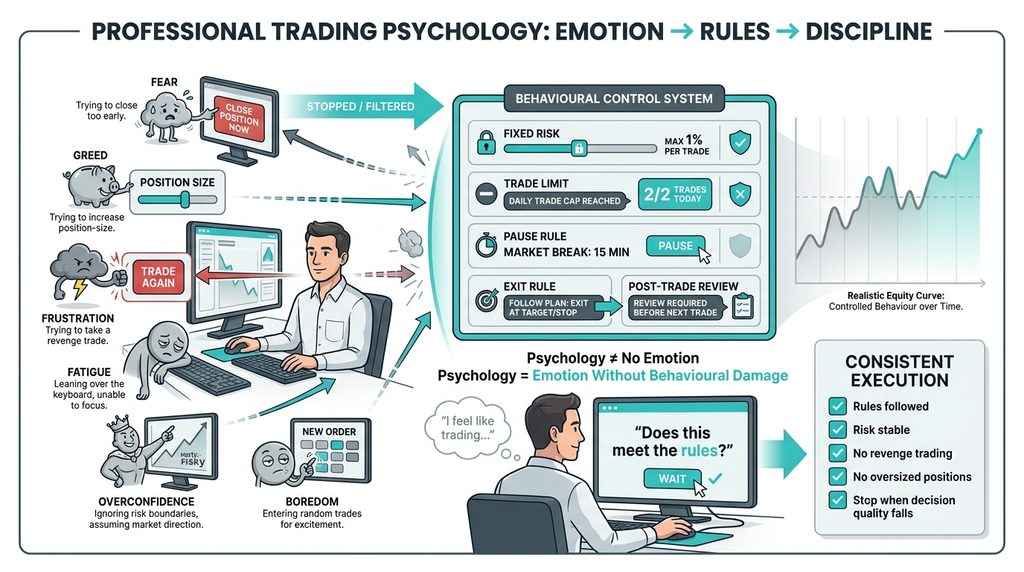
Professional Trading Psychology isn’t just about getting rid of emotions. It’s about emotional self-regulation.
A professional mindset means you can:
- Execute the same rules during stress.
- Keep risk stable during both wins and losses.
- Stop trading when decision quality drops.
- Measure success by process, not P&L.
- Protect long-term expectancy by controlling behavior.
In Trading Resilience, they dive right into the topic, saying that sticking to survival discipline is key to making money in the long run
The Core Problem: Traders Break Behaviourally Before Strategies Break
Most traders stay steady when rare events happen. They tend to fall apart under normal market fluctuations.
- A cluster of losses.
- A winning streak that triggers entitlement.
- Fatigue from too much screen time.
- A drawdown that triggers “recovery trading”
- A period of stagnation that triggers overtrading.
When this happens, the plan goes out the window because execution breaks down.
This kind of mistake usually leads to overtrading and risk drift, which connects to knowing when to quit trading, as detailed in Trading Exit Strategies.
Pillar 1 — Process Over Identity (Detach From P&L)
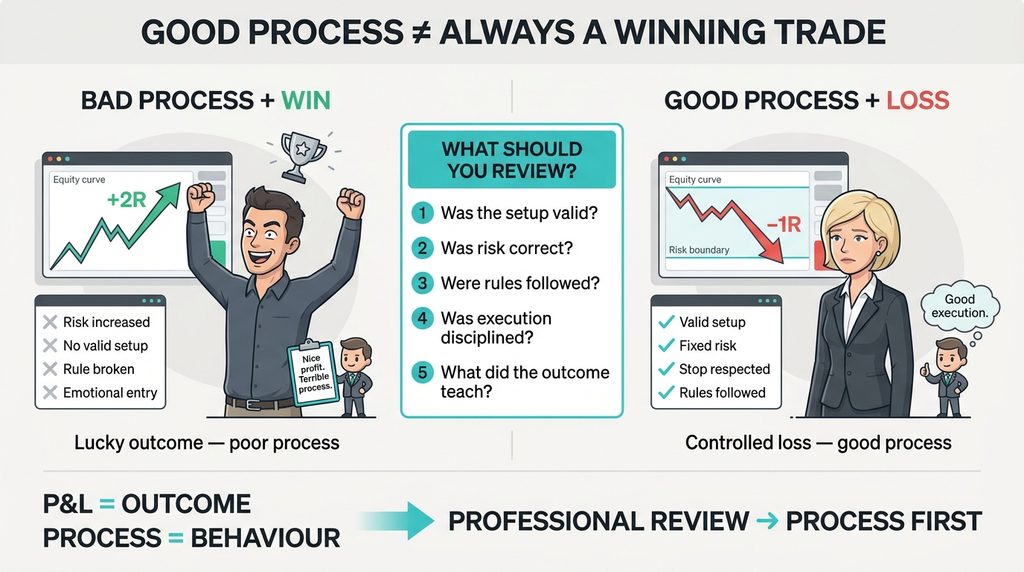
When traders tie their identity to profits and losses, they start trading based on feelings.
- Losses feel like personal failure
- Wins feel like proof of superiority
- Drawdowns become shame, not data
- Behavior becomes reactive
Professionals separate self-worth from trading results.
Value comes from results, and we assess performance by how well we do. This is the central idea in Process-Oriented Trading, where the “did I follow my rules?” question replaces emotional evaluation.
Key takeaway: If P&L controls your identity, it will influence your choices.
Pillar 2 — Resilience (Survive the Psychological Weight of Variance)
Resilience isn’t the same as motivation. It’s the ability to stay stable when conditions are unpredictable.
Resilient traders expect:
- Losing streaks
- Drawdown phases
- Flat or slow performance periods
- Temporary underperformance
They don’t “push harder” when things are slightly off. They maintain discipline long enough for expectancy to play out.
This framework is fully developed in Trading Resilience, where resilience is built through structured rules rather than mindset hype.
Key takeaway: The market doesn’t need you to be overly sure. It needs some solid grounding
Pillar 3 — Burnout Prevention (Fatigue Is a Hidden Risk Variable)
Burnout isn’t just about being lazy. Cognitive overload quietly breaks down discipline. When traders burn out:
- Patience declines: Waiting for suitable trading opportunities becomes harder
- Entry standards weaken: Traders may take lower-quality setups
- Overtrading increases: Unnecessary trades become more frequent
- Emotional decisions rise: Frustration and impulsive behaviour influence execution
- Mistakes accumulate: Repeated errors can contribute to account drawdowns
Burnout is a big reason why traders keep overtrading and lose hope and you can learn all about it in the article Trader Burnout & Overtrading.
Mental fatigue and prolonged stress can affect a trader's ability to maintain focus and follow a structured decision-making process. The American Psychological Association's guidance on stress provides further information about stress and its psychological effects. For traders, this reinforces the importance of recognising fatigue, scheduling breaks and following predefined trading limits rather than relying solely on willpower.
A structured approach can help traders manage fatigue through:
- Session limits: Restricting time spent actively trading
- Daily trade caps: Limiting unnecessary trading activity
- Scheduled breaks: Allowing time for mental recovery
- Non-trading days: Taking time away from market monitoring
- Reduced exposure: Lowering risk or pausing trading when concentration declines
Key takeaway: When your mental resources are depleted, your financial performance often suffers.
Pillar 4 — Overconfidence Control (Winning Streaks Create Risk Expansion)
Many traders fear losing streaks, but winning streaks can be equally dangerous when they create a false sense of confidence and encourage excessive risk-taking.
Overconfidence leads to:
- Larger position sizes: Increasing exposure beyond predefined risk limits
- Skipping confirmations: Entering trades without following established criteria
- Breaking trading rules: Taking positions outside the trading plan
- Overtrading: Increasing trade frequency after consecutive wins
- Neglecting trade reviews: Reducing journaling and performance analysis
The danger is subtle: The trader’s mood improves while discipline weakens. This psychological trap is unpacked in the link titled “Overconfidence in Trading: Why Winning Streaks Destroy Accounts.
Key takeaway: Confidence is about the process, not just the outcome. Overconfidence focuses only on results.
Pillar 5 — Exit Rules (Know When to Stop Trading, Not Just Close Trades)
Disciplined traders understand that managing a trading session is just as important as managing individual trades. Knowing when to pause or stop trading helps prevent emotional decisions and unnecessary risk-taking.
Traders should consider stepping away when:
- Emotional control weakens: Fear, frustration or excitement begins influencing decisions.
- Trading rules are violated: Positions are taken outside the predefined trading plan.
- Mental fatigue increases: Reduced concentration affects decision quality.
- Drawdown limits are reached: Daily or session loss limits have been triggered.
- Overtrading urges emerge: The desire to trade outweighs the quality of available opportunities.
That’s why leaving the market is more about discipline than just technical rules. The complete plan is laid out in Trading Exit Strategies, where it’s all about saving your capital by knowing when to call it quits
Key takeaway: Sometimes, choosing not to trade is the smartest move you can make
The Professional Trading Psychology System (A Simple Model That Works)
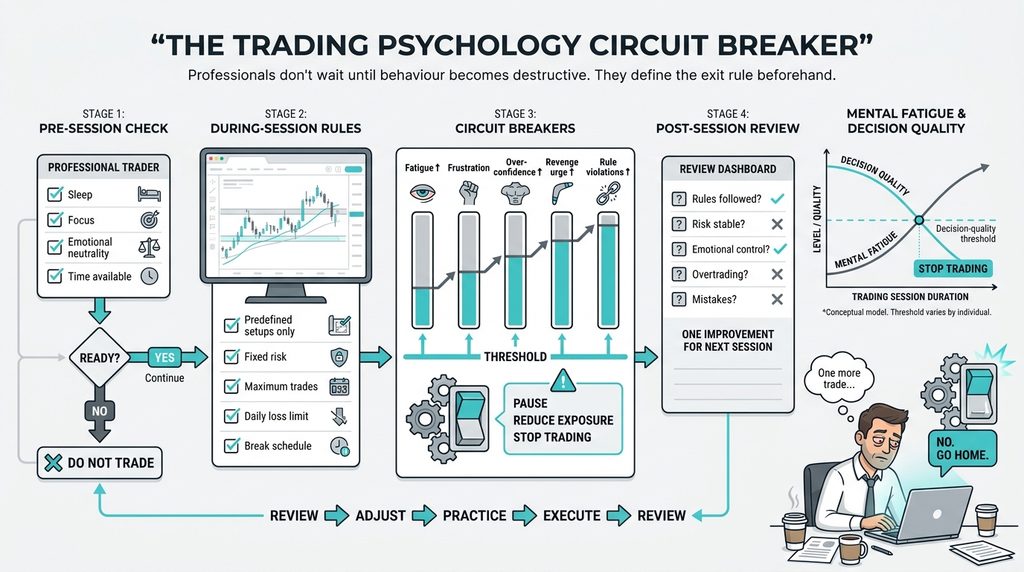
Professional Trading Psychology isn’t just about emotions. It relies on structured safeguards.
A practical structure:
- Pre-session readiness check: Sleep, focus, emotional neutrality, and time boundaries.
- During-session behavior rules: Trade only predefined setups, fixed risk, and controlled frequency.
- Circuit breakers: Stop trading when a behavioral rule breaks, not only when money is lost.
- Post-session review: Review process quality and emotional behavior, not just outcomes.
If any part is missing, psychology becomes guesswork and guesswork becomes inconsistency.
Common Trader Psychology Mistakes That Professionals Avoid.
Professionals steer clear of these because they know they’re not minor issues :
- Trading to recover losses quickly
- Trading more to feel productive
- Increasing risk after wins
- Ignoring fatigue and emotional drift
- Staying in the market after rule violations
- Measuring success by single-trade outcomes
Eventually, behavior shows up in the equity curve.
Conclusion: Professional Trading Psychology Is Like Behavioral Risk Management
Professional trading psychology is not simply about controlling emotions. It is about building a structured approach that supports disciplined decision-making and effective risk management.
By establishing clear behavioural rules, traders can:
- Maintain risk discipline: Avoid impulsive changes to position sizes and exposure.
- Manage drawdowns: Reduce unnecessary losses caused by emotional decisions.
- Protect long-term expectancy: Avoid behaviours that undermine a trading strategy's potential performance.
- Build psychological resilience: Manage setbacks, uncertainty and emotional pressure more effectively.
Key takeaway: Professional trading psychology is not about feeling confident before every trade. It is about following a structured process, managing emotional responses and maintaining discipline regardless of market conditions.








